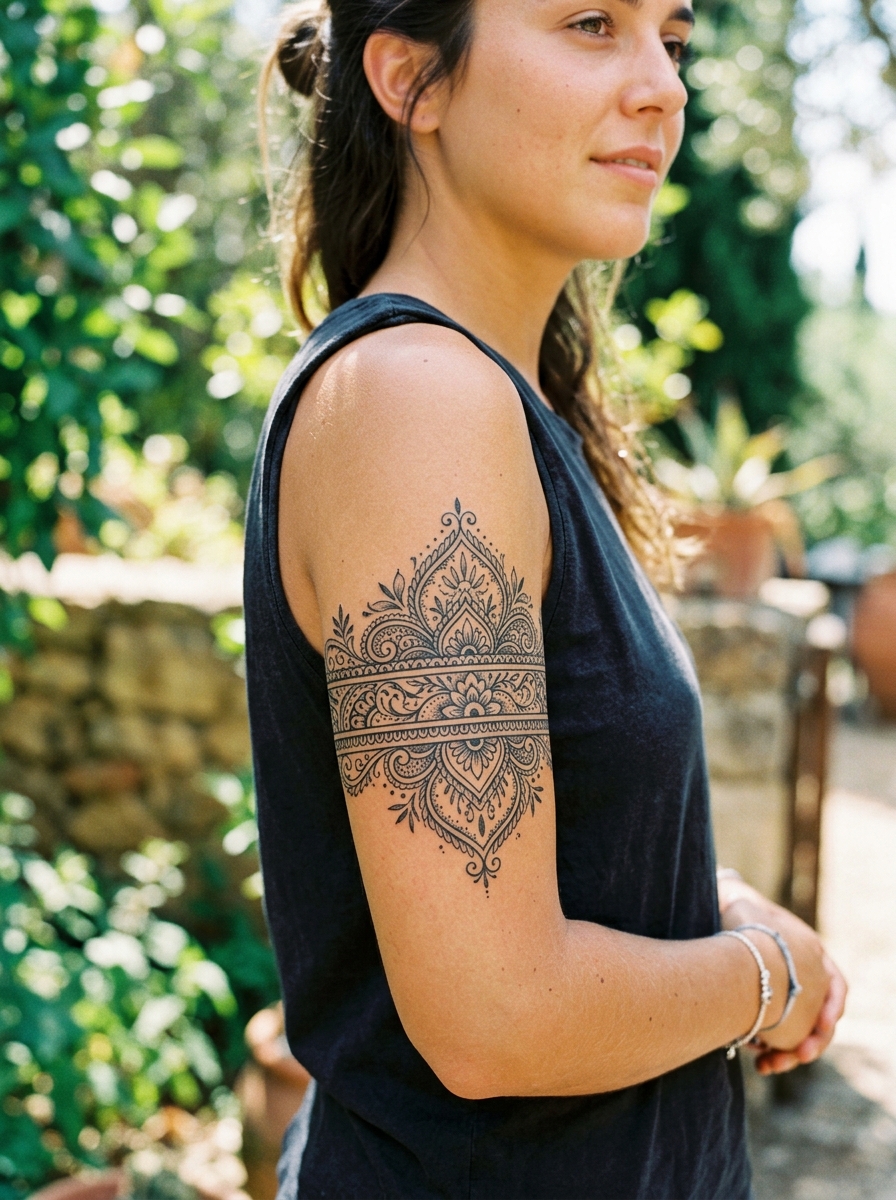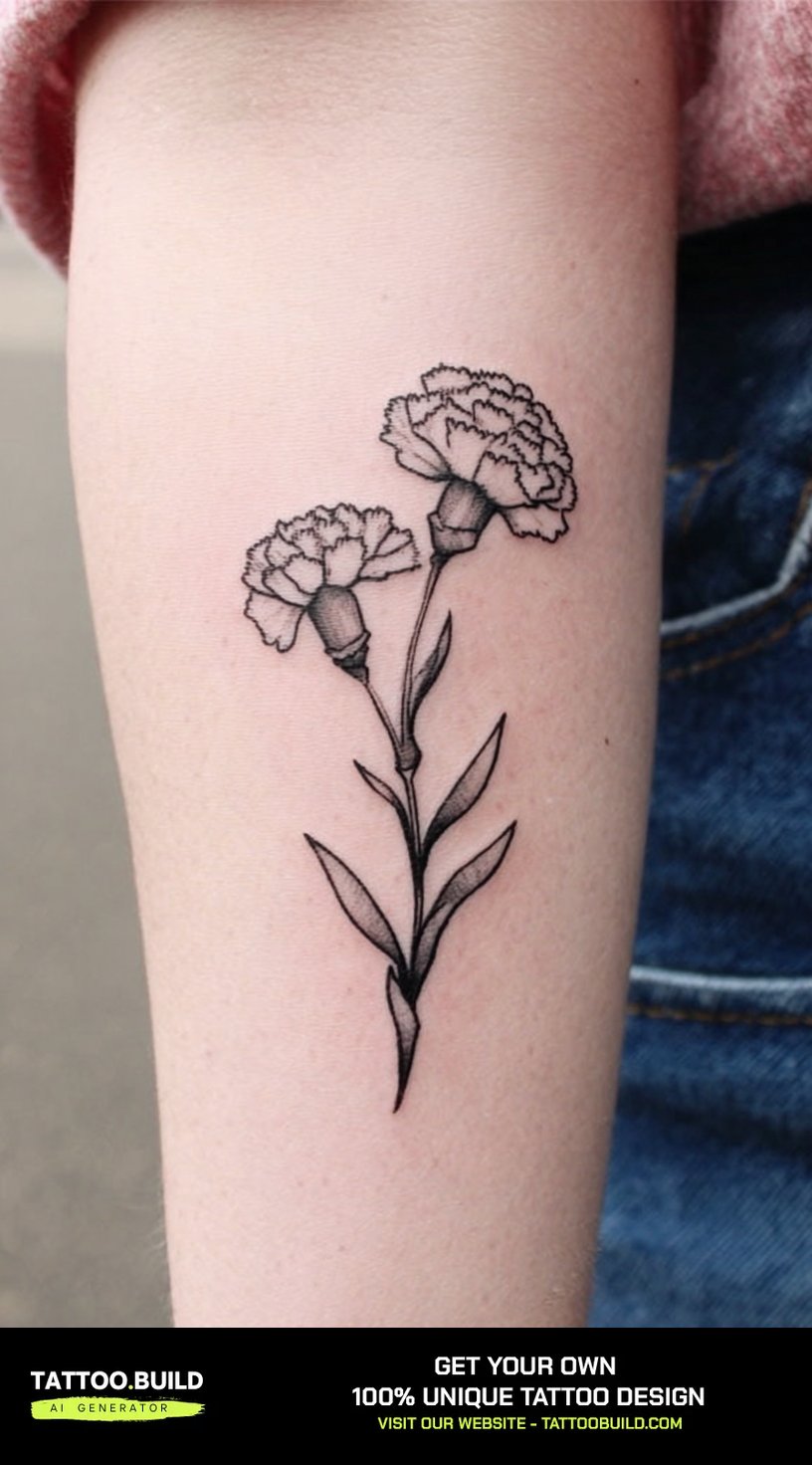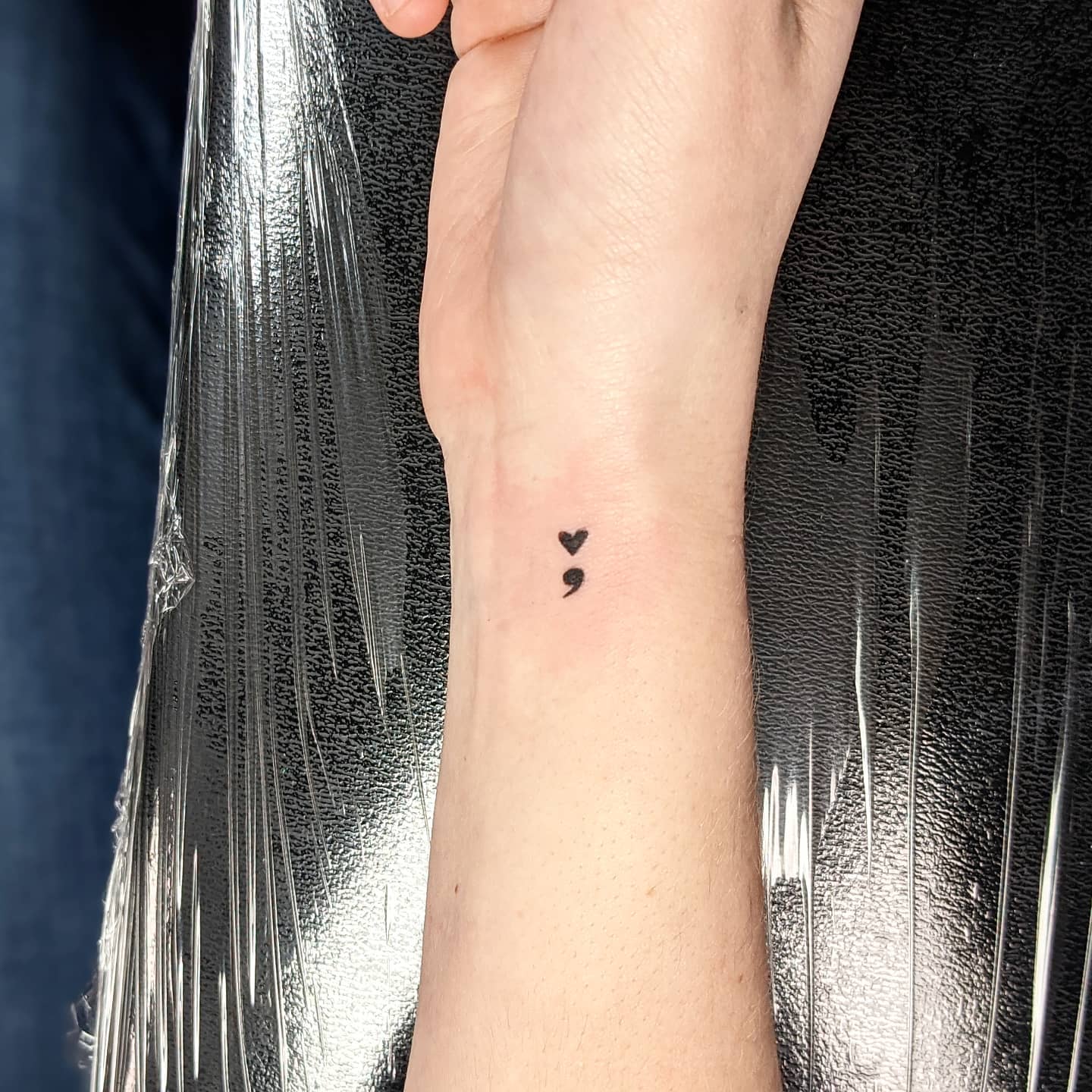
A mental health tattoo is not a trend piece. It is a decision to carry a specific part of your own story where you can see it, usually at the point where hiding it stopped being useful.
I have sat in on enough consultations for these designs to notice a pattern. People arrive apologetic, half expecting the artist to talk them out of it, and almost nobody needs talking out of anything. They have usually been thinking about the design for months.
The 22 ideas below cover what mental health tattooing actually looks like in studios right now: the recognised symbols, the nature imagery, the lettering, and the quietly personal marks that mean nothing to anyone but the person wearing them. If you already know you want the punctuation, there is a wider selection in this semicolon tattoo gallery.
None of these are obligatory. All of them are honest.
Photo: @walt_tattoo_mke
Which Mental Health Tattoo Is Right for You?
The most useful question is not which design looks best. It is what you want the tattoo to say, and how much you want a stranger to be able to read it.
| What You Want It to Say | Designs That Fit | Typical Size | How Public It Reads |
|---|---|---|---|
| I survived a crisis | Semicolon, heartbeat line | 1–2 inches | Widely recognised |
| This is ongoing, not cured | Infinity loop, waves | 1–3 inches | Reads as decorative |
| It was a long slow climb | Mountain and sun, tree | 2–5 inches | Meaning stays private |
| I came out of it different | Phoenix, butterfly, lotus | 3–8 inches | Reads as decorative |
| I want to talk about it openly | Green ribbon, semicolon | 1–3 inches | Openly a mental health tattoo |
| I need a working reminder | “Breathe”, a single word | 1–3 inches | Reads as a quote |
| Only I should be able to read it | Coordinates, own handwriting | 2–4 inches | Effectively private |
Sizes here are the ranges I see most often for these motifs, not rules. Your artist will adjust for placement and for how much line detail the design carries.
Why People Choose Mental Health Tattoos
There is no single reason, but the reasons cluster into a handful of recognisable groups.
Some people want a visual cue for the bad hours: something to look at when the internal voice is loudest and least fair. That is a practical function, not a sentimental one.
Some want to end the silence. Wearing the experience openly changes how conversations start, and for a lot of people that is the entire point of choosing a symbol strangers can read.
Some are marking a specific moment: a discharge date, the day they made the call, the year they stopped counting days. The tattoo is a full stop on a chapter they are done rereading.
And some just want their ink to reflect the whole truth of who they are, including the parts that were hard. There is no wrong reason, and there is no wrong design as long as it carries genuine meaning for you rather than for an algorithm.
If you are currently in crisis, that is worth naming honestly here. In the US you can reach the 988 Suicide & Crisis Lifeline at any hour, and NAMI maintains a directory of support options. A tattoo is a good thing to plan while you are getting steady, not a substitute for support.
22 Mental Health Tattoo Ideas
Grouped by what they say rather than by how they look, because that is the decision people actually struggle with.
Recovery Symbols People Recognise
1. The Semicolon
The most widely recognised mental health tattoo symbol there is. A sentence that could have ended, where the author chose to continue instead.
The symbol was popularised by Project Semicolon, the nonprofit founded by Amy Bleuel in 2013 after she lost her father to suicide.
In my experience this is also the design people most often want smaller than their artist expects. I have watched three separate clients ask for it at around half an inch on the inner wrist, and at that scale a good artist will thin the line weight so the punctuation still reads as punctuation rather than a blob.
It is a quiet tattoo. That is usually the point.
2. The Green Ribbon
Green is the recognised awareness colour for mental health, and the ribbon is the most explicitly public design on this list.
Most of the other symbols here can be read as decorative by a stranger. This one cannot, and people choose it precisely because it starts conversations rather than avoiding them.
If you want the colour to stay true, ask about pigment fade. Greens generally hold better on areas with less sun exposure, which is one reason the inner forearm outperforms the outer for coloured awareness pieces.
Photo: @evamohrman
3. The Infinity Loop
The infinity loop is most often chosen for what it says about continuity: this is ongoing, not resolved.
Plenty of people who live with a lifelong diagnosis prefer it to the symbols that imply an ending, because managing a condition is not the same thing as being cured of one.
The version I see most in studios now threads a semicolon or a heartbeat line through the loop. It is a small addition that changes the whole meaning, and it costs almost nothing extra in time under the needle.
Photo: @kabirainktattooandpiercing
4. A Heartbeat Line
An ECG trace, sometimes flowing into a word, a semicolon, or a date.
The meaning is blunt: still here. For people who came close to not being here, blunt is often exactly right.
The common mistake is asking for the line too thin. An ECG spike relies on the contrast between flat sections and sharp peaks, and if the whole thing is hairline the shape stops reading from a normal distance. There are cleaner layouts in this heartbeat tattoo collection.
Photo: @carpediam.ink
Nature and Growth Imagery
5. The Lotus
A flower that pushes up through mud and dark water before it opens. The lotus does not bypass the difficulty, it grows through it.
As a mental health tattoo, the lotus makes a statement about transformation that does not pretend the path was easy. That honesty is why it has outlasted most of the other “healing” motifs I have seen come and go.
It scales well, which matters more than people think. A lotus works at two inches on a wrist and at eight inches on a thigh, and the petal structure gives an artist room to add linework detail without the design collapsing.
If you want the fuller symbolic version with mandala geometry behind it, look at these lotus flower tattoo designs before you book.
Photo: @hawktattooofficial
6. A Phoenix
The obvious one, and it stays popular because the metaphor is exact: the bird has to burn before it can come back.
People who have had a full breakdown, a hospitalisation, or a period where the previous version of their life ended tend to gravitate here rather than to gentler symbols.
Be realistic about scale. A phoenix with any real detail needs space, usually a forearm, a thigh, or a back placement, and that means multiple sessions rather than a lunch-hour appointment. There is a fuller range of options in this phoenix tattoo gallery.
Photo: @aatman_tattoos_bangalore
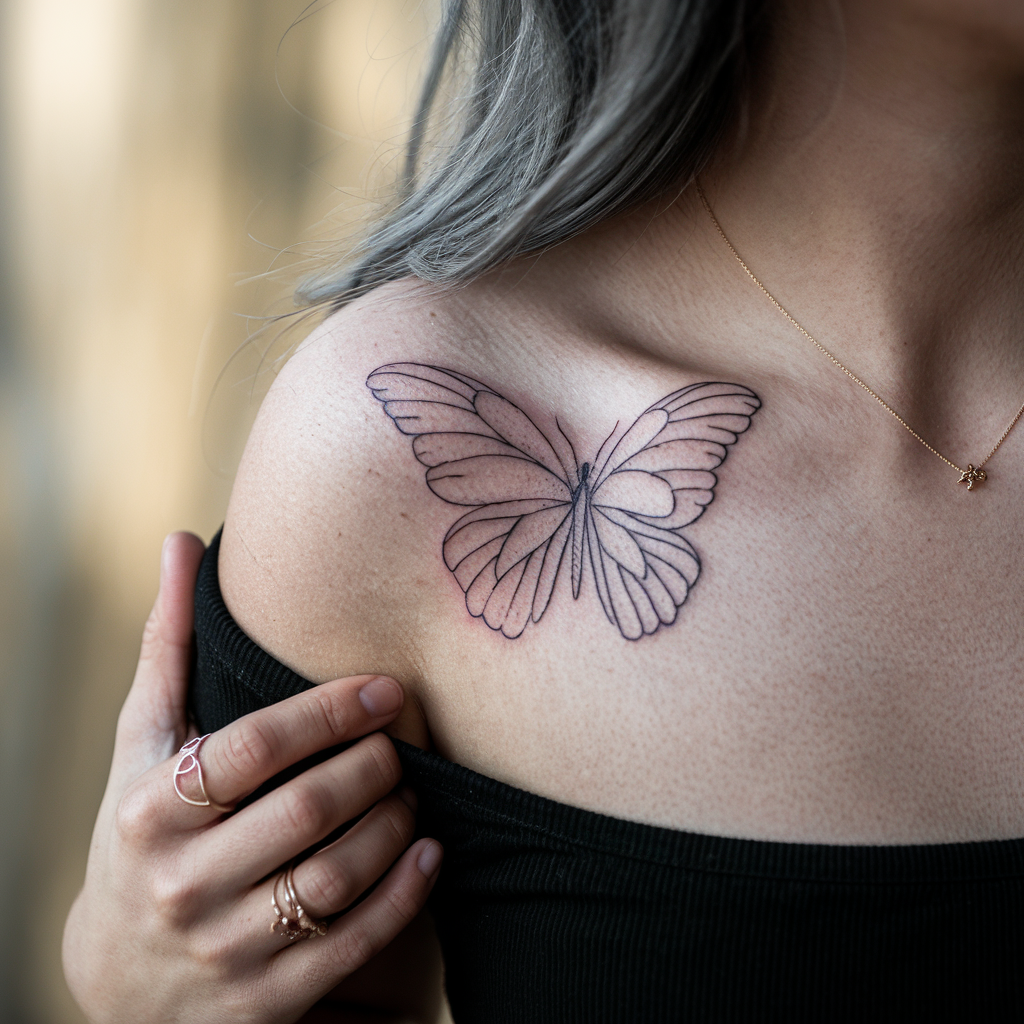
7. A Butterfly
Transformation, obviously, but the useful part of the butterfly metaphor is the bit people skip: what happens in the chrysalis is dissolution, not gradual improvement.
That reading makes the butterfly more honest than its reputation suggests, and it is why it keeps appearing on people who came out of a crisis genuinely different rather than merely recovered.
It is also a design with a lot of stylistic range, from single-line minimal to full colour realism. The meaning behind butterfly tattoos shifts noticeably depending on which style you choose.
Photo: @kabirainktattooandpiercing
8. A Tree
Roots, seasons, and the fact that a bare tree in February is not a dying tree.
People who have had recurring depressive episodes often connect with the seasonal reading more than with any survival symbol, because it frames the low period as part of a cycle rather than a failure.
Bare-branch trees are harder to tattoo well than they look. Every branch is a tapering line, and tapers are where inexperienced artists give themselves away.
Photo: @finelinelaurie
9. Waves
Waves come and they go, and neither the arrival nor the departure is personal.
For anxiety in particular this is a more accurate metaphor than most. The wave passes if you let it, and fighting it in the middle usually makes it worse.
Visually it is the most flexible design on the list. A single continuous line reads well on a wrist, a collarbone, a finger or along the ribs, and it costs very little chair time.
Photo: @yantratattoos
10. A Small Sun
Sometimes the symbolism does not need to be layered. A sun is warmth and daylight and the fact that mornings keep arriving.
This is a good option for anyone who wants a mental health tattoo without a design that invites questions from strangers.
Simple radiating shapes are also among the most durable small tattoos, because the linework is bold enough to survive years of settling without needing a touch-up.
Photo: @blue_heaven_tattooz
Words, Quotes and Lettering
11. “Still I Rise”
Maya Angelou’s three words carry more weight than most tattoo quotes because they were earned before they were quoted.
For people who have risen out of depression, trauma, or circumstances designed to keep them down, the phrase is a plain statement of fact rather than a motivational slogan.
A word of caution from experience: script this small ages faster than symbols. Ask your artist to keep the letter spacing generous and avoid hairline serifs, because fine lettering closes up as ink settles over the years.
Photo: @mamajaiitattoos
12. “Breathe”
One word, usually on the inner forearm or the inside of the wrist, positioned where the wearer can actually see it.
This is the most functional tattoo on the list. For people managing panic or acute anxiety, a visible cue to slow the breath is a genuine grounding tool rather than a decorative sentiment.
Every artist I have asked about single-word tattoos says the same thing: choose the placement for line of sight first and aesthetics second. A word you have to twist your arm to read stops being useful in the moment you need it.
Photo: @inkvilla_tattoos_hub
13. “This Too Shall Pass”
An old phrase that survives because it is true in both directions. The bad passes and so does the good.
As a mental health tattoo it works best for people whose difficulty comes in episodes, where the useful reminder is that the current state is temporary even when it does not feel that way.
Longer quotes need somewhere to live. The inner forearm, the ribcage, the collarbone and the upper spine all give you a straight run of skin, which matters because script bent across a curved muscle distorts as you move.
Photo: @niko_bonett_tattoos
14. A Single Word That Is Your Own
Not “breathe” and not “strength”, but the word that actually did the work for you.
The clients I have seen happiest with this choice picked words that mean nothing to anyone else: a nickname, a place, a word from a language a grandparent spoke, one line from a song they played on repeat during the worst month.
Because the word is private, nobody can misread it, and you never have to explain it at a dinner party unless you want to.
If you want ideas on lettering weight and layout, the single-word tattoo styles here are a reasonable starting point regardless of gender.
15. Your Own Handwriting
A phrase, a date, or a single word written in your own hand, scanned and tattooed as drawn.
The imperfection is the entire point. It looks like you made it, because you did.
Practically, write it larger than you want the tattoo, on unlined white paper, with a pen that gives a solid black line. Your artist can scale it down cleanly, but they cannot rescue a faint ballpoint scribble.
Photo: @wildeblumetattoo
Direction, Grounding and Personal Marks
16. A Lighthouse
A lighthouse does not stop the storm. It just tells you where the shore is.
That distinction is why it works so well as a mental health tattoo. It is not a promise that things get easy, only that there is a fixed point to steer toward.
People often pair it with a date, a coordinate, or a single initial for the person who was their fixed point. The lighthouse is one of the few motifs that reads as hopeful without reading as naive.
Photo: @liv9lives
17. A Compass
Less about travel than about orientation. A compass is for people who lost their sense of direction and had to find it again.
I have seen this one asked for after a period of derealisation or dissociation more than once, where the appeal is having something fixed on your body that always points the same way.
Fine line compass work is technically demanding because the needle has to stay consistent across a lot of intersecting straight lines. Look at healed photos, not fresh ones, before you choose the artist.
Photo: @_dr_woo_
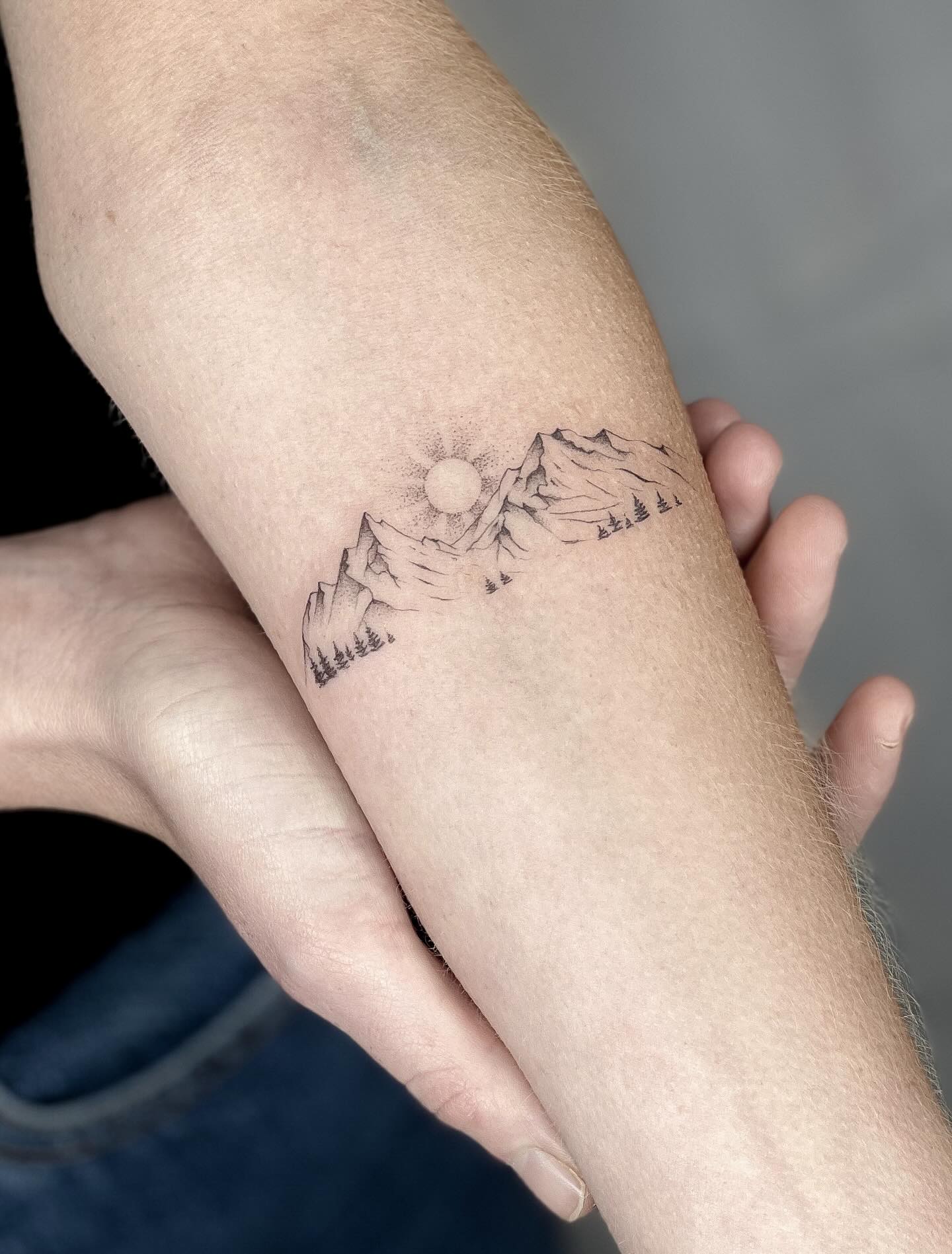
18. A Mountain with a Sun
Mountains are hard, slow and indifferent, and the sun coming up behind one is about as direct as tattoo symbolism gets.
It suits people whose experience has been a long grind rather than a single crisis. Depression that lasted years does not fit neatly into a semicolon.
Design-wise this is a forgiving motif. The shapes are broad, so it holds up at small sizes, and it sits naturally on a forearm, a calf, or the outer edge of the upper arm.
Photo: @greg_klotz
19. Unalome
A Buddhist symbol showing the path to awareness: a tight spiral at the base that gradually straightens as it rises.
The spiral is the confusion and the circling back. The straight line is not perfection, only clarity arriving late.
This is the design people most often get for the wrong reason, so be honest with yourself about whether the symbolism belongs to you. If you are drawn to the shape rather than the tradition, an artist can draw you something similar without the religious weight attached.
Photo: @studio46lebouscat
20. A Small Bird in Flight
Birds have carried the idea of release for as long as people have been marking skin, and they are still one of the most requested small designs.
For mental health specifically, the bird tends to mean something narrower than freedom: leaving a place, a relationship, or a version of yourself behind.
A practical note. Very small birds rely on tiny negative-space gaps between the wing lines, and those gaps are the first thing to close up if the design is placed on a high-friction spot like the side of a finger.
Photo: @sweetandoffbeat
21. An Open Hand
An open hand can mean receiving help or offering it, and the ambiguity is the point.
For a lot of people the hardest part of a mental health crisis is not the symptom, it is asking. A permanent reminder that the asking is allowed carries real weight.
Two open hands, or one hand with something small resting in the palm, is a common variation when the tattoo is about someone specific who helped.
Photo: @stunningbasil
22. The Coordinates of Where You Found Help
The latitude and longitude of the place where you first asked for help, first felt understood, or first started to get better.
The clinic, the hospital, a friend’s kitchen, the park bench where you made the call. Precise, private, and unreadable to anyone who does not already know.
Numerals are unforgiving at small sizes, so give the artist enough room that the digits stay distinct as the ink settles. Most artists I have asked suggest at least three inches of width for a full coordinate pair.
Photo: @lubitattoo
Placement: Where These Tattoos Actually Work
Placement matters more for mental health tattoos than for most other work, because a lot of these designs are meant to be looked at by the wearer rather than admired by other people.
The Inner Wrist
The most common choice, and for good reason: it is in your line of sight without any effort, which is exactly what you want from a grounding cue.
The trade-off is exposure. It is also the first thing anyone sees when you hand over a coffee, so choose it knowing the tattoo will be part of your introductions. Fine line work here can also soften faster than on the forearm, since the skin is thin and sees a lot of sun and friction.
The Inner Forearm
My usual recommendation for anything with lettering. You get a flat, straight run of skin, generous space, and easy line of sight when you turn your arm over.
It also holds ink well over time compared with hands, fingers and feet, which is worth weighing for a tattoo you intend to keep readable for decades.
The Ribcage, Hip and Sternum
For designs you want entirely to yourself. These placements hurt more than most people expect, and they are usually a poor choice for a first tattoo.
The upside is total control over who sees it, which is why so many coordinate tattoos and handwriting pieces end up here.
Behind the Ear and the Nape
Good for very small symbols like a semicolon, a wave or a single dot-and-line motif. Easy to cover with hair, easy to reveal deliberately.
Bear in mind you will almost never see it yourself, so this is a placement for meaning rather than for daily reminding. If you want something small and visible instead, these tiny wrist designs cover the same size range.
Practical Advice Before You Book
Sit with the design for at least a few weeks before you commit. The ideas that survive a month of daily second-guessing are usually the right ones.
Bring reference images to the consultation, but bring the meaning too. An artist who understands what the piece is for will make better decisions about weight, spacing and scale than one working from a screenshot alone.
On healing: expect the surface to look settled in roughly two to three weeks, with the deeper skin continuing to settle for a couple of months. Keep it clean, keep it out of the sun, and follow the artist’s aftercare instructions rather than advice from a comment section. The American Academy of Dermatology has straightforward guidance on tattoo aftercare and on the warning signs of infection or an allergic reaction, and anything that looks like spreading redness, fever or a rash is a doctor’s call, not a forum’s.
If pain is the thing making you hesitate, that is a solvable problem: eat beforehand, book a shorter first session, and pick a forgiving placement. There is more detail in this guide to managing tattoo pain. And never let anyone tattoo you outside a licensed studio, however good the price sounds.
Common Mistakes and What to Do Instead
The first mistake is getting the tattoo mid-crisis. Not because the impulse is wrong, but because a permanent decision deserves a clear head, and the design will still be available when you are steadier.
The second is going too small. Fine line work is beautiful and it is also the most likely to blur, so if a design depends on gaps narrower than a millimetre, size it up rather than fighting the physics of ink in skin.
The third is picking a symbol because it is the recognised one rather than because it is yours. A semicolon you feel nothing about is just punctuation.
Still not sure which direction fits? It is worth browsing adjacent themes before you decide: hope tattoo ideas if you want something forward-looking, or self-love tattoo designs if the piece is about how you treat yourself rather than what you survived.
Frequently Asked Questions
What is the most popular mental health tattoo?
The semicolon is still the most widely recognised and most requested mental health tattoo. It comes from Project Semicolon, founded by Amy Bleuel in 2013, and represents a sentence the author chose to continue rather than end. Its popularity is also its main drawback, since a stranger can read it instantly. If you would rather the meaning stayed private, a wave, an infinity loop or a set of coordinates carries a similar message without announcing it.
Do mental health tattoos have to be small?
Not at all, though most people choose something between one and three inches. Small designs suit recognisable symbols like a semicolon or a heartbeat line, where the shape is doing the work. Larger pieces such as a phoenix, a lotus or a detailed tree need room for the linework to breathe and usually take more than one session. Size the tattoo to the design rather than to a rule you read online.
Where is the best place to put a mental health tattoo?
The inner wrist and inner forearm are the most common because they sit in your own line of sight, which matters if the tattoo is meant to work as a grounding cue. Ribs, hips and the sternum give you complete privacy but hurt considerably more. Behind the ear suits very small symbols you want to be able to cover. In my experience, choosing for line of sight first and aesthetics second leads to fewer regrets.
Should I get a tattoo while I am in a mental health crisis?
It is generally better to wait until you are in a more stable place. The impulse is not wrong, but a permanent decision made in an acute state is harder to feel good about later, and reputable artists will often say the same. The design will still be there when you are ready. If you are struggling right now, contact a crisis line or a professional first, and book the appointment afterwards.
Will a fine line mental health tattoo blur over time?
Some softening is normal for any tattoo, and fine line work shows it soonest because the gaps between lines are narrow to begin with. Placement plays a large part: hands, fingers and feet blur faster than the inner forearm or the upper arm. Sun exposure accelerates it, so sunscreen once healed genuinely helps. A good artist will adjust line weight for the placement, and most fine line pieces can be tidied with a touch-up years later.
Quick Summary
- The semicolon remains the most recognised mental health tattoo, popularised by Project Semicolon in 2013.
- Nature imagery — lotus, phoenix, tree, waves — suits long recoveries better than single-moment symbols.
- Lettering works best on flat runs of skin such as the inner forearm, ribcage or collarbone.
- Choose placement for line of sight if the tattoo is meant to function as a grounding cue.
- Fine line work blurs soonest on hands, fingers and feet; size up rather than shrinking a detailed design.
- Coordinates, handwriting and a private single word give you meaning nobody else can read.
- Wait until you are out of an acute crisis before making a permanent decision.
- Surface healing usually takes two to three weeks; follow your artist’s aftercare and see a doctor for any sign of infection.