Most “unique” tattoo galleries are the same forty designs shuffled into a new order. A tattoo becomes genuinely unique when the reference material comes from your own life rather than from a search results page.
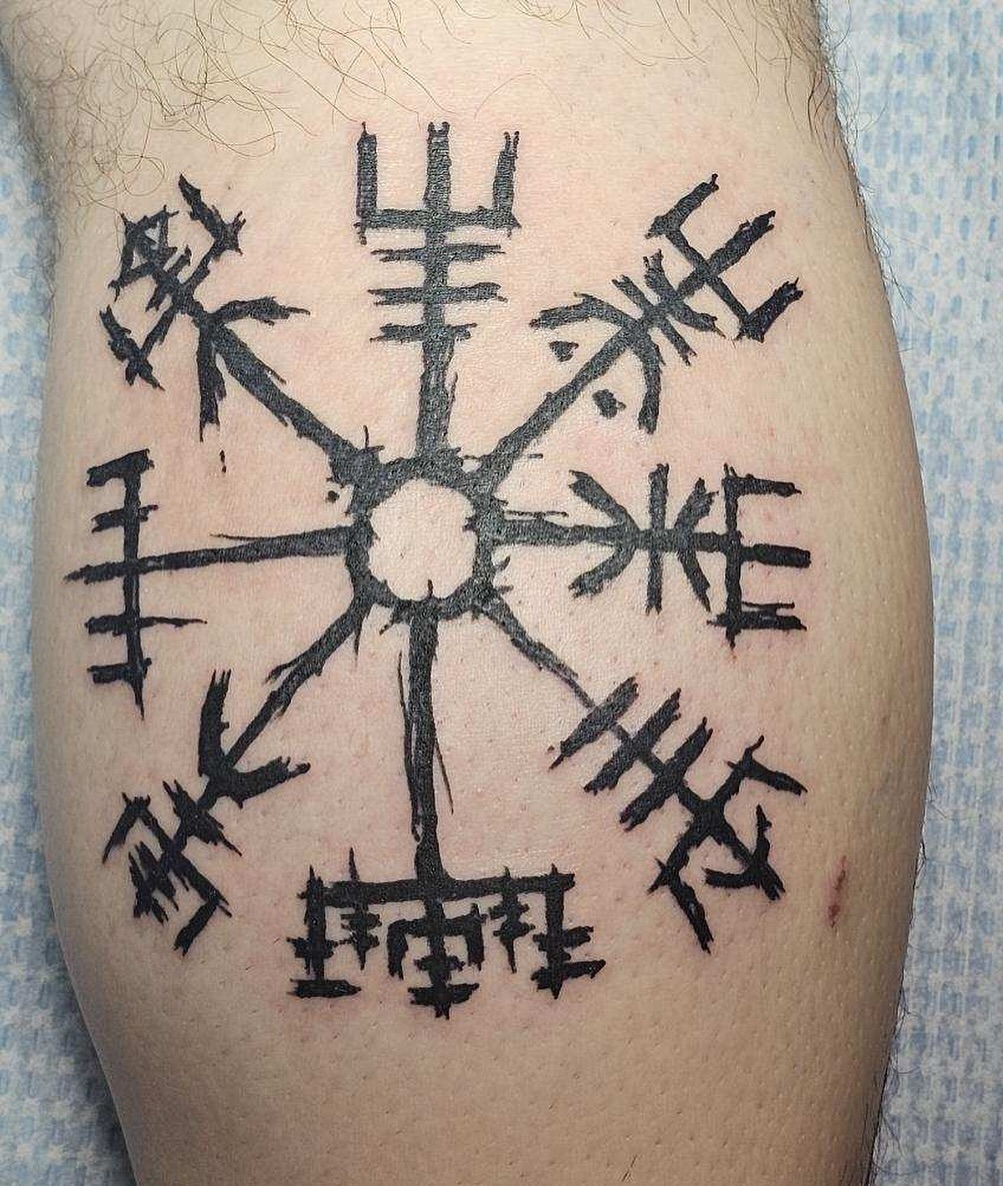
I have sat in consultations where a guy pulls up fifteen saved images and every one of them is the same compass. The interesting conversation only starts when I ask what he actually looks at, reads, builds or listens to.
The 21 ideas below are all built on that principle. Some are specific enough to hand an artist tomorrow; others are frameworks you fill with your own material. If you want the groundwork first, our guide to designing your own tattoo covers the reference-gathering stage in more detail.
Fair warning: a few of these need an artist with real drafting skill. I will flag which ones as we go.
Which Kind of Unique Is Right for You?
The three routes below all produce something no one else has, but they demand different things from you and from your artist.
| Route | What it needs from you | What it needs from the artist | Best if |
|---|---|---|---|
| Personal data | A real source file: a scan, a trace, a recording, a document | Clean linework and the judgement to simplify | You want meaning nobody can copy |
| Obscure subject | Deep familiarity with a niche you already care about | Illustrative range and reference discipline | You want something people ask about |
| Unusual treatment | Willingness to let the artist lead | Strong composition and confident negative space | Your subject is common but you are not |
What Actually Makes a Tattoo Unique
Uniqueness is not a subject. It is a combination of subject, source and treatment, and most people only ever change the first one.
Swapping a lion for a wolf does not make a design original, because both are drawn from the same pool of stock reference. The design is still one search away from a thousand near-identical versions.
Changing the source is what actually moves the needle. A wolf traced from a photograph you took in Jasper is a different object from a wolf pulled off an image board, even when the finished tattoo looks superficially similar.
Treatment is the third lever, and the most underrated. The same subject rendered in heavy blackwork, in dense blackwork or in sparse single-needle line reads as three different tattoos.
In my experience the pieces that hold up longest use at least two of those three levers. One is usually not enough.
Ideas Drawn From Your Own Body and History
These five are the strongest category, because the source material literally cannot be duplicated.
1. A Map of Your Own Neural Pathways
Diffusion tensor imaging produces branching, root-like tracts that look like nothing else in tattooing. If you have ever had a research MRI or a clinical scan you can request your own imaging.
Realistically, most people will not have access to their own scan, so the honest version is a stylised interpretation rather than a literal trace. Ask for it in soft grey wash; hard black lines flatten the depth that makes it interesting.
2. Your Own Fingerprint
Ink pad, plain paper, phone scan at high contrast. It takes five minutes and the result is unrepeatable.
The mistake I see constantly is going too small. Fingerprint ridges sit close together, and lines that tight will blur into a grey smudge within a decade. Scale it up to at least palm size and let the artist redraw the ridges with proper spacing.
3. Your Own ECG Trace
Not the generic heartbeat squiggle that has been done to death. An actual printout, with your own rhythm, taken at a clinic or from a consumer ECG device.
Bring the paper strip, not a photo of a screen. Artists can work far more accurately from the original grid.
4. Your Own Handwriting, Expanded
Most handwriting tattoos come from a note left by a parent or grandparent, and the usual approach is to trace it exactly.
The more interesting version is to have a lettering artist study the hand and extend it: they learn the letterforms, then write a phrase that person never wrote. It is a harder brief and worth asking for by name.
5. Sound Wave Tattoo
A waveform of a specific recording, rendered as a bar or ribbon. Be clear-eyed about this one: a waveform is not readable as sound, and the app-based versions that claim to play back from a scan depend on a service that may not exist in ten years.
Treat it as an abstract shape you happen to know the origin of, and it holds up fine.
Ideas From Science and the Natural World
Natural subjects are everywhere in tattooing. These five stay unusual because the reference is specific.
6. A Vintage Scientific Illustration
Nineteenth-century plates from Haeckel, Audubon or the old botanical monographs have a line quality modern illustration does not. Many are old enough to be public domain, and the Biodiversity Heritage Library hosts high-resolution scans.
Ask for stipple and hatching rather than solid fill; that is what makes it read as an engraving.
7. An Extinct Animal
Thylacine, great auk, Steller’s sea cow. Recognisable enough to be a real animal, obscure enough that nobody has the same one.
Use museum specimen photographs as reference where you can, since a lot of the popular illustrations online are anatomically loose.
8. A Specific Microorganism
Diatoms in particular are extraordinary: glass-shelled, radially symmetric, and already close to a mandala without any stylisation.
This is one of the few subjects where scientific accuracy and good tattoo composition point in the same direction.
9. A Chemical Structure
Skeletal formulae are clean, geometric and easy to place. Caffeine and serotonin are common enough now to feel generic, so pick something with a real personal link.
Have the artist check the structure against a reliable database before needle touches skin. I have seen a wrong bond angle tattooed and it cannot be quietly fixed.
10. A Specific Geological Formation
A cross-section of folded strata, a columnar basalt cluster, or the layer sequence from a canyon you have actually stood in.
Strata read beautifully as horizontal bands and sit well on a forearm or ribcage.
Ideas From Maps, Places and Data
Place-based tattoos are common; place-based tattoos drawn from real survey data are not.
11. A Topographic Map Section
Contour lines from one specific area, pulled from a national survey dataset rather than a stylised graphic.
Contours need breathing room. Anything under about four inches and the lines will close up as the ink spreads over the years.
12. A Specific Satellite Image
River deltas, sea ice, salt pans and agricultural circles all reduce to strong abstract black-and-grey compositions.
Public agency imagery is often freely usable, which avoids the copyright question entirely.
13. An Architectural Blueprint
A floor plan of a building that matters to you, in fine line with dimension marks left in.
Every artist I have asked about this one says the same thing: the dimension lines and annotations are what sell it. Do not let them be cleaned away.
14. Algorithmic or Generative Art
A pattern produced by a rule rather than a hand: Voronoi cells, flow fields, L-systems, reaction-diffusion. Some people generate it themselves, which makes the source genuinely theirs.
This is where geometric tattoo work and organic form meet, and it needs an artist who is comfortable with dense, repeating detail.
Ideas From Craft, Type and Machines
Five ideas for people whose interests are technical rather than symbolic.
15. An Antique Mechanical Diagram
Old patent drawings are a deep and largely unused well. National patent offices publish scans going back to the nineteenth century, and the drafting style is already tattoo-ready.
Escapements, linkages and gear trains all translate especially well.
16. A Specific Typeface Character
Not a word. A single glyph, drawn at a size where the letterform itself becomes the subject.
An ampersand from a specific cut of Garamond is a real design object with a history. It also demands an artist who can draw type, which is a narrower skill than it sounds.
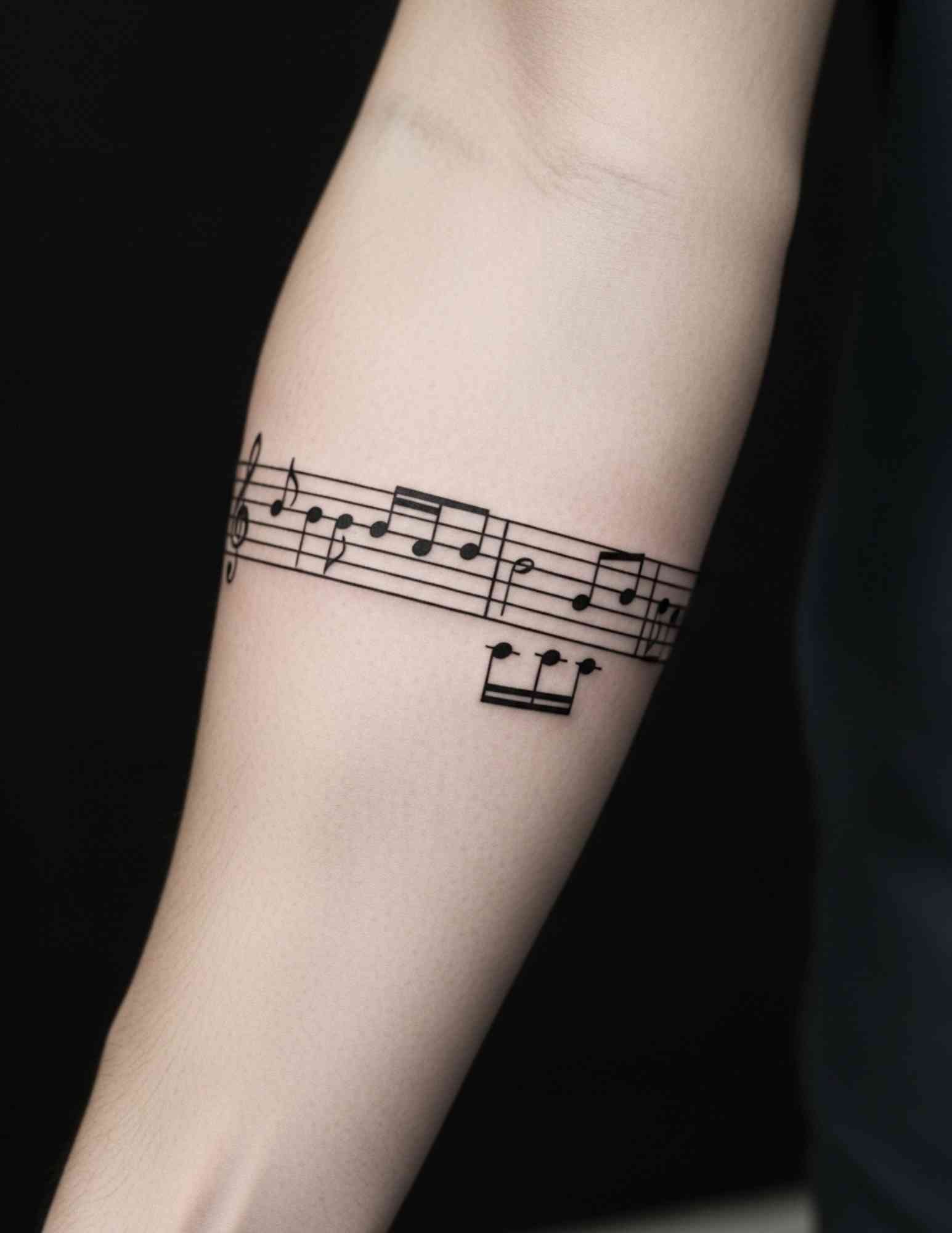
17. A Musical Score Fragment
Four bars, correctly notated, with the clef and key signature intact.
Bring printed sheet music. If you cannot read notation yourself, ask someone who can to check the transcription before the appointment.
18. A Mathematical Proof or Equation
Euler’s identity has been done thousands of times. A line from a proof you personally worked through has not.
Handwritten notation nearly always beats typeset notation here, because it carries the trace of a person thinking.
19. A Chess Endgame Position
A board diagram frozen at a specific move, from a game you played or one you have studied for years.
It works because it is legible to anyone who plays and invisible to anyone who does not. That asymmetry is the whole appeal.
Ideas That Play With Space and Restraint
The last two are less about subject and more about how the ink behaves on skin.
20. Negative Space Only
The subject is drawn by untouched skin surrounded by solid black. It is technically demanding and completely unforgiving of hesitation.
Large blocks of solid black also take longer to heal and need an artist with genuine experience packing black evenly. This is not a first-tattoo project; start somewhere simpler if you are new to being tattooed.
21. Something Only You Would Think Of
The honest last entry. Spend a week noting what you actually look at, and the idea usually arrives without being forced.
The best custom pieces I have seen came from a specific object, not a category. Not “the ocean” but a particular buoy. Not “music” but one instrument’s fingering chart.
Variations Worth Considering
If none of the 21 land exactly, these adjustments usually get you closer.
Change the placement instead of the subject
A common subject on an uncommon placement reads as new. Inner bicep, ribs and the back of the arm are all under-used compared with the outer forearm.
Change the scale
Detailed subjects shrunk too far are the single most frequent cause of regret I hear about. Going larger is often the cheaper decision in the long run.
Commission the drawing separately
You can hire an illustrator to produce the artwork and a tattooer to apply it. Tell both people what you are doing; some artists will decline, and that is their call to make.
Build it as a sequence
Several small related pieces added over years often end up more personal than one large planned composition. It also spreads the cost, and small tattoo pricing is easier to plan around.
Getting a Unique Tattoo Made Well
A custom idea only works if the person applying it can actually draw it. Portfolio matching matters more here than for flash.
Look specifically for the technique your idea needs. Fine stipple, solid black packing and small-scale type are three different skill sets, and very few artists are excellent at all three.
Bring source files rather than descriptions. A scan, a PDF, a printout, a photo you took yourself. In every consultation I have watched go well, the client arrived with material the artist could put on the table.
Expect to pay for design time. A genuinely custom piece involves hours of drawing before the appointment, and artists who charge for that are being straightforward with you, not padding the bill.
On the practical side: eat beforehand, and read up on managing tattoo pain if it is a long session. For aftercare, follow the instructions your artist gives you, and if you see spreading redness, swelling, pus or fever, contact a doctor rather than a forum. The American Academy of Dermatology publishes clear guidance on caring for tattooed skin, and the US FDA has a plain-language fact sheet on tattoo inks and reactions. Neither this article nor any article is medical advice.
Never attempt this at home. Stick-and-poke kits and DIY removal cause infections and scarring that a professional then has to work around.
Common Mistakes — and Still Not Sure?
Four things go wrong more than anything else with custom work.
- Too small for the detail. Line spacing that looks fine on paper closes up in skin over ten to fifteen years.
- Chasing novelty for its own sake, which tends to produce something you cannot explain in five years.
- Bringing a mood board of finished tattoos instead of source material, which pushes the artist toward copying someone else’s design.
- Booking with whoever is available soonest rather than whoever draws in the right style.
Still undecided? Working from a broader category first often helps. Browse simple designs for men if you want restraint, meaningful forearm tattoos if the meaning matters more than the subject, or geometric sleeve ideas if you are thinking about a larger long-term project.
Frequently Asked Questions
How do I know if my tattoo idea is actually unique?
Search the exact description you would give an artist and look at what comes back. If the first page shows near-identical pieces, the subject is common — but that does not kill the idea. Change the source or the treatment and the same subject becomes yours. Uniqueness usually comes from where the reference came from, not from the noun at the centre of it.
Will an artist tattoo a design I drew myself?
Most will, though nearly all will want to redraw it for skin. Line weight, spacing and how ink spreads over decades are things a drawing on paper does not account for. Treat their redraw as part of the service rather than a rejection of your work. If an artist refuses outright, it is usually because the design will not hold up, and that is worth listening to.
How much does a custom tattoo cost compared with flash?
Custom work generally costs more because you are paying for design time as well as the session itself. Many artists charge a separate drawing fee or fold it into a deposit. Rates vary enormously by city and by artist, so ask directly during the consultation. Anyone unwilling to give you a range before you commit is worth being cautious about.
Are these ideas suitable for a first tattoo?
Some are, some are not. The fingerprint, a chemical structure or a small topographic section are all reasonable first pieces. Large negative-space blackwork and dense generative patterns are long, demanding sessions and better once you know how you sit. There is no rule against starting big, but most people are glad they did not.
What if I cannot find an artist who works in the style I need?
Widen your search radius before you compromise on skill. Plenty of people travel or book a guest spot for a piece they intend to keep for life. Waiting several months for the right artist is almost always better than booking the wrong one this week, especially for a design that only exists once.
Quick Summary
- Unique comes from subject, source and treatment — change at least two of the three.
- Personal data (fingerprint, ECG, handwriting, your own scans) cannot be duplicated by anyone.
- Obscure but real subjects — diatoms, extinct animals, patent drawings — stay original because the reference is specific.
- Maps, satellite imagery and topographic contours give you place-based work without the usual clichés.
- Scale up. Detail that is too small is the most common regret with custom pieces.
- Bring source files to the consultation, not a board of other people’s finished tattoos.
- Match the artist to the technique the idea needs, and expect to pay for design time.
- Follow your artist’s aftercare instructions, and see a doctor for any sign of infection.