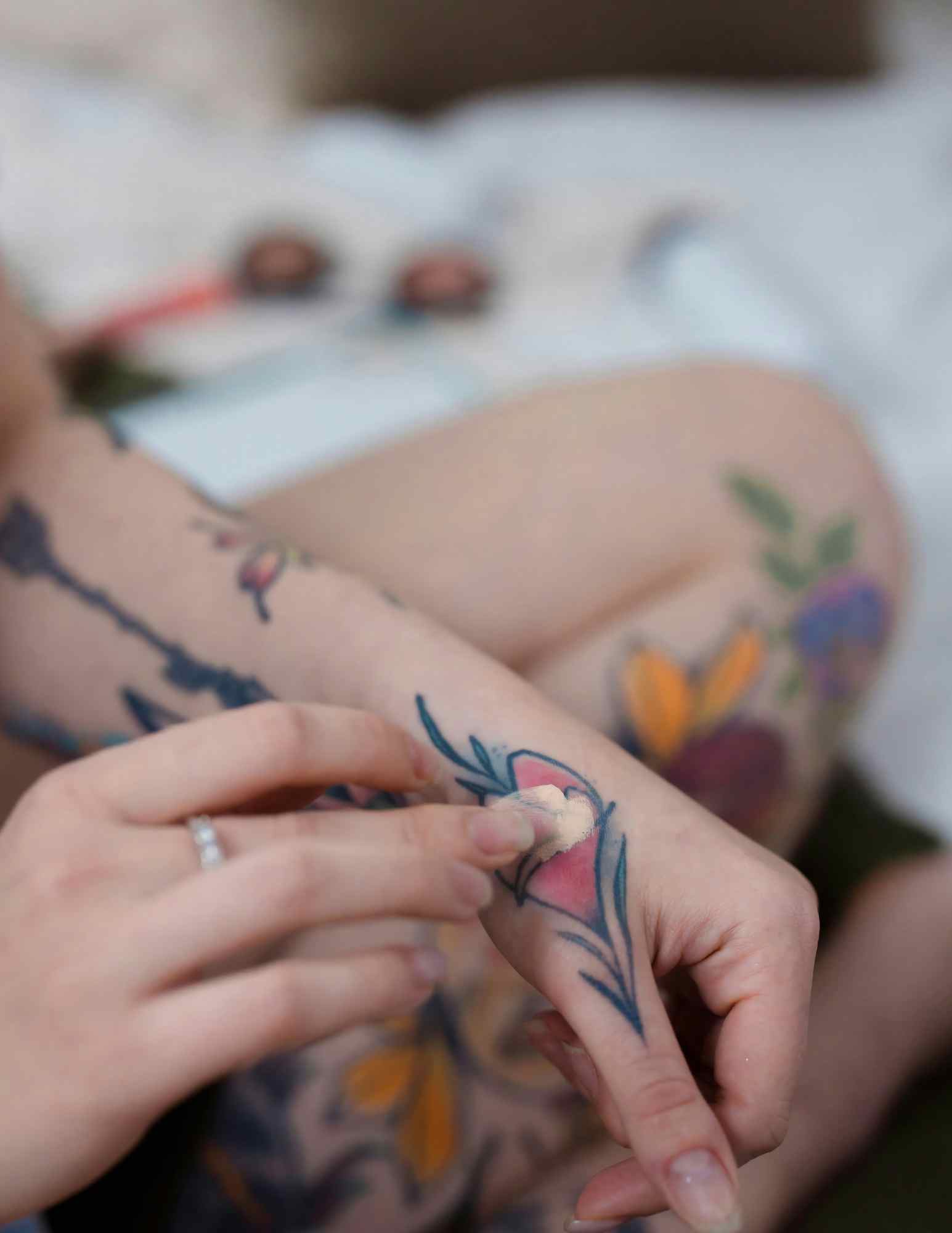
The lotion aisle is the most over-marketed corner of tattoo aftercare. Dozens of products are sold specifically for tattooed skin, each promising faster healing, brighter colour, and better long-term retention. After more than a decade of getting tattooed and comparing notes with the artists who did the work, my honest conclusion is that the marketing is far more differentiated than the formulas.
I have used the £4 drugstore bottle and the £22 boutique balm on comparable pieces, healed on the same body, in the same season. Both healed fine. What separated a good heal from a bad one was never the brand on the tube.
What did separate them: how thin the layer was, how clean my hands were, and how consistently I applied it. That is unglamorous, and it is also the whole answer. The rest of this guide is about the details around it, and it pairs closely with my broader tattoo aftercare guide.
Below is what actually matters in an ingredient list, which products consistently earn their reputation, what to skip, and how the right lotion changes across the healing timeline.
Which Lotion Is Right for Your Stage of Healing?
The product that is correct on day two is the wrong product on day twelve. This is the single most useful thing I can tell you, and almost no packaging says it.
| Stage | Texture you want | Typical products | How often | Main risk |
|---|---|---|---|---|
| Day 1–3 (weeping) | Very thin ointment or light lotion | Aquaphor, Hustle Butter, plain unscented lotion | 2–3x daily, after gentle washing | Applying far too thick a layer |
| Day 4–10 (flaking) | Thin, fast-absorbing lotion | Lubriderm unscented, Cetaphil, Aveeno fragrance-free | 2–4x daily, or when it feels tight | Letting it dry out and crack |
| Week 2–4 (dull, itchy) | Richer cream | Eucerin Original, CeraVe Moisturizing Cream | 1–2x daily | Scratching instead of moisturising |
| Month 2 onward | Any decent daily lotion + sunscreen | Whatever you already own, plus SPF 30–50 | Daily; SPF before sun exposure | Skipping sun protection |
If you only change one thing after reading this, make it the day 1–3 row. That is where most people go wrong, and where the damage is hardest to undo.
What Tattoo Lotion Actually Does (And What It Cannot Do)
Lotion has exactly one job during healing: keep the skin pliable enough that it does not dry into a thick crust, without keeping it so wet that the fragile healing layer lifts away.
It does not accelerate healing. It does not improve ink retention. It does not make colours brighter. Your skin heals on its own schedule, and your job is simply to avoid getting in the way.
A fresh tattoo is a superficial wound — thousands of needle punctures through the epidermis into the upper dermis. The American Academy of Dermatology frames tattoo aftercare in exactly those terms: keep it clean, keep it moisturised, keep it out of the sun.
The moment you start expecting a lotion to do something a wound dressing would not do, you have been sold marketing rather than skincare. Every artist I have asked about "colour-enhancing" formulas has given me some version of the same shrug.
Where products genuinely differ is in tolerability. A formula with fewer potential irritants gives you fewer chances of a reaction on skin that is already inflamed. That is a real, if modest, advantage.
How to Read a Tattoo Lotion Ingredient List
Fragrance-free is non-negotiable
This is the one rule I will not soften. Fragrance compounds are among the most common contact allergens in personal care products, and healing tattooed skin is unusually reactive.
I learned this the expensive way on a forearm piece in my twenties, using a scented lotion because it was what was in the bathroom. Within two days the skin around the tattoo was raised, hot and blotchy — not infected, but irritated enough that healing dragged on for an extra week.
"Unscented" and "fragrance-free" are not the same claim. Unscented products often contain masking agents added to neutralise a raw ingredient smell. Fragrance-free means no scent compounds were added at all. Turn the bottle over and read the actual ingredient list; the front of the package is advertising.
Occlusives: petrolatum and lanolin
Occlusive ingredients sit on the surface and slow water loss. Petrolatum, mineral oil and lanolin are the classic examples, and they are genuinely effective at what they do.
The catch is dosage, not safety. On a fresh tattoo, a thick occlusive layer traps moisture, plasma and whatever bacteria are on the skin underneath it. That is the mechanism behind most "my tattoo got gooey and angry" stories I have heard.
Applied in a genuinely thin film — enough to make the skin look faintly damp, not shiny — these ingredients are useful in the first 48 hours. After that I switch to something lighter, and so do most artists I have worked with.
Humectants: panthenol, glycerine, hyaluronic acid
Humectants pull water into the skin rather than sealing it in from above. Panthenol (provitamin B5), glycerine and hyaluronic acid are the ones you will see most often.
These are well-tolerated, and their presence in an ingredient list is a positive signal for tattoo healing. Panthenol in particular shows up in a lot of wound-care and post-procedure formulations for good reason.
In my experience they make the biggest difference during the flaking stage, when the skin feels tight and itchy but does not need anything heavy sitting on top of it.
Ceramides and colloidal oatmeal
Ceramides are lipids that help the skin barrier hold itself together. Colloidal oatmeal is a long-established soothing ingredient for irritated skin — it is the reason CeraVe and Aveeno keep appearing in artist recommendations.
Neither is essential. Both are helpful if your skin runs dry, eczema-prone or generally reactive. I keep a ceramide cream around specifically for the second and third weeks of a large piece.
What to avoid outright
Denatured alcohol high in the ingredient list. It is drying, and on freshly tattooed skin that is the opposite of what you want.
Antibacterial additives such as triclosan, and antibiotic ointments like Neosporin unless a doctor specifically told you to use one — a meaningful number of people develop contact dermatitis from neomycin, and I have watched it wreck an otherwise clean heal.
Also skip exfoliating acids, retinoids, essential-oil-heavy "natural" balms, and sunscreen on broken skin. Sunscreen is for after the tattoo has closed, not during.
Price versus formula
I have compared ingredient decks side by side more than once. A dedicated tattoo balm at four times the price frequently contains shea butter, a carrier oil, beeswax or a petrolatum base, and vitamin E — components you can find in far cheaper products.
You are usually paying for packaging, scent design and the tattoo-specific branding, not for a materially different formula. That is not a scam; it is just worth knowing before you spend.
Where the premium products do earn their keep is convenience. A small tin that fits in a jacket pocket and does not leak is genuinely easier to reapply at work, and reapplication is what actually matters.
Products That Consistently Perform
These are the products I keep coming back to, and the ones artists hand out most often. None of them are magic; all of them are boring in the right ways.
Lubriderm Daily Moisture, unscented
Still the most commonly recommended lotion by professional artists in the English-speaking world, and its reputation is earned rather than bought. It is thin, fragrance-free, cheap, and available almost everywhere.
It is my default from roughly day three onward. Absorbs quickly, does not leave a film, and I have never had a reaction to it.
Aquaphor Healing Ointment (first 24–48 hours only)
A petrolatum-based ointment that is very good at preventing moisture loss on a fresh, weeping tattoo — and very easy to overdo. I have written more about the specifics in my guide to using Aquaphor on a healing tattoo.
The rule I follow: a barely-there layer, applied after washing and patting dry, twice a day, for two days maximum. If it looks glossy in the mirror, wipe some off with a clean paper towel.
Eucerin Original Healing Cream
Richer than Lubriderm, fragrance-free, and well suited to weeks two and three when the skin goes dull and flaky. This is the stage where a thin lotion sometimes stops being enough, particularly in winter.
I use it on legs and backs of arms, which in my experience dry out faster than the inner forearm does.
Hustle Butter Deluxe
A shea and mango seed butter balm that is genuinely popular with artists, used both during sessions and in early aftercare. It is vegan, petrolatum-free, and pleasant to apply.
It is the one dedicated tattoo product I actually buy. The formula logic is comparable to cheaper balms, but it absorbs well and the tin is practical. Fair warning: it is noticeably more expensive per ounce than the drugstore options.
CeraVe Moisturizing Cream and Aveeno fragrance-free
Both are excellent second-string options, particularly for people with dry, sensitive or eczema-prone skin. CeraVe brings ceramides; Aveeno brings colloidal oatmeal.
If your skin has ever objected to a moisturiser before, start here rather than with a tattoo-branded product you have never tested.
Plain unscented lotion you already own
Genuinely acceptable, provided it is fragrance-free and alcohol-free. Check the ingredient list once, and if it passes, you have saved yourself a trip.
Some artists I know actively prefer this answer, because it removes the temptation to buy something exotic mid-heal.
Alternatives, Variations and Special Cases
If you are healing under Saniderm or a similar film
You use no lotion at all while the film is on. That is the entire point of the product — the dressing manages moisture for you.
Lotion starts after the final piece comes off, usually somewhere between day four and day seven. My walkthrough of healing a tattoo under Saniderm covers the timing in more detail, and it is worth reading before you buy film.
Coconut oil and other natural options
Coconut oil is reasonably popular and mostly harmless once the tattoo has closed over. On a fresh, open tattoo I would not use it, and I do not know an artist who recommends it at that stage.
Unrefined natural products vary batch to batch and carry a higher chance of an unexpected reaction. Vaseline sits in a similar category of "it depends" — I have gone through the trade-offs in whether Vaseline is safe on a tattoo.
Very dark skin, very fair skin, and body location
Ingredient rules do not change by skin tone. What does change is how visible dryness and ash look, which makes people on deeper skin tones more likely to over-apply in pursuit of an even finish.
Location matters more than tone. Hands, feet, ribs and anything that creases or rubs against clothing dry out faster and need reapplication more often than a flat outer bicep does.
Colour work versus blackwork
Aftercare is the same. Heavily saturated colour and dense blackwork both traumatise the skin more than fine linework, so they tend to weep longer and flake heavier — that is a volume-of-work difference, not an ink-type difference.
Where the difference shows up long term is sun exposure, which fades colour more visibly than black. Sunscreen, not lotion, is the tool for that job.
How to Actually Apply It: Practical Aftercare
Wash your hands with soap and water first, every single time. This matters more than the product you are about to apply, and it is the step people skip when they are in a hurry.
Wash the tattoo gently with lukewarm water and a fragrance-free liquid soap, then pat — do not rub — with a clean paper towel. Let it air dry for a few minutes so you are not sealing water underneath the lotion.
Apply a layer thin enough that it disappears into the skin within a minute or two. If the tattoo looks wet or shiny after that, you have used too much; blot the excess away rather than leaving it.
Reapply two to four times a day, guided by feel rather than a rigid schedule. Tight, dry and itchy means it is time; still soft means it is not. And if the piece is large, expect to be doing this for the better part of a month — my guide to how long a tattoo takes to heal sets realistic expectations.
Common Mistakes and When to Stop Guessing
Over-application is by far the most common. A thick layer looks caring and behaves like an occlusive dressing you did not intend to apply.
Starting too early is second. If your artist wrapped you, follow their timing rather than the internet’s — see how long to keep a tattoo wrapped for the usual ranges.
Switching products mid-heal because a forum told you to, scratching instead of moisturising, and applying lotion with unwashed hands round out the list. So does swimming too soon, which no lotion compensates for — the swimming timeline is longer than most people expect.
Genuine warning signs are different from normal healing: spreading redness, heat, swelling that increases after day three, pus, red streaking, or fever. Those are reasons to see a doctor, not to change lotion. Persistent itching, raised skin or a rash confined to the tattoo can indicate an allergy — the US Food and Drug Administration notes that reactions can appear even years after the tattoo was done. This article is general guidance from personal experience, not medical advice.
If the heal goes sideways, tell your artist. They have seen far more healing tattoos than you have, and a touch-up conversation is easier to have early. If you are still choosing an artist, how to find a good one is worth reading first.
Frequently Asked Questions
Can I use regular body lotion on a new tattoo?
Yes, provided it is fragrance-free and does not list alcohol high in the ingredients. Plain unscented lotion is what a lot of artists recommend anyway, and it performs perfectly well from about day three onward. Check the back of the bottle rather than trusting the front. If it has a noticeable scent, keep it for the rest of your body and buy something plain for the tattoo.
How soon after getting a tattoo should I start using lotion?
Usually after the first wash once the initial wrap comes off, which is typically somewhere between two and 24 hours depending on what your artist used. If you are healing under an adhesive film like Saniderm, you use nothing until the film comes off for good. Your artist’s instructions override any general timeline, including this one. When in doubt, message them rather than guessing.
Is Aquaphor or Vaseline better for tattoo healing?
Aquaphor is the more common recommendation because it is slightly less occlusive and contains panthenol and glycerine alongside its petrolatum base. Both work in genuinely thin layers during the first day or two, and both cause problems when applied thickly. Neither should be your product for the whole heal. Most people are better off switching to a light lotion once the tattoo stops weeping.
Do expensive tattoo-specific lotions heal better than drugstore ones?
In my experience, no — not in a way I have ever been able to see in the healed result. The ingredient logic is broadly similar, and the price difference mostly reflects branding, packaging and scent design. Where premium products win is convenience: a pocket-sized tin genuinely does get reapplied more often. Buy one if you will use it more consistently, not because it will heal you faster.
How long do I need to keep moisturising my tattoo?
Actively, for the two to four weeks it takes the surface to settle, and for a larger or denser piece it can run closer to six. After that, moisturising is ordinary skin maintenance rather than aftercare, though well-hydrated skin does keep a tattoo looking sharper. The habit worth keeping forever is sunscreen, not lotion. UV exposure fades ink faster than dryness ever will.
Quick Summary
- Fragrance-free is the only truly non-negotiable rule — and "unscented" is not the same claim.
- Apply thin. If the tattoo looks shiny after a minute, you have used too much.
- Use a light ointment such as Aquaphor for the first 24–48 hours only, then switch to a thin lotion.
- Move to a richer cream in weeks two and three when the skin goes dull and flaky.
- Skip alcohol-heavy products, antibiotic ointments, exfoliating acids and essential-oil-heavy balms.
- Wash your hands before every application; it matters more than the brand you chose.
- Expensive tattoo-branded balms are convenient, not chemically superior to good drugstore lotion.
- Once healed, sunscreen — not lotion — is what preserves the tattoo long term.