Greek mythology is the richest single source material in tattooing, and I have never found a subject category that gives an artist more to work with. The figures are visually fixed, the stories are morally complicated, and almost every one of them carries a second meaning under the first.
These stories have been retold for nearly three thousand years, and they survived that long because the characters keep being useful. Ambition, grief, vengeance, restraint, the cost of knowing too much — the Greeks built a figure for each of them.
In my experience, the clients who end up happiest with a mythological piece are the ones who picked the story first and the styling second. The people who pick the image first usually come back within two years asking about a rework.
Below are 20 ideas that translate well to skin, with honest notes on what each one demands from an artist. If you already know Medusa is your figure, our dedicated Medusa tattoo ideas guide goes deeper on that one subject than this list can.
Which Greek Mythology Tattoo Style Is Right for You?
Style choice matters more here than in almost any other category, because these subjects were originally rendered in stone and painted clay rather than ink.
| Style | Works Best For | Honest Trade-Off |
|---|---|---|
| Black and grey realism | Full portraits of gods, statue studies, marble texture | Needs a large canvas and a specialist; small versions turn muddy |
| Neo-traditional | Medusa, Athena, Artemis, anything with strong headwear or attributes | Reads as illustration rather than antiquity, which not everyone wants |
| Fine line | Labyrinths, constellations, single attributes like a trident or lyre | Lines soften over the years and may need a touch-up sooner |
| Blackwork and etching | Creatures, underworld scenes, high-contrast dramatic pieces | Large solid areas are slower to heal and harder to cover later |
| Pottery-inspired line art | Narrative scenes, Heracles labours, silhouetted figures | A niche look that depends entirely on the artist knowing the source |
Why Greek Mythology Works So Well on Skin
The subjects are visually pre-defined. Zeus has his bolt, Athena her owl and aegis, Poseidon his trident, Medusa her serpents.
That means the figure reads instantly, even at a glance across a room, which is not true of most custom illustration. Instant legibility is the single most underrated quality in a tattoo, and mythology hands it to you for free.
At the same time the meanings stay open. Icarus is a warning in one reading and a celebration of ambition in another, and both readings are defensible from the same source text.
There is also a practical reason. Classical sculpture already solved the problem of how these bodies and faces should look, so an artist has a deep reference library instead of a blank page.
Every artist I have asked about this says the same thing: mythology consultations go faster because the client and the artist are working from a shared visual vocabulary from the first minute.
20 Greek Mythology Tattoo Ideas
1. Medusa Portrait
The Gorgon whose gaze turned onlookers to stone has become one of the most requested figures in the whole category, and the reasons are layered.
Compositionally, the serpent hair does the work that a wreath or halo does in other portraits — it fills the negative space and gives the piece movement without extra background.
The gaze is confrontational by definition, which makes placement a real decision rather than an afterthought. Facing outward on a forearm it engages strangers; facing inward on a thigh it is only for you.
Many modern readings treat her as a survivor reclaimed rather than a monster, drawing on the version of the myth in which she is punished for something done to her. The image at the top of this guide is a good example of that softer, more human treatment.
2. Athena
Goddess of wisdom, craft and strategic warfare — the strategist rather than the brawler, which is what separates her from Ares.
She appears in ancient art with three consistent attributes: the plumed helm, the owl, and the aegis bearing Medusa’s head. Any one of them identifies her.
A full portrait works best in black and grey realism or neo-traditional on the upper arm or thigh, where there is room for the crest of the helm to breathe. If you want to read the ancient sources on her attributes before you commit, Theoi collects the primary texts in one place.
3. Zeus and the Lightning Bolt
Zeus is the obvious choice and, for that reason, the one most likely to look generic if it is not handled carefully.
The version that works is almost always mid-action: the arm raised, the bolt about to leave the hand, the beard and drapery moving. Static bust portraits of Zeus tend to read as a stock statue photo.
The bolt is the anchor of the whole design, so decide early whether it is stylised into a clean geometric shape or rendered as raw light. Mixing the two rarely lands.
4. The Minotaur
Half man, half bull, kept in a maze because nobody knew what else to do with him.
The design problem is the join between the bull head and the human shoulders, and it is where most Minotaur tattoos fail. Ask to see healed work from your artist before committing.
Read sympathetically, he is a figure of isolation rather than menace, which is the reading I see most often from clients who choose him deliberately rather than for the horns.
5. Icarus Falling
The boy who ignored his father’s instructions, flew too near the sun and lost his wings to melting wax.
It is usually read as a warning about hubris, but the reading I hear more often in the chair is the opposite one: he flew, and most people never do.
Vertically oriented placements suit it — the outer arm, the calf, the spine — because the fall needs somewhere to go. Scattered feathers below the figure are the detail that sells it.
6. The Three Fates (Moirai)
Clotho spins the thread of a life, Lachesis measures it, Atropos cuts it. Three figures, one continuous line.
That thread is the reason this design works so well on skin: it gives the composition a built-in flow line that can follow a forearm, a spine or a ribcage.
It is a large-format idea. Squeezing three figures into a small panel is the most common mistake I see with this one.
7. Artemis With Her Bow
Goddess of the hunt, of wild places, of the moon, and famously of her own independence.
The drawn bow is a gift to a tattoo artist because the arms and the bowstring create a natural frame that wraps a limb rather than fighting it.
Add the crescent moon above her and a stag or hound at her side and the figure becomes unmistakable without any text.
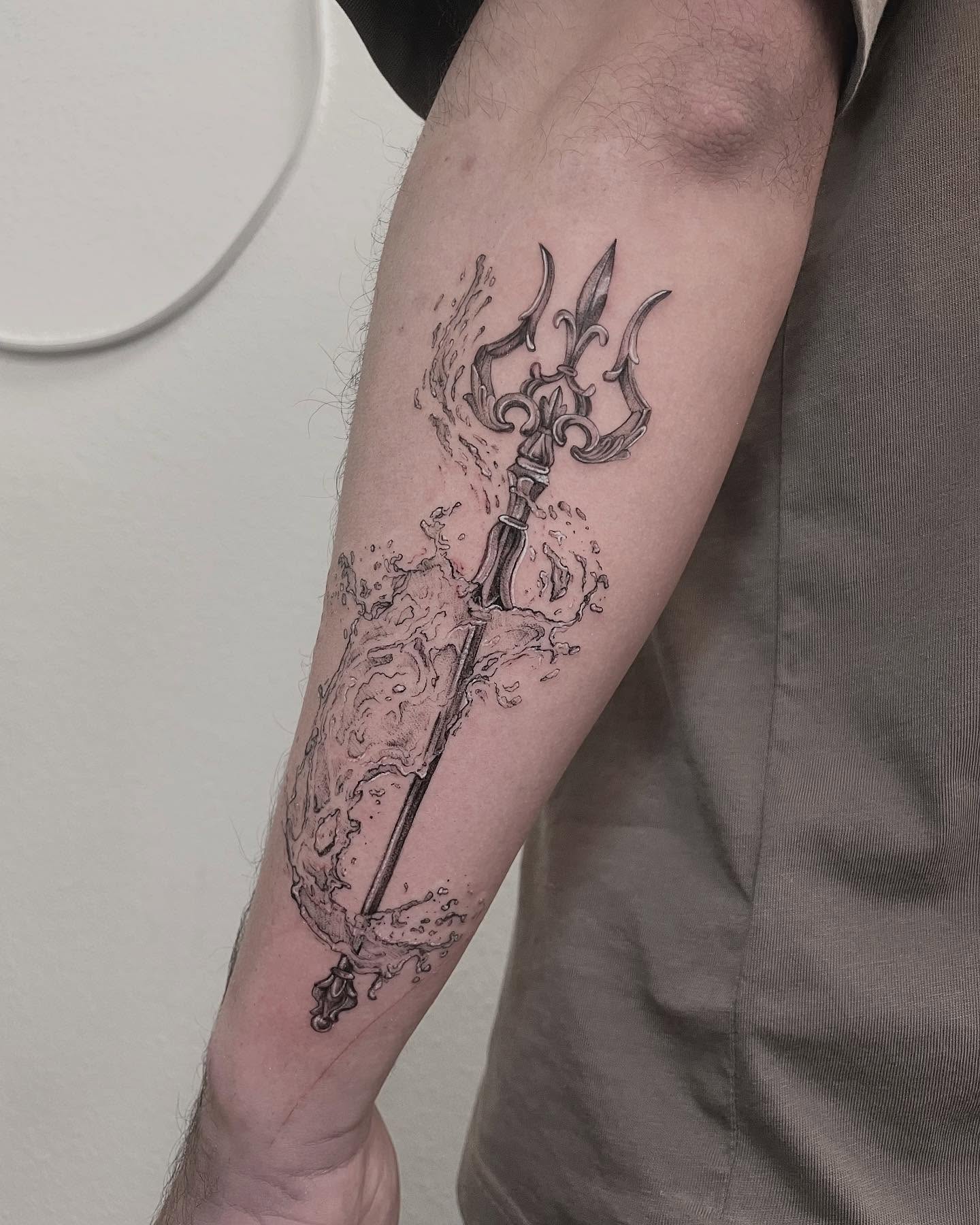
8. Poseidon’s Trident
You do not need Poseidon himself. The trident alone identifies him, which makes this one of the most flexible ideas on the list.
Its long vertical shape suits the forearm, the outer calf and the spine, and it can be scaled down further than almost any other subject here without losing legibility.
Wrapping waves or a wave-crest base adds context. Left plain, it reads as a clean graphic mark.
9. Prometheus and the Eagle
He stole fire for humanity and was chained to a rock, where an eagle came each day to eat his regrowing liver.
It is the most explicitly brutal image in this guide, and it means something specific: paying an unending price for something you would do again.
Chest and back placements suit it because the composition needs both the bound body and the bird. On a forearm it usually has to lose one or the other.
10. The Labyrinth
The maze built by Daedalus to hold the Minotaur, and the purest piece of geometry the Greeks left us.
It appears on Cretan coins as a seven-circuit pattern, and that historical version is far more interesting than a generic maze drawn from scratch.
One warning from experience: closely spaced parallel lines are exactly the pattern that blurs first as a tattoo ages. Ask your artist to open the spacing more than looks necessary on paper — the same rule that governs good linework tattoo design generally.
11. Nike, Goddess of Victory
The winged personification of victory, best known now from the headless Winged Victory of Samothrace in the Louvre.
That statue is the reason the missing head reads as intentional rather than unfinished, and a lot of the strongest Nike tattoos lean into the fragment.
The wings and wind-blown drapery are where the piece lives, so give the artist enough space that the folds do not collapse into grey.
12. The Cyclops Eye
Polyphemus, the one-eyed giant Odysseus blinded to escape the cave.
Reduced to a single eye, this becomes one of the few genuinely small Greek mythology tattoo ideas that still carries a full story.
It sits comfortably beside the wider tradition of protective eye imagery, though the meanings are not the same — the Cyclops is the one who was blinded, not the one who wards off harm.
13. Hades and Persephone
The most requested pairing in the category, and the one most often softened in the retelling.
Worth being honest about: in the Homeric Hymn to Demeter this is an abduction, not a romance. The modern reading of Persephone as a queen who chose her own crown is a later reinterpretation.
Either reading makes a good tattoo, but knowing which one you are wearing matters. The pomegranate — six seeds, six months below — is the detail that carries the whole myth in one small object.
14. Apollo and His Lyre
God of music, poetry, prophecy, healing and the sun — the widest portfolio on Olympus.
The lyre alone is the cleanest way in. It is a compact, symmetrical object that scales down to a wrist or an inner forearm without losing shape.
A radiating sun behind the figure or laurel around the frame pushes it from “instrument” to “Apollo” without needing a face at all.
15. The Hydra
Cut off one head and two grow back. Heracles only won by cauterising each stump.
As a metaphor it is unusually specific — a problem that multiplies when you attack it directly — and that specificity is why people choose it over a plain serpent.
The multiple necks are perfect for wrapping a limb. If you are weighing this against a single-snake design, our guide to snake tattoo meaning covers how the symbolism differs.
16. Hecate’s Torch
Goddess of crossroads, boundaries, night and magic, often shown holding two torches and sometimes with three faces looking three ways at once.
The triple form is the interesting design problem here, and it is not an easy one — three faces on one head goes wrong quickly at small sizes.
The torches alone are the safer version, and they carry the crossroads meaning perfectly well on their own.
17. Hermes’s Caduceus
A winged staff with two serpents twined around it, carried by Hermes as messenger, trickster and guide of souls.
One thing worth knowing before you commit: the caduceus is commonly mistaken for a medical symbol. The staff of Asclepius — one snake, no wings — is the actual symbol of medicine.
If you want the medical association, ask for Asclepius. If you want commerce, travel and messages, the caduceus is correct.
18. Sisyphus and His Boulder
Condemned to roll a boulder uphill forever, watching it roll back down every time.
Albert Camus turned the image into a modern one by arguing we must imagine Sisyphus happy, and that reading is why the tattoo shows up so often on people in long, grinding work.
The strong composition is a simple diagonal: the slope of the hill running across the limb, the figure leaning into it. It is one of the few ideas here that works as pure silhouette.
19. Cerberus
The three-headed hound at the gate of the underworld, whose job was to stop the dead from leaving rather than the living from entering.
That detail changes the meaning: he is a guardian of a boundary, not a hunter.
Three heads need horizontal room, so chest, upper back and outer thigh suit him far better than a forearm. Fanning the heads outward rather than stacking them is the arrangement that consistently reads best.
20. The Owl of Athena
The little owl of Athens appeared on the city’s silver coinage for centuries, which makes it one of the most historically grounded images on this list.
It is also the most wearable. A coin-style owl in a circular frame sits neatly on an inner forearm, a shoulder or behind the arm.
If the bird interests you more than the goddess, our broader owl tattoo ideas collection covers styles well beyond the classical.
Beyond the Big Twenty: Other Directions Worth Considering
If none of the twenty fits, the source material is far from exhausted. These four directions come up regularly in consultations.
Roman Counterparts
Jupiter, Minerva, Neptune, Diana and Mercury are the same figures under different names, and much of the surviving sculpture is Roman rather than Greek.
If your reference photo is a marble bust in a European museum, there is a good chance you are already working from the Roman version. That is fine — just say so to your artist so the attributes stay consistent.
Constellations and Catasterisms
Many of these figures were placed in the sky at the end of their stories — Orion, Perseus, Andromeda, Callisto as the Great Bear.
A star-map version gives you the same myth in a form that stays small and fine-line, which is the compromise I most often suggest to clients who want mythology but not a large piece.
Text in Ancient Greek
A line from Homer or Heraclitus in the original script is a real option, but it is the highest-risk idea in this guide.
Have the text checked by someone who actually reads ancient Greek before it goes on skin. Machine translation of classical Greek fails often, and diacritics get dropped or mangled by fonts.
Black-Figure and Red-Figure Pottery Style
Athenian vase painting gives you a ready-made visual language: silhouetted figures, incised detail, terracotta and black.
It ages unusually well as a tattoo because it is built from solid shapes rather than fine gradients. Not every artist has studied it, so look specifically for someone who has.
Planning and Living With a Greek Mythology Tattoo
Bring the story, not just the picture. When I have sat in on consultations that went well, the client could say in one sentence why that figure and not a different one — and the artist designed around that sentence.
Size honestly. Detailed portraits and multi-figure scenes need real estate; if the space you have in mind is small, choose an attribute — a trident, a lyre, an owl — over a face. Larger flat areas like the chest and back are where full scenes belong, and our chest piece tattoo ideas guide shows how those compositions are usually laid out.
Match the artist to the style, not the subject. Someone whose portfolio is full of black and grey realism portraits is the right choice for Zeus and the wrong choice for a fine-line labyrinth, even though both are Greek mythology.
On healing: follow the aftercare your artist gives you, since it is specific to the work you just had done. General guidance from the American Academy of Dermatology and the US Food and Drug Administration is worth reading beforehand, and anything that looks like spreading redness, swelling, heat or a rash needs a doctor rather than an internet search. This article is not medical advice.
Common Mistakes, and What to Do If You Are Still Not Sure
The most common mistake is choosing the figure from a search results page rather than from the story. That is how people end up with an Icarus they cannot explain.
The second is cramming a multi-figure scene into a small panel. In most cases the fix is to drop a figure, not to shrink everything.
The third is mismatching attributes — a trident on Zeus, an owl on Artemis. It is a small error that anyone who knows the material will notice immediately. Reference collections such as the Theoi Project’s Gorgon entry are a quick way to check before the stencil is drawn.
If you are drawn to the mood rather than the specific pantheon, it may be worth looking sideways. Norse mythology tattoo ideas cover similar territory with a colder visual palette, and Viking tattoo ideas lean more heavily on knotwork and weaponry.
If it is the styling you are unsure about rather than the subject, compare a delicate treatment in our fine line sleeve tattoo ideas against the heavier contrast in blackwork tattoo ideas. The same god looks like a different tattoo in each.
Frequently Asked Questions
What is the most popular Greek mythology tattoo?
Medusa has been the most requested Greek mythology subject in most of the studios I have spoken to over the past few years, with Hades and Persephone close behind. That is a snapshot of shop conversation rather than a measured statistic, so treat it as a trend rather than a fact. Zeus, Athena and the Fates all appear consistently as well. Popularity should not decide your choice — the story you actually want to wear should.
Do Greek mythology tattoos have to be black and grey?
No. Black and grey dominates because it mimics marble sculpture, which is how most people picture these figures. But the originals were painted, and Athenian pottery was terracotta and black rather than white. Colour work in neo-traditional or in a pottery-inspired palette is historically defensible and often more distinctive.
Where do these designs work best on the body?
It depends entirely on the composition. Single attributes such as a trident, lyre or owl suit forearms, calves and shoulders; full portraits need the upper arm, thigh, chest or back. Multi-figure scenes like the Three Fates or Prometheus generally need the largest flat areas you have. In most cases, letting the design decide the placement produces a better result than the other way round.
Is a Medusa tattoo a symbol of surviving assault?
For many people who wear it, yes. That reading draws on Ovid’s version of the myth, in which Medusa is punished for something done to her rather than for a crime she committed. It is a modern reinterpretation rather than an ancient one, and both readings coexist today. Nobody wearing one owes anyone an explanation of which they mean.
How do I make sure my artist gets the mythology right?
Bring written reference, not just images — a short note on which figure, which version of the story and which attributes belong to them. Ask to see the stencil before it goes on and check the attributes yourself at that point. A good artist welcomes this, because a corrected detail on paper costs nothing and a corrected detail on skin costs a lot.
Quick Summary
- Pick the story first and the styling second — it is the single biggest predictor of long-term satisfaction.
- Medusa, Athena, Zeus, Hades and Persephone, and the Three Fates are the most requested figures.
- Attributes alone — trident, lyre, owl, caduceus, torch — identify a god and scale down far better than portraits.
- Black and grey realism suits portraits; fine line suits labyrinths and constellations; blackwork suits creatures and underworld scenes.
- Multi-figure scenes such as the Fates, Prometheus and Cerberus need chest, back or thigh, not a forearm.
- Check attributes against a reliable source before the stencil is drawn, and have any ancient Greek text verified by a reader of the language.
- Follow your artist’s aftercare instructions, and see a doctor rather than an internet forum if healing looks wrong.