I have lost count of how many cat tattoos I have photographed, asked about in studios, or talked people into and out of over the years. The cat is one of the few subjects that genuinely works in every major tattoo style, from a three-millimetre silhouette behind the ear to a full colour neo-traditional thigh piece.
That range is the whole reason this subject is so popular with women, and it is also the reason so many people freeze at the design stage.
Cats have lived alongside people for thousands of years, and almost every culture that kept them built a story around them. Sacred in ancient Egypt, lucky in Japan, faintly suspicious in medieval Europe, and permanently in charge at home.
Below are 21 ideas I keep coming back to, grouped so you can see how the same animal changes completely depending on the style you choose. If you already know you want something delicate, the wider fine line tattoo ideas guide pairs well with this one.
Which Cat Tattoo Style Is Right for You?
Style matters more than subject here. The same sitting cat reads as sweet, sinister, or sacred depending entirely on how it is drawn.
| Style | Best For | Typical Size | Ageing Notes |
|---|---|---|---|
| Fine line | Portraits of a specific cat, delicate placements | 5-15 cm | Softens fastest; usually wants a touch-up within a few years |
| Minimalist blackwork | Silhouettes, single-line drawings, tiny placements | 2-8 cm | Holds shape well if lines are not crowded |
| Neo-traditional | Bold decorative cats, florals, colour | 10-25 cm | Ages the most reliably of the colour styles |
| Watercolour | Tabbies, tortoiseshells, painterly effects | 8-20 cm | Softest edges over time; better with a black anchor line |
| Japanese-influenced | Maneki-neko, bold outlines, symbolic work | 10-30 cm | Built to last; heavy outlines carry the design for decades |
What Actually Affects How a Cat Tattoo Ages
The two things that decide how your cat tattoo looks in ten years are line weight and detail density, not the subject itself.
Cat faces are made of small features: whisker dots, eye highlights, the fine gradient where fur meets muzzle. Pack those into a piece the size of a coin and the detail will blur as the ink settles.
In my experience the most common regret is not the design but the scale. The same portrait at eight centimetres instead of four will still read clearly a decade later.
Placement matters too. Hands, fingers, feet and the outer forearm see the most sun and friction, and fine line work there tends to fade first.
None of this makes small cat tattoos a bad idea. It just means a small one is a piece you should expect to maintain, and a good artist will tell you that before you book.
21 Cat Tattoo Ideas for Women
Each of these works as a standalone piece. Several also combine well, which is worth thinking about if you suspect this will not be your only cat tattoo.
1. Fine Line Cat Portrait
A portrait of one specific cat, not a generic one. The individual ear set, the particular tilt of the head, the asymmetry in the markings.
This is the design people bring me photos for, and the photos are almost always too dark. Bring three or four shots in daylight, from the front and from slightly above.
The difference between a portrait of your cat and a portrait of any cat lives entirely in the artist’s ability to render individuality at small scale.
Ask to see healed fine line animal work before you book, not just fresh photos. Fresh fine line always looks perfect.
Photo: @spamueltattoos
2. Minimalist Cat Silhouette
A cat reduced to its outline: the sitting pose, the arched back, the stretch. Nothing inside the shape at all.
This is the most forgiving cat tattoo there is. With no interior detail to blur, a solid silhouette holds its read for a very long time.
It works at genuinely small scales, which is why it is so common on the inner wrist, behind the ear, and on the ankle.
If you like this direction, the broader minimalist tattoo ideas collection shows how the same restraint plays out across other subjects.
3. Cat with Floral Crown
A cat wearing a ring of flowers, which softens the animal’s natural aloofness without making it cute.
The botanical element also solves a practical problem: it gives the artist somewhere to put visual weight, so the cat’s face does not have to carry the whole design.
Peonies and wildflowers suit neo-traditional versions. Small sprigs of baby’s breath or lavender suit fine line.
Pick flowers that mean something to you rather than whatever is trending, because the florals are the part you will be asked about.
4. Japanese Maneki-Neko
The beckoning cat with one paw raised, a fixture of Japanese shopfronts and now one of the most recognisable cat tattoos going.
Traditionally the raised paw is read as an invitation, and different versions carry different associations depending on which paw is up and what the cat is holding.
In tattooing it suits bold outlines and flat colour, which is also why it ages so well.
Worth asking your artist about the specific version you want rather than copying a design off a keyring, since the details carry meaning.
Photo: @noodle.21
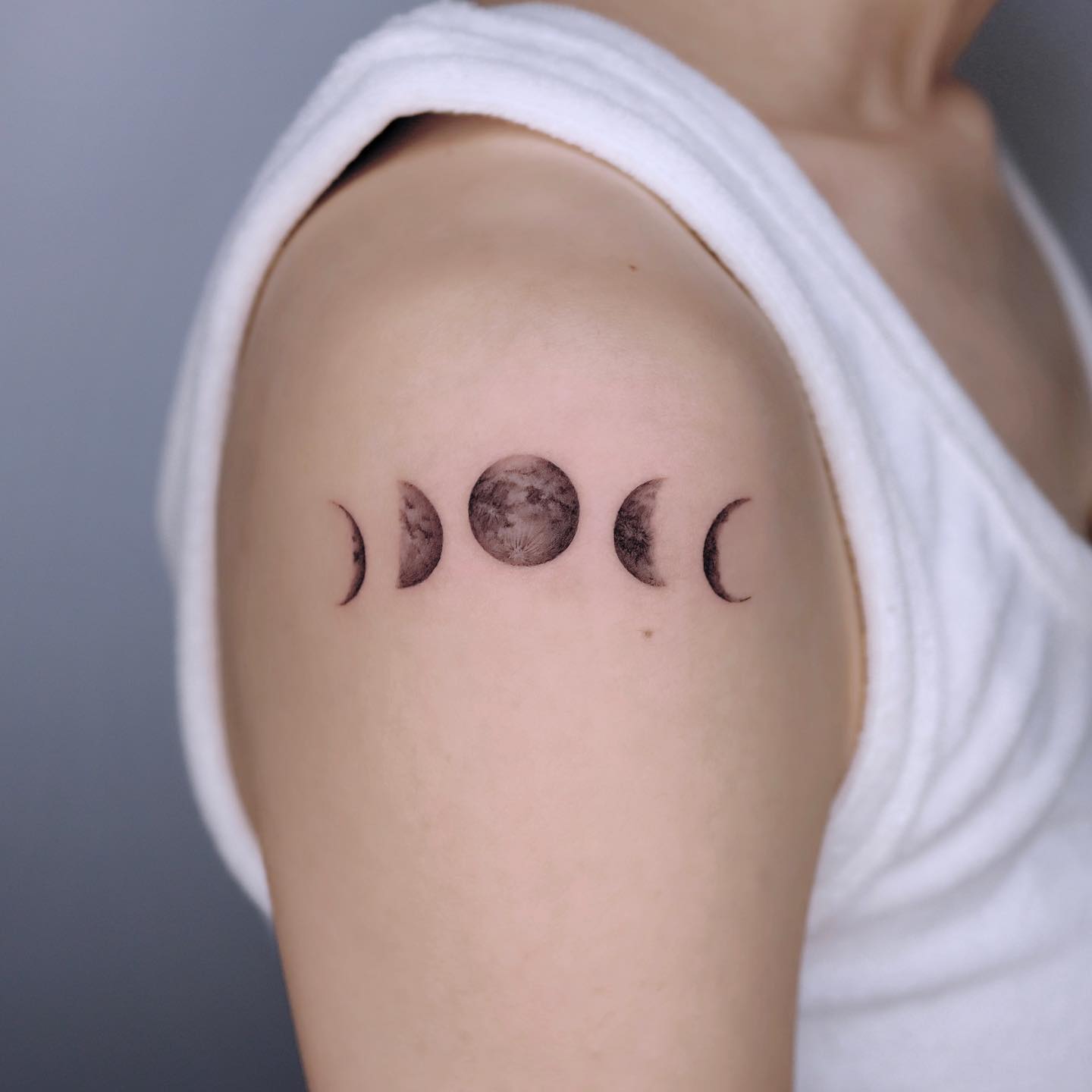
5. Cat and Moon
A cat curled inside a crescent, or sitting beneath a full moon. Probably the most requested cat pairing I see.
The combination works because both shapes are simple and both read instantly, even at small sizes.
The crescent gives the composition a frame, which is useful on curved placements like the outer forearm or the back of the shoulder.
There is a lot more range here than most people expect, as the moon tattoo ideas guide shows.
Photo: @pookies.pokes
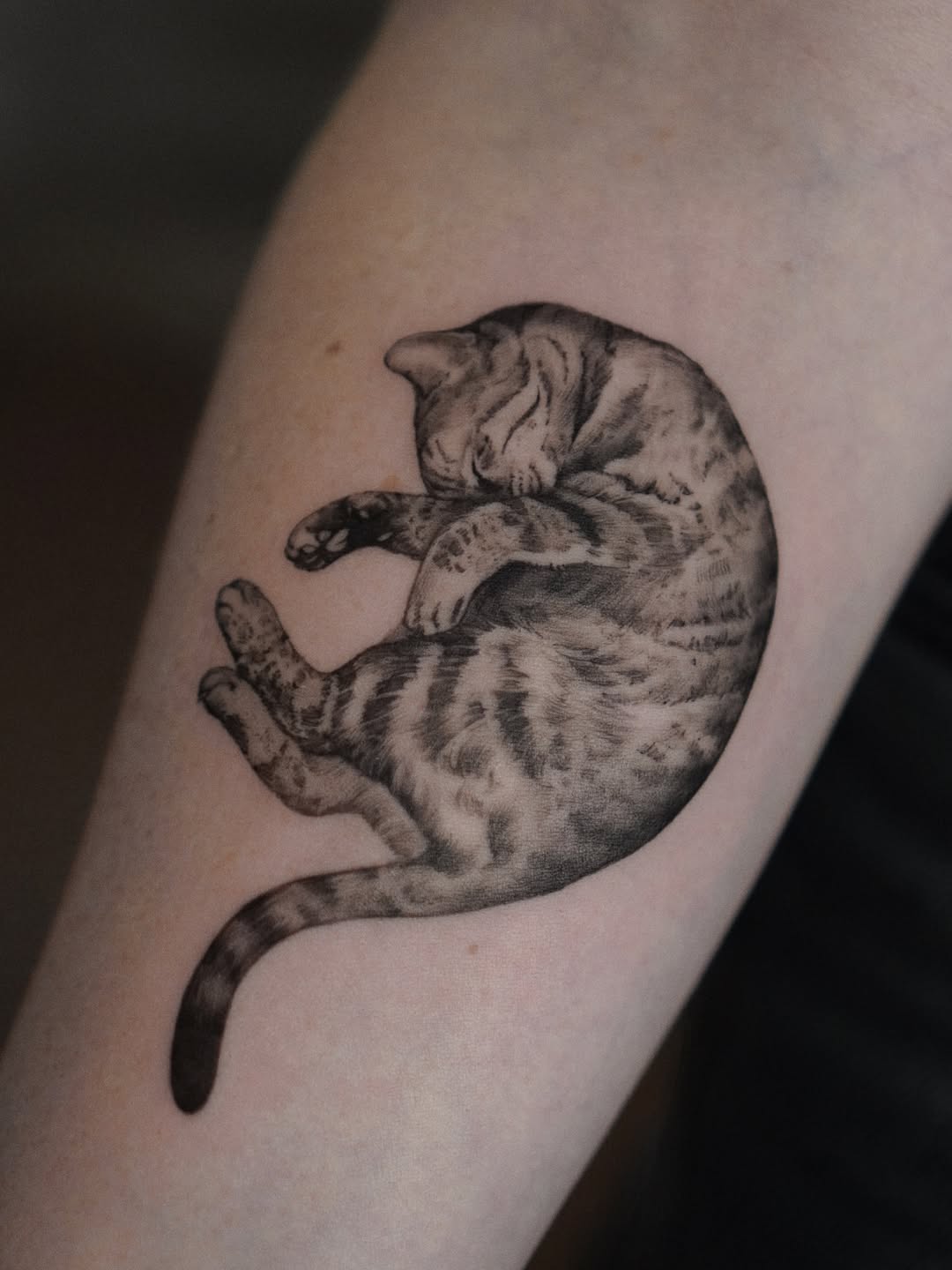
6. Sleeping Cat
A cat curled into a circle, nose tucked under tail. The pose is naturally compact, which makes it one of the easiest cat designs to place well.
It suits the inner forearm, the shoulder blade, and the top of the thigh, because the round shape sits comfortably on flat and slightly curved skin alike.
The curled sleeping pose is the single most flattering shape a cat makes for tattooing.
Soft shading works here, but ask for a defined outer edge. A shading-only sleeping cat can lose its silhouette as it settles.
Photo: @angelicafilipp
7. Cat Eyes Close-Up
Just the eyes, cropped tight, usually across the forearm or along the sternum. It is a striking piece and a demanding one.
Eyes live or die on the highlights. If the white areas are placed even slightly wrong, the whole thing looks flat.
This is a design where I would pay for the more experienced artist rather than the closer studio.
It also needs a reasonable amount of space. Cropped eyes at four centimetres tend to read as an abstract blur once healed.
Photo: @tattooist_yeono
8. Witchy Cat
The black cat with occult trimmings: moons, candles, tarot suits, the occasional pointed hat.
Because the cat itself is solid black, this style ages unusually well. There is no interior detail to lose.
The decorative elements around it are where the design gets personal, so this is a good one to collaborate on rather than picking flash.
The black cat tattoo ideas guide covers the symbolism in more depth, including the wide gap between how black cats are read in Britain and in the United States.
Photo: @freakyface_
9. Cat Stretching
The full downward stretch, front legs extended, spine in a long arc. It is the most cat-shaped thing a cat does.
The elongated form suits long narrow placements: along the forearm, down the outside of the calf, or across the collarbone.
It also gives the artist a natural flow line to follow, which usually means the tattoo sits better on the body than a static pose would.
Keep the paws simple. Overworked toe detail is the first thing to go fuzzy on a stretched pose.
Photo: @her_void
10. Watercolour Cat
Soft colour washes for the fur, a thin dark line holding the shape, and loose pigment bleeding out past the edges.
It is the best option if your cat’s colouring is the point: orange tabbies, tortoiseshells, and blue-greys all translate beautifully.
The honest caveat is that watercolour softens more than other styles as it ages, particularly where the wash has no line to sit against.
Ask for a black anchor line somewhere in the design. The watercolour tattoo ideas guide explains why that one detail changes how the piece holds up.
11. Cat and Window
A cat sitting in a window frame, sometimes with curtains, sometimes with a plant on the sill.
The frame does a lot of work: it contains the design, gives it a clear rectangle to live in, and adds a sense of place that a floating cat lacks.
It suits the upper arm and the thigh, where there is enough room for the architecture around the animal.
This one photographs badly and looks far better in person, which is worth knowing before you judge it from reference images.
Photo: @tattoosnob
12. Geometric Cat
The cat built from straight lines, triangles, and hard angles rather than organic curves.
It is a strong choice if you want a cat tattoo that does not read as sentimental. The geometry keeps it graphic.
Precision is everything. A wobbly straight line is far more visible than a wobbly organic one, so this style is unforgiving of a rushed artist.
Ask specifically for healed photos of geometric work, because line consistency is exactly what settles unevenly on some skin.
Photo: @mercurial_ink
13. Cat Paw Print
The simplest option on this list, and the one I most often suggest to people getting their first tattoo.
A single paw print is small, cheap, quick, and reads clearly forever because it is nothing but solid shapes.
It also works as a memorial piece without announcing itself as one, which matters to a lot of people.
Some artists will take an ink print from your own cat’s paw and work from that. The cat paw tattoo ideas guide covers that process and its variations.
Photo: @neonmoontattoo
14. Cat and Book
A cat asleep on an open book, or curled beside a small stack of them. A specific kind of person wants this tattoo and they know exactly who they are.
The book gives the composition a base, which is useful because it stops the cat floating awkwardly on the skin.
Fine line suits it, but keep the page detail minimal. Text inside a tattooed book almost never survives healing at small sizes.
If you want a title to be readable, the book needs to be bigger than most people expect, or the lettering needs to sit outside it.
Photo: @kait.deitz
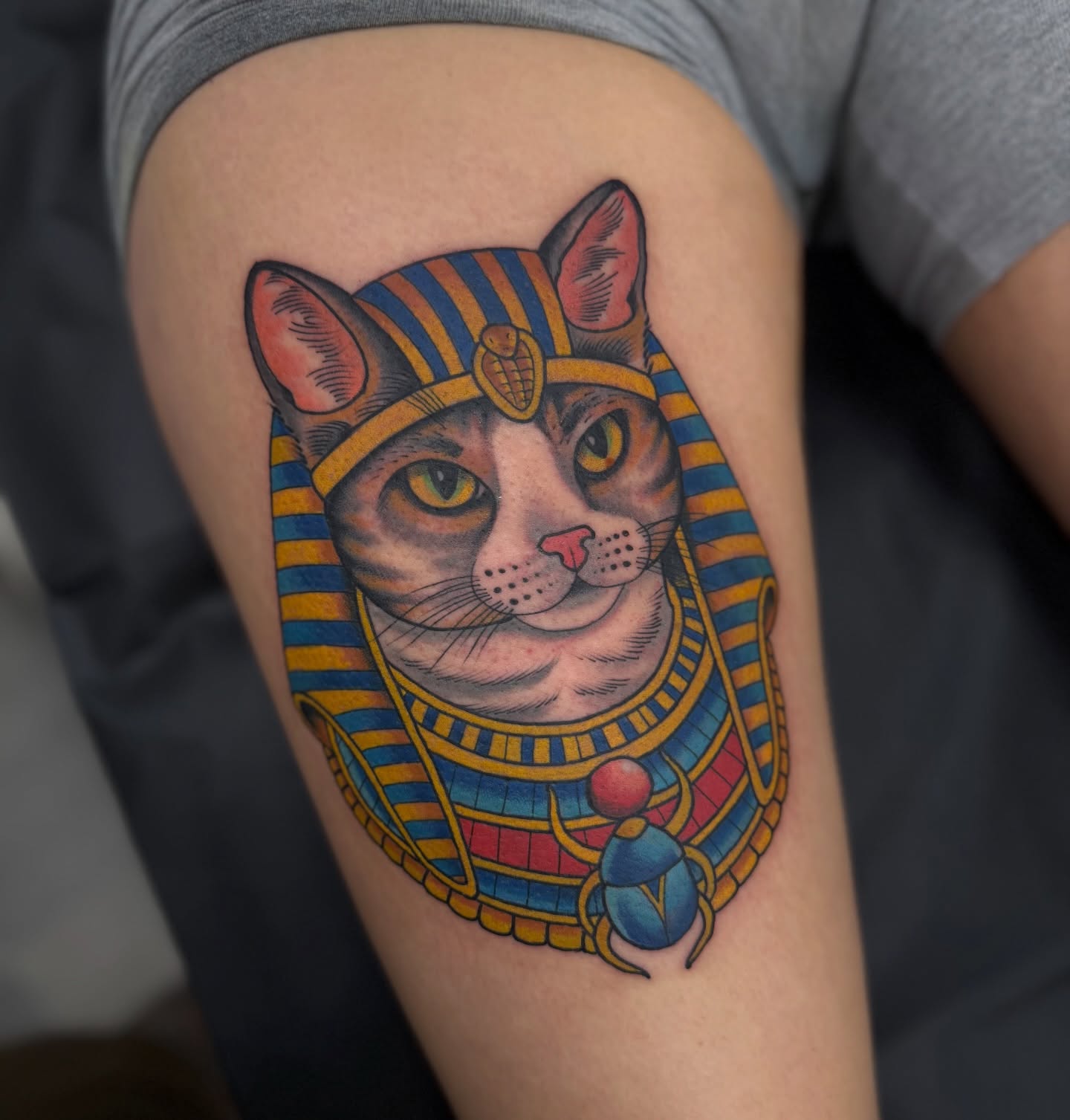
15. Egyptian Cat (Bastet)
The seated Egyptian cat, often with a collar, sometimes with the goddess Bastet rendered as a woman with a feline head.
Bastet was worshipped at Bubastis in the Nile delta, and Britannica notes that thousands of mummified cats and bronze cat statuettes were left there as offerings.
The upright seated pose is rigid and symmetrical, which makes it a natural fit for the spine, the sternum, and the back of the neck.
Blackwork and dotwork both suit it. The Egyptian tattoo ideas guide covers the wider iconography if you want to build a larger piece around it.
Photo: @martinnasim
16. Cat Spine Piece
A cat, or a row of them, running down the centre of the back along the spine.
It is a dramatic placement and a genuinely painful one. The skin over the vertebrae is thin and there is bone directly underneath.
Most people I have spoken to who sat for a spine piece did it across two sessions rather than one, and were glad they did.
The feminine spine tattoo guide goes into placement and alignment, which matters more here than almost anywhere else on the body.
Photo: @lilbit_tats
17. Neo-Traditional Cat
Heavy outlines, saturated colour, decorative framing, and a slightly stylised face. The style borrows the structure of American traditional and loosens the drawing.
If you want colour and you want it to still look good in twenty years, neo-traditional is the safest bet on this list.
The bold outline is doing the long-term work. Even as colour softens, the drawing underneath stays legible.
It needs size, though. Under about ten centimetres the outline weight starts to swallow the interior detail.
Photo: @jj.neotraditional
18. Two Cats
Two cats together, either as a pair of pets or as a symmetrical decorative motif facing each other.
The symmetrical version is the stronger design in my view, because the mirroring gives the piece a structure that two randomly posed cats lack.
If it is a portrait of two actual animals, they need to be doing different things. Two cats in the same pose looks like a printing error.
This is also a common memorial format, with one cat rendered in solid black and one in outline.
Photo: @jankyjake_tattoos
19. Cat with Yarn
The cat tangled in wool, batting a ball, or trailing a single loose thread.
The thread is the useful part. It lets the design extend across the body in a way a compact cat cannot, wrapping a wrist or trailing up a forearm.
It is also one of the few cat designs that can be added to later, since more thread can always be run further.
Keep the wool a single consistent weight. Thread that changes thickness mid-run reads as a mistake rather than a choice.
Photo: @primavera_goa
20. Minimalist Cat Line Art
The whole cat drawn without lifting the pen: one unbroken line describing the head, back, tail and legs.
It looks effortless and it is not. The line has to be laid down in one confident pass, and any hesitation shows permanently.
Because there is so little ink, this is among the fastest and cheapest pieces on the list, often under an hour.
Small single-line work does need maintenance. Expect to consider a touch-up at some point rather than treating it as finished forever.
Photo: @daily_tattoo_idea
21. Cat with Starry Night Sky
A cat with the night sky either behind it or inside its silhouette, filled with small stars and dot work.
The negative-space version, where the stars sit inside the cat’s black body, is the one that tends to hold up best.
Stars scattered around the outside can blur together over time if they are placed too close, so ask for generous spacing.
It pairs naturally with the moon designs above if you want to build toward a larger celestial piece later.
Photo: @dreamshenna
Variations Worth Considering
Most people arrive with one of the 21 above in mind and leave with a version of it that has been bent slightly to fit their life. These are the three directions that come up most.
Memorial Cat Tattoos
A cat that has died can be marked without the tattoo announcing itself as a memorial.
Dates, names and paw prints are the obvious route. Subtler options include rendering the cat in outline rather than solid, or including a detail only you would recognise.
The memorial tattoos people seem happiest with years later are the ones that read as a portrait first and a memorial second.
Cats Combined with Other Subjects
Cats sit well alongside botanicals, celestial elements, snakes and daggers, and lettering.
What they do not sit well alongside is another animal of similar visual weight, unless the composition is deliberately symmetrical. Two competing focal points is the most common design problem I see in cat pieces.
Colour Choices Beyond Black
Black and grey is the default, and for good reason, but a single spot colour can do a lot of work.
Green or amber eyes on an otherwise black-and-grey cat is the most reliable version of this. It costs very little extra time and gives the piece a focal point.
Full colour is worth it mainly when the cat’s actual coat is the point, as with a ginger tabby or a calico.
Getting a Cat Tattoo Right: Practical Advice
Bring more reference than you think you need. For a portrait, I would bring at least five daylight photos from different angles, plus one that shows the cat’s personality even if the lighting is bad.
Be honest with your artist about size. If they tell you the design needs to be bigger to survive, that is not an upsell, it is the difference between a tattoo that lasts and one you are back to fix in three years.
Placement drives pain more than subject does. Ribs, sternum, spine and the tops of the feet are consistently reported as the worst, and the tattoo pain chart is a useful sanity check before you commit to a placement you have romanticised.
Follow the aftercare your artist gives you rather than what you read online, since it is tailored to the work they did. Keep it clean, keep it out of the sun, and do not pick.
If a healing tattoo becomes increasingly painful, hot, swollen or starts weeping after the first few days, contact a doctor rather than your artist. The FDA notes that unsterile equipment and contaminated inks can both cause infections, and that allergic reactions to pigments, while rare, do happen. Their tattoo and permanent makeup fact sheet is worth reading before your first appointment. Nothing here is medical advice.
Still Not Sure? The Mistakes I See Most
Going too small is the big one. Almost every regret I hear about a cat tattoo traces back to a design that needed another three centimetres.
Choosing a style because it is fashionable rather than because it suits the image is the second. A watercolour cat is a beautiful thing and a poor choice if you wanted crisp detail.
Copying another person’s tattoo exactly is the third, and artists generally dislike it. Bring it as a reference for the feeling you want, not as a template.
If you are still weighing options, the broader cat tattoo ideas collection covers designs that are not specifically framed for women, and there is a lot of crossover worth stealing from.
Frequently Asked Questions
How much does a cat tattoo cost?
It depends far more on size, detail and your artist’s rate than on the fact that it is a cat. A small silhouette or paw print is usually a shop-minimum piece, often finished in under an hour. A detailed fine line portrait or a neo-traditional colour piece is priced by the hour and can run to several sessions. Ask for a quote based on a specific size and placement rather than a general idea, because artists cannot price a vague description.
Do small fine line cat tattoos fade quickly?
They soften more than heavier work, yes. Fine line relies on very thin lines placed close together, and as ink settles and spreads slightly over the years those lines can lose definition. That does not mean they are a mistake, only that they should be treated as pieces you may want to touch up rather than as permanently finished. Sun exposure accelerates this more than anything else, so sunscreen on a healed tattoo genuinely helps.
Where is the best place for a cat tattoo?
The inner forearm, upper arm and shoulder blade are the most forgiving: reasonably flat, not heavily sun-exposed, and roomy enough for detail. The wrist, ankle and behind the ear work well for silhouettes and other simple shapes. The spine and sternum look striking but hurt considerably more and sit over bone. Match the placement to the design’s shape rather than picking the placement first.
Can I get a tattoo of my own cat?
Yes, and it is one of the most common requests artists get. What matters is finding someone who specialises in animal portraits and can show you healed examples of that work, not just fresh photographs. Bring several clear daylight photos from different angles. Expect the artist to want the piece larger than you first imagined, because individual likeness needs room.
Are black cat tattoos considered unlucky?
It depends entirely on where you are. Black cats are widely associated with good luck in Britain and Japan and with bad luck in much of the United States and parts of Europe, which is a genuine cultural split rather than a single superstition. In tattooing, black cats are simply popular, partly because solid black holds up so well over time. If the symbolism matters to you, decide which tradition you are drawing on and tell your artist.
Quick Summary
- Cats work in every major tattoo style, so choose the style before you choose the pose.
- Size is the single biggest predictor of how well the tattoo ages, especially for portraits.
- Silhouettes, paw prints and solid black cats hold their read longest with the least maintenance.
- Fine line and watercolour are beautiful and should be treated as pieces you may touch up later.
- Neo-traditional is the most reliable choice if you want colour that lasts.
- For a portrait of your own cat, hire for healed animal work, not for a nearby studio.
- Match placement to the design’s shape: long poses to forearms and calves, curled poses anywhere flat.
- Follow your artist’s aftercare, and see a doctor rather than your artist if a healing tattoo looks infected.