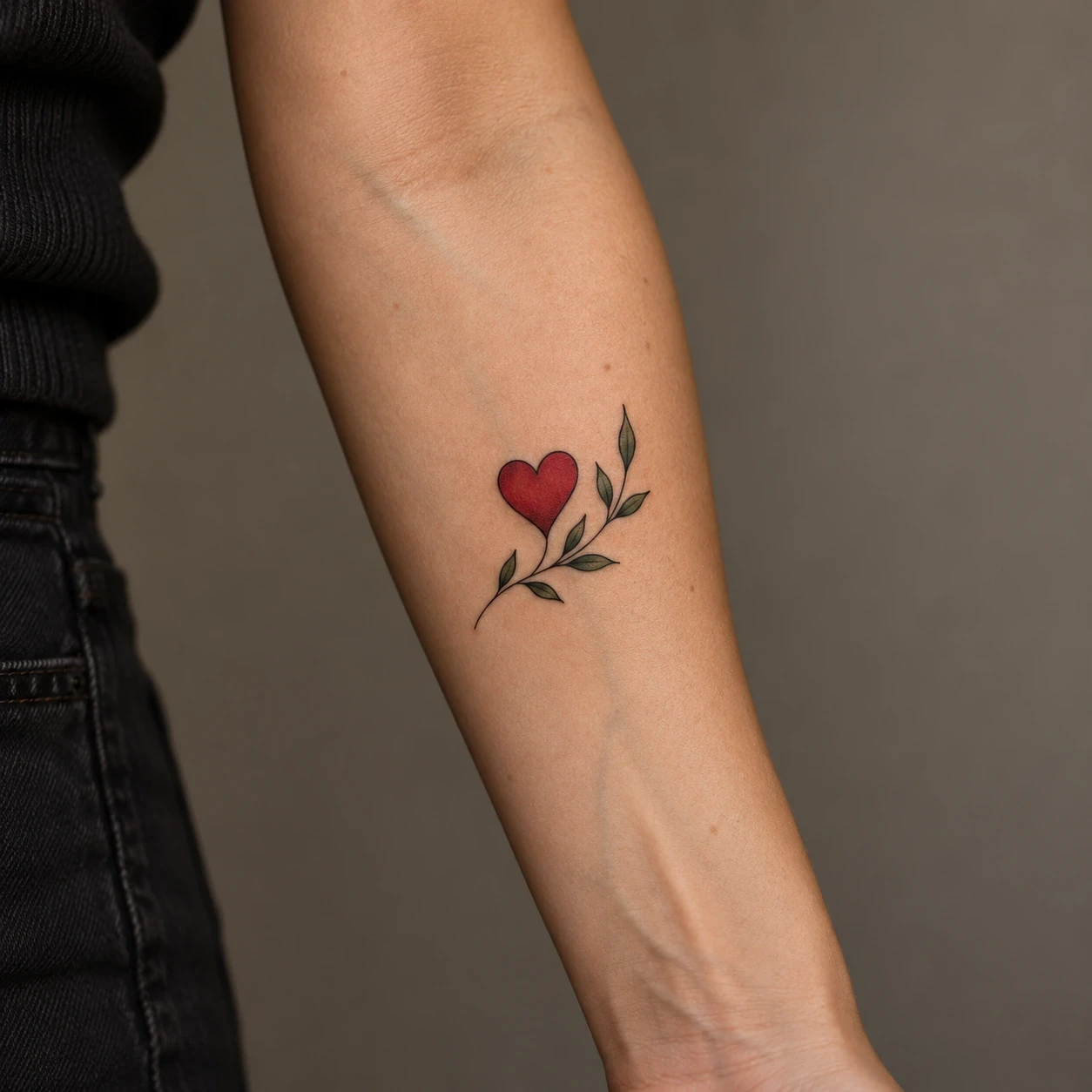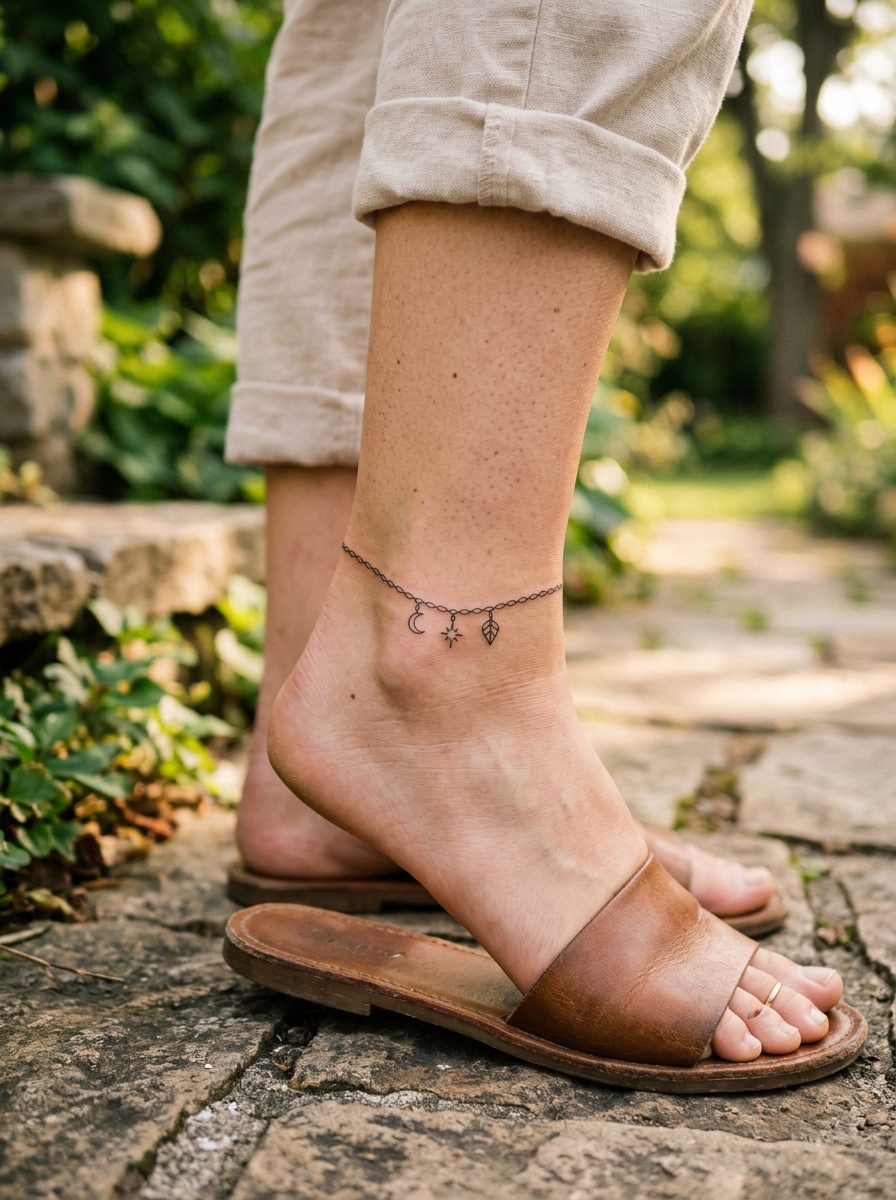
Celestial tattoo ideas attract a specific kind of person. Someone who looks up without being prompted, and feels something when they do.
The sky is the only design source every human being has already looked at, which is exactly why a celestial tattoo has to be personal to work. A generic crescent reads as decoration. A crescent that matches the moon on a date that mattered reads as a record.
I have been collecting and writing about these designs for years, and the pattern is consistent: the pieces that hold up are the ones with a reason behind them. The ones that fade into wallpaper are the ones chosen off a flash sheet in five minutes. If you are weighing a two-symbol design, the sun and moon pairing is where most people start.
Below are 21 ideas, sorted from the simplest single symbols to full sky maps, with honest notes on which ones age well and which ones need a specialist.
Which Celestial Style Is Right for You?
Style matters more than subject with sky designs, because the same crescent moon can look like a childhood doodle or a museum etching depending on how it is rendered.
Here is how the five most common approaches actually behave over time. If you lean toward the thinnest end of this range, read the fine line tattoo guide before booking.
| Style | Best For | Smallest Size That Works | How It Ages |
|---|---|---|---|
| Fine line | Constellations, small crescents, sky-map circles | About 2 in / 5 cm | Softens noticeably; expect a touch-up in a few years |
| Bold blackwork | Full moons, suns, eclipses, solid planets | About 1.5 in / 4 cm | The most reliable of the group; holds shape for decades |
| Dotwork / stippling | Craters, nebulae, gradient skies | About 3 in / 8 cm | Dots merge slightly as they settle, which usually flatters it |
| Black and grey wash | Galaxies, auroras, deep-space scenes | About 4 in / 10 cm | Light greys can drop out; a solid black anchor keeps it readable |
| Micro-realism | Planet surfaces, lunar craters, telescope views | About 4 in / 10 cm | Detail-dependent; needs a specialist and a forgiving placement |
Why Celestial Tattoos Age Differently Than Other Designs
Sky imagery is mostly circles, gradients and scattered points. Each of those behaves in skin in a way that flowers and lettering do not.
Circles are unforgiving. A wobble in a moon outline is visible in a way that a wobble in a leaf never is, so a full moon is a genuine test of an artist rather than an easy first tattoo.
Gradients are the second issue. A galaxy is only as durable as its darkest values, because the pale greys that make the smoke read as depth are the first thing to soften over years of sun exposure and healing.
Scattered points are the third. Tiny star dots placed close together tend to spread and merge, which is why experienced artists space them wider than a design on paper suggests they should.
In my experience the pieces that still look sharp after five or six years share one trait: somewhere in the design there is a passage of solid black holding the whole thing together.
Moon Tattoo Ideas
The moon is the entry point for most people, and there is more range inside it than the category suggests. If you want to go deeper on this branch alone, the moon tattoo collection covers it in detail.
1. Full Moon
A full moon, rendered with crater detail or simplified to a clean circle, is the most direct celestial tattoo available. It reads instantly and carries centuries of symbolic weight: completion, visibility, the thing that was hidden now shown.
The simplest version is often the strongest. A single solid black disc, three or four centimetres across, is a design I have seen hold up better than almost anything else in this list.
If you want craters, ask for them in dotwork rather than fine line. Stippled shadow settles into the skin; hairline crater outlines tend to blur into grey.
2. Crescent Moon
The crescent is the most-requested celestial shape and the easiest to get wrong, because a slightly uneven inner curve is obvious to the eye even when nobody can say why.
Two versions dominate. The thin decorative crescent, often with a small star tucked in the hollow, and the astronomically correct crescent with a soft terminator line where light meets shadow.
The second reads more grown-up. Every artist I have asked about this says the same thing: give the crescent a little more thickness than the reference image, because it will thin out on its own.
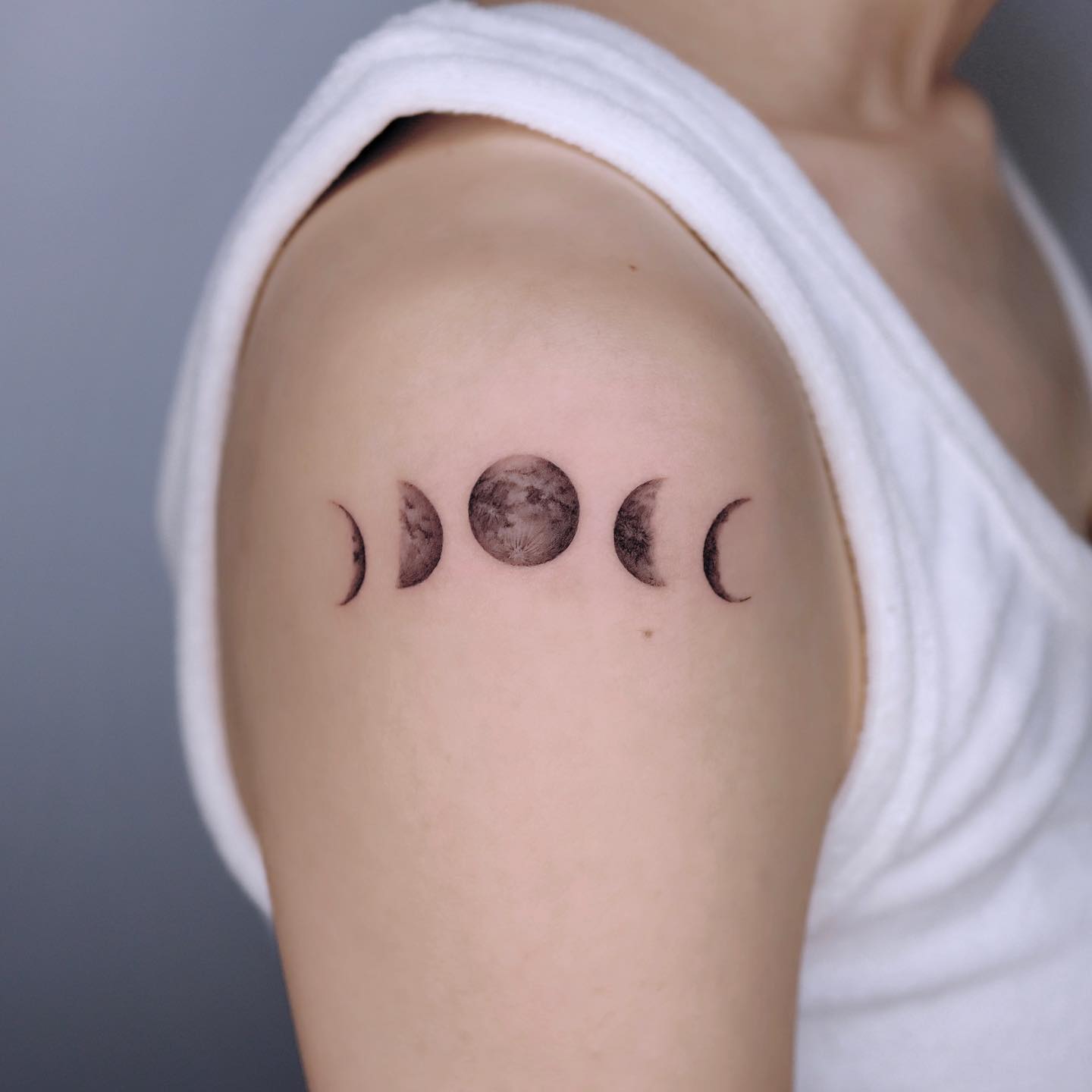
3. Moon Phase Arc
A row of moons from new to full and back again is one of the few celestial designs that is genuinely about time rather than space. The full cycle runs roughly 29.5 days, and the arc is a way of wearing that rhythm.
Placement drives it: a forearm, a collarbone, a spine, the underside of a bicep. Anywhere with a natural line for the sequence to follow.
The classic count is eight phases, though five or seven often sits better on a shorter run of skin. There is a full breakdown in the moon phase tattoo guide.
4. Eclipse
An eclipse is the most graphically satisfying design in the entire celestial category: a black disc, a thin ring of light, nothing else.
It also happens to be the most technically demanding, because the ring has to stay even the whole way round. A one-millimetre variation in the corona is visible from across a room.
Symbolically it does something unusual. It is the only common sky design about two bodies in the same moment rather than one body alone, which is why it turns up so often as a couple or sibling piece.
Star and Constellation Tattoo Ideas
Stars are where celestial tattoos get personal, because a constellation can encode a birthday, a place or a person without anyone else being able to read it.
5. Shooting Star
A shooting star is motion in a still medium, and the trail is what carries it. A short, tapering tail reads as speed; a long one reads as drama.
Keep the head solid. The most common failure I see is a head drawn as a thin outlined star, which loses its weight and leaves the tail floating.
Sizes from three centimetres up all work, which makes this one of the most flexible pieces here. The shooting star ideas page has variations by placement.
6. Birth Sign Constellation
A constellation drawn as dots and connecting lines is the quietest way to wear a star sign, and by a wide margin the most requested version.
Two decisions matter. Whether the connecting lines are included at all, and how much larger the brightest star is drawn relative to the rest.
Ask for wider spacing than the reference. Dots that look elegantly tight on paper have a habit of closing up as the tattoo settles, and a constellation that merges into a blob is not fixable without a rework. The constellation tattoo guide covers the individual signs.
7. North Star
The four-pointed star, sometimes called a sparkle or a compass star, is currently the single most popular small tattoo in the celestial family.
It is the design I would recommend to anyone getting a first tattoo. It is small, it is cheap, it heals fast, and its simplicity means there is very little that can go wrong.
Symbolically it is about orientation, which makes it a natural companion piece rather than a standalone statement. Most people I know who have one have two or three.
8. Meteor Shower
Several thin streaks running in parallel, all radiating from roughly the same point, capture something a single shooting star cannot: the sense of an event rather than an object.
The trick is uneven spacing. Three streaks of identical length at identical intervals looks like a pattern; three of varying length and angle looks like a sky.
This one scales well along a forearm, a calf or a ribcage, following the natural direction of the limb.
9. Comet
A comet is a shooting star with astronomy behind it: a bright nucleus, a broad dust tail, and often a second, straighter ion tail pointing away from the sun.
That second tail is the detail that separates a comet from a generic star streak, and almost nobody asks for it.
Halley’s Comet returns roughly every 75 years, which is why it turns up as a birth-year or once-in-a-lifetime marker more than any other object in this list.
Planet and Deep Space Tattoo Ideas
This is the ambitious end of the category. The designs are larger, cost more, and reward finding an artist who specialises in smooth black and grey. For the wider field, the space tattoo collection is a good starting point.
10. Saturn
Saturn is the most tattooable planet by a distance, because the rings give it an outline that nothing else in the solar system has. It is recognisable at any size, from a two-centimetre wrist piece up.
The ring ellipse is the whole design. Drawn too circular it looks like a hat; drawn too flat it disappears into the planet.
A useful ask: have the artist run the rings in front of the planet on one side and behind it on the other. That single overlap is what makes it read as a three-dimensional object.
11. Solar System Lineup
Eight planets in a row is a design about scale, and it needs a long, straight run of skin: an outer forearm, a spine, the outside of a calf.
Nobody renders it to true scale, because Jupiter would swamp everything else. Most artists compress the size differences while keeping the order intact.
Some people include Pluto anyway. That is a personal call, not an error, and I have yet to meet anyone who regretted it.
12. Nebula Detail
A nebula is pure texture: layered greys, soft edges, scattered points of light. There is no outline to hold it together, which is exactly the difficulty.
The version that works is the one with a defined boundary somewhere, usually a dark region or a frame. An unbounded cloud of grey tends to read as a bruise from a distance.
This is a specialist piece. Look at healed photographs, not fresh ones, before committing.
13. Galaxy Wash
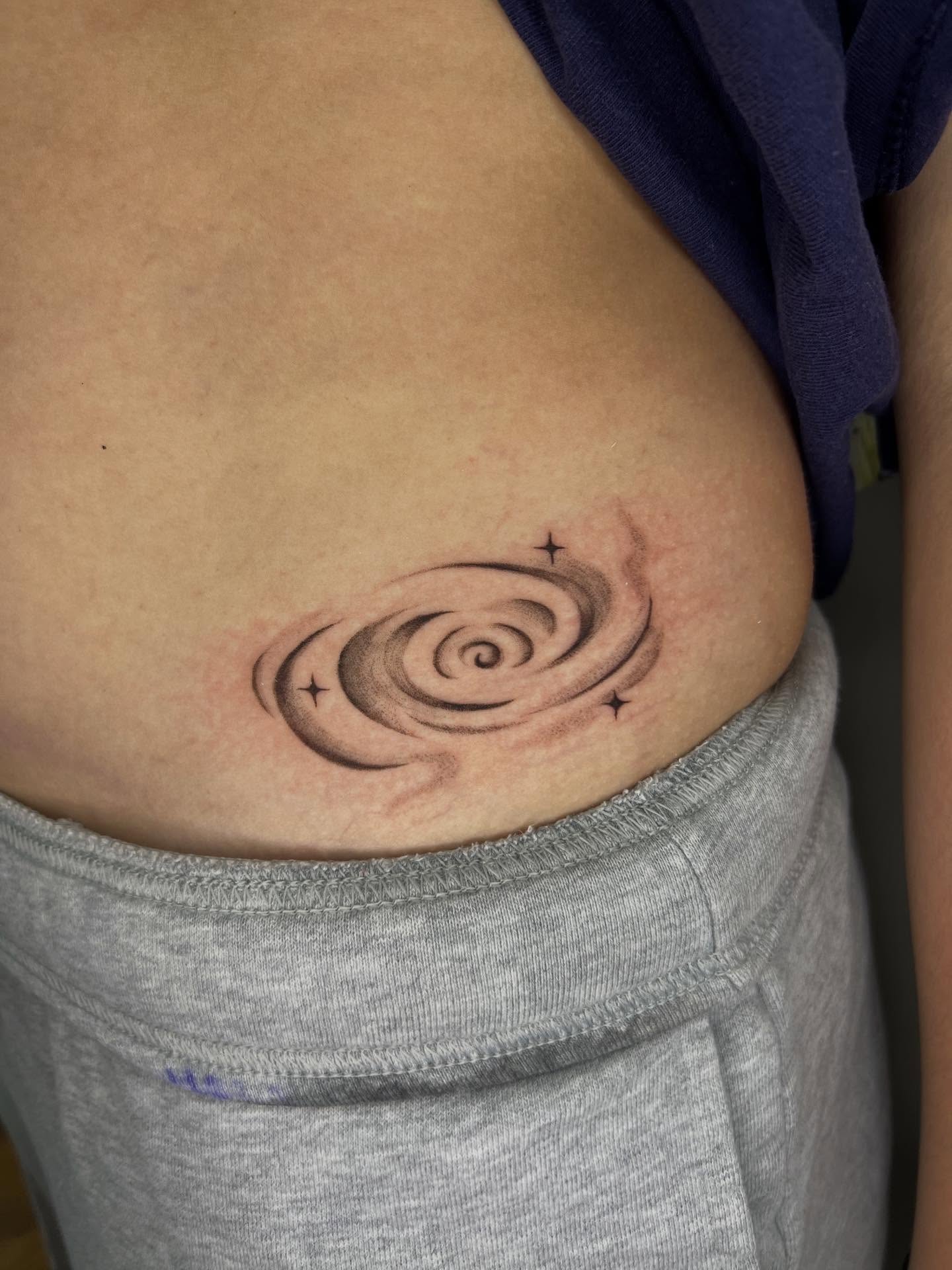
A galaxy wash is a field of soft shading with stars pulled out of it, and it functions more like a background than a subject. That is its best use: filling the space between other celestial elements.
Done in black and grey it is one of the most flattering effects in tattooing, because it follows the curve of a limb instead of fighting it.
Done in colour it is harder to keep, since pale blues and violets fade faster than black. The galaxy tattoo ideas page shows both routes.
14. Andromeda Galaxy
Andromeda is our nearest large neighbouring galaxy, around 2.5 million light-years away, and it is the one spiral that people can name.
As a tattoo it is a spiral rendered in dots and shading, usually tilted rather than face-on, because the ellipse is more interesting than the circle.
It suits round placements. A shoulder cap, the back of a hand, the inside of a forearm where the shape has room to sit whole.
Sun and Sky Event Tattoo Ideas
The sun half of the category is under-served, and sky events, the things that only happen sometimes, are where the most personal designs live.
15. Sun With Rays
The rayed sun is the oldest design in this entire article. Versions of it appear in the visual traditions of nearly every culture that has left a record.
There are two families: the geometric sun with evenly spaced triangular rays, and the flowing sun with wavy rays of alternating length. The first is bolder, the second warmer.
Bold black line work is the right choice here. A sun drawn in hairlines loses the one quality the symbol needs, which is weight.
16. Aurora Borealis
An aurora is bands of light rippling above a horizon, and it is the only celestial design that genuinely needs a landscape underneath it to make sense.
In black and grey it becomes a study in soft vertical movement. In colour it is a commitment, because the greens and violets that make an aurora recognisable are exactly the pigments most vulnerable to sun exposure.
If you go colour, protect it. Daily sunscreen on a healed aurora is not optional advice.
17. Personal Sky Map
A sky map shows the stars as they were above a specific place at a specific moment, usually framed inside a circle. It is the most personal design in this article and the one people most often get wrong.
The error is asking for accuracy. A true star chart for one location contains far more points than skin can hold, and a literal transcription heals into grey noise.
Ask instead for an interpretation: the brightest twenty or thirty stars, correct relative positions, everything else dropped. It still encodes the moment. It just survives.
Celestial Variations Worth Considering
Four more directions that come up constantly in consultations but rarely make it onto idea lists.
18. Phases of Venus
Venus goes through phases in the same way the moon does, a fact Galileo used as evidence that the planets orbit the sun. As a tattoo it looks like a moon phase arc to anyone who does not know the difference, which is part of the appeal.
It suits people who want the visual language of a phase sequence without the crowded associations the moon version now carries.
19. Celestial Map Section
Rather than a whole sky, a fragment of an antique star atlas: engraved lines, an old constellation figure, a piece of a grid.
This one needs an artist comfortable with etching-style line work, and it wants a rectangle rather than a circle. On a thigh or an upper arm it is genuinely striking.
20. Lunisolar Calendar
A design that tracks sun and moon together, often as a ring of phases around a solar disc. It is the most conceptually dense idea here and the least common.
If you want something in the celestial family that nobody else in the room will have, this is it.
21. Constellation Portrait
The mythological figure drawn over its constellation: Orion the hunter across the stars of Orion, Leo the lion across Leo.
It doubles the size requirement, because both layers need room to be legible. Below about fifteen centimetres the figure and the stars start competing rather than combining.
Placement, Sizing and Aftercare
Round celestial designs want round placements. A moon on a shoulder cap, an inner forearm, the back of a hand, where the shape has a curve to sit inside instead of a flat plane to float on.
Linear designs, phase arcs, planet lineups, meteor streaks, want long placements that follow the natural direction of the limb. Fighting the anatomy is the most common composition mistake in this category.
Give any design with fine star dots more room than the drawing suggests it needs. Spacing that looks precise on paper closes up as the tattoo heals, and a merged constellation cannot be un-merged.
On aftercare, follow the instructions your artist gives you, since they know what they put in your skin. In general terms, keep it clean, keep it moisturised, keep it out of direct sun, and do not pick. The American Academy of Dermatology publishes plain-language guidance on tattoo care and warning signs, and the US Food and Drug Administration covers ink safety and reactions. If you see spreading redness, swelling, heat, pus, or a fever, that is a doctor visit, not a forum question. Nothing in this article is medical advice.
Common Mistakes, and What to Do If You Are Still Not Sure
The first mistake is too much detail at too small a size. Celestial designs tempt people into micro-detail because the real thing is so intricate, and skin does not hold micro-detail the way paper does.
The second is choosing symbols with no personal anchor. A crescent and three stars is a nice arrangement, but it is a nice arrangement anyone could have.
The third is picking an artist by portfolio style rather than by healed work. Ask specifically to see photos of celestial pieces one or two years old. A good artist will have them and will be glad you asked.
If you are still deciding on the symbol itself, browsing star tattoo drawings is a fast way to narrow it down. Reference images from NASA science are also worth bringing to a consultation, since a real photograph gives your artist far more to work from than a Pinterest screenshot of another tattoo.
Frequently Asked Questions
How small can a celestial tattoo be?
A four-pointed star or a simple crescent works down to roughly two centimetres, and a solid full moon can go slightly smaller. Anything with internal shading, crater detail, nebula texture or connected star dots needs at least five centimetres to stay readable. In my experience the size people first suggest is usually a centimetre or two below what the design actually needs. Ask your artist for the minimum they are willing to do it at, and then take their number.
Do celestial tattoos hurt more in certain places?
The design does not change the pain, but the placement does. Areas with thin skin over bone, such as the spine, ribs, sternum, ankles and the tops of the feet, are consistently reported as more painful than fleshier areas like the outer forearm, thigh or shoulder. Since many celestial designs suit the spine and ribs, this is worth planning for. Larger pieces are usually split across sessions for exactly this reason.
Should I get a celestial tattoo in colour or black and grey?
Black and grey is the safer long-term choice for almost everything in this category, and it suits the subject matter. Colour makes sense for auroras, nebulae and galaxy work where the hue is the point, but pale blues, violets and greens fade faster than black and will likely need a touch-up sooner. If you go colour, daily sunscreen once healed makes a real difference. Ask to see your artist’s healed colour work before deciding.
How much does a celestial tattoo cost?
It varies enormously by region, artist and size, so any single figure would be misleading. Small pieces like a north star or a crescent usually fall at or near a studio’s minimum charge, while a detailed sky map, galaxy sleeve panel or planet lineup is priced by the hour and can run across multiple sessions. Message two or three studios with your reference and size and compare. Choosing on price alone is the most expensive decision in tattooing.
Can a celestial tattoo cover an old one?
Sometimes, and galaxy or nebula work is genuinely one of the better cover-up vehicles because the dense black and grey shading can absorb existing linework. Whether it will work for your specific tattoo depends on how dark and how large the original is, and that is a judgement only a cover-up specialist can make from seeing it in person. Bring a photo to a consultation before you plan the design. A cover-up almost always ends up larger and darker than you first imagined.
Quick Summary
- Pick a symbol with a personal anchor — a date, a place, a person — or the design will read as decoration.
- Bold blackwork ages best in this category; fine line looks sharpest on day one and softens fastest.
- Circles are the hardest shape to execute well, so a full moon or eclipse is a real test of an artist.
- Space star dots wider than the drawing suggests, because they close up as the tattoo heals.
- Round designs want round placements; phase arcs and planet lineups want long, straight ones.
- For a first celestial tattoo, a four-pointed north star is the most forgiving choice available.
- Ask to see healed photographs of celestial work, not fresh ones, before booking.
- Follow your artist’s aftercare instructions, and see a doctor for spreading redness, heat, pus or fever.