Faith is one of the oldest reasons people have marked their bodies, and after years of looking at these designs I keep landing on the same conclusion. A faith tattoo works when the meaning belongs to you first and to the symbol second.
Pilgrims returning from Jerusalem carried tattooed crosses as proof of the journey. Buddhist monks inscribed protective text into skin. The impulse is ancient, and it has not weakened.
What has changed is the range of choice. In my experience most people arrive with one symbol in mind and leave with something quieter and more personal, which is usually the better outcome. If your interest sits specifically within Christian imagery, the Christian tattoo ideas guide covers that ground in more depth.
Below I have grouped the designs I see most often by tradition and by symbol, with honest notes on what ages well and what does not.
Which Faith Symbol Fits You?
This is the comparison I sketch out for people who are torn between traditions. Sizes are the smallest I would personally trust to still read clearly after ten years.
| Symbol | Tradition | Smallest size I trust | Ages well? |
|---|---|---|---|
| Plain cross | Christian | 1 inch | Yes, very |
| Rosary | Catholic | Wrist wrap | Yes, if beads stay open |
| Praying hands | Christian | 4 inches | Only at size |
| Om | Hindu / Buddhist | 1.5 inches | Yes |
| Unalome | Theravada Buddhist | 3 inches tall | Yes, fine lines soften |
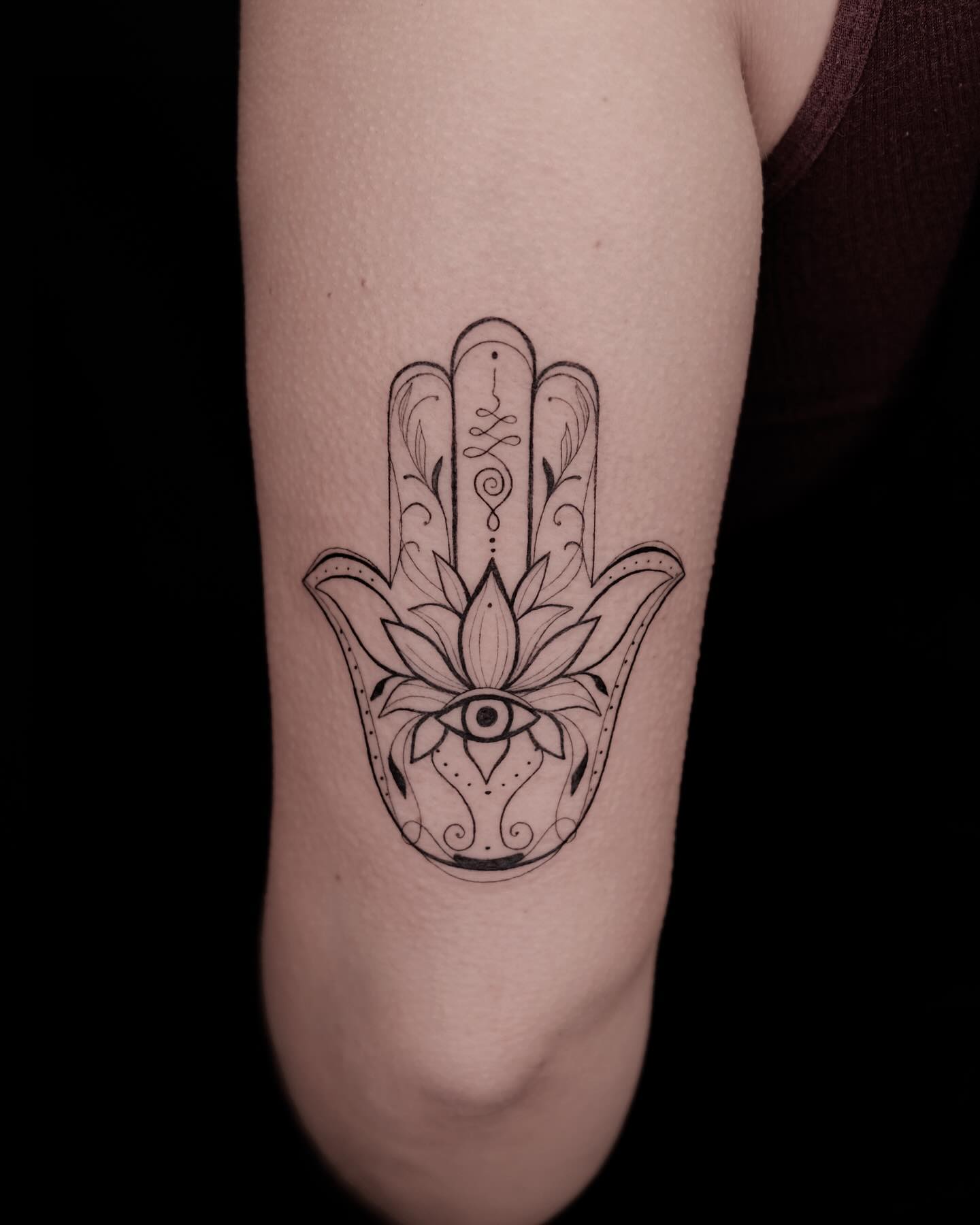
| Hamsa | Jewish / Islamic / North African | 2.5 inches | Depends on interior detail |
| Arabic calligraphy | Islamic | 3 inches | Needs a specialist |
| Triquetra | Celtic Christian | 2 inches | Yes, if the weave is clean |
| Angel wings | Christian | Back or shoulder scale | Yes, multi-session piece |
What Actually Makes a Faith Tattoo Last
Two things decide whether you still like a faith tattoo in fifteen years: how specific the meaning is, and how much line detail you asked the skin to hold.
Meaning first. Symbols chosen because they signal belief to other people tend to age badly. Symbols tied to a specific moment, a person, or a promise tend to hold up, because the memory does not change even if your practice does.
Then the technical side. Skin spreads ink slowly over decades. Fine parallel lines closer than roughly two millimetres will eventually merge, which is why dense Arabic calligraphy and intricate knotwork need more size than people expect.
Every artist I have asked about faith work says the same thing about placement: forearms, outer upper arms and calves hold detail best. Fingers, feet and the side of the hand do not, no matter how clean the first heal looks.
Give a symbolic tattoo more room than you think it needs. Almost nobody regrets going slightly larger. Plenty of people regret the two-inch version of a design that wanted four.
Faith Tattoo Ideas by Symbol and Tradition
Crosses and Christian Monograms
The cross is the most tattooed faith symbol in the world and also the most variable. Latin, Orthodox, Coptic, Celtic and Byzantine forms all carry different histories, and picking one deliberately makes the tattoo say something more precise than ‘I am Christian.’
A plain Latin cross is the safest design on this entire page. Straight lines, high contrast, nothing to blur. It survives being small, which almost nothing else here does.
If you want something less common, look at the Chi Rho, the monogram formed from the first two Greek letters of Christ. It has been in use since the fourth century and reads as a mark rather than an image. Britannica has a short history worth reading before you commit to it.
For placement and styling specifically, the cross tattoo designs for women collection shows how much variation is possible inside one shape.
Rosary, Praying Hands and the Ichthys
These three are the devotional workhorses of Christian tattooing, and each has a different technical requirement.
Rosary tattoos wrap. That is their strength. Wrists, ankles and collarbones all suit them because the chain follows the curve of the body naturally. The mistake I see most is beads drawn too close together, which merges them into a rope over time.
Praying hands demand size. When I tested this against older work, the pieces still reading clearly after a decade were all four inches or larger. Below that, the gaps between fingers close up.
The ichthys is the opposite case. Two intersecting arcs, nothing to lose, and it heals beautifully at an inch across. It is the design I recommend most often to people getting a first tattoo.
Scripture, Verse and Sacred Calligraphy
Text is the most personal category and the easiest to get wrong.
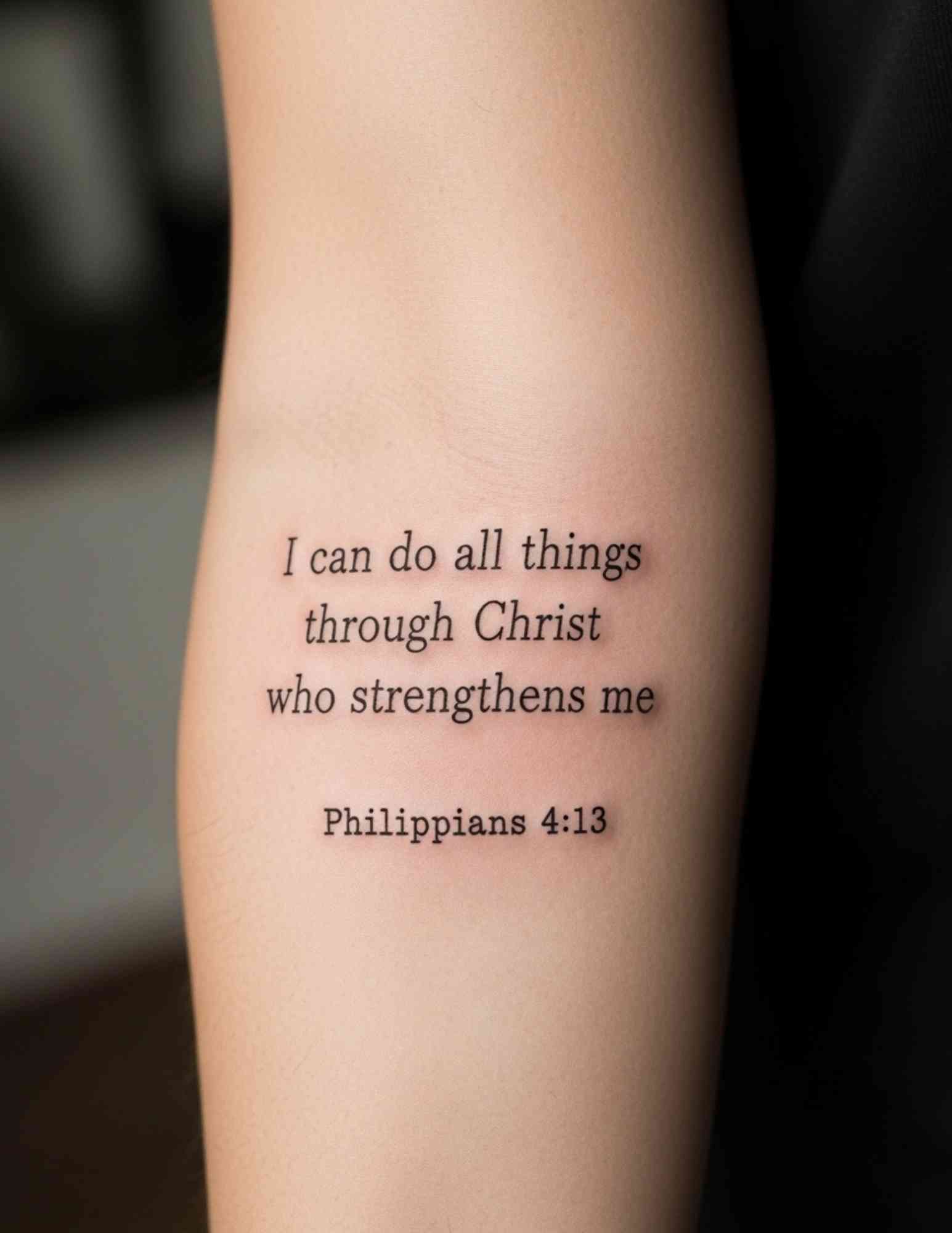
A verse reference alone, for example a book, chapter and number, is more elegant than the full passage and far less likely to date. It also keeps the meaning private, which many people prefer.
If you want the full text, the bible verse tattoo guide covers font choice and placement in detail. Script fonts with hairline connecting strokes are the ones that blur first.
Arabic calligraphy deserves a separate warning. The letterforms carry meaning in their proportions, and a well-meaning artist without Arabic script training can produce something that reads incorrectly. Find someone who specialises. Ask to see healed work, not just fresh photographs.
Om, Lotus, Unalome and the Dharma Wheel
Eastern symbols are the fastest-growing category in faith tattooing, and also the one where accuracy matters most.
The Om symbol is a syllable, not a decoration, and its curve proportions are fixed. Artists unfamiliar with it sometimes stylise the shape until it stops being the character. Bring a reference.
The lotus carries the idea of something clean emerging from mud, which is why it appears so often in recovery and rebirth pieces. Dotwork suits it better than solid shading. If you like the geometry, the lotus mandala designs take the same symbol somewhere more architectural.
The unalome traces a path from spiralling confusion to a straight line and finally a point, so it needs vertical space to tell that story. Squashed into a two-inch square it loses the narrative entirely.
The dharma wheel has eight spokes representing the Eightfold Path. Not six, not twelve. This is the single most common accuracy error I see in this category.
Protective Symbols: Hamsa, Star of David, Eye of Providence
Protection is one of the oldest reasons for a faith tattoo, and these three symbols are the ones people reach for most.
The hamsa appears across Jewish, Islamic and North African traditions, which is part of its appeal and part of its complexity. The hamsa tattoo ideas page goes into the regional variations. Its interior detail is where the design lives, so give it at least two and a half inches.
The Star of David benefits from restraint. Clean geometry, even line weight, no unnecessary embellishment. It reads well small, which is unusual for a symbol with this many intersections.
The Eye of Providence is worth thinking about twice. In Christian iconography it represents divine watchfulness, but it has also been absorbed into a lot of unrelated modern symbolism. In most cases people still love it, but be aware that strangers will read it in more than one way.
Celtic Knotwork and the Triquetra
The triquetra, or trinity knot, is a continuous three-cornered weave used in Celtic Christian art to represent the Trinity, though its use predates that association.
Knotwork is technically demanding for one reason: the over-under sequence has to be consistent. If a single crossing is drawn the wrong way, the knot stops resolving visually, and most people cannot say why it looks wrong, only that it does.
Ask to see the stencil before it goes on. I have seen more errors in this category than any other. The Celtic knot tattoo designs and the Celtic cross variations both show the weave done properly.
Wings, Doves and Ascension Imagery
Angel wings are usually memorial pieces, and they are among the biggest commitments here. Full back or shoulder-blade coverage is normally several sittings, and feather detail is expensive in both time and pain.
A dove is the compact alternative. It carries peace and the Holy Spirit depending on context, and it holds up at small sizes far better than most bird designs because the silhouette does the work.
If you are leaning toward larger wing work, the angel tattoo designs collection is a useful reference for scale and shading style.
The Sacred Heart and Devotional Realism
The Sacred Heart layers flame, thorns, light and sometimes a wound into one image, which makes it one of the most technically demanding faith designs going.
It needs an artist comfortable with black and grey depth or with traditional bold colour, and it needs size. Every version I have seen fail was simply too small for the amount of information inside it.
Done well, it is also one of the few faith tattoos that works as a centrepiece rather than an accent.
Alternatives When No Standard Symbol Fits
Not everyone’s faith maps onto an existing icon, and forcing it usually produces a tattoo that feels borrowed.
A Word Instead of a Symbol
One word in your own handwriting, or a word in a language your family actually speaks, often carries more than a symbol would. It also sidesteps the question of whether you are entitled to wear a particular tradition’s imagery.
An Ancestral or Regional Symbol
Faith travels through families. A symbol from your grandparents’ church, region or practice will mean more to you than the internationally recognised version of the same idea, and it is far less likely to appear on someone else.
A Mantra or Short Line of Text
A repeated phrase from your own practice reads as private rather than declarative. Keep it short. Long text on curved skin is the single most common regret in lettering work.
Negative Space and Abstraction
Some of the best faith pieces I have seen contain no recognisable symbol at all: light through a window, a horizon line, an open door. The meaning is yours to explain or not.
Practical Advice Before You Book
Bring accurate references. For any symbol with fixed proportions, print the reference rather than describing it. A good artist will thank you, and a great one will still correct the reference if it is wrong.
Ask specifically whether the artist has done that symbol before. Faith work is one of the few areas where cultural and technical accuracy overlap, and the honest answer to that question tells you a lot.
On healing: keep it clean, keep it out of direct sun, and do not pick. If a healing tattoo becomes hot, swollen, increasingly painful after the first few days, or produces pus, that is a medical question rather than a tattoo question and it needs a doctor, not a forum thread. The Mayo Clinic overview of tattoo risks and the FDA consumer guidance on tattoo safety both set out the warning signs plainly.
Never attempt a faith tattoo at home, and never attempt to remove one yourself. Both carry real infection and scarring risk. Removal is a clinical procedure and belongs with a qualified practitioner.
Still Not Sure? The Mistakes Worth Avoiding
Choosing a symbol from a tradition you have no connection to is the first one. It is not always wrong, but it deserves a real conversation with someone inside that tradition rather than a search-results decision.
Going too small is the second, and it is the one I see most. A symbolic tattoo that has blurred into a smudge no longer symbolises anything.
Rushing the third. Faith tattoos are frequently tied to an emotional moment, and the design that feels urgent in month one often is not the one you want in month six. Sitting with it costs nothing. If you are still exploring, the spiritual tattoo ideas and Jesus tattoo designs collections are good places to keep browsing without committing.
Frequently Asked Questions
Do faith tattoos have to be religious?
No. Plenty of people get symbols from a tradition they were raised in without currently practising, and plenty choose abstract imagery that represents belief without naming it. In my experience the tattoos that hold up best are the ones tied to a personal turning point rather than to a doctrinal statement. The symbol is the container; the meaning is whatever you put in it.
Is it disrespectful to tattoo a symbol from a religion I do not follow?
It depends heavily on the tradition and on how you wear it. Some communities are relaxed about it, others consider certain symbols and sacred texts inappropriate on skin altogether, and a few consider particular placements, such as below the waist, actively offensive. The honest answer is to ask someone inside that tradition rather than a tattoo forum. If you cannot find a comfortable answer, that is usually a reason to choose something else.
What size should a faith tattoo be?
It depends entirely on line density. A plain cross or an ichthys works at an inch. Praying hands, Arabic calligraphy, a Sacred Heart or detailed knotwork usually want three to four inches minimum, because fine parallel lines merge as skin ages. When in doubt, size up rather than down.
Where do faith tattoos age best?
Forearms, outer upper arms, calves and the upper back generally hold detail best, since the skin there stretches less and sees less friction. Hands, fingers, feet and the ribs are harder on fine detail, and hand and finger work in particular often needs touching up within a few years. Sun exposure matters as much as placement, so sunscreen on healed work genuinely extends its life.
How long does a faith tattoo take to heal?
Surface healing usually takes around two to three weeks, though the deeper layers settle over a couple of months and the tattoo may look slightly cloudy in between. That is normal. What is not normal is increasing pain after the first few days, spreading redness, heat, or discharge, and any of those warrant a doctor rather than waiting it out.
Quick Summary
- Pick the symbol that connects to your own story, not the one that signals belief most clearly to strangers.
- Plain crosses, the ichthys and the Star of David are the designs that survive being small.
- Praying hands, Sacred Hearts, Arabic calligraphy and knotwork all need three to four inches or more.
- Check accuracy details: eight spokes on the dharma wheel, correct Om proportions, a consistent over-under weave on knotwork.
- Forearms, outer arms, calves and upper back hold fine detail best over decades.
- For sacred text in a script you do not read, find a specialist and ask to see healed work.
- Sit with the design for a few months if it came out of an emotional moment.
- Treat unusual healing symptoms as a medical question and see a doctor, not a search engine.