Hawaii has one of the oldest living tattoo traditions on earth, and that is exactly why so many Hawaiian tattoo ideas go wrong. The best Hawaiian-inspired tattoos borrow the visual world of the islands — the flowers, the water, the volcanic landscape — without copying sacred kakau patterns that were never meant to be decorative.
I have spent a lot of time going through Hawaiian and Hawaiian-inspired portfolios, and the split is obvious once you know to look for it. The strongest pieces are built from island imagery. The weakest are traditional patterns lifted off a search results page with no idea what they say.
This guide covers twenty directions worth considering, grouped by theme rather than listed at random, so you can see which family of imagery actually suits you. If you already know you want botanicals, Hawaiian flower tattoo ideas goes deeper on that one branch.
I have also been honest about the parts that are not straightforward — the cultural question in particular, which deserves more than a disclaimer at the bottom of the page.
Which Hawaiian Tattoo Direction Is Right for You?
These four routes get lumped together constantly, and they are not the same thing. This is the comparison I wish someone had put in front of me early on.
| Direction | What it looks like | Cultural weight | Best for |
|---|---|---|---|
| Island imagery | Hibiscus, honu, waves, palms, volcanoes | Low — open to anyone | Most people wanting a Hawaii connection |
| Traditional kakau | Geometric black bands with inherited meaning | High — tied to genealogy | People of Hawaiian descent, guided by a practitioner |
| Pan-Polynesian blackwork | Dense repeating motifs, large coverage | Medium to high, varies by motif | Those willing to research the specific culture first |
| Tropical / vacation style | Pineapples, surfboards, sunsets, script | Low — general tropical vocabulary | Marking a trip, a move, or a love of the ocean |
If your honest answer is somewhere between rows, start with island imagery. It is the direction with the fewest ways to get it wrong.
Why Cultural Respect Comes First With Hawaiian Tattoos
Kakau is the indigenous Hawaiian tattooing practice, and it predates contact with Europeans by centuries. It was never decoration.
Patterns recorded genealogy, rank, occupation and protection. Specific marks belonged to specific families and specific roles, which is the part that does not translate into a flash sheet.
Many Hawaiian cultural practitioners ask that people without Hawaiian ancestry avoid reproducing traditional kakau patterns directly. The Bishop Museum in Honolulu is a reasonable starting point if you want to read about the practice from a Hawaiian institution rather than a tattoo blog.
That request is narrower than people assume. A hibiscus, a honu, a wave, a volcano — none of these are restricted, and artists across the islands tattoo them every day. The restriction sits on inherited pattern work, which is also where Polynesian tattoo designs raise similar questions across other Pacific cultures.
In my experience the artists who are most careful about this are also the best technicians, because both come from the same habit of actually researching what they are putting on skin.
20 Hawaiian Tattoo Ideas, Grouped by Theme
I have grouped these so you can see the families rather than twenty disconnected options. Most people find their answer inside one or two of these groups.
Island Flowers and Tropical Botanicals
The hibiscus is the obvious entry point, and for good reason — the yellow hibiscus is Hawaii’s official state flower, so it carries an actual civic link to the islands rather than a vague tropical vibe.
Plumeria is the other heavyweight. Strung into a lei curve it gives you a shape that wraps a forearm, a collarbone or an ankle far more gracefully than a single centred bloom.
Monstera leaves are the quiet workhorse of this category. Every artist I have asked about tropical compositions uses them the same way: as structure and negative space between the showier elements, in much the same role as the fronds in palm tree tattoo designs.
Botanical work ages better in fine line than most people expect, provided the artist leaves real gaps between petals instead of packing them edge to edge.
Ocean Animals: Honu, Manta Ray and Whale
The honu, the Hawaiian green sea turtle, is the single most requested Hawaiian animal motif I come across. It carries associations of long life, guidance and safe return.
It is also a real animal with real protections — green sea turtles in Hawaiian waters are federally protected, and NOAA Fisheries publishes the current status if you want the specifics. Plenty of people get the honu partly for that reason. The symbolism is unpacked further in what a sea turtle tattoo means.
Manta rays suit the ribs, the shoulder blade and the outer thigh, because those surfaces curve and the curve reads as movement. Flat placement wastes the design.
Humpbacks winter in Hawaiian waters each year, which is why whales show up in island portfolios far more than you would guess. Whale tattoo ideas covers the styling options in more depth.
Waves, Water and Island Sunsets
The Pacific wave is the backbone motif of Hawaiian-inspired work. Done well, the spray is carved out of solid black rather than drawn as thin lines, which is what keeps it readable a decade later.
Scale is the decision that matters here. A minimal fine line wave on the wrist and a full blackwork swell across the ribs are barely the same tattoo.
Sunsets are the higher-risk option. Gradients are the first thing to go patchy if the colour packing is rushed, so ask specifically to see healed photos — a point I make again in ocean tattoo ideas.
Water motifs are also the easiest Hawaiian theme to extend later, because a wave can grow into a sleeve without ever looking like it was added on.
Volcanoes, Craters and the Island Chain
Hawaii is volcanic landscape before it is anything else, and the imagery reflects that. Diamond Head — Lēʻahi — is the silhouette most people recognise instantly.
Lava is one of the few subjects where a saturated red genuinely earns its place. Against black rock it does something no grey wash can imitate.
The island chain drawn as a simple map silhouette is deceptively hard. The spacing and relative sizes have to be right, or anyone from the islands will spot it immediately.
I have seen this go wrong more than once, and it is always the same cause: the artist redrew it by eye rather than working from an accurate reference.
Pattern-Inspired Bands and Blackwork
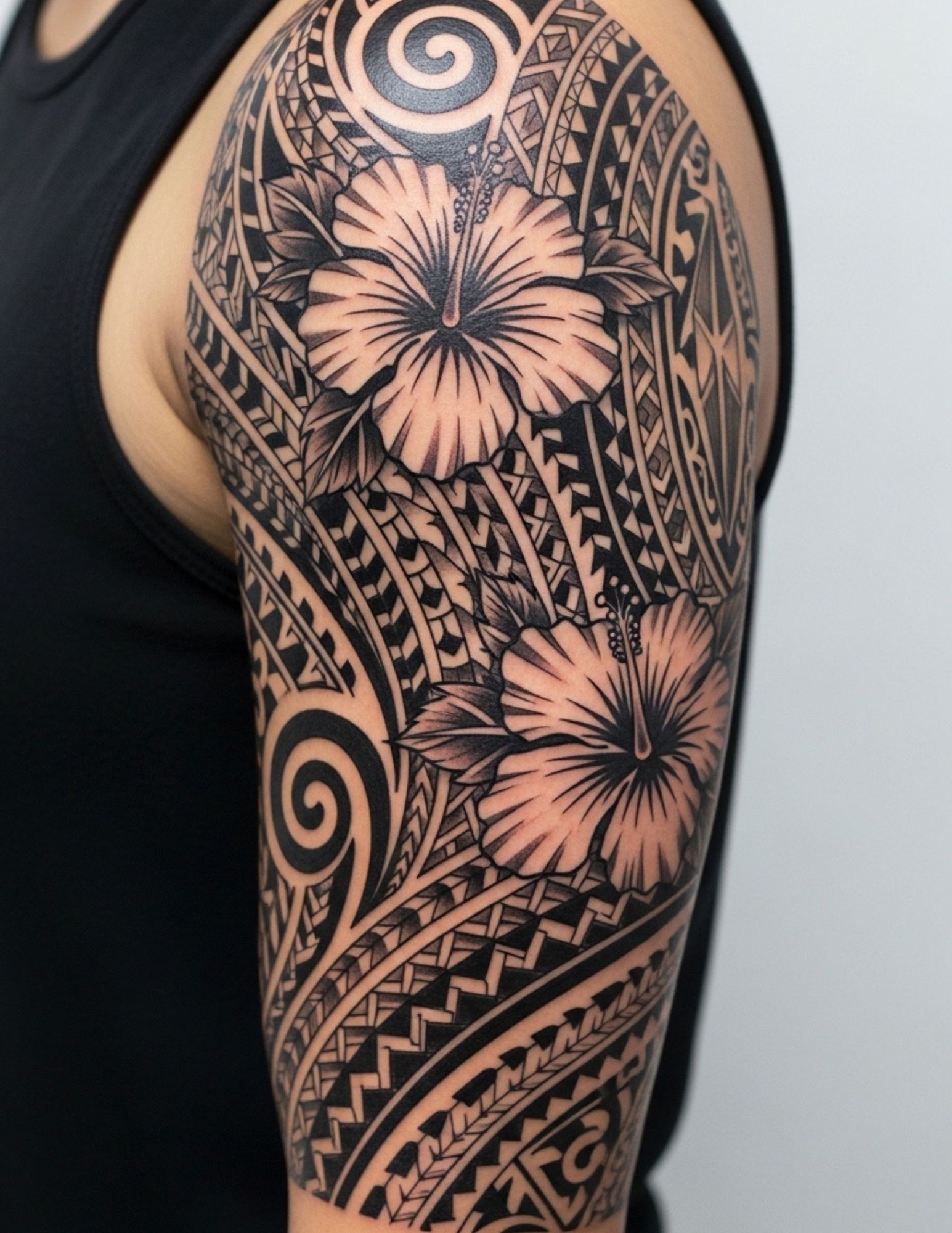
This is the category that needs the most care. An armband of repeating geometric blackwork is the classic Hawaiian-inspired request, and it sits closest to the traditional patterns discussed above.
The honest route is to ask the artist to design motifs rather than reproduce inherited ones. Good artists will already be working this way, as they do with Maori-inspired tattoo designs and other Pacific traditions.
Technically, a band has to taper. The arm is a cone, not a cylinder, and a pattern drawn at uniform width will look crooked on the body even when it measured perfectly on paper.
Cultural Symbols: Makau, Tiki and Warrior Figures
The makau, the fishhook associated with the demigod Māui, is one of the most popular Pacific symbols worldwide. It reads as provision, strength and safe passage over water.
It also has a practical advantage: it is compact, it has a strong outline, and it stays legible at forearm size when more detailed motifs do not.
Tiki figures depend entirely on contrast. Heavy shadow and clean carved shapes hold up; a tiki rendered in delicate grey wash turns to mush within a few years.
Warrior figures need real estate. In my experience anything smaller than a decent chunk of the upper arm will lose the face first, and the face is the whole point.
Everyday Island Icons: Pineapple, Surfboard and Gecko
This group is the lightest in tone and the most personal. None of it is sacred imagery, and nobody will read it as a claim to heritage.
The pineapple signals hospitality and travel more than Hawaiian tradition specifically, which is part of the appeal for people marking a trip rather than an ancestry.
A surfboard framed by flowers is the neat compromise between water and botanical themes, and it is a staple of beach tattoo ideas generally.
Geckos are the sleeper pick of this list. The tail lets the design follow a forearm or ankle instead of sitting on it, which is a genuinely useful property.
Script, Lettering and Aloha
Aloha and ohana are the two words that come up most. Both mean considerably more in Hawaiian than the English shorthand suggests, which is worth knowing before it is permanent.
Script paired with a small floral element is the standard treatment, and it works because the flowers give the lettering a shape to sit inside.
If you are using Hawaiian words, get the spelling and the diacritical marks checked by someone who speaks the language. The ʻokina and the kahakō change meaning, and they are not decorative.
This is the single most common correction I see requested afterwards, and it is entirely avoidable.
Placement and Style Variations Worth Considering
The same idea changes completely depending on where it goes and how it is rendered. These are the variations that come up most often once the subject is settled.
Fine Line Versus Bold Traditional
Fine line gives you delicacy and detail now, and asks more of you later in touch-ups. Bold linework gives up some detail and buys decades of legibility.
For Hawaiian motifs specifically, bold suits the pattern and figure work; fine line suits botanicals and script.
Colour Versus Blackwork
Hibiscus, plumeria, sunsets and lava are the motifs that genuinely gain from colour. Waves, bands, makau and tiki usually do not.
Colour also asks more of your skin and your sun habits, which matters a great deal for a design theme people associate with beaches.
Small Standalone Versus Building a Sleeve
Hawaiian imagery stacks unusually well, because the elements share a visual world. A honu, a wave and a monstera leaf will look related without any planning.
If a sleeve is even a possibility, tell the artist at the first piece. Placement decisions made early are what make later additions look intentional.
Wrapping Versus Flat Placement
Waves, geckos, bands and lei curves are all designed to travel around a limb. Putting them flat on a forearm panel wastes what makes them work.
Practical Advice Before and After You Get Inked
Bring reference photos of healed tattoos, not fresh ones. Fresh work flatters everybody, and healed work is what you are actually buying.
Ask the artist directly how they approach Hawaiian pattern work. A thoughtful answer is a strong signal about the rest of their practice; a shrug is a signal too. General guidance on tattoo aftercare and skin reactions is available from the American Academy of Dermatology.
Aftercare for these designs is ordinary aftercare, with one Hawaiian-specific wrinkle: sun and salt water. Keep a new tattoo out of the ocean and out of direct sun until it is fully healed — usually around two to three weeks on the surface, and longer underneath.
Long term, sunscreen is the difference between colour that holds and colour that fades. This matters more for tropical palettes than for blackwork.
If a healing tattoo becomes hot, swollen, increasingly painful, or starts weeping after the first few days, that is a question for a doctor, not for a forum. The same goes for any reaction you suspect is an allergy to a pigment — see a medical professional rather than trying to manage it yourself, and never attempt to remove or alter a tattoo at home.
Common Mistakes and What to Do Instead
The most common mistake is treating traditional kakau patterns as free-to-use decoration. The fix is simple: commission original motifs in the same visual language instead.
The second is cramming too much into too little space. Tiki faces, warrior figures and detailed island maps all need room to breathe.
The third is picking an artist by portfolio aesthetic alone without checking they have done this specific kind of work. If you are still weighing themes, travel tattoo ideas and tribal tattoo ideas are useful comparisons before you commit.
Take the extra week to decide. Every rushed Hawaiian tattoo I have seen was rushed for a reason that stopped mattering within a month.
Frequently Asked Questions
Is it disrespectful to get a Hawaiian tattoo if I am not Hawaiian?
It depends entirely on what you get. Island imagery such as hibiscus, honu, waves, palms and volcanoes is generally considered open to anyone, and artists across Hawaii tattoo these designs daily. Traditional kakau patterns are a different matter, because they carry inherited meaning tied to specific families and roles, and many Hawaiian cultural practitioners ask that people without Hawaiian ancestry not reproduce them. The respectful middle ground is original design work in the island visual language rather than copied traditional patterns.
What does the honu sea turtle mean in Hawaiian culture?
The honu is associated with long life, guidance, and safe return, and it holds a place of real significance in Hawaiian tradition. It is also a protected species in Hawaiian waters, which adds a conservation dimension that matters to a lot of people who choose it. In tattooing, the shell is often filled with patterned linework, which gives the design decorative structure without borrowing sacred motifs. It remains one of the most requested Hawaiian-inspired subjects.
Which Hawaiian tattoo designs work best in a small size?
The makau fishhook, a single hibiscus or plumeria bloom, a simple wave, and a gecko all hold up well small. They share a strong outer silhouette, which is what determines whether a small tattoo stays readable as it ages. Detailed subjects such as tiki figures, warrior portraits and island maps usually need more space. In my experience anything that relies on facial detail or fine internal pattern should be sized up rather than squeezed down.
How should I care for a new tattoo in a tropical climate?
Follow whatever aftercare instructions your artist gives you, and keep the tattoo out of the ocean, pools and direct sun until it is fully healed. Surface healing usually takes around two to three weeks, though the deeper layers take longer. Sun exposure is the main long-term threat to colour, so sunscreen once healed makes a genuine difference. If you notice increasing pain, swelling, heat or discharge, contact a doctor rather than waiting it out.
Should I choose colour or black and grey for a Hawaiian tattoo?
Colour suits florals, sunsets and lava, where the hue is carrying much of the meaning. Black and grey or solid blackwork suits waves, bands, fishhooks and tiki figures, where contrast and shape do the work. Colour typically needs more maintenance over the years, especially if you spend time in the sun. Ask your artist to show you healed examples of both before deciding.
Quick Summary
- Island imagery — flowers, honu, waves, volcanoes — is open to anyone and is the safest starting point.
- Traditional kakau patterns carry inherited cultural meaning; commission original motifs rather than copying them.
- Botanicals suit fine line and colour; bands, tiki and warrior figures need bold contrast to last.
- Ocean subjects reward curved placement — ribs, shoulder blade, outer thigh — over flat panels.
- Size up anything that depends on facial detail or fine internal pattern.
- Check Hawaiian spelling and diacritical marks with a speaker before any script tattoo.
- Keep new work out of sun and salt water until healed, usually two to three weeks on the surface.
- See a doctor for any sign of infection or pigment reaction, and never attempt home removal.