Few animals carry as much symbolic weight as the horse. Freedom and power, wildness and loyalty, gentleness and force all sitting in the same silhouette.
A horse tattoo works because the shape is instantly readable and the meaning is genuinely yours to set — the same galloping outline can read as grief, independence, or a tribute to one animal you knew personally.
I have been photographing and writing about equine work for years, and the pattern I keep seeing is that horse pieces fail on anatomy long before they fail on concept. The artists who nail them are usually the same ones doing strong cowboy and western tattoos — they have simply drawn the animal a thousand times.
Below are 20 directions worth considering, each one with a note on what it actually takes to execute well. Every photo here is credited to the artist who made it.
Which Horse Tattoo Style Is Right for You?
Style choice matters more than subject choice with horses, because the same animal reads completely differently depending on how it is rendered. This is the comparison I sketch out for anyone who asks me where to start.
| Style | Best For | Smallest Size That Still Works | How It Ages |
|---|---|---|---|
| Black & grey realism | Portraits of a specific horse | Roughly palm-sized and up | Softens gradually; needs a skilled hand to stay readable |
| Fine line | Subtle, minimal placements | A few inches | Lines can spread over time, especially on high-friction skin |
| American traditional | Bold, legible-from-across-the-room work | Around three to four inches | Usually the most forgiving of all the options here |
| Blackwork | High-contrast graphic statements | Medium and up | Holds shape well; solid black may need a touch-up eventually |
| Watercolour | Movement, emotion, colour-led pieces | Medium and up | Fades faster than most; better with a black line structure underneath |
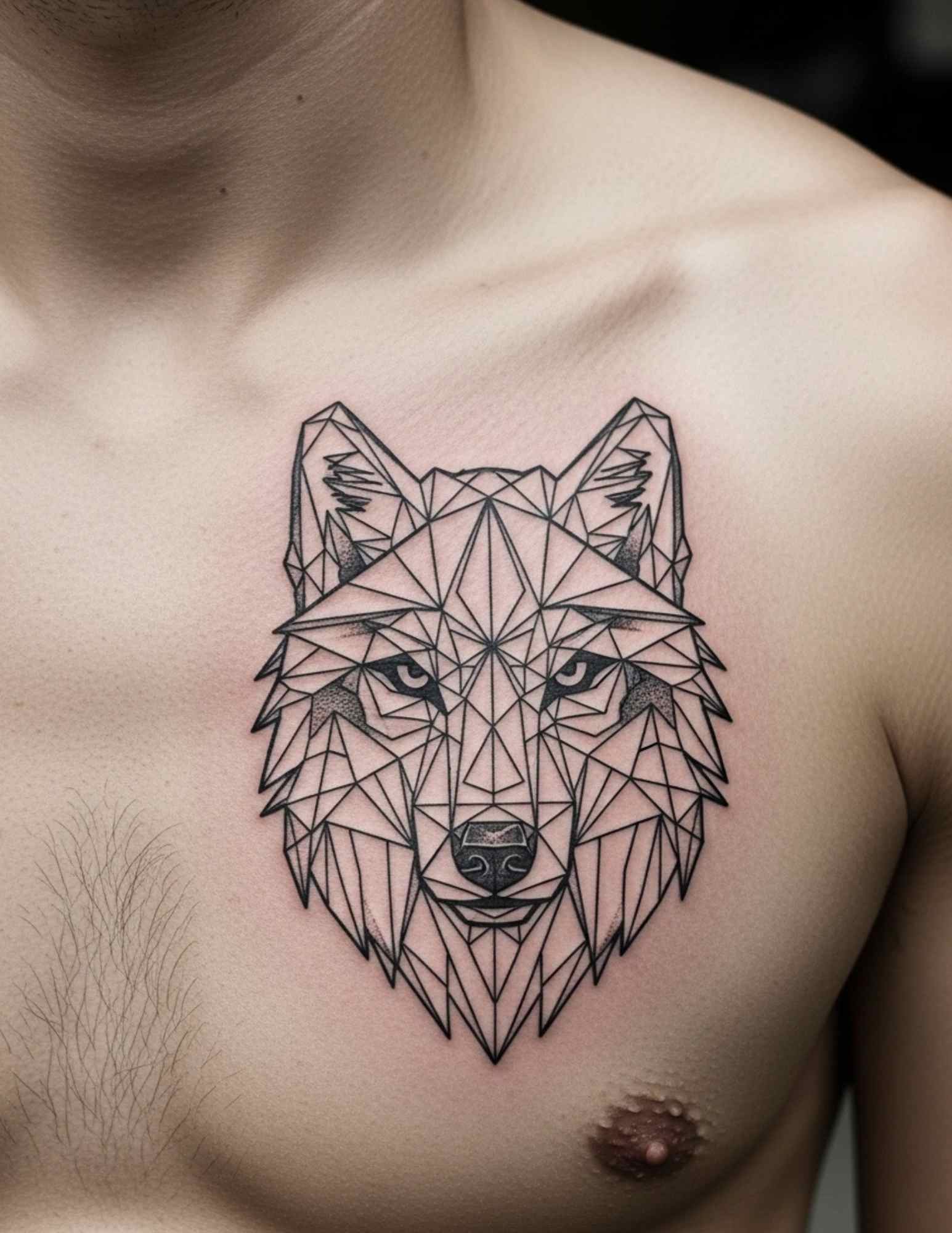
| Geometric / dotwork | Stylised heads and abstract takes | Medium | Dot density can blur slightly; strong outlines help |
What the Horse Actually Symbolises
In Celtic tradition the horse was sacred to Epona, a goddess associated with horses and the land, and one of the few Gaulish deities the Romans adopted outright — Britannica has a short entry on her if you want the historical footing before you commit.
In Norse myth, Odin’s eight-legged horse Sleipnir moved between worlds. In Chinese astrology, the horse stands for energy, freedom and forward motion.
In the American West, the wild horse became shorthand for independence that will not be broken. That is the meaning most of my clients are reaching for, whether or not they can name where it came from.
Then there is the personal layer, which in my experience outweighs all of the above. People who grew up around horses almost never want a symbol — they want that horse, with the correct blaze and the correct ear set.
Both readings are valid, but they need different artists. Symbolic work rewards a strong illustrator; a tribute portrait needs someone who does animal realism specifically.
20 Horse Tattoo Ideas
1. Realistic Running Horse
A horse at full gallop in photorealistic black and grey, with the extended legs and streaming mane doing all the work.
This is the hardest piece on the list to execute. Horse legs at speed sit in positions that look wrong to the untrained eye but are anatomically correct, and an artist who guesses will produce something that reads as broken without the viewer being able to say why.
When I have watched these being tattooed, the reference stack is enormous — usually multiple photos of the same gait so the artist can check joint angles against each other. Budget for a large placement; this does not compress.
2. Minimalist Horse Silhouette
The clean outline of a rearing or running horse in a single fine line. No fill, no shading, just the shape.
The horse silhouette is one of the most recognisable in the animal kingdom, which is exactly why the minimal version survives at small sizes where a wolf or a deer would turn to mush.
The catch is that fine line work spreads a little as it settles, and on fingers, wrists and ribs it spreads faster. In most cases I would size up slightly beyond what looks right on paper.
3. Wild Mustang
An American mustang mid-stride, mane tangled, muscle groups clearly defined.
The mustang carries a narrower meaning than a generic horse: untamed, specifically. If freedom is the point of the tattoo, saying mustang to your artist gets you a different drawing than saying horse.
It works in realism and in looser watercolour or illustrative treatments, because the wildness comes from the pose and the mane rather than from rendering detail.
4. Horse and Moon
A horse silhouetted against a full moon, a crescent, or a full lunar cycle running behind it.
This is the quietest composition on the list and the one I recommend most often to people who want something symbolic rather than literal. If you like the direction, the moon phase tattoo ideas guide covers how the lunar half of the design gets built.
It also solves a practical problem: the moon gives the artist a circular frame, which makes the piece sit well on a shoulder, a forearm or the back of a calf without needing a background.
5. Watercolour Horse
Loose colour washes bleeding past the animal’s outline, with splatter and drips left deliberately unresolved.
Watercolour suits horses better than it suits most subjects, because the medium reads as motion and the horse is a motion animal. The bleed looks like speed.
Be honest with yourself about longevity. Colour-only watercolour is the fastest-fading approach here, and the versions that still look good after five or six years almost always have a black structural line hidden underneath. Ask your artist to build that in.
6. Celtic Horse (Epona)
A horse rendered in interlaced knotwork, or a knotwork panel wrapped around a more literal horse figure.
The knot side of this is its own craft — spacing, over-under consistency and knowing which lines can close. Our Celtic knot tattoo ideas guide goes into what separates clean knotwork from the kind that unravels visually at arm’s length.
In my experience the strongest versions keep the knotwork to the mane and tail and leave the body relatively plain. All-over interlace tends to fight the anatomy.
7. Geometric Horse Head
A horse’s head broken into angular planes and straight lines, sometimes with a mandala or sacred-geometry element behind it.
Geometric work suits the horse head specifically because the skull already has strong planes — the cheekbone, the jaw, the long nasal bridge. The style is describing something that is genuinely there.
Precision is everything. A geometric horse with a wobbly line is worse than a realistic horse with a wobbly line, because the eye has a reference for straight. Look for healed photos, not fresh ones.
8. Traditional American Horse
Heavy black outlines, a restricted palette, and a stylised horse in profile or rearing — often with a banner or roses.
This is the most durable option on the list. Bold lines and flat colour are what American traditional animal tattoos were designed around, and they hold up over decades in a way finer work rarely does.
The trade-off is that you give up likeness. Traditional horses are archetypes, not portraits. If you are memorialising a specific animal, this is usually the wrong style.
9. Horse Portrait (Personal)
A likeness of one specific horse, worked from photographs you supply.
Bring more reference than you think you need — several angles, in good daylight, plus a shot of any markings. Every artist I have asked about equine portraits says the same thing: the eye and the muzzle carry the likeness, and both are easy to lose.
Expect multiple sessions on anything larger than a hand-span, and expect the artist to want a consultation first. If they agree to a portrait sight-unseen from one blurry photo, that tells you something.
10. Pegasus
The winged horse of Greek myth, from full-detail classical renderings to a simple line drawing with feathered wings.
Pegasus solves a compositional problem: wings give you something to wrap around a shoulder or across a back that a plain horse does not offer.
The difficulty is the join. Where wing meets shoulder is the spot that separates a convincing Pegasus from a horse with wings stuck on, so ask to see how your artist has handled that seam before.
11. Horse Skull
The long equine cranium in detailed black and grey, sometimes with florals, sometimes with a bridle or headdress.
Horse skulls read very differently from human ones. The proportions are strange enough that most viewers register it as an unusual object first and a death symbol second, which is part of the appeal.
It photographs beautifully on a forearm or the outside of a calf, where the length of the skull can run with the limb rather than across it.
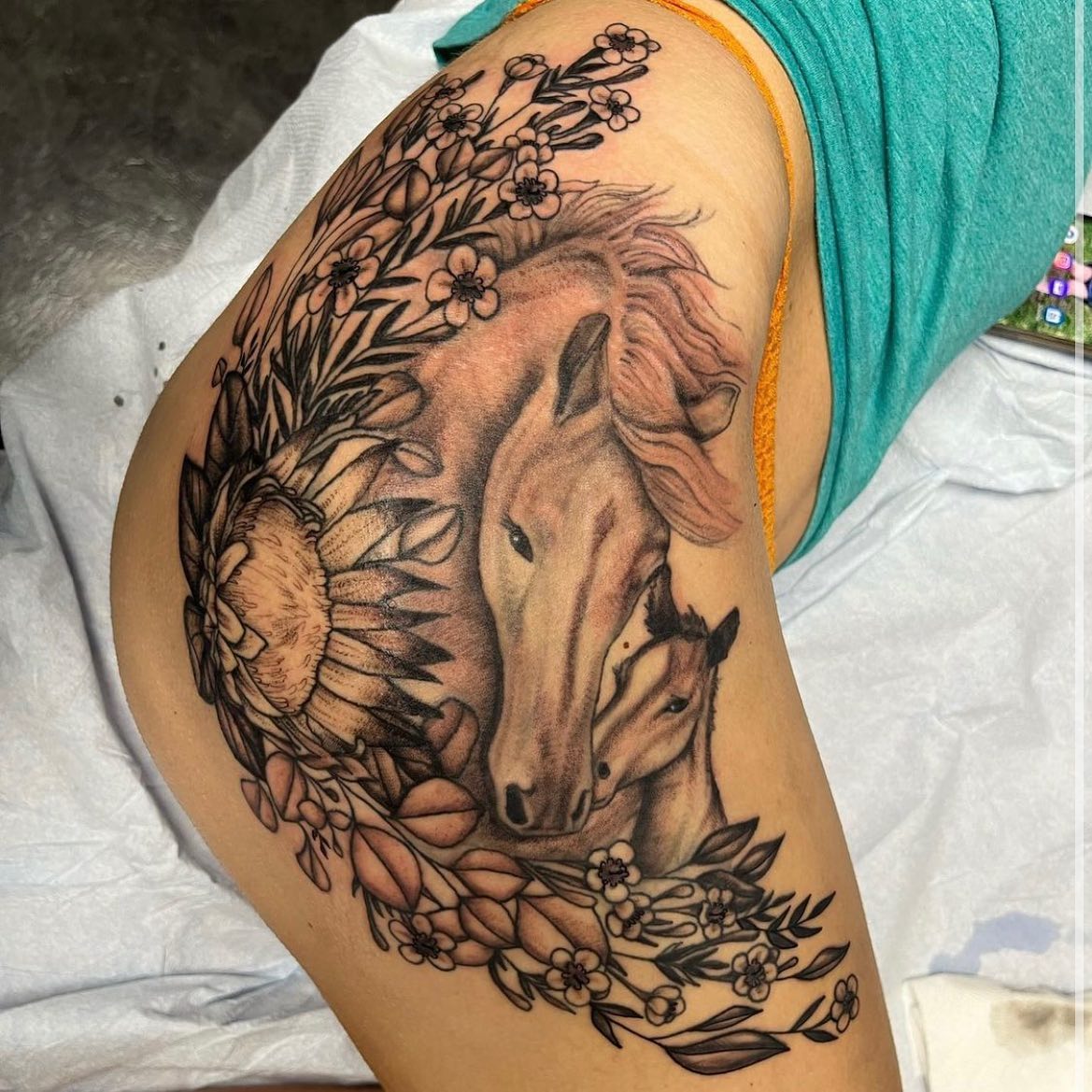
12. Mare and Foal
An adult horse with a young one, usually in soft black and grey or a gentle illustrative style.
Almost everyone who asks for this is marking a relationship — a parent, a child, a bond that survived something. That intent should steer the drawing.
Keep the sizing honest. Foals are leggy and awkward relative to their bodies, and artists who smooth that out end up with two small horses instead of a mother and a baby.
13. Horse and Mountains
A horse standing in or moving through a landscape, with ranges, treelines or open plains behind it.
Landscape backgrounds anchor the animal instead of leaving it floating on skin, which is why I keep pushing people towards them. The staging tricks in our mountain tattoo ideas guide transfer directly.
One practical note: backgrounds add healing area and session time. A landscape version of a piece is usually a meaningfully longer sit than the animal alone.
14. Aztec Horse
A horse built from Mesoamerican-inspired stepped patterns, blockwork and geometric fill.
Worth knowing the history: horses were reintroduced to the Americas by Europeans, so a horse in this visual language is a modern stylistic choice rather than a historical motif.
If the culture matters to you rather than just the pattern, talk to an artist who works in that tradition and can tell you what the shapes actually mean before you wear them.
15. Blackwork Horse
Solid black mass with the horse defined by negative space, or a heavy silhouette with sharp internal cutouts.
Blackwork is unforgiving of hesitation and enormously effective when committed to. Our blackwork tattoo designs guide covers packing and saturation, which is what separates a rich black from a patchy grey after healing.
Large solid areas take longer to heal and can feel more raw in the first week. Plan the appointment for a stretch where you are not going to be sweating through a gym session two days later.
16. Unicorn
Same anatomy, single spiral horn, and a completely different story.
Modern unicorn work has largely left the pastel era behind. The versions I see now are fine line, blackwork or heavy realism, and they read as mythic rather than childish.
If you want the myth without the association, a subtle horn on an otherwise realistic horse does the job — most people notice it on the second look, which tends to be the effect people are after.
17. Horse and Rider
A mounted figure, from western silhouettes to detailed equestrian scenes.
The relationship is the subject here, not the animal, so the pose matters more than the rendering. A rider leaning into a turn says something a rider sitting upright does not.
Two figures need room. This is a thigh, back or full-forearm piece in most cases, and cramming it smaller is the most common way I see it go wrong.
18. Japanese-Style Horse
A horse worked into Japanese composition, with wind bars, waves or peonies filling the background.
Horses are less common in the traditional Japanese canon than dragons or koi, so this is usually an adaptation rather than a classical motif. Our Japanese tattoo designs guide explains how the background elements are meant to move.
Go to someone who works in the style properly. The background rules are what make Japanese work cohere, and a horse dropped into approximate wind bars looks exactly as borrowed as it is.
19. Dotwork Horse
The animal built entirely from stippled dots, with density creating the shading instead of solid black.
Dotwork gives horses a soft, almost engraved quality that suits the muscle transitions well. The pacing and density questions are covered in our dotwork tattoo ideas guide.
It is slow. A dotwork horse of any size takes noticeably longer than the same design in shading, and that shows up in the price. Ask for a realistic session estimate up front rather than an hourly rate alone.
20. Horse and Flowers
A horse’s head crowned with or surrounded by roses, wildflowers or loose botanicals.
The contrast is the point — raw animal power against something delicate. That tension is what makes the composition hold attention longer than the horse alone would.
Match the flower to the meaning if it matters to you. Wildflowers read as freedom and open country; roses pull the piece towards tribute and memorial.
Placement and Sizing Variations
Where the horse goes changes the drawing more than most people expect, because the animal is long and the body mostly is not.
Forearm and Outer Calf
These are the two placements that suit a horse best. Both are long, relatively flat, and let a galloping or standing figure run with the limb instead of fighting it.
They also heal predictably and are easy to keep out of the sun, which matters for anything with fine detail.
Thigh and Back
If you want a rider, a landscape, or a mare and foal, this is where it belongs. There is room for a full scene without shrinking the anatomy.
The trade-off is session length. Large flat areas take hours, and the fine detail usually gets pushed to a second sitting.
Small and Hidden Placements
Ankle, wrist, behind the ear and inner bicep all work for a minimal silhouette and almost nothing else.
Anything with internal detail will close up at this scale. Pick the silhouette on purpose rather than shrinking a realistic design and hoping.
Ribs, Sternum and Spine
A rearing horse along the sternum or a running horse down the ribs can be striking, and these are the placements people most often regret sizing down.
They are also among the more uncomfortable sits, so factor that into how long a session you can realistically hold still for.
Getting a Horse Tattoo That Ages Well
Vet the artist on animal work specifically. A brilliant floral portfolio does not predict a good horse, and the fastest filter I know is asking for healed equine photos — not fresh ones. If nerves are the sticking point, our tattoo pain management tips are worth reading before you book.
Follow whatever aftercare your artist gives you rather than advice from the internet, mine included. They know their inks, their machines and how your particular piece was worked.
Surface healing usually takes a couple of weeks, with the deeper settling running considerably longer, and sun exposure during that window is what dulls detail fastest. The Mayo Clinic overview of tattoo risks is a level-headed summary of what to watch for.
If you see spreading redness, heat, pus, or a fever, that is a doctor conversation, not a forum conversation — see a healthcare professional promptly. The FDA fact sheet on tattoos and permanent makeup covers reactions and ink safety, and never attempt to treat or remove a tattoo yourself.
Still Not Sure? Common Mistakes to Avoid
The mistake I see most is booking on style rather than subject. Someone loves an artist’s linework, brings them a horse, and gets a technically clean animal with wrong proportions.
The second is going too small. Horses have long faces and long legs, and both details vanish first. If a wolf is the alternative you are weighing up, the sizing logic in our wolf tattoo design ideas guide applies here too, only more so.
The third is treating a memorial piece as a rush job. If the tattoo is for a horse you lost, give yourself time to gather reference and find the right artist — grief is a bad deadline.
And the fourth is skipping the consultation. Ten minutes of conversation about gait, breed and markings changes the outcome more than any amount of Pinterest saving.
Frequently Asked Questions
What does a horse tattoo symbolise?
Most commonly freedom, power, endurance and loyalty, though the specific reading depends on the tradition you are drawing from. Celtic horse imagery connects to Epona and the land, Norse to Sleipnir and travel between worlds, and western imagery to untamed independence. For many people the meaning is personal rather than mythological — a tribute to a specific animal they rode or cared for. There is no single correct interpretation, and your artist will design differently depending on which one you tell them.
How big does a horse tattoo need to be?
It depends entirely on style. A clean silhouette can work at a few inches, while a realistic portrait usually needs at least a palm-sized area to hold the eye, muzzle and muscle detail. Horses have long faces and legs, so the details that carry the likeness are the first to close up when a design is shrunk. In my experience, sizing up slightly beyond what looks right on the stencil is almost never regretted.
Which style holds up best over time?
American traditional and well-packed blackwork generally age the most gracefully, because bold lines and solid colour tolerate the natural spreading that happens in skin over years. Fine line and watercolour are the most vulnerable, particularly on high-friction areas or without a black structural line underneath. Sun exposure and aftercare matter as much as style, though. Your artist can tell you how their own work has healed on clients with similar skin.
Do I need special reference photos for a horse portrait?
Yes, and more than you probably think. Several angles in good daylight, a clear shot of the head, and images showing any markings or scars all help. The eye and muzzle carry the likeness, so blurry or low-light photos of those areas make the artist guess. Most artists doing equine portraits will ask for a consultation before quoting, which is a good sign rather than a hassle.
How long does a horse tattoo take to heal?
Surface healing usually takes a couple of weeks, with the deeper layers settling over a longer period, though this varies with placement, size and your own body. Large blackwork and full-colour pieces typically feel rawer in the first days than fine line work. Follow the specific aftercare your artist gives you rather than generic advice. If you notice spreading redness, heat, pus or a fever, contact a healthcare professional rather than waiting it out.
Quick Summary
- Horses read as freedom, power and loyalty — but the personal meaning almost always outweighs the symbolic one.
- Choose the style before the pose; the same horse looks entirely different in realism, traditional and blackwork.
- Realistic portraits need a palm-sized area at minimum and an artist with healed animal work in their portfolio.
- Minimal silhouettes are the only version that survives at wrist, ankle or behind-the-ear scale.
- Watercolour suits the subject but fades fastest — ask for a black line structure underneath.
- Forearms and outer calves suit the animal’s long shape; thighs and backs are for riders and landscapes.
- Bring multiple daylight reference photos for any tribute piece, and book a consultation first.
- Follow your artist’s aftercare, keep it out of the sun while healing, and see a doctor if anything looks infected.