I have sat in on more phoenix consultations than almost any other mythological design, and the conversation always starts the same way. The client wants a bird. What they actually want is a record of something they came back from.
A phoenix only works as a tattoo when the composition earns the size the story needs — a rising bird crammed into a four-inch square stops being a phoenix and becomes a generic flame-shaped blob within a decade.
That is the honest tension in this design. It is one of the most meaningful pieces a man can get, and one of the easiest to get wrong by going too small, too detailed, or too literal about the flames.
Below are 19 directions I keep coming back to, grouped so you can see what each style actually costs you in sessions, pain and long-term upkeep. If you are still deciding on a subject at all, our broader guide to tattoo ideas for men is a good place to widen the net first.
Which Phoenix Style Is Right for You?
This is the table I sketch out on paper for clients before we talk placement. It is not exhaustive, but it covers the five routes that account for most phoenix work walking out of shops.
| Style | Best Placement | Session Load | How It Ages | Best If You Want |
|---|---|---|---|---|
| Japanese (Ho-O) | Full back, full sleeve, chest-to-ribs | Heavy — usually many sittings over months | Excellent, built for it | A body-scale piece with a defined ruleset |
| American Traditional | Chest, outer arm, thigh | Light to moderate | Excellent — the whole point of the style | Bold colour that stays readable for decades |
| Black and Grey Realism | Sleeve, back, thigh | Heavy, and detail-dependent | Good with size, poor when cramped | Depth, smoke and soft transitions |
| Blackwork / Tribal | Arm, shoulder, calf | Moderate, but solid black is tender | Very good | Maximum impact with minimum fuss |
| Neo-Traditional | Upper arm, chest, thigh | Moderate to heavy | Good — outlines hold the shape | Traditional structure with modern shading |
| Geometric / Ornamental | Forearm, outer thigh, sternum | Light to moderate | Good, but line spacing matters a lot | A graphic mark rather than a portrait |
Session counts vary enormously between artists and body types, so treat that column as a planning range you confirm at your consultation rather than a quote.
What Actually Makes a Phoenix Read as a Phoenix
Strip away the fire and a phoenix is just a bird. The thing that makes it legible at a glance is the silhouette: a raised head, an upward diagonal through the body, and a tail that is longer than you think it should be.
The mythology backs that up. The classical phoenix described in Greek and Egyptian sources is a long-lived bird that dies and regenerates from its own remains, and you can read the source material on the Britannica entry for the phoenix if you want the version that predates the video-game one.
The Japanese Ho-O and the Chinese Fenghuang are related but not identical birds, and they carry different associations — more about virtue, harmony and imperial authority than about personal rebirth. Artists who work in Japanese style will usually tell you this before you book.
The single most common mistake I see is treating the flames as the subject. Fire is background. When the fire is drawn as loudly as the bird, the eye has nowhere to land and the whole piece reads as noise from two metres away.
The second most common is asking for too much detail in too little space. Every artist I have asked says the same thing: they would rather give you a simplified phoenix at eight inches than a photorealistic one at four.
19 Phoenix Tattoo Ideas for Men
These are ordered roughly from largest commitment to smallest, so you can stop reading at the point where the scale stops being realistic for you.
1. Japanese Ho-O Full Back
The full back is the format the Japanese phoenix was designed for, and it is the version pictured at the top of this guide.
You get room for the tail to sweep across the shoulder blades and down toward the waist, plus space for wind bars or clouds behind it. Nothing has to be shortened to fit.
Be realistic about the commitment. A back piece is typically outlined in one long sitting and then shaded and coloured across many more, spread over months, and it is not a project you rush. The payoff is that a properly composed back phoenix will still read cleanly in thirty years. If you like the ruleset but not the scale, the wider world of Japanese tattoo designs has smaller entry points.
2. Traditional American Phoenix Chest
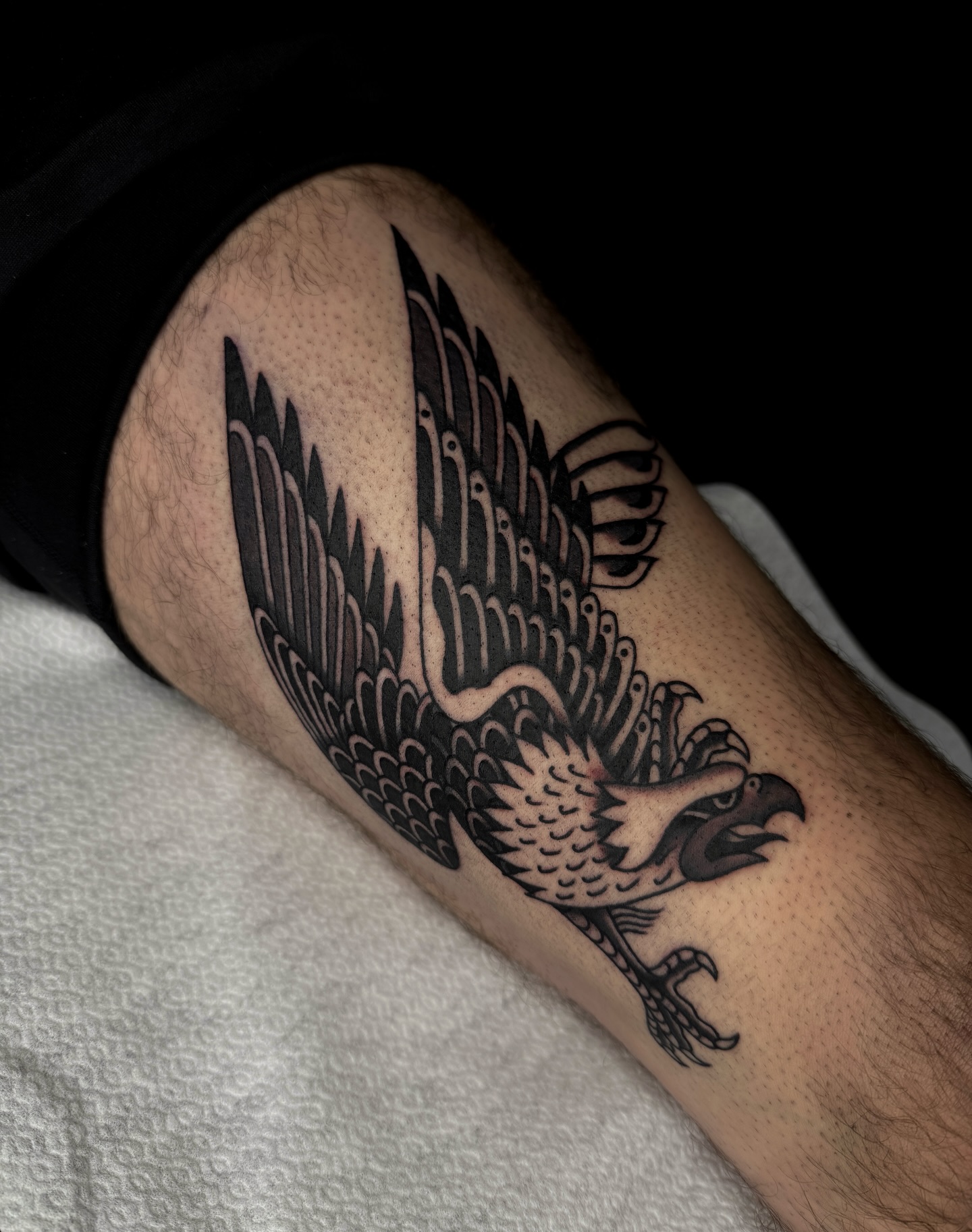
Bold outline, limited palette, no gradients to speak of. American traditional does one thing exceptionally well: it stays readable.
On the chest, the style suits the symmetry — the bird sits centred on the sternum with the wings following the pectoral line outward. In my experience this is also the easiest phoenix to get right on a first big piece, because the style does the heavy lifting.
The trade-off is that traditional does not do subtlety. If you want smoke, fine feather detail or a photoreal eye, this is not the route. If you want something that looks intentional forever, it is. Our guide to chest piece tattoo ideas for men covers how the placement behaves as you age.
3. Black and Grey Sleeve Phoenix
A black and grey phoenix wrapping the arm is probably the most requested version of this design right now, and for good reason.
Grey wash lets the artist push the wings into shadow where the arm curves away, which means the bird follows your anatomy instead of sitting flat on it. When I have watched artists stencil this, they spend as long on the wrap as on the drawing itself.
Ask specifically how the piece will read from the front, the side and the back before you commit. A sleeve is seen in the round, and a phoenix that only works from one angle is a common and expensive disappointment. There is more on planning the whole arm in our full sleeve tattoos for men guide.
4. Blackwork Phoenix Rising
Blackwork drops grey entirely. You get solid black and bare skin, and the drawing happens in the negative space between them.
It is a harder design problem than it looks, because there is no shading to rescue a shape that is not working. The silhouette has to carry everything. When it does work, the contrast is unbeatable in daylight and the piece needs very little upkeep.
Solid black packing is tender to sit through and can take a little longer to settle than lighter work, so plan your schedule around it. See blackwork tattoo designs for more of the style vocabulary.
5. Phoenix and Dragon Sleeve
Phoenix paired with dragon is one of the oldest compositions in East Asian art, traditionally read as a balance of two forces rather than a fight between them.
As a tattoo it is genuinely demanding. Two large subjects on one arm means one of them has to yield — usually the dragon wraps low and the phoenix rises, or vice versa. Artists who work Japanese style will have a strong opinion on which, and it is worth deferring to it.
I would not attempt this as a first tattoo. It rewards a client who already knows how they sit for long sessions.
6. Phoenix Chest and Ribs
Letting the wings run off the chest and down onto the ribs is what separates a chest piece that looks integrated from one that looks stuck on.
The composition works because the ribs give you a vertical panel for the tail and a natural taper. The bird ends up hugging the torso rather than floating on it.
Be warned that the ribs are, for most people, the least pleasant place on the torso to be tattooed. Everyone I have asked about rib work says the same thing: it is manageable in short sessions and brutal in long ones. Our guide to rib tattoo ideas for guys goes into the practicalities.
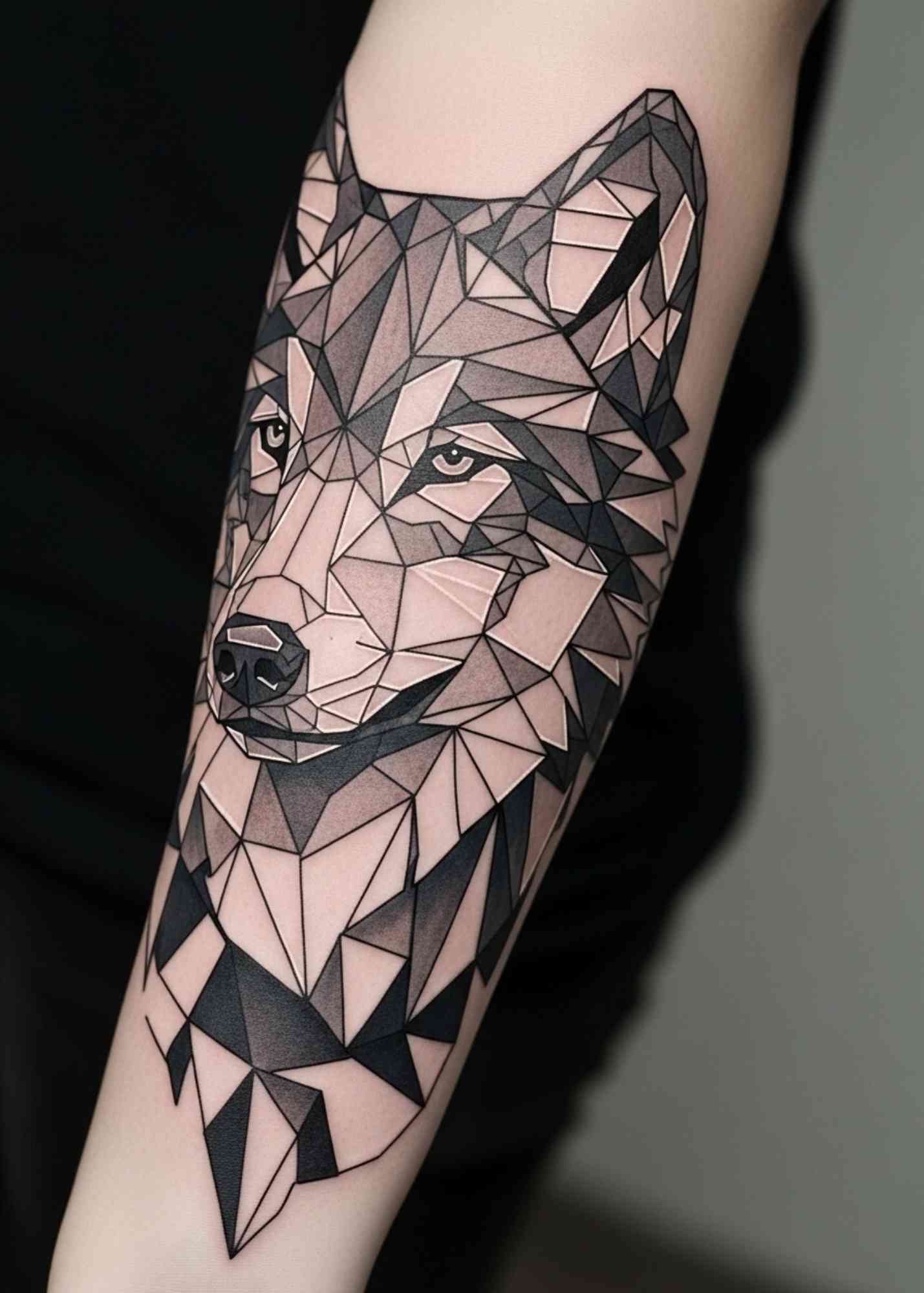
7. Geometric Phoenix Forearm
A geometric phoenix abstracts the bird into straight lines, repeated shapes and controlled spacing. It reads as a graphic mark first and a creature second.
The forearm suits it because the surface is relatively flat and the piece is seen head-on most of the time, which matters when the design depends on precise alignment.
The thing to ask about is line spacing. Fine parallel lines placed too close together can blur into each other over the years as ink settles, and a good artist will space them deliberately with that in mind rather than packing the design as tight as it will go on day one.
8. Phoenix Head Portrait
Cropping to the head is the smartest move available if you want detail without committing to a back or a sleeve.
Instead of shrinking a whole bird until the feathers turn to mush, you keep one element at full size. The eye, the beak and the crest all stay large enough to hold detail through decades of settling.
It is also the version that reads most clearly as intense rather than decorative. If the piece is about defiance more than rebirth, this is usually the composition I would point someone toward.
9. Phoenix Rising from Chest
This is the literal interpretation: flames low across the sternum, the bird lifting out of them, wings following the collarbones.
The reason it works is structural. Collarbones give the wings a line to follow, so the design has a built-in frame and does not need an invented one.
Keep the flames restrained. When I have seen this design fail, it is almost always because the fire was drawn at the same visual weight as the bird and the whole thing turned into an orange smear.
10. Phoenix Shoulder to Chest
If a full chest piece feels like too much, running the phoenix from the shoulder cap down onto the upper chest is the sensible middle ground.
You get a large, visible design that still disappears under a t-shirt, and you leave the sternum free for later. That last point matters more than people expect — a lot of men come back within two years wanting to extend.
Tell your artist at the consultation if you might extend it. A phoenix designed with an exit route is easy to grow; one designed as a closed shape usually is not.
11. Neo-Traditional Phoenix
Neo-traditional keeps the heavy outline of American traditional but allows far more shading, layering and colour range inside it.
For a phoenix that is close to ideal, because the outline preserves the silhouette while the interior can carry feather texture and depth. You get the ageing behaviour of traditional with a lot more to look at up close.
It sits well on the upper arm and thigh, where there is enough surface to justify the interior detail. Expect more chair time than straight traditional.
12. Phoenix Thigh
The thigh is the most underrated placement for a first large piece, and I say that to almost every client considering one.
It is broad, relatively flat, comparatively forgiving to sit through, and completely hidden by anything longer than shorts. For a phoenix specifically, the length of the thigh suits the long tail without any compression.
The one caveat is that the outer thigh and the inner thigh feel very different to sit through, and the inner side is considerably more sensitive. Plan the composition so the bulk of the work sits on the outer surface if that matters to you.
13. Tribal Phoenix
Tribal reduces the bird to bold tapered shapes with no shading at all. It is unfashionable in some circles and it does not care.
What it does better than any other style is age. Solid black shapes with generous spacing hold their form for a very long time, and the design stays legible from a distance.
If you go this route, ask for a design drawn for your body rather than picked off a wall. Tribal lives or dies on how the shapes flow with the limb, and a generic pattern applied to an arm it was not drawn for always looks it.
14. Phoenix and Skull
Phoenix over skull is a death-and-return composition, and it is one of the more common requests from men marking recovery or loss.
The design problem is focal point. Two high-contrast subjects competing for attention will flatten the piece, so one has to be clearly primary — usually the phoenix, with the skull sitting lower and softer.
Bring the meaning to the consultation. This is one where the artist genuinely needs to know what the piece is for in order to weight the two elements correctly.
15. Phoenix Eye
A single phoenix eye surrounded by feather and flame is the most minimal way to reference the whole myth.
It works at sizes where a full bird would fail, which makes it viable on the inner forearm, the sternum or the back of the arm. The symbolism is intact even though the subject is not.
Done badly it looks like a generic eye tattoo. The difference is entirely in the surrounding feather structure, so ask to see the artist’s previous eye work before booking.
16. Phoenix Full Sleeve
A dedicated full sleeve gives the phoenix the whole arm: head at the shoulder, body along the bicep, tail running to the wrist.
The advantage over a half sleeve is that nothing has to be cut off. The disadvantage is that you are committing to a multi-session project measured in months, and to a design that is visible in most short-sleeved clothing.
Background filler matters here more than the bird does. Smoke, clouds or wind bars are what stop a full sleeve looking like a large tattoo floating on bare skin.
17. Phoenix in Storm Clouds
Swapping fire for storm clouds is a quieter version of the same story, and it suits black and grey far better than flames do.
Clouds give the artist a way to fade the design out at the edges instead of ending it with a hard line, which makes the piece sit more naturally on the body.
It also reads less aggressively than a burning phoenix, which some men specifically want. Rising out of weather rather than fire is a different tone entirely.
18. Minimalist Phoenix
A minimalist phoenix is drawn with a single line weight, no shading, and only the shapes the silhouette actually needs.
It is the lowest-commitment version on this list and also the hardest to draw well, because there is nothing to hide behind. Every line has to be doing work.
Fine single-weight lines will soften over the years, particularly in high-friction areas like the hand or the inner wrist. Discuss line weight honestly with your artist rather than asking for the thinnest possible.
19. Phoenix Ribcage
The ribcage gives you a tall narrow panel, which is exactly the proportion a phoenix wants — head high, tail running down toward the hip.
Very few subjects suit ribs this well. Most designs have to be reshaped to fit; a rising bird already is that shape.
It is a hard sit, and the skin over the ribs moves a lot with breathing, which is one reason artists tend to book rib work in shorter sessions. Worth it if you want the composition, but go in knowing what you are signing up for.
Variations Worth Considering Before You Commit
Not every phoenix has to be a whole bird. These four variations solve problems that come up constantly in consultations.
A Single Phoenix Feather
One long tail feather with a hint of ember at the base carries most of the symbolism at a fraction of the size and cost.
It suits the forearm, the calf and the spine, and it leaves you room to add the full bird later if you decide you want it.
Phoenix as a Cover-Up
The phoenix is one of the better cover-up subjects available, because flames, smoke and layered feathers give an artist a lot of legitimate places to put dark value.
That said, cover-ups have real limits, and a competent artist will tell you honestly if the old piece is too dark or too large to disappear under a phoenix. Our tattoo cover-up ideas guide explains what actually works.
Half Phoenix, Half Something Else
Splitting the design — half phoenix, half skeleton or half ordinary bird — makes the before-and-after explicit rather than implied.
It is a strong concept and an easy one to overcook. Keeping one half genuinely plain is what makes the other half land.
Black with a Single Colour Accent
An otherwise black and grey phoenix with red or orange confined to the eye, the crest or the ember line gives you a focal point without a full colour commitment.
It also ages more predictably than a fully saturated colour piece, since there is far less coloured pigment to hold.
Getting a Large Phoenix Through Healing
Big pieces heal differently from small ones, mostly because the trauma is spread over a much larger area and you cannot simply avoid moving that part of your body.
Follow whatever aftercare your artist gives you over anything you read online, including this. They know what needles, inks and wrap they used. If you want the general shape of what to expect week by week, our guide to tattoo healing stages lays it out, and the American Academy of Dermatology publishes straightforward aftercare guidance.
Sun is the single biggest long-term threat to a phoenix, particularly a colour one. Once healed, sunscreen on an exposed sleeve or chest piece does more for its longevity than any aftercare product.
Watch for anything that is not ordinary healing: spreading redness, increasing pain after the first few days, heat, pus, or a fever. Those are signs to see a doctor rather than to ask a forum. Allergic reactions to specific pigments are uncommon but real, and the Mayo Clinic overview of tattoo risks is a reasonable place to read about them. Nothing here is medical advice.
Common Mistakes — and What to Do If You Are Still Not Sure
The mistakes I see repeat are boringly consistent, and all of them are avoidable at the consultation stage.
Going too small for the detail requested. Letting the flames overpower the bird. Choosing a placement that cuts the tail off. Booking on price rather than on portfolio. Bringing a reference image and asking for it to be copied exactly rather than adapted to your body.
If you are torn on scale, look at how a phoenix behaves across a whole back before deciding — our collection of back tattoo designs for men makes the size question concrete.
If what is actually holding you back is the sitting itself, that is a solvable problem and worth reading up on properly in our tattoo pain management tips rather than guessing.
And if you are still undecided after all that, wait. A phoenix is a design that people regret rushing far more often than they regret delaying.
Frequently Asked Questions
How big does a phoenix tattoo need to be?
Bigger than most people expect. As a rough working minimum, a recognisable full phoenix with any feather detail wants at least six to eight inches of length, and realistically more if you want a full tail. Below that, artists generally simplify the design heavily or crop to the head. If size is limited, a phoenix head or a single feather is a better answer than a shrunken full bird.
What does a phoenix tattoo mean for a man?
Most commonly rebirth, survival and coming back from something — addiction, illness, loss, or a period of life that ended badly. In East Asian traditions the associated birds carry different meanings closer to virtue, harmony and authority. There is no fixed rule, and the meaning that matters is the one you attach to it. Artists will usually ask, because it changes how they weight the composition.
Where does a phoenix tattoo hurt least?
Generally the outer thigh, the outer upper arm and the calf are among the more tolerable areas, since there is more tissue between needle and bone. Ribs, sternum, inner arm and the area over the spine tend to be the hardest. Pain varies a lot between individuals, so treat any ranking as a rough guide rather than a promise.
How much does a phoenix tattoo cost?
It depends almost entirely on size, style and the artist’s rate, which varies enormously by city and reputation. Most shops price large work by the session or the day rather than by the piece, so the honest answer is that you get a range at your consultation once the artist knows the scale. Be wary of a quote that seems far below local norms for a large piece.
Can a phoenix tattoo cover an old tattoo?
Often, yes. Flames, smoke and dense feather work give an artist plenty of legitimate dark areas to hide old ink behind, which makes the phoenix a genuinely good cover-up subject. Whether it works in your case depends on how dark, how large and how saturated the existing piece is. A cover-up specialist will tell you honestly, and may suggest a few laser sessions first.
Quick Summary
- A phoenix needs size to work — the silhouette and the tail are what make it readable, and both need room.
- Fire is background, not subject. Flames drawn at the same weight as the bird will flatten the whole piece.
- Japanese, American traditional and blackwork all age exceptionally well; fine-line and heavily detailed realism need more care and more space.
- Back, chest-to-ribs, full sleeve and thigh are the four placements that suit the shape without compromise.
- If scale is limited, crop to the head or use a single feather rather than shrinking the full bird.
- Tell your artist whether you might extend the piece later — it changes how the design is drawn from day one.
- Sun protection after healing does more for the tattoo’s longevity than anything you buy in the first two weeks.
- Anything that looks like infection or an allergic reaction is a doctor’s question, not a forum’s.