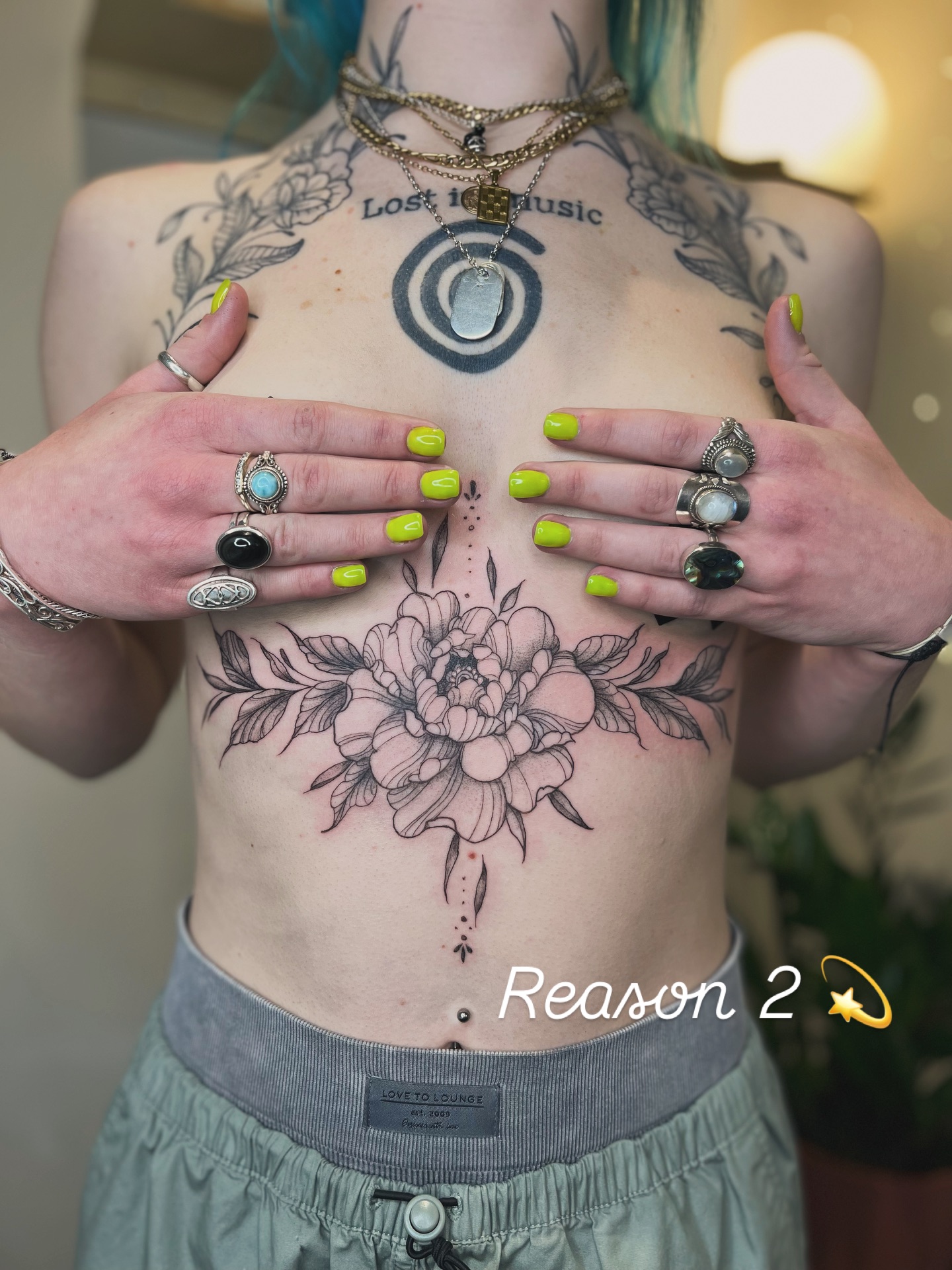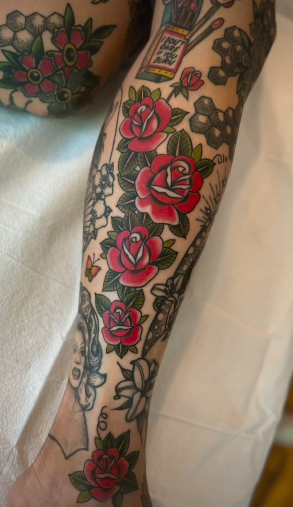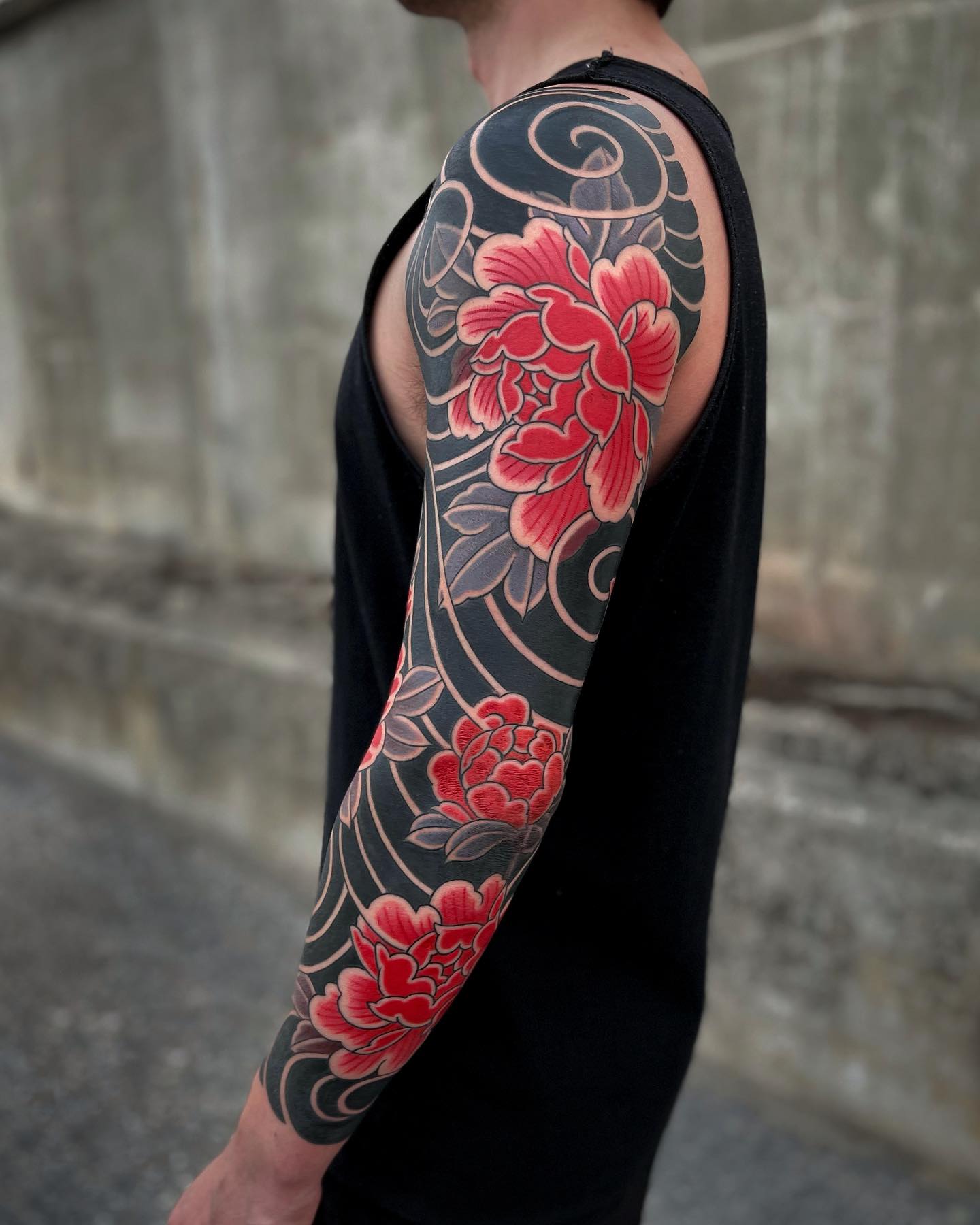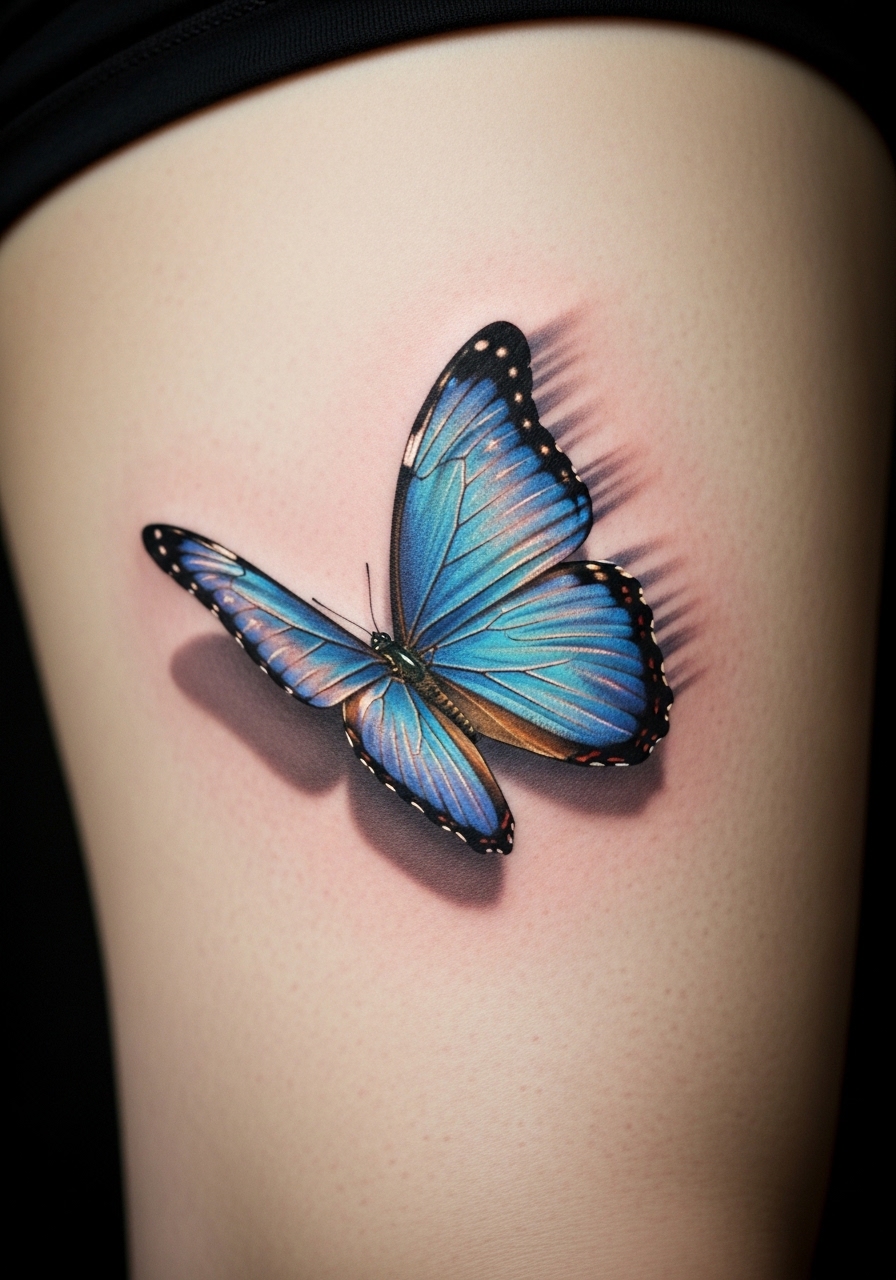
I have looked at more rose and butterfly reference photos than almost any other floral combination, and there is a reason it keeps coming back. The rose and the butterfly work together because each one solves a problem the other has.
A rose on its own can sit heavy on the skin, particularly in dense black and grey. Add a butterfly and the eye suddenly has somewhere to travel.
The 21 ideas below run from fine line to American traditional, at sizes from a two-inch neck piece to a full thigh panel. If you are still deciding on the flower itself, the wider guide to rose tattoo ideas is a sensible first stop.
I have also noted what each style tends to cost you in session time and how it ages, because that is the part most idea lists leave out.
Which Rose and Butterfly Style Is Right for You?
Style choice affects the sitting, the price and how the piece looks in ten years far more than the design itself does.
| Style | Best for | Typical sitting | How it ages |
|---|---|---|---|
| Fine line | Small, delicate placements: neck, collarbone, inner arm | 1–3 hours | Softens fastest; thin lines can blur, so keep detail generous |
| Black and grey realism | Upper arm, thigh, larger canvases | 4–8 hours, often split into sessions | Ages well if contrast is strong; mid-greys can flatten |
| American traditional | Anyone who wants it readable at a distance, forever | 2–5 hours | The most durable option by a clear margin |
| Neo-traditional | Colour lovers who still want bold outlines | 4–7 hours | Very good; the outline carries it as colour softens |
| Watercolour | Soft, painterly pieces with no hard border | 3–5 hours | Least predictable; ask to see the artist’s healed work |
| Dotwork and geometric | Structured, modern takes on a soft subject | 3–6 hours | Stipple can lighten; strong geometry holds the shape |
What the Rose and the Butterfly Actually Mean Together
The rose is the older symbol of the two and the more layered. Love, yes, but also beauty that comes with thorns attached.
Colour shifts that reading. Red leans romantic, black leans toward grief or remembrance, and the fuller picture is covered in the guide to the meaning of a rose tattoo.
The butterfly is almost universally read as transformation, and often as someone remembered. It is one of the few motifs where the popular meaning and the personal meaning usually line up.
If you want to be deliberate about that half of the design, it is worth reading what a butterfly tattoo means before you commit to a species and a colour.
Put together, the pairing reads as something rooted and something passing through. That tension is why the composition holds attention in a way either subject alone often does not.
None of this is fixed. Every artist I have asked has said the same thing: the meaning that matters is the one you bring to the appointment.
21 Rose and Butterfly Tattoo Ideas
1. Butterfly Resting on a Rose
This is the version most people picture, and it is popular for a good reason. The butterfly lands on the open bloom, which gives the composition a single obvious focal point.
The trick is scale. When I have seen this go wrong, it is nearly always because the butterfly was drawn too large and started competing with the flower instead of sitting on it.
Ask for the butterfly at roughly a third to a half of the bloom’s width. A long stem underneath turns it into a natural fit for the inner or back of the arm.
2. Rose Petals Transforming Into Butterflies
Here the petals detach and become butterflies as they rise, so the transformation is shown rather than stated.
It needs length to breathe. A forearm, a calf or a spine gives the sequence enough room to read as movement instead of clutter.
In my experience this is the design where colour earns its keep most clearly. Matching the petal pink to the wing pink is what sells the illusion.
3. Butterfly Wings Filled With Rose Detail
Instead of two subjects side by side, the roses live inside the wings. The silhouette stays a butterfly; the texture is entirely floral.
It suits symmetrical placements. Across the collarbones, the centre of the chest or the middle of the back all give the wings the mirrored space they need.
Be honest with your artist about size here. Four roses inside a small butterfly will close up over time, and I would rather see two roses drawn larger than four drawn tight.
4. American Traditional Rose and Butterfly
Heavy black outlines, a limited palette and no shading gymnastics. Traditional is the least fashionable-looking option on this list and the one most likely to still look sharp decades from now.
The red rose with green leaves and a yellow or orange butterfly is the classic arrangement. Small filler dots around the edges keep the shape balanced on a curved limb.
If you are worried about how a tattoo will look in twenty years, this is the style to pick.
5. Watercolour Pair
Soft washes of colour with no containing outline, so the rose and butterfly bleed slightly into the skin around them.
It is the most beautiful option fresh and the least predictable healed. Pigment without a line to hold it can spread, and how much depends on the artist, your skin and the placement.
My honest advice: ask specifically to see healed watercolour work that is at least two years old before you book. A portfolio of fresh photos tells you very little about this style.
6. Fine Line Minimalist Pair
A single-weight outline rose, a small butterfly nearby, no shading at all. This is the version that fits behind an ear, on a neck or along a wrist.
The restraint is the point. Separating the two elements slightly, rather than overlapping them, keeps the negative space that makes fine line work read cleanly.
Fine line does soften with time, which is worth knowing rather than fearing. The same considerations apply to a fine line spine tattoo and to any delicate placement.
7. Rose Bouquet With Multiple Butterflies
Three to five roses gathered on shared stems, with butterflies scattered around the outside of the arrangement.
The butterflies do structural work here. Placed at the edges, they soften what would otherwise be a hard oval of flowers and help the piece sit naturally on a rounded upper arm.
This is a half-day design at minimum. When I have seen it rushed, the roses lose the individual definition that makes a bouquet work.
8. Black and Grey Realism Pair
Smooth grey gradients, a rose rendered with real depth, and a butterfly with visible wing texture. No outlines doing the work — just shading.
Realism needs room. Below roughly palm-size the greys blend together and the detail you paid for disappears within a couple of years.
Contrast is what keeps it legible long term, so push for deep blacks in the shadows. The same principle runs through most black and grey flower tattoo designs.
9. Neo-Traditional Rose and Butterfly
Bold outlines like traditional, but with a wider palette, richer shading and room for decorative extras such as moon phases or filigree.
It is the best compromise on this list. You get colour that stays vivid and an outline that will still hold the shape when the colour eventually softens.
A monarch butterfly suits this style particularly well, because its natural black veining reads as bold linework rather than fighting it.
10. Single Long Stem With Butterfly at the Bloom
One rose, one long thorned stem, one small butterfly at the top. The whole design is essentially a vertical line with interest at one end.
That shape is why it works on the collarbone, the sternum, the spine and the outside of the forearm — anywhere the body already gives you a long, narrow run of skin.
It is also one of the cheaper pieces here, which makes it a reasonable first tattoo for someone who wants the pairing without a full sitting.
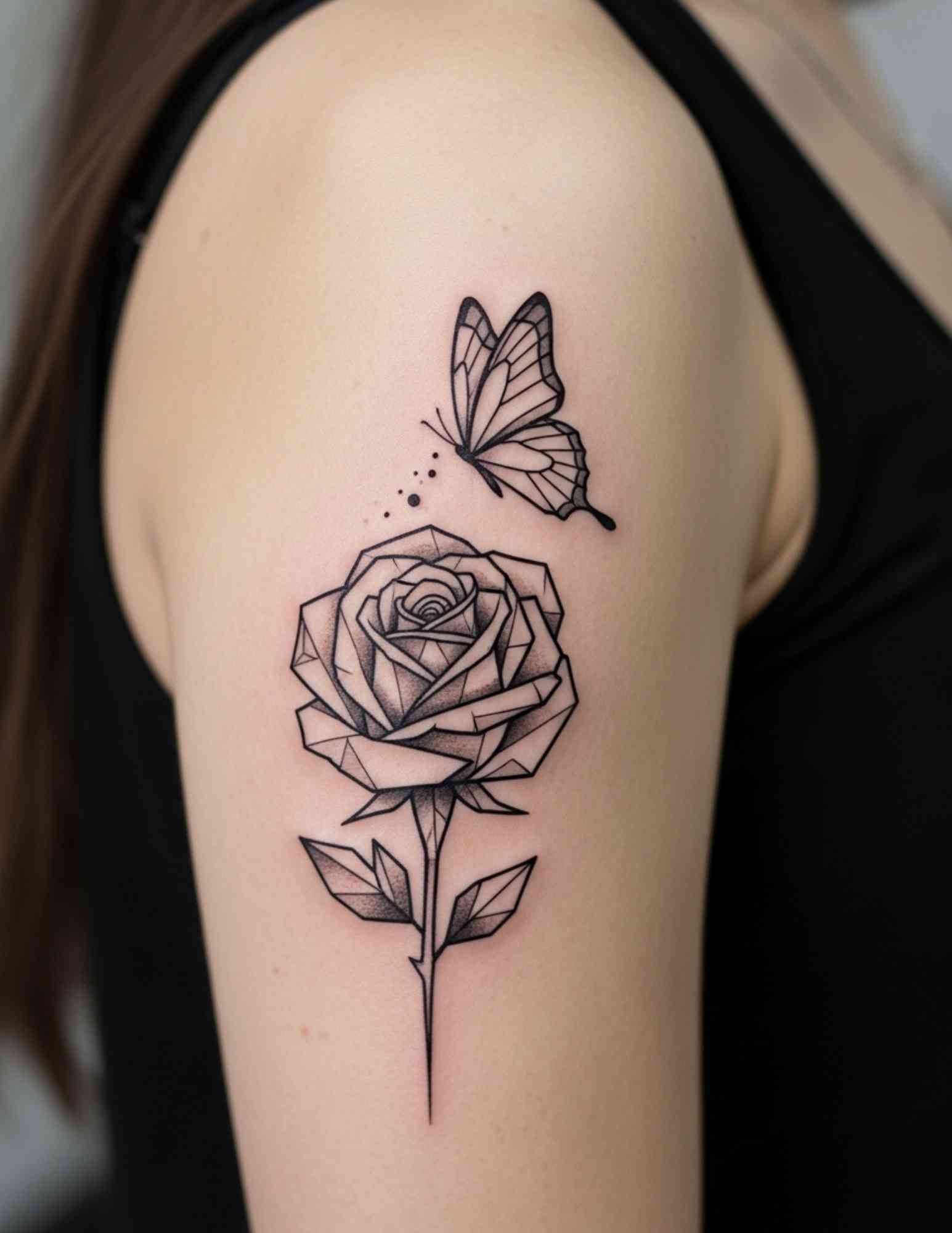
11. Geometric Rose With Butterfly
The rose is faceted into angular planes, as if folded from paper, while the butterfly stays organic. The contrast between the two is the whole idea.
It is a good fit for people who like the symbolism but find conventional florals too soft for their taste.
Precision matters more than usual. Straight lines show every wobble, so this is one to book with an artist whose portfolio already shows clean geometric work.
12. Butterfly Emerging From a Rose Bud
A closed or half-open bud with a butterfly climbing out of it, borrowing the imagery of a chrysalis.
It is the most literal way to draw transformation, and it lands well for people marking recovery, a departure or a change they chose.
Ask for the bud to stay mostly closed. The moment it opens fully, the emergence reads as a butterfly simply sitting on a flower.
13. Rose and Monarch Butterfly
Choosing a real species rather than a generic butterfly gives the tattoo a second layer of meaning at no extra cost.
The monarch carries associations with long migration and return, which is why it appears so often in memorial pieces.
Its orange and black also happen to sit beautifully against a red or deep pink rose, so the decision is aesthetic as much as symbolic.
14. Matching or Complementary Pieces
One person takes the rose, the other takes the butterfly, drawn in the same style so they read as a set.
I prefer this to identical matching tattoos, because each piece still works alone if life goes a different direction.
Book both appointments with the same artist, ideally on the same day. Two artists working from one reference rarely produce a matched pair.
15. Skull, Rose and Butterfly
Adding a skull turns a romantic design into a memento mori: death, beauty and change in a single composition.
Three subjects need a large canvas. The chest, the outer thigh and the back all give the arrangement enough room to stay readable.
If this direction appeals, the dedicated collection of rose and skull tattoo ideas covers the composition in more depth than I can here.
16. Thigh Piece With Roses in Abundance
The thigh is the most forgiving canvas on the body: flat, wide, easy to cover and comparatively low on the pain scale for most people.
That space lets you run five or six roses with butterflies threaded between them, in full colour, without crowding anything.
Expect multiple sessions. For more on this placement, the guide to butterfly thigh tattoo ideas covers sizing and layout well.
17. Dotwork Rose and Butterfly
All shading built from stippled dots rather than solid grey, which gives the piece a soft, engraved quality up close.
Dotwork takes longer than smooth shading for the same area, so budget more chair time than the size suggests.
It pairs unusually well with butterfly wings, where the natural speckling of the wing pattern and the technique are doing the same job.
18. Japanese-Influenced Composition
Borrowing the flow and background elements of Japanese tattooing — wind bars, wave patterns, deliberate negative space — while keeping a Western rose as the subject.
The result is a design that moves with the limb instead of sitting on it as a flat sticker.
Go to an artist who actually works in this tradition. Its rules about flow and framing are specific, and they are what make the style work.
19. Continuous Line Art
The rose and butterfly drawn as one unbroken line, the way a single-stroke illustration works on paper.
It is quietly demanding. The line has to be perfectly consistent in weight, because there is no shading anywhere to hide a wobble.
This is also the easiest style to extend later — the same line can be carried on into a larger piece without redrawing what you already have.
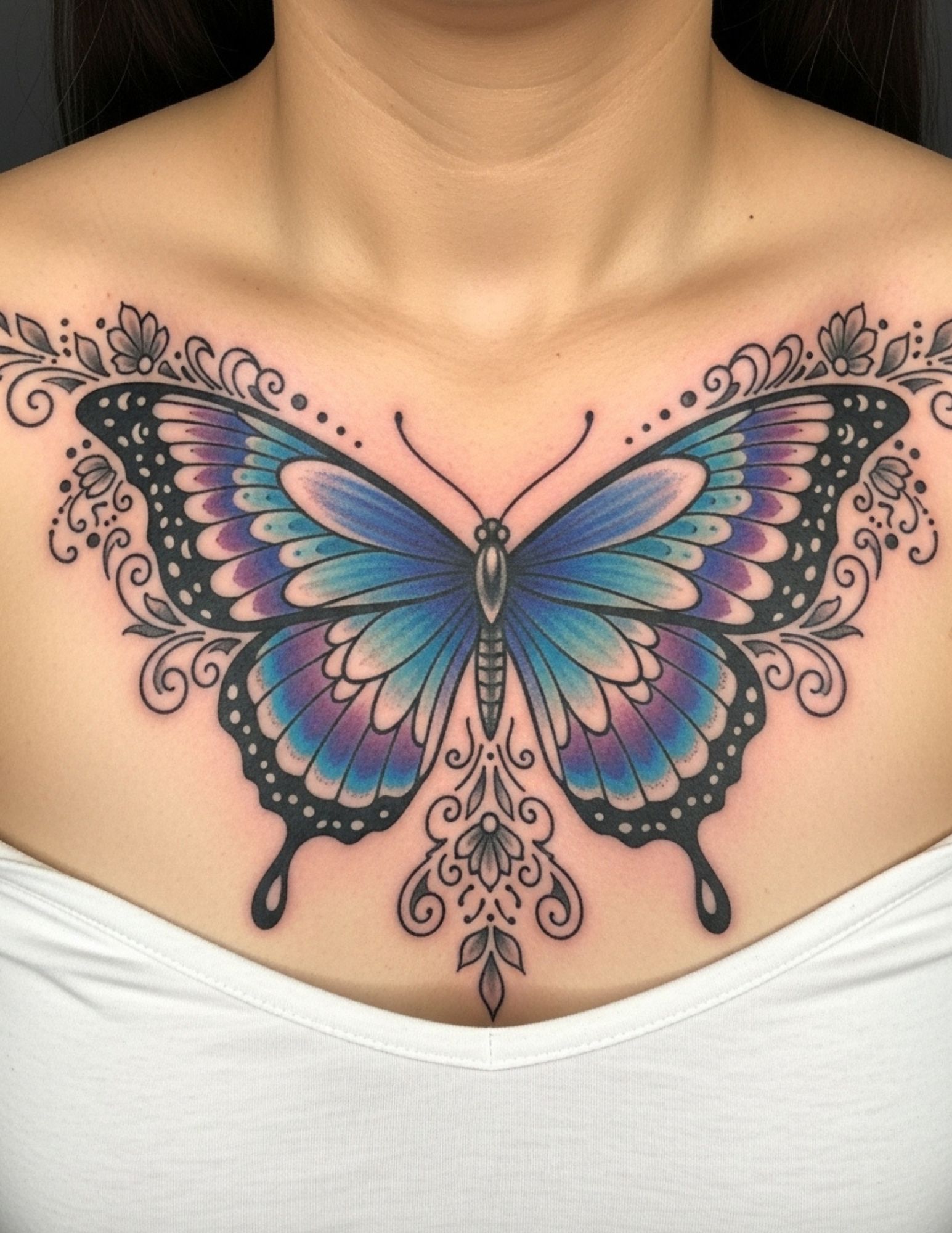
20. Chest Piece With Decorative Filigree
A single bold rose set high on the chest, a butterfly above it, and sweeping filigree lines that anchor the pair to the body’s shape.
Those flourishes are not decoration for its own sake. They carry the composition outward so it does not float as an isolated shape on open skin.
Fair warning: the chest and sternum are among the more uncomfortable places to sit, and everyone I have spoken to about this placement has said the same.
21. Your Own Variation
The most interesting versions I have seen were not copied from a gallery. They came from someone bringing a specific detail to the artist.
A rose variety from a particular garden. A butterfly species that appears where someone grew up. A date hidden inside the linework.
Bring the reference images for style, then bring one thing that is only yours. Good artists want that far more than they want to reproduce a screenshot.
Variations Worth Considering
Swap the Flower
Everything on this list works with a peony, a lily or your birth flower in place of the rose.
Peonies in particular give a butterfly more surface to sit against, which helps at larger sizes.
Swap the Butterfly
A moth reads darker and more nocturnal; a dragonfly reads sharper and more graphic.
If the standard butterfly feels too widely used to you, one swap changes the tone of the whole design without touching the composition.
Colour or Black and Grey
Black and grey is easier to extend into a sleeve later, because it will sit alongside almost anything you add.
Colour makes a stronger single statement but constrains what you can put beside it in five years’ time.
Add a Name, Date or Short Line
Text woven along a stem or hidden in wing detail turns a decorative piece into a memorial one.
Keep lettering larger than feels necessary. Small script closes up faster than any other element on a tattoo.
Placement, Sizing and Aftercare
Pick placement before you finalise the drawing. A design built for a flat thigh rarely wraps convincingly onto a forearm without being redrawn.
When in doubt about size, go one step larger than you first pictured. Almost every regret I have heard about a floral tattoo is about detail that was squeezed too small, not about a piece being too big.
Keep the healing routine boring: clean hands, a light layer of whatever your artist recommends, no soaking, no picking, no direct sun on it. The guide to healing a tattoo with Aquaphor covers the ointment question in detail.
Your artist’s written aftercare sheet beats anything you read online, including this page, because they know the ink and the technique they used on you.
If a healing tattoo becomes hot, increasingly painful after the first few days, swollen, or starts weeping pus, contact a doctor rather than waiting it out. The FDA’s tattoo and permanent makeup fact sheet and the American Academy of Dermatology’s guidance on caring for tattooed skin are both worth reading before your appointment.
Nothing here is medical advice, and no article can assess your skin. An infection or an allergic reaction to pigment needs a professional, not a search result.
Common Mistakes, and What to Do Instead
The most frequent mistake is scale: a butterfly drawn as large as the rose, so the two subjects compete and neither wins.
The second is bringing a single reference photo and asking for an exact copy. You get a weaker version of someone else’s tattoo, drawn by an artist working outside their instincts.
The third is booking on style rather than portfolio. Bring three to five references for the feel you want, then find the artist whose healed work already looks like that.
Still weighing it up? Browse the broader collection of butterfly tattoo ideas to see the motif on its own first.
And if the sitting itself is the part putting you off, these tattoo pain management tips are more useful than any placement chart.
Frequently Asked Questions
What does a rose and butterfly tattoo mean?
Most people read it as beauty paired with transformation. The rose carries love, beauty and the thorns that come with them, while the butterfly signals change, rebirth or someone remembered. Together they tend to be read as something rooted alongside something passing through. There is no fixed meaning, though, and the one you assign it at the appointment is the one that counts.
Where does a rose and butterfly tattoo look best?
It depends on the shape of the design more than on personal taste. A single long stem suits narrow runs of skin: the forearm, the spine, the collarbone. Bouquets and multi-butterfly arrangements want a wide, flat canvas such as the thigh, the upper arm or the back. Symmetrical designs, like roses set inside butterfly wings, look best centred on the chest or between the shoulder blades.
How small can this design go?
A simple fine line version works down to roughly two inches, provided the butterfly is kept as an outline with little interior detail. Below that, wing pattern and petal separation start to merge as the tattoo settles. Anything involving realistic shading generally needs at least palm-size to stay legible. Your artist will tell you the honest minimum for the specific drawing, and it is worth listening when they push back.
How long does it take and what will it cost?
A small fine line piece is usually a single short sitting. A detailed black and grey upper arm design is commonly a half day or longer, and a full colour thigh panel is normally split across multiple sessions. Pricing varies enormously by city and by artist, so ask for a quote on the actual drawing rather than working from an hourly rate alone. Most studios will give you an estimate once they have seen your references.
Can I add to this design later?
Yes, and it is worth planning for even if you are certain this is your only tattoo. Tell your artist at the first appointment that you might extend it, and they will leave the composition open on one side rather than closing it with a hard border. Black and grey work is the easiest to build on, since it sits comfortably beside almost anything added later. A tight, fully enclosed colour piece is the hardest to grow.
Quick Summary
- The pairing works because the rose gives the design weight and the butterfly gives it movement.
- Keep the butterfly at roughly a third to a half of the bloom’s width so the two do not compete.
- American traditional and neo-traditional age the most reliably; watercolour is the least predictable.
- Fine line suits the neck, collarbone and wrist; realism and bouquets need the arm, thigh or back.
- Choose your placement before the drawing is finalised, and size up rather than down.
- Picking a real butterfly species adds a second layer of meaning at no extra cost.
- Bring three to five style references plus one detail that is personal to you.
- Follow your artist’s aftercare sheet, and see a doctor if a healing tattoo looks or feels infected.