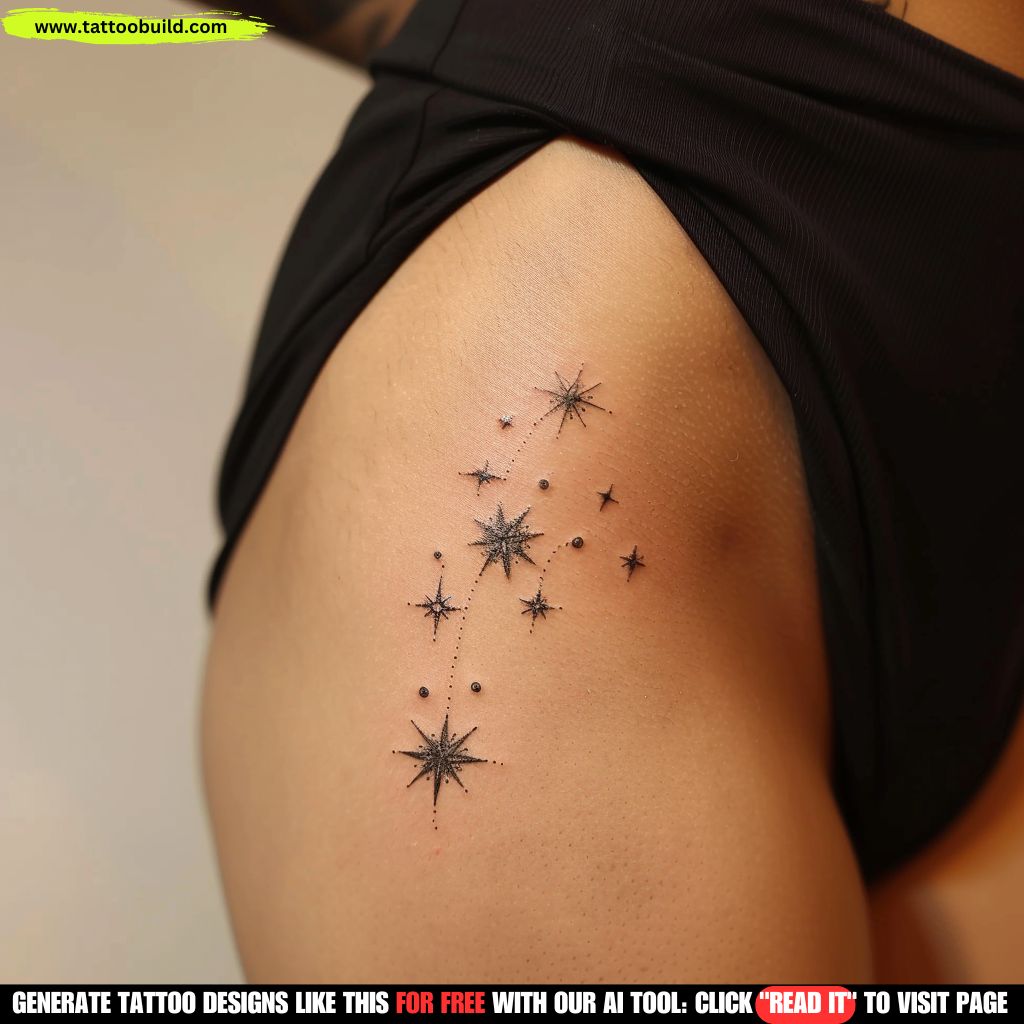
A shooting star lasts about a second. That brevity is exactly the point: a shooting star tattoo is an attempt to make permanent the one thing in the night sky that refuses to stay.
I have watched this design come through studios for years, and the pattern is consistent. People arrive wanting something small and simple, and then spend most of the consultation talking about direction, angle and where the star should appear to be heading.
That is the part most guides skip. A shooting star is a directional design, and the direction it travels changes how the whole piece reads on the body. Everything else, from linework to colour, sits downstream of that one decision. If you are still weighing the broader category, our wider celestial tattoo ideas guide is a useful starting point.
Below are 20 shooting star concepts grouped by approach rather than listed at random, plus what I have learned about how each one actually behaves once it is healed and settled into skin.
Which Shooting Star Style Is Right for You?
Style is the decision that determines cost, session length and how the piece ages. Here is how the five most common approaches compare.
| Style | Best For | Typical Size | How It Ages |
|---|---|---|---|
| Fine line | Discreet placements, first tattoos | 2–6 cm | Softens noticeably; expect a touch-up eventually |
| American traditional | Bold, legible pieces meant to last | 5–12 cm | The most forgiving option of the five |
| Watercolour | Colour-led, painterly compositions | 8–15 cm | Washes fade first; an outline underneath helps |
| Geometric | Precision, symmetry, clean structure | 4–10 cm | Holds shape well; straight lines expose drift |
| Neo-traditional | Dimensional colour with graphic weight | 8–20 cm | Strong, given the heavy outline structure |
In my experience, the two extremes of that table cause the most regret in opposite directions. People go smaller than they should with fine line work, and larger than they planned with watercolour once the artist explains how much room the washes need.
What a Shooting Star Actually Means
The shooting star carries a narrow, unusually consistent set of associations across cultures: a wish, a fleeting opportunity, momentum, and the rarity that makes the moment worth noticing.
What people are actually seeing is a meteor. NASA notes that meteoroids range in size from dust grains to small asteroids, and that almost all of that material is vaporised in the atmosphere, leaving the bright trail we call a shooting star. You can read the full explanation at NASA if the astronomy side matters to you.
That framing matters because it changes the tattoo from a symbol of luck into a symbol of scale. Something that mostly does not survive the trip, briefly bright enough to be worth a wish.
Most of the clients I have talked to about this design fall into two camps. One group is marking a specific moment: a birth, a loss, a decision. The other group wants the general idea of transience without attaching it to anything.
Both work. But the first group should think hard about text, dates and placement, and the second group is usually better served by keeping the design abstract enough that it does not lock to one story.
20 Shooting Star Tattoo Ideas, Grouped by Approach
I have organised these by how they are built rather than numbering them at random, because the grouping is what helps you brief an artist properly.
1. Minimal and Fine Line Shooting Stars
The smallest workable version is a single star with a trailing tail, drawn in the thinnest line the artist is comfortable committing to. Wrist, collarbone and behind the ear are the standard placements.
A variation swaps the solid tail for a run of diminishing dots, which reads as sparkle or debris rather than a streak. It is softer, and in my experience it photographs better at small sizes than a solid tail does.
A third minimal option is a line of three stars ascending at a shared angle, often used for siblings or children. Every artist I have asked about tiny celestial work gives the same warning: go a little bigger than feels necessary, because thin lines spread over the years. Our fine line tattoo ideas guide covers that trade-off in detail.
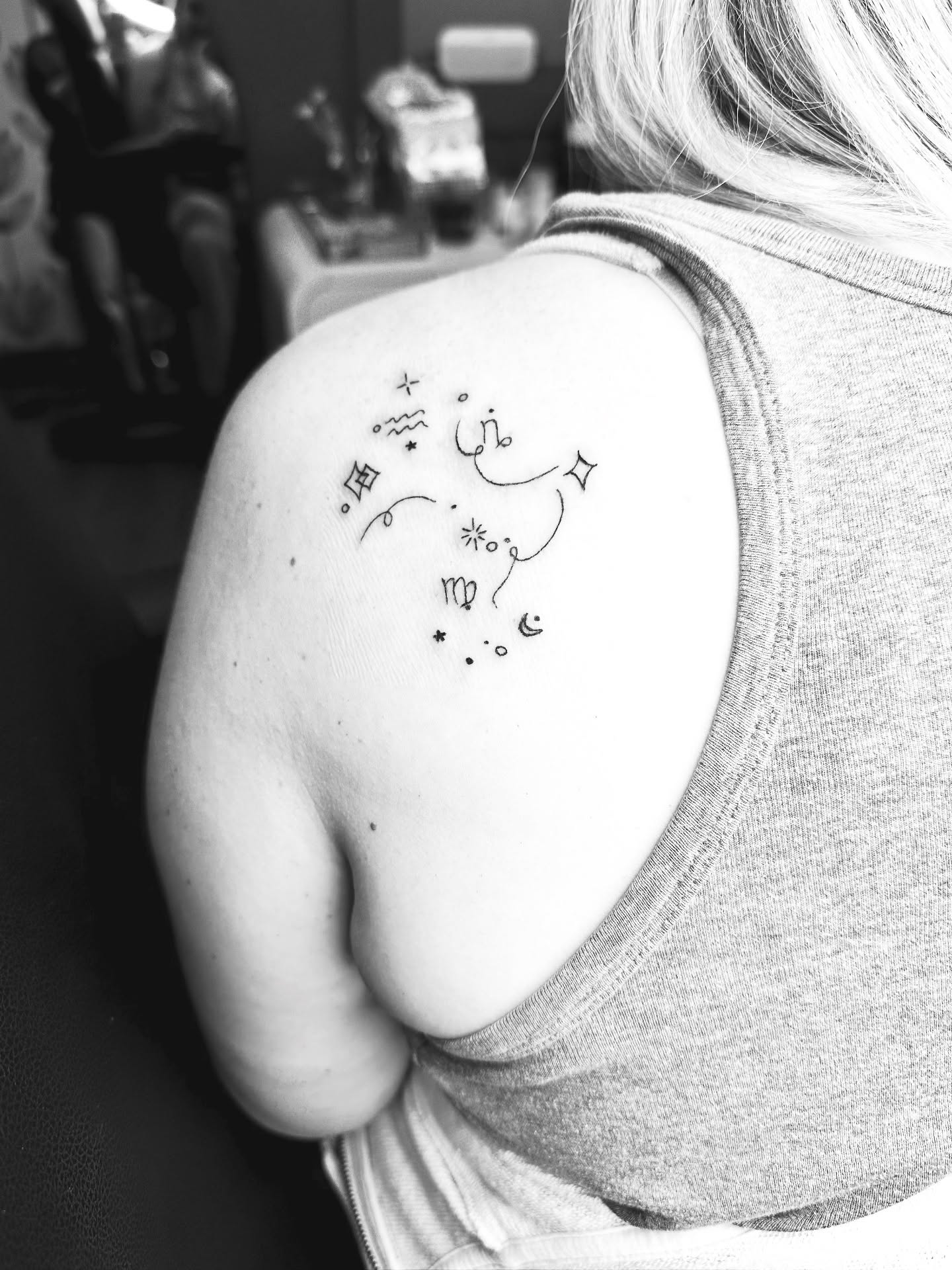
2. Shooting Stars Set in a Wider Night Sky
Putting the star inside a scene solves the biggest weakness of the standalone version, which is that a lone streak can read as abstract rather than celestial.
A constellation with a shooting star passing through it is the most popular of these. The fixed stars give the moving one something to move against, and the contrast is what sells the motion.
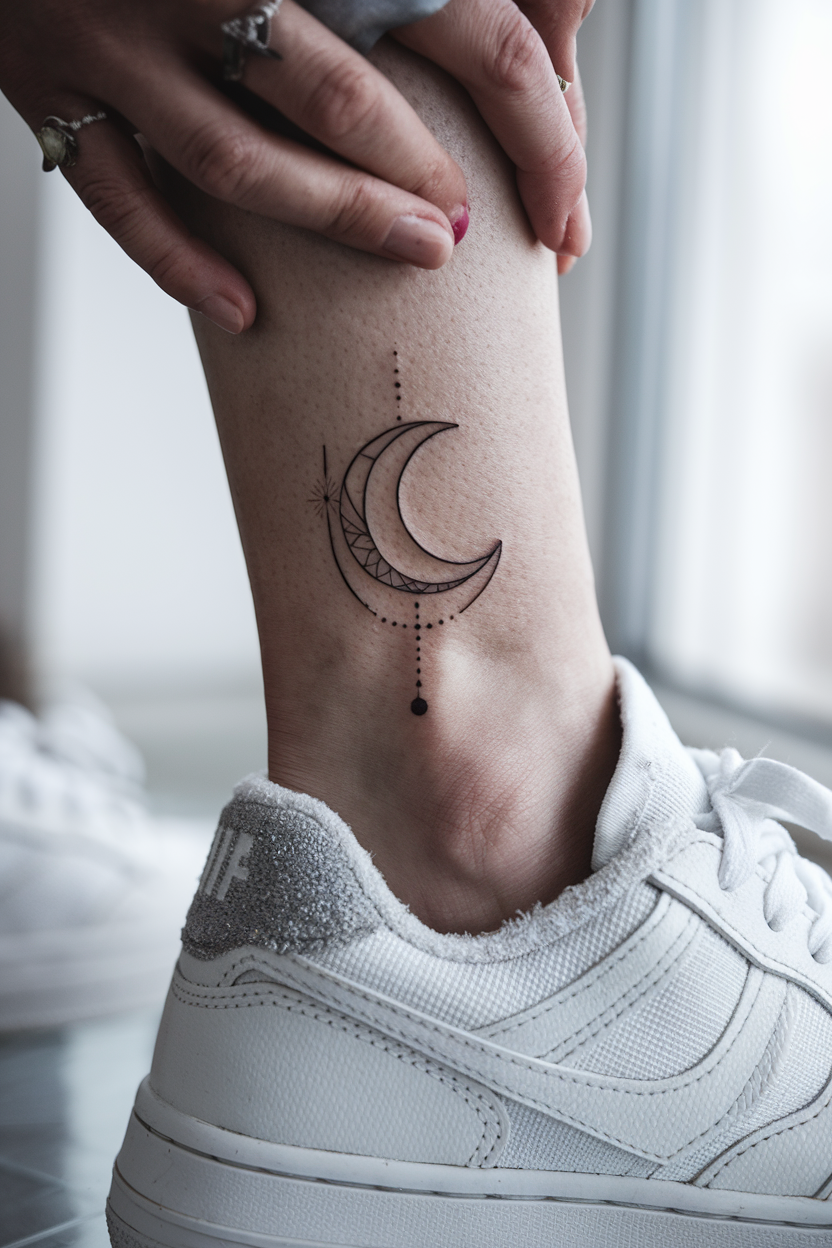
A crescent moon works the same way with fewer elements. And a ringed planet pushes the scale further, turning the piece into a proper space scene. When I have watched these designed on paper, the moon version almost always ends up smallest and the planet version largest. See our moon tattoo ideas for the lunar half of that pairing.
3. Colour-Led Shooting Stars
Watercolour treats the star as a light event rather than a drawn object. The head sits in white or pale gold, and the tail dissolves into blue, purple and pink washes.
Neon takes the opposite route, using fully saturated electric pink, cyan or green to imitate a glow tube rather than a natural meteor.
Both are gorgeous fresh, and both are the styles I would most strongly advise getting an honest ageing conversation about first. Saturated and unoutlined colour is generally the first thing to soften. Our watercolour tattoo ideas guide goes through how artists build these to last longer.
4. Meteor Showers and Repeated Stars
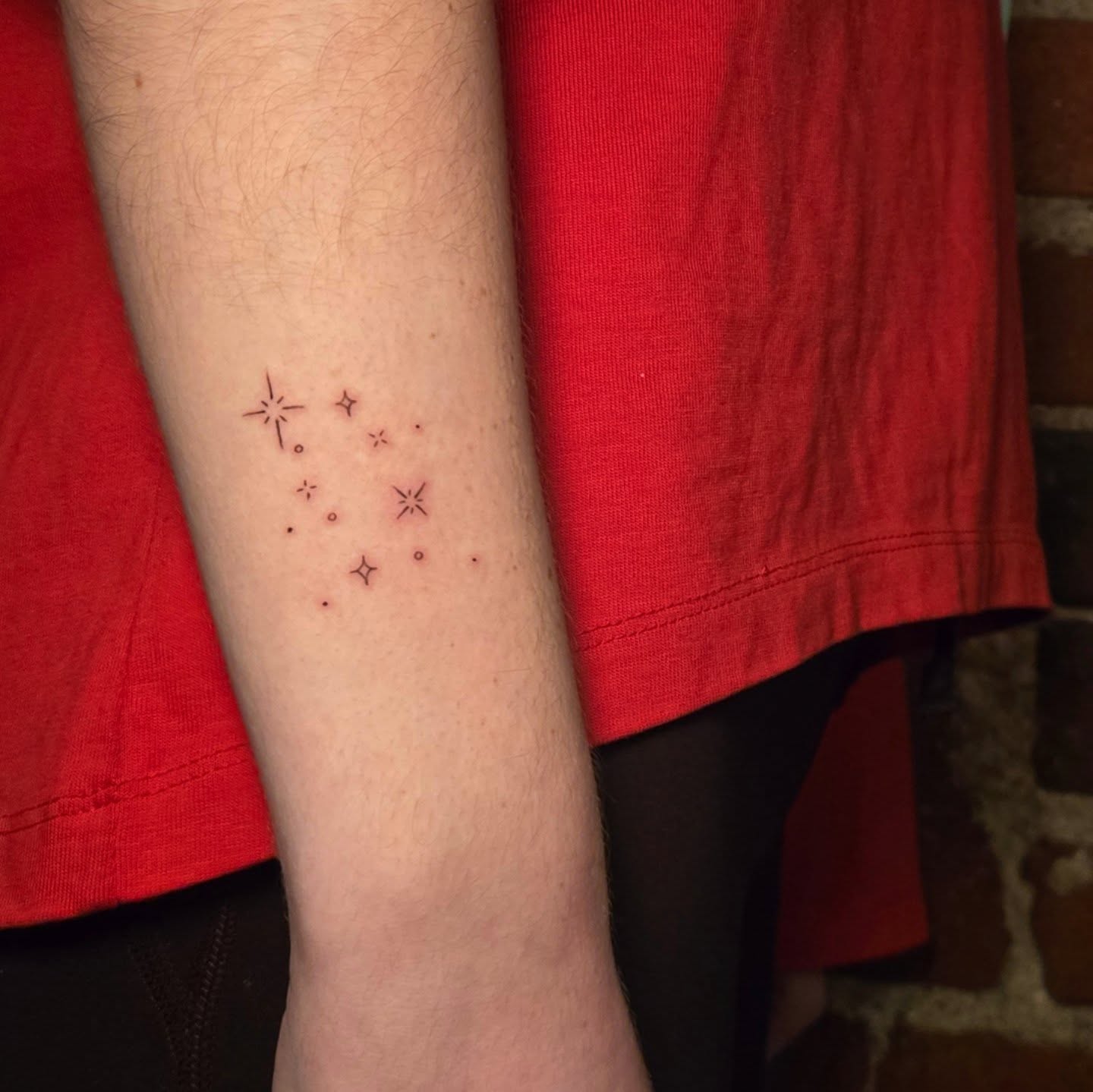
Rather than one star, several at different sizes and slightly different angles. This is the single biggest visual upgrade available to this design.
The scattered approach needs real estate: shoulder, upper back or across the ribcage. On a wrist it just looks crowded.
A close relative is the ankle wrap, where a trail of small stars circles the ankle so the design resolves as you move around the leg. The rule I have seen work every time is odd numbers and varied sizes. Evenly spaced identical stars look like clip art. For more of this scattered treatment, see our galaxy tattoo ideas.
5. Bold Line Styles: Traditional, Neo-Traditional and Geometric
American traditional gives the shooting star a heavy black outline, a limited palette and a five-point star head. It is the most durable version on this list by a clear margin.
Neo-traditional keeps that graphic weight but opens up the colour range, adding dimension and slightly exaggerated proportion.
Geometric goes the other way, building the star from faceted planes and straight lines, sometimes with the trail as a series of parallel rules. Precision is the appeal and also the risk, because a straight line makes any drift obvious. If you want the fundamentals of star shapes before you brief an artist, our star drawings for tattoos guide is the practical reference.
6. Shooting Stars With Text, Names and Dates
Adding a word makes explicit what the star already implies, which is why the shortest options tend to work best. A single “wish” beside or woven into the trail is the usual choice.
Names and dates run along the tail rather than sitting beside the star, which keeps the text integrated instead of bolted on.
The most ambitious variant is a timeline, where the tail carries several milestone dates and the star marks the present. I have seen this done well at forearm size and poorly at wrist size, because the text needs legible spacing and small script closes up as it heals.
7. Narrative and Storybook Shooting Stars
These add a figure, turning the tattoo from a symbol into a scene. A fairy riding the trail is the classic version, and it has been in the repertoire for decades.
A silhouette of a child looking up and making a wish is the quieter option, and often the more affecting one.
Both need more space than clients expect, because the figure carries the detail load and the star becomes supporting cast. Budget for a thigh, upper arm or back placement. Our fairy tattoo ideas guide covers how those figures are usually built.
8. Landscape and Botanical Pairings
A mountain ridge under the star gives it a horizon, and a horizon gives the whole design scale. It is the cheapest way to make a small celestial tattoo feel like a place.
Florals are the other common pairing, usually fine line stems arcing to echo the trail.
The mistake I see most often here is treating both elements as equally important. One has to lead. When the flowers and the star compete for attention, the piece reads as two tattoos sharing space rather than one composition.
Placement and Direction: The Decision Everyone Underestimates
A shooting star points somewhere. That single property makes placement harder than it is for a symmetrical design like a rose or a mandala.
Aim the star with the limb, not against it
On a forearm, a star travelling toward the wrist reads as descending and a star travelling toward the elbow reads as rising. Neither is wrong, but they feel different, and most people I have watched choose end up going upward.
On a ribcage or spine, the vertical axis does the work for you and the star usually wants to travel up.
Small placements that genuinely work
Inner wrist, behind the ear, back of the arm above the elbow, and the outer ankle. All four give you a clean flat plane and enough skin for a 4–6 cm design. Our tiny wrist tattoo ideas round-up shows the scale these sit at in practice.
Placements to think twice about
Fingers, the side of the hand and the top of the foot all take fine line celestial work badly over time, because those areas turn over skin quickly and rub constantly.
Artists will often still do them. Ask directly how long they expect the linework to hold before it needs revisiting.
Practical Advice Before You Book
Bring reference images of style, not just of subject. Five photos of the linework quality you want tells an artist far more than five photos of shooting stars.
Ask to see healed work, not fresh work. Fresh fine line always looks crisp. Healed fine line from a year ago is the honest sample, and any artist worth booking will have it on hand. It also helps to understand the normal stages of healing before you sit.
Follow your artist’s aftercare instructions rather than advice from the internet, including this article. If you want a general grounding, our tattoo aftercare guide covers the basics, but the studio that did the work knows the specifics.
And take signs of infection seriously. Spreading redness, heat, swelling that worsens after the first few days, pus or fever are reasons to contact a doctor rather than wait it out. The American Academy of Dermatology has clear, non-commercial guidance on what normal healing looks like and when to seek care.
Still Not Sure? Common Mistakes to Avoid
Going too small is the most common. A shooting star has two components, a head and a tail, and squeezing both into 2 cm leaves the tail as a smudge within a few years.
Copying an exact design from a photo is the second. Artists build for the body part in front of them, and a design that sat well on someone else’s collarbone rarely maps cleanly onto your forearm.
Committing to colour without discussing longevity is the third. If bright colour matters to you, ask specifically how the artist builds it to last. Browsing our space tattoo ideas will show you how colour and black-and-grey versions of the same subject diverge over time.
And treating the meaning as fixed is the fourth. A shooting star is broad enough to hold whatever you bring to it, which is precisely why locking it to a specific date or name is a bigger commitment than it looks.
Frequently Asked Questions
How much does a shooting star tattoo cost?
Most studios charge a shop minimum for anything small, and a simple fine line shooting star usually lands at or near that minimum. Larger celestial scenes with a moon, planet or multiple stars move into hourly rates, so a half-day session is realistic for anything above roughly 15 cm. Rates vary a lot by city and by artist demand, so treat any specific figure you read online with caution. The only reliable answer comes from sending your reference and placement to the studio you want to book.
Does a shooting star tattoo hurt?
It depends far more on placement than on the design itself. The inner wrist, ribcage and behind the ear are generally reported as more uncomfortable than the outer arm or shoulder. Most small shooting stars take well under an hour, which limits how much discomfort accumulates regardless of location. If pain is a real concern, talk to your artist beforehand rather than pushing through it silently.
Which direction should the shooting star point?
There is no traditional rule, which surprises people. In practice most clients choose upward or forward, since a star travelling toward the body or downward can read as falling rather than rising. On limbs, the direction should follow the natural line of the arm or leg so the design works when you move. Ask your artist to draw it both ways on your skin before committing.
Will a fine line shooting star fade quickly?
Fine line work softens more than bold line work, and that is a property of the technique rather than a sign of poor tattooing. On well-chosen placements a fine line shooting star usually holds its shape for years before it wants a touch-up, and many artists offer one at a reduced rate. High-friction spots like fingers and feet are the exception and fade considerably faster. Sun exposure is the other major factor you actually control.
Can a shooting star be added to an existing tattoo?
Often yes, and it is one of the easier elements to integrate because it is small, directional and does not demand symmetry. It works particularly well filling negative space in celestial sleeves or beside existing moon and constellation pieces. The key is matching line weight and style to what is already there. Take the existing work to the artist in person rather than relying on photographs.
Quick Summary
- Decide the direction of the star before anything else, because placement and composition both follow from it.
- Go slightly larger than feels necessary; the tail is the part that suffers at very small sizes.
- Fine line suits discreet placements, traditional and neo-traditional suit longevity, watercolour and neon suit colour-led pieces.
- Adding a constellation, moon or planet gives the star context and makes the motion read more clearly.
- Multiple stars need real estate – shoulder, back or ribcage – and work best in odd numbers at varied sizes.
- Keep any text short and run it along the tail rather than beside the star.
- Ask to see healed work from the artist, not just fresh photos.
- Follow studio aftercare, and contact a doctor if you see spreading redness, worsening swelling, pus or fever.