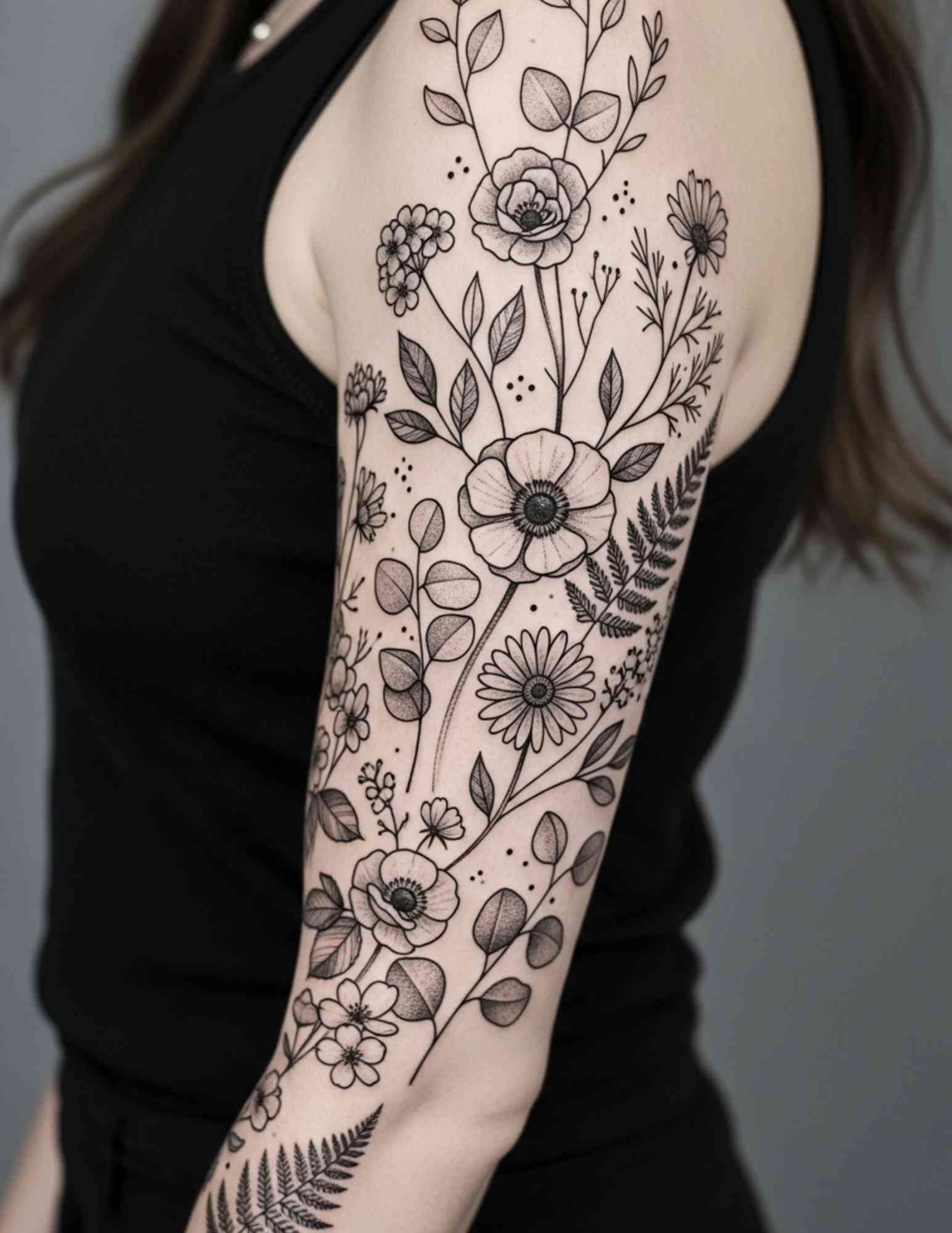
A single line tattoo has nowhere to hide. There is no shading to soften a wobble, no fill to distract from a shaky corner, and no second pass to correct the first one.
I have sat for three continuous line pieces and watched a dozen more get done, and the thing that surprised me every time was how quickly they happen. The stencil takes longer than the tattoo.
What takes the real time is everything before the needle: the drawing, the placement, and the artist deciding where the line starts and where it ends. Get that wrong and the tattoo fails in a way no amount of skill at the machine can rescue.
Below are 20 single line ideas I keep coming back to, plus what I have learned about how these age, what they cost, and which subjects actually survive the reduction. If you are still deciding between styles, the fine line tattoo ideas guide covers the closest relative to this one.
Single Line vs. the Styles People Confuse It With
Single line, fine line, and minimalist all get used interchangeably, and they are not the same thing. The difference is structural, not just visual.
| Style | What Defines It | Typical Sitting | Ages Best When |
|---|---|---|---|
| Single line | One unbroken stroke, no lifts, no fill | 15–45 minutes | Line weight is medium, not hairline |
| Fine line | Thin lines, but multiple separate strokes allowed | 1–3 hours | Spacing between lines is generous |
| Minimalist | Few elements, any line weight | 30–90 minutes | The design has real negative space |
| Blackwork outline | Bold, heavy contour, often closed shapes | 1–4 hours | Almost always — heaviest lines last longest |
| Dotwork | Stippled points instead of continuous line | 2–6 hours | Dots are spaced, not crowded into grey |
If the table pushes you toward heavier work, blackwork outline is the honest next stop. If it pushes you lighter, look at minimalist tattoo ideas instead.
Why Single Line Work Is Harder Than It Looks
The continuous line drawing is an old art school exercise: the pen does not leave the paper, the eye tracks the subject, and the hand follows in real time. The result records the act of looking rather than the finished study.
Tattooing that same idea removes the two things the exercise relies on — cheap paper and a second attempt. Every hesitation is permanent.
In my experience the tell of a weak single line piece is not a crooked shape. It is inconsistent line weight, where the artist slowed down at a tight curve and the line quietly fattened.
The other tell is where the line begins and ends. A good design hides the two endpoints in a place the eye does not search, usually low and to one side. A careless one leaves them floating mid-subject, and after healing they read like a mistake.
The last thing worth knowing before you commit: this style is very fast, which means it is often priced at a studio’s shop minimum rather than by the hour. That is a real consideration if you were budgeting by time. The small tattoo cost breakdown is a reasonable reference point.
20 Single Line Tattoo Ideas Worth Considering
I have grouped these by what the line has to do, because that matters more to the outcome than what the subject is.
1. Continuous Line Face
A human face in one stroke: across the forehead, down the nose, around the mouth, back up to describe the eye. The continuous line portrait is the style’s signature application.
Every feature is suggested rather than rendered, which is exactly why it works. The viewer’s brain completes the face, and the completion is what makes it feel alive.
A warning from watching these get done: the nose-to-lip passage is where most of them fall apart. Ask to see healed examples of that specific transition, not just fresh photos.
Photo: @bluetattoo
2. Single Line Cat
A cat is one of the friendliest subjects for this technique because the silhouette is smooth and the recognisable parts — ears, tail, back curve — are all contour.
Nothing about a cat requires interior detail to read as a cat. That is rare, and it is why these tend to come out well even with a less specialised artist.
Scale it anywhere from about two inches on the wrist to six on the forearm. Below roughly an inch and a half the ears start to merge on most skin.
3. Single Line Mountain
A peak, a slope, a horizon, all in one mark. At small scale this reads simply as a landscape gesture; at larger scale the specific character of the mountain comes through.
I have seen people bring a photo of an actual summit they climbed and have the artist trace its real profile. That version carries more than a generic peak ever will.
If you want the tree-and-mountain variation, adding the treeline costs you very little of the line’s simplicity and gives the horizon somewhere to rest.
4. Continuous Line Dog
Dogs are harder than cats because breed identity often lives in the face, and the face is the part this style gives up first.
The fix most artists use is posture. A specific head tilt or ear set does more for recognition than any amount of detail would.
If this is a memorial piece, bring several photographs from different angles rather than one favourite. The artist needs the shape, not the portrait.
Single line designs and the prompts behind them
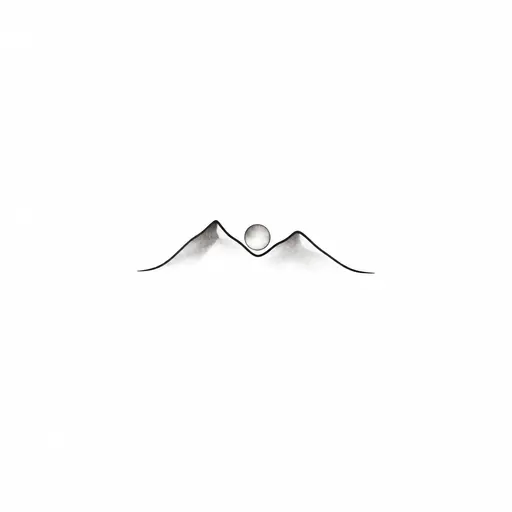
Two mountain peaks in a single continuous line, a small sun resting between them
Use this idea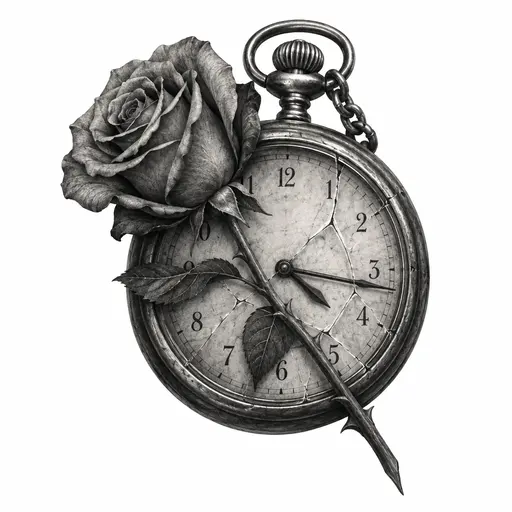
An old pocket watch stopped at 4:17, its glass cracked, a single rose lying across the face
Use this idea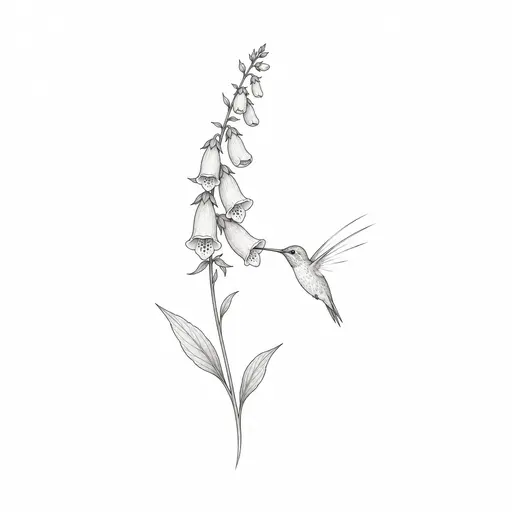
A tiny hummingbird drinking from a single foxglove, its wings drawn as three quick strokes
Use this idea
5. Single Line Wave
A wave in one stroke has a natural advantage: water already moves in continuous curves, so the technique and the subject agree with each other.
The curl of the crest is the only genuinely difficult passage. Everything before and after it is a long, forgiving arc.
These sit well wrapping a forearm or following a collarbone, because the line can keep travelling instead of closing.
6. Abstract Single Line
No subject at all: just one line moving through space, looping and crossing itself. This is the purest version of the style and the most dependent on the artist’s taste.
There is no likeness to judge it against, so the only question is whether the curve is beautiful. That makes portfolio review more important here than anywhere else on this list.
Abstract line work also scales the best of anything here, because there is no detail to lose. If that appeals, abstract tattoo ideas explores the wider category.
7. Single Line Flower
Stem, leaf, petals, all without lifting. The petals are usually handled as a series of loops returning to a shared centre.
Roses are the most requested and among the least suited, because a rose’s identity is in its overlapping interior. Tulips, poppies and daisies translate far better.
For birth-month designs, check the shape of your flower before committing, since some birth flowers reduce far more gracefully than others.
8. Continuous Line Bird in Flight
Two wing sweeps and a body. This is one of the smallest designs on the list that still reads clearly, which is why it turns up so often on ribs and behind ears.
The negative space between the wings does the work. If the artist crowds it, the bird becomes a shapeless mark within a few years.
9. Single Line Constellation
A strict constellation is dots joined by separate segments, so a true single line version has to cheat: the line travels back along itself between stars.
Done well, that doubling reads as deliberate. Done carelessly, it reads as a scribble, and there is no middle ground.
Ask the artist to show you the path they plan before the stencil goes on. It is the one design here where the route matters more than the shape.
10. Continuous Line Couple
Two figures described by one line that passes from one body into the other. The single line is the whole point of the metaphor, which is unusually apt for once.
These work best in profile and in embrace, where the two silhouettes genuinely share a contour. Facing figures force awkward crossings.
If you are planning a matching pair instead of a single shared piece, two halves of one continuous shape is usually a stronger idea than two identical copies.
11. Single Line Deer or Stag
A stag gives you a clean body and then asks the line to handle antlers, which branch — the one thing a continuous line cannot naturally do.
The solution is retracing, and it makes the antlers the densest part of the design. Over ten or fifteen years that density is where blur will show first.
Placing it somewhere with less friction and less sun, like the inner bicep, meaningfully slows that down.
12. Continuous Line Horse
A horse in one stroke is mostly about speed. The line drawn quickly reads as an animal in motion; the same shape drawn slowly reads as a diagram.
This is one case where I would ask the artist how confidently they work. A cautious hand produces a technically clean horse with no life in it.
13. Single Line Landscape
Horizon, hills, maybe a sun, all in one pass. The sun is usually the closing loop, which conveniently hides the endpoint.
These suit long thin placements — under a collarbone, along a forearm, across the top of the back — because a landscape is naturally wide.
14. Continuous Line Hand
Two hands reaching, or one hand holding something. The fingers are the difficulty: five branches off one path, each needing a return trip.
Most artists simplify to three visible fingers. It looks correct and it saves the design from becoming a knot.
15. Single Line Whale
A long body curve and a fluke. Possibly the most forgiving subject on this entire list, because a whale is essentially one shape already.
If you want a whale with more content than one line allows, the usual route is to keep the single line body and add a small filled element such as a spout or a wave.
16. Continuous Line Woman
A female profile or figure in one stroke. Alongside the face, this is the most common single line tattoo being done right now.
The nose and upper lip are the two make-or-break moments. Everything else in a profile is a long, easy curve.
Because it is so common, quality varies enormously. Judge the artist on those two centimetres and ignore the rest of the photo.
17. Single Line Geometric Form
An impossible triangle, a cube, a knot: geometry drawn without lifting. The line has to follow a route that visits every edge, which is a genuine puzzle.
Precision matters more here than anywhere else, because the eye measures straight lines against each other automatically. A two degree error is visible.
If you like this direction, geometric tattoo designs is built around exactly that kind of precision work.
18. Continuous Line Eye
Lid, lash, iris, all in one movement. A small subject carrying a lot of expression, which makes it disproportionately demanding.
The iris is usually a closed loop at the end of the path, which again hides the endpoint neatly.
19. Single Line Fox
Pointed muzzle, sharp ears, a tail that is all soft curve. The contrast between angular and flowing is what makes the fox a satisfying single line subject.
It holds up small — wrist and inner forearm placements work at around two inches in most cases.
Photo: @inkedbyanita
20. Continuous Line Heart
Not the symmetrical graphic heart, but a gestural one: an organic loop that describes the form in a single pass.
The hand-drawn quality is the entire appeal. A perfectly symmetrical single line heart loses the thing that makes it worth doing this way.
Variations on the Single Line Approach
If the strict one-stroke rule feels too limiting, there are several established ways to loosen it without losing the look.
Single Line With One Accent
The whole design in one stroke, plus a single small element in colour or solid fill — a red dot, a filled leaf, one shaded lip.
It keeps the discipline visible while giving the eye somewhere to land. In my experience this ages slightly better than pure line, because the accent stays legible as the line softens.
Two-Line and Three-Line Work
Two separate continuous lines that interact. Common for couples, siblings, and any design where two subjects need to stay distinct.
Purists will tell you it is no longer single line work. Practically, it solves the branching problem that ruins antlers and fingers.
Single Line Wrapped Around a Limb
The line travels around the wrist, ankle or bicep and meets itself. The join is the only difficult part and it should sit on the inside of the limb.
Bring the design to the artist already drawn on a strip of paper wrapped around your own wrist. Flat drawings of wrap-around pieces mislead almost everyone.
Single Line Lettering
A word or name written without lifting, often with the letters connected in ways ordinary handwriting would not allow.
Keep it short. Every additional letter adds a connection point, and connection points are where these designs get muddy.
Getting a Single Line Tattoo That Lasts
The single biggest factor is line weight. A hairline stroke looks stunning for two years and then starts to break up; a slightly heavier line looks almost identical on day one and considerably better on year ten.
Ask your artist to go one needle size up from what you think you want. Nearly every experienced line specialist I have spoken to gives the same advice unprompted.
Placement matters nearly as much. High-friction, high-sun areas — hands, feet, the outer forearm — fade fastest. Inner arm, inner bicep and upper back hold line work considerably longer.
Depth is the third factor, and it is entirely on the artist. Too shallow and the line fades early; too deep and the ink spreads into the surrounding skin, which on a single line piece is the difference between elegant and smudged. This is why specialisation matters here more than in most styles.
Still Not Sure? Common Mistakes to Avoid
Choosing a subject that needs interior detail. Roses, portraits of specific people, and detailed architecture all fight the technique rather than using it.
Going too small. A single line piece under about an inch and a half rarely has room for the line to change direction cleanly, and it is direction change that carries the meaning.
Picking an artist on fresh photos alone. Fresh single line work almost always looks good. Understanding the healing stages is a more useful comparison, since it shows you what the line becomes once the skin settles.
Underestimating the pain because the tattoo is small. It is short, not painless, and several popular placements for this style are bony. The most painful tattoo spots is worth a look if you are choosing between spots.
Skipping aftercare because there is so little ink. A thin line in compromised skin heals worse than a bold one, not better — follow your artist’s instructions closely, and see a doctor rather than an internet thread if you get spreading redness, swelling or discharge. The aftercare guide covers the normal timeline.
Frequently Asked Questions
How long does a single line tattoo take?
Usually far less time than people expect. A small continuous line piece is often 15 to 30 minutes of actual tattooing, with a larger forearm design running to about 45 minutes. The drawing and stencil stage typically takes longer than the tattoo itself. Most studios price work this short at their shop minimum rather than by the hour.
Do single line tattoos fade faster than other styles?
Thin line work generally fades sooner than bold work, and single line pieces are often drawn thin. That said, the fading has more to do with line weight, placement and depth than with the style label. A medium-weight single line on the inner arm can hold up for many years. A hairline version on the hand will not.
Can a single line tattoo be touched up or reworked?
Touch-ups are straightforward as long as the original path is still readable, and most artists will re-run the existing line. Reworking is harder, because there is no fill to hide changes and a corrected line sits visibly beside the old one. The usual approach is to build a larger design around the original rather than alter it.
Does the artist really not lift the needle at all?
In most cases, no — not strictly. Machines are lifted to reposition, wipe and adjust, and on larger pieces the line is tattooed in sections that meet invisibly. What matters is that the finished tattoo reads as one unbroken path, not that the machine never left the skin.
What subjects should I avoid for single line work?
Anything whose identity lives in interior detail rather than outline. Realistic portraits of specific people, roses, detailed buildings and heavily patterned animals all lose too much in the reduction. Subjects with strong silhouettes — cats, whales, waves, profiles, mountains — are where this technique is genuinely at its best.
Quick Summary
- Single line means one continuous unbroken stroke with no fill, no shading and no second pass.
- The style rewards subjects with strong silhouettes and punishes anything that needs interior detail.
- Line weight is the main driver of longevity — go slightly heavier than feels right.
- Inner arm, inner bicep and upper back hold line work far longer than hands, feet and outer forearm.
- Most pieces take 15 to 45 minutes and are priced at the studio minimum rather than hourly.
- Judge an artist on healed photographs of the hardest passage, not on fresh work.
- Branching subjects like antlers and fingers need retracing, which is where blur eventually appears.
- Anything involving healing problems, spreading redness or a suspected reaction is a question for your artist or a doctor, not a forum.
For a broader view of where this style sits, the tiny wrist tattoo collection is the closest neighbour on the site. If you would rather see the technique taken in the opposite direction — texture instead of contour — dotwork tattoo ideas is the one to read.
For general safety and hygiene standards to expect from any studio, the NHS guidance on tattoo safety is a useful independent reference, and the US FDA maintains plain-language information on tattoo inks and reactions.