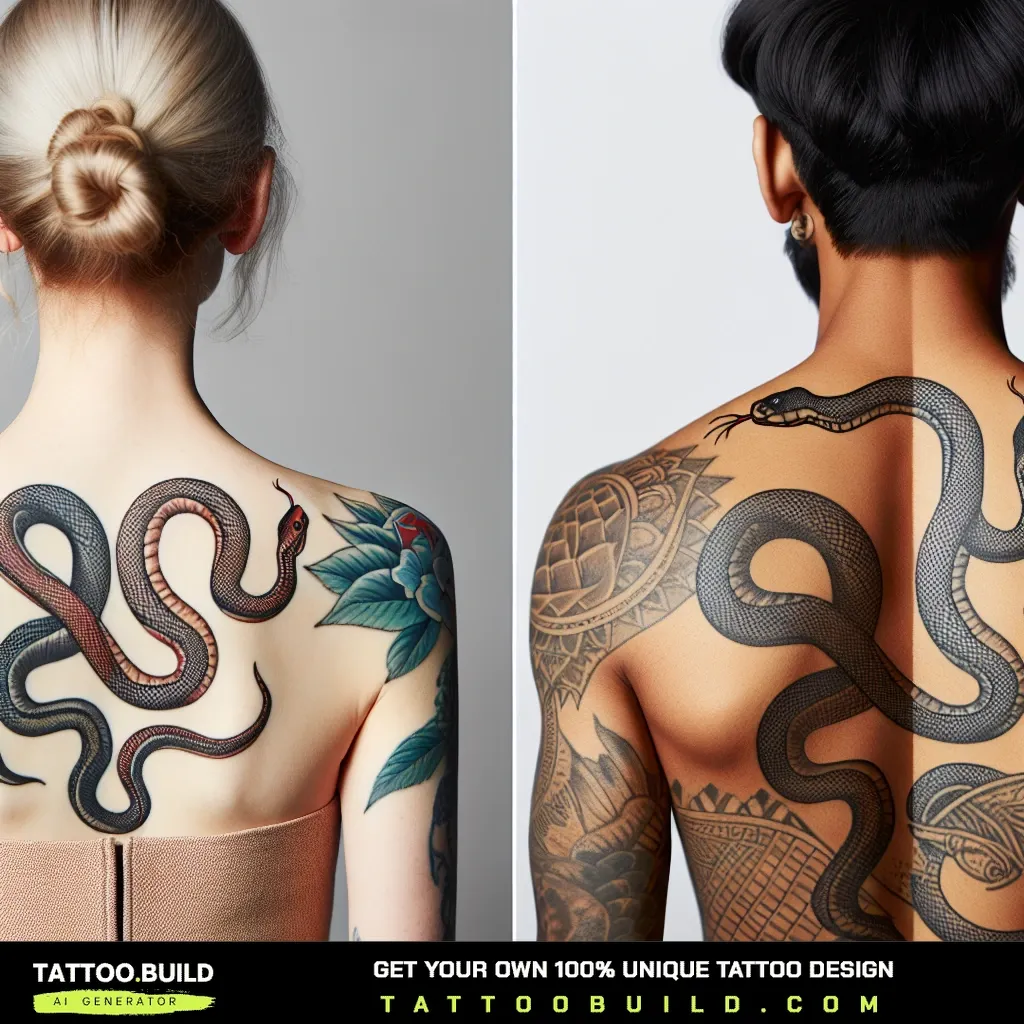
I have been sketching and researching snake tattoos for years, and the same thing happens every time a woman brings one to a consultation: the artist sits up straighter. A snake is one of the few motifs that can be made delicate or menacing with the same set of lines, which is exactly why it suits so many women so well.
The serpent shows up in the Garden of Eden, on Cleopatra’s arm, around Athena’s shield and at the base of the caduceus. Every culture that met it had to decide what it meant, and most landed somewhere near the same three words: danger, wisdom, renewal.
For women there is an extra layer. The snake is one of the symbols most often used to explain away female power, so wearing one is usually a deliberate act rather than a decorative one — and if you want the full symbolic background before you commit, our guide to snake tattoo meaning goes deeper than I can here.
Below are 20 directions I keep coming back to, with real photographs of each, plus what I have learned about placement, healing and cost along the way.
Which Snake Style Is Right for You?
This is the comparison I sketch out on paper for people who know they want a snake but have no idea which lane to pick.
| Style | Best for | Typical size | How it ages | Sitting time |
|---|---|---|---|---|
| Fine line | Subtle, jewellery-like pieces | 2–6 inches | Softens and can blur; may need a touch-up in a few years | 1–2 hours |
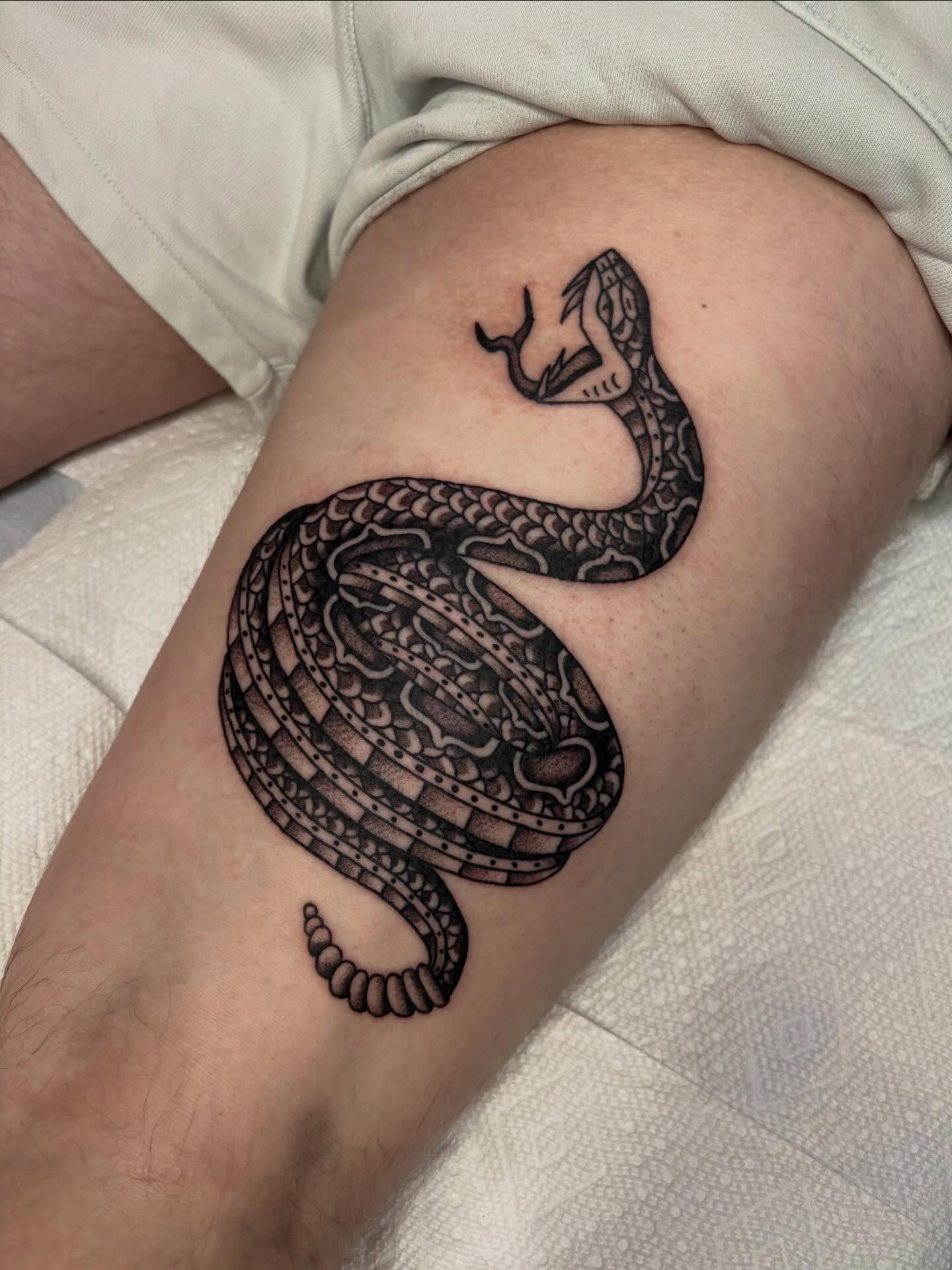
| Traditional / American traditional | Bold outlines that stay readable | 4–8 inches | Ages best of any style, by a wide margin | 2–4 hours |
| Japanese (irezumi-influenced) | Large flowing pieces on arm, thigh or back | 8 inches to full sleeve | Excellent, designed for scale | Multiple sessions |
| Blackwork | High contrast, graphic impact | 4–10 inches | Very well, though solid fill needs an experienced hand | 3–5 hours |
| Colour realism | A specific real species, scale detail | 6–12 inches | Fades fastest; keep it out of the sun | 4+ hours, often two sessions |
| Watercolour | Soft, painterly, unconventional looks | 4–8 inches | Poorly without a black line structure underneath | 2–4 hours |
If you are torn, my honest advice is to pick the style that ages well first and the concept second. A blurred fine line snake at year ten is a different tattoo than the one you booked.
What the Snake Actually Means
Transformation is the association that comes up most. The serpent sheds its skin and continues, which is why so many people book one after a divorce, a recovery or a move.
Wisdom sits right behind it. In a long list of traditions the snake knows something humans are not supposed to know, which is where the Eden story and the forbidden-knowledge reading come from.
Then there is authority. In ancient Egypt the uraeus cobra sat on the pharaoh’s brow as an emblem of sovereignty, and in Hindu practice the kundalini is described as a serpent coiled at the base of the spine.
The ouroboros — the snake eating its own tail — is its own case, an ancient emblem of cyclical return that Britannica traces back through Egyptian and Greek sources.
You do not get to pick only one of these meanings. Whatever you tattoo will carry some of the others with it, so it is worth knowing which ones you are inviting along.
20 Snake Tattoo Ideas for Women
1. Ouroboros Wrist Bracelet
A snake eating its own tail, drawn as a continuous circle that sits where a bracelet would.
I like this one because it solves a problem most wrist tattoos have: it has no awkward start or end point, so it reads correctly from every angle.
Keep the head small and the tail taper gradual, or the join becomes the only thing anyone looks at. If you like the wrapped-around-the-limb format generally, there are more directions in our bracelet tattoo ideas.
Expect a short sitting, often under 90 minutes in fine line.
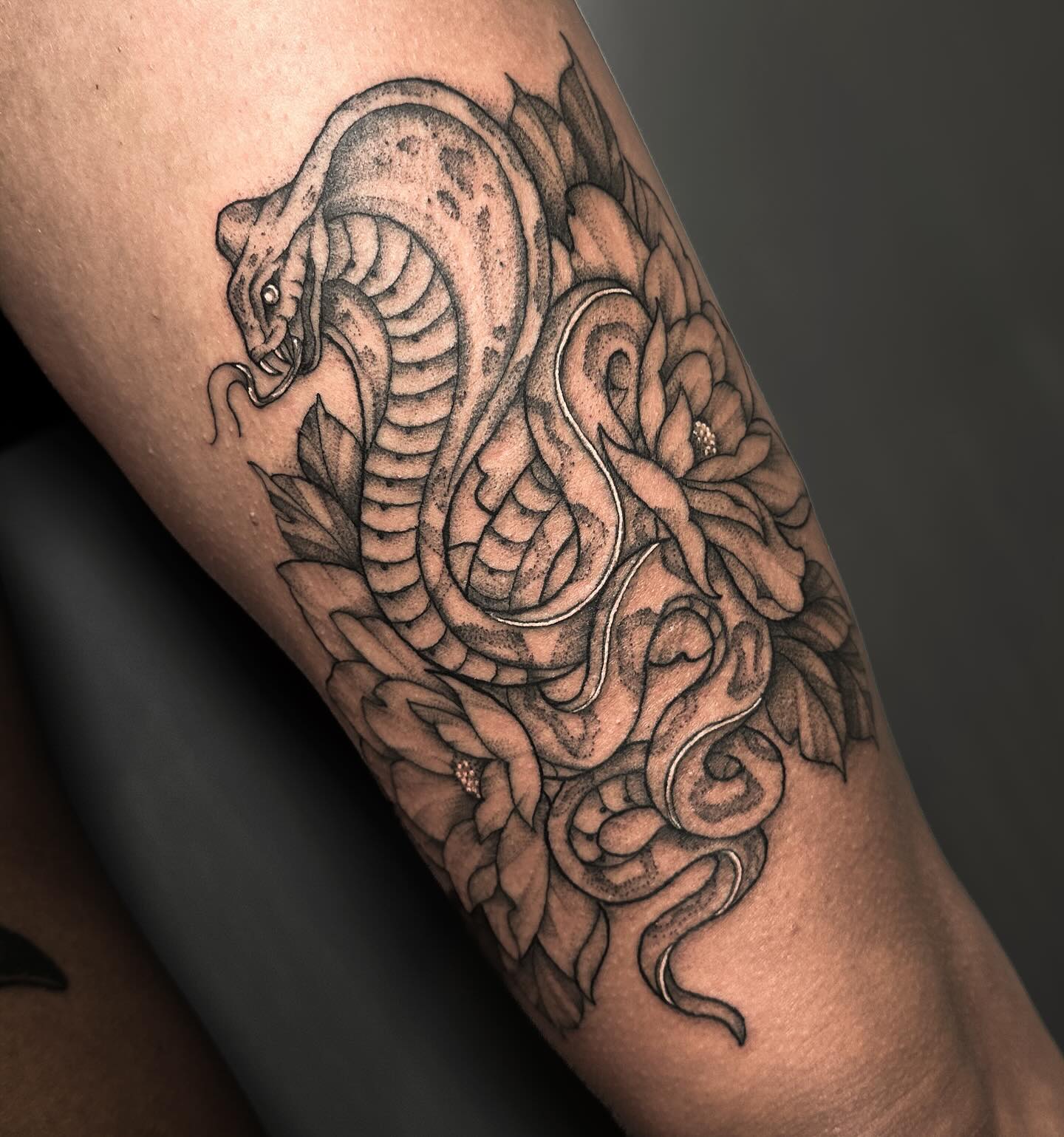
2. Cobra with Hood Spread
A cobra in the defensive display, hood fanned wide, head lifted off the coil.
The spread hood gives an artist a broad symmetrical shape to work inside, which is why cobras look so good in traditional and in realism but rarely in fine line.
In my experience this is the version women choose when they want the tattoo to be unmistakably a warning rather than a decoration.
Forearm, outer thigh and shoulder blade all suit it because they give the hood room to sit flat.
3. Snake Through a Floral Arrangement
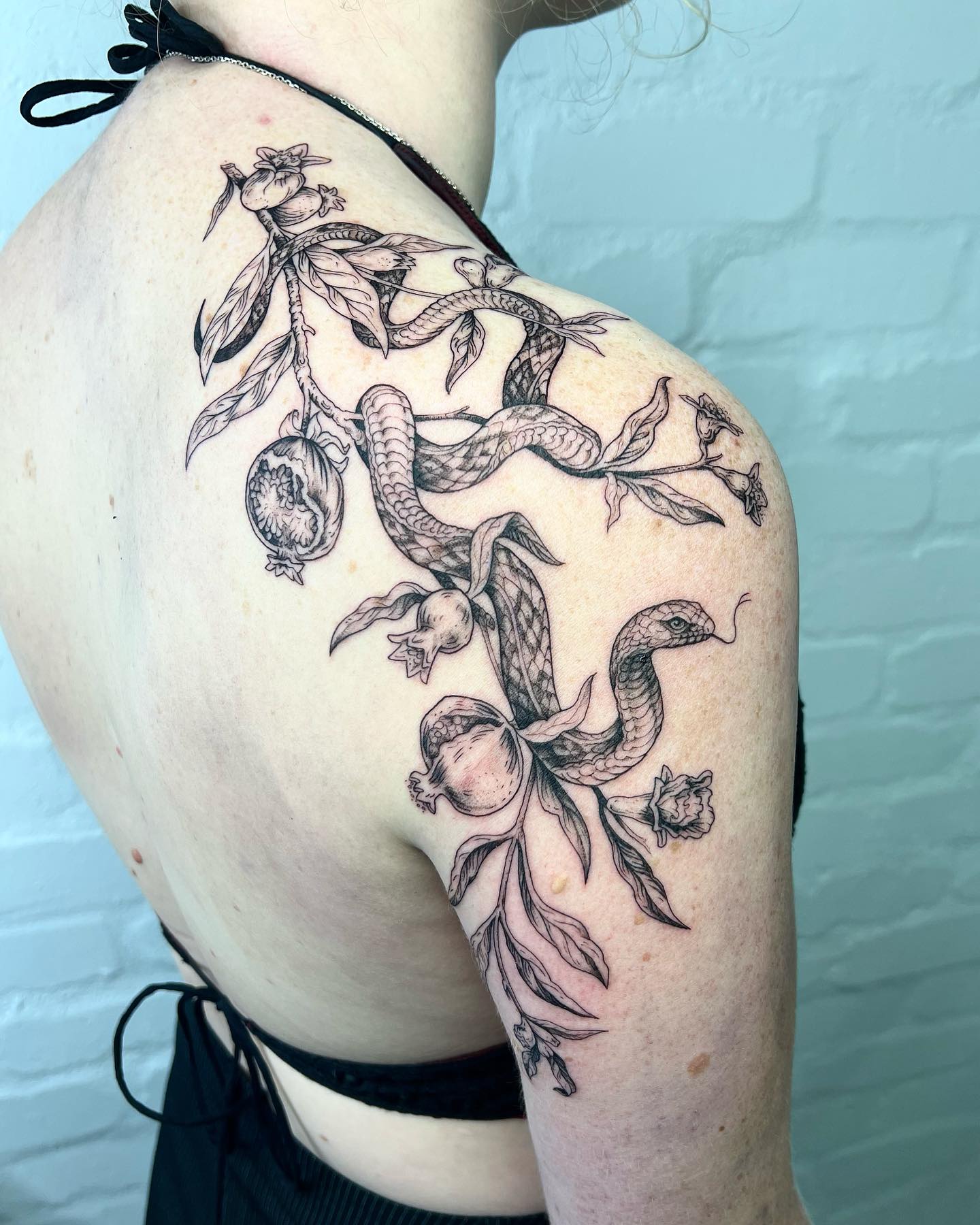
A serpent threading between roses, peonies or wildflowers rather than lying on top of them.
This is the single most requested snake format for women that I have come across, and the reason is the tension: soft petals against a hard, coiling predator.
The technical trick is overlap. If the snake weaves behind one bloom and in front of the next, the piece gains depth; if it does not, it looks like a sticker.
It scales beautifully — the same concept works at three inches on a forearm or as a full floral back piece.
4. Fine Line Coiling Snake
A single snake coiled in unbroken outline, no shading, no fill.
Fine line is the most fragile choice on this list and I will always say so before someone books it.
When a fine line snake is done well the coil crossings stay open and legible; when it is done badly those crossings close up over a few years and the whole thing turns into a grey knot.
Ask to see healed photographs at least three years old before you commit to an artist for this one.
5. Snake and Moon
A serpent curled around, through or beneath a crescent or full moon.
Both symbols are about cycles, so the pairing is coherent rather than just pretty — shedding skin and waxing and waning are the same idea in two languages.
Black and grey suits this better than colour, in my view, because the moon needs soft gradient work that colour tends to fight.
It sits well on the forearm, the sternum, or vertically along the ribs. Our moon phase tattoo ideas pair naturally with it.
6. Japanese-Style Serpent
The hebi of Japanese tattooing: a long-bodied snake with heavy outlines, scale texture and usually wind bars or peonies around it.
This style is built to flow with the body rather than sit on it, so it is the right answer if you want an arm, thigh or back piece rather than a single motif.
Every artist I have asked about Japanese work says the same thing — do not treat it as a style filter you apply to any drawing, because the composition rules are the whole point.
If you like the scale and flow, dragon tattoos for women come out of the same tradition.
7. Snake Spine Piece
A slim serpent running vertically down the centre line of the back, head at the nape or the tailbone.
The spine is the most natural home a snake has on the human body, because the body already provides the line the design needs to follow.
It is also one of the more uncomfortable placements — bone with very little padding — and I would not recommend it as a first tattoo.
There is a lot more on placement, pain and design in our guide to spine tattoos for women.
8. Watercolour Snake
Soft washes of colour bleeding outside the snake’s form, mimicking paint on wet paper.
I am cautious about this one and I would rather say so plainly: watercolour without a black line structure underneath tends to lose definition faster than any other style.
The versions that survive are the ones where a competent black outline holds the shape and the colour is doing the decoration, not the drawing.
If you love the look, ask your artist for a hybrid rather than pure wash.
9. Snake Wrapped Around a Dagger
A serpent spiralling up a blade, one of the oldest pairings in Western traditional tattooing.
The reading is usually protection, or a threat met head on, and it is compact enough to work on a forearm or calf without needing much space.
Traditional styling suits it best because the bold outlines keep the blade and the coils separate at a distance.
The symbolism is covered in more depth in our dagger tattoo meaning guide.
10. Snake and Peony
A single large bloom with the serpent moving through or behind it.
The peony is the classic Japanese pairing for a snake, and it carries associations with prosperity and bravery in that tradition.
Because it is one flower rather than a bouquet, it stays readable at smaller sizes than a full floral arrangement does.
This is the version I most often suggest to someone who wants the floral-and-serpent idea but only has a palm-sized space.
11. King Snake in Colour Realism
A specific real species rendered with accurate banding, scale texture and light.
Colour realism asks the most of both artist and client: long sessions, a real budget, and diligent sun protection afterwards.
When I have seen it done well it is the most striking thing on this list, because a real snake’s banding is already a designed object.
Bring reference photographs of the exact species rather than a general idea of “a colourful snake”.
12. Geometric Snake Head
A serpent head broken into faceted planes, or framed inside a circle, triangle or mandala.
Geometry gives a snake something it does not naturally have — hard straight edges — and the contrast is what makes the design work.
It reads as modern rather than traditional, and it suits the forearm, the sternum and the back of the calf.
Precision matters here more than in any organic style, because a wobbly straight line is obvious in a way a wobbly curve is not.
13. Snake as Armband
A serpent wrapped fully around the upper arm, forearm or thigh, meeting itself on the far side.
Armbands have to be designed on the body rather than on flat paper, and any artist who does not want to stencil, check and re-stencil it is telling you something.
The join at the back is the make-or-break detail: it should be hidden inside a natural overlap of the coil, not left as a visible seam.
It is a strong choice if you want something that is visible to you constantly but easy to cover with a sleeve.
14. Two Snakes Intertwined
Two serpents mirrored or braided around each other, sometimes echoing the caduceus.
Symmetry does a lot of the work, and it is a natural fit for the sternum, the spine or the centre of the back where the body is already symmetrical.
Duality is the common reading — two sides of one person, or two people bound together.
Watch the negative space between the bodies; in the best versions it is as considered as the linework itself.
15. Snake and Hourglass
A serpent coiled around or threaded through an hourglass.
It is a memento mori without the obviousness of a skull, and I find people connect with it when the tattoo marks a specific turning point.
The hourglass gives the composition a rigid vertical anchor, which stops the snake from looking like it is floating.
Traditional or blackwork styling both suit it; realism tends to make the glass fight the snake for attention.
16. Blackwork Snake
Solid black fill with the design carried by shape and by the skin left uninked.
Blackwork ages better than almost anything else, and on darker skin tones it often reads more cleanly than fine line does.
The catch is that large areas of solid black need an experienced hand — patchy fill is very hard to fix later, and it usually requires a second pass.
Ask specifically how many sessions the artist expects, and take the healing instructions seriously.
17. Snake with a Skull
A serpent moving through the eye sockets or coiled around a skull.
This is the most explicit life-and-death version of the motif, and it is popular for a reason: the two shapes fit together naturally.
It works in traditional, in blackwork and in realism, though the fine line version tends to lose the skull’s structure.
Forearm, calf and outer thigh are the placements I see it on most.
18. A Specific Species
Not “a snake” but a corn snake, a green tree python, a hognose — drawn with its real markings.
When someone keeps snakes, or has a particular species that means something to them, this is nearly always the better choice.
It also gives the artist a genuine reference to work from instead of a composite, which usually raises the quality of the result.
Bring several photographs from different angles, not one screenshot.
19. Snake in the Garden
The Eden scene: serpent, branch, apple, leaves, sometimes a hand.
For a lot of women this one is pointed rather than decorative — it takes the story that has been used against them and puts it back on their own terms.
It needs room. Squeezed into a small space the elements collapse into each other and the story stops being legible.
Ribs, thigh, back and upper arm all give it the space it wants.
20. Kundalini Serpent
A coiled serpent placed at the base of the spine, referencing the kundalini of Hindu yogic tradition.
If you take that tradition seriously the placement is not decorative — it is where the energy is described as resting, and the tattoo marks it.
I would encourage anyone drawn to this to read a little about the tradition first rather than borrowing the shape alone.
Fine line and blackwork both suit it; the design is usually simpler than the concept.
Variations Worth Considering
If none of the twenty land exactly right, these are the adjustments I suggest most often.
Change the Scale Rather Than the Concept
A concept that feels too heavy at eight inches often feels right at three, and the reverse is true just as often.
Before rejecting an idea, ask your artist to stencil it at two different sizes and look at both in a mirror.
Swap the Companion Element
The snake is the constant; the dagger, moon, skull, hourglass or flower is the variable.
Changing that one element changes the entire reading of the tattoo without touching the drawing you already like.
Move It Somewhere Less Obvious
The same design reads very differently on an inner bicep than on a forearm, and healing on the inner arm is generally kinder.
If visibility at work is a concern, upper arm, ribs and thigh give you control that hands, necks and forearms do not.
Go Negative Space
Instead of drawing the snake, have the artist black out the area around it and let the untouched skin form the body.
It is a bold, graphic option that ages unusually well, though it is a much bigger commitment of black than most people expect.
Aftercare and Practical Advice
Choose the artist before you finalise the design. A specialist in the style you want will improve your drawing; a generalist will simply copy it.
Look for healed work in their portfolio, not just fresh photographs. Fresh tattoos all look good, and healed ones are where technique actually shows.
For healing, follow the aftercare instructions your artist gives you over anything you read online, including this page — they know what ink and technique they used. General guidance from the American Academy of Dermatology is a reasonable baseline: keep it clean, keep it moisturised, do not pick, and keep it out of the sun.
If you develop spreading redness, swelling that increases after the first few days, pus, or a fever, that is a matter for a doctor rather than a tattoo forum. The same goes for any rash or persistent itching, which can indicate a reaction to a pigment — the FDA’s consumer guidance on tattoo inks covers what to watch for.
On budget: in my area, reputable artists quote by the hour and a half-day sitting is a real expense, so I would rather someone save for another two months than book the cheapest available chair. Never attempt to tattoo or remove a tattoo yourself — both carry genuine infection and scarring risk.
Common Mistakes and What to Do Instead
The most common one I see is picking a style for how it photographs rather than how it heals. Watercolour and very fine line both photograph beautifully on day one.
The second is going too small for the level of detail. A snake with scale texture, a skull and a flower crammed into two inches will be a dark smudge in a decade.
The third is bringing an artist a Pinterest screenshot and asking for it exactly. Good artists will redraw it, and the redraw is what you are paying for.
Still not sure? It can help to look sideways at the same motif — our snake tattoos for men collection shows the bolder end of the range, and fine line spine tattoos is useful if you are weighing up the delicate route.
Frequently Asked Questions
Do snake tattoos have a negative meaning?
Not inherently, though the association depends heavily on cultural context. In Western and Judeo-Christian readings the serpent often carries temptation and deceit, while in Japanese, Hindu, Egyptian and Greek traditions it is closer to protection, wisdom and renewal. In my experience most women choosing one are drawing on the second set deliberately. If a particular reading matters to you, the surrounding elements — a flower, a moon, a dagger — do most of the work of steering it.
Where do snake tattoos hurt the least?
Fleshier areas with more padding are generally the most tolerable: outer thigh, upper arm, calf and outer forearm. Spine, ribs, sternum, hands and feet sit at the harder end because the skin is thin over bone. Pain is genuinely individual, so treat any ranking as a guide rather than a rule. If it is your first tattoo, starting somewhere forgiving usually makes the experience better.
How much does a snake tattoo cost?
It depends entirely on size, style, your city and the artist’s experience, so anyone quoting a single figure is guessing. Most artists charge either an hourly rate or a flat price for the piece, and fine line work sits at the cheaper end while colour realism and large Japanese pieces sit at the top. Ask for a written quote at consultation, including whether a touch-up is included. Budgeting for the artist you actually want is nearly always the better decision.
How long does a snake tattoo take to heal?
The surface usually looks settled within two to three weeks, while the deeper layers generally take a couple of months to finish healing. Larger and heavier-fill pieces tend to be at the longer end of that. Follow your artist’s specific instructions rather than a general timeline, and see a doctor if you notice signs of infection. Avoid swimming, soaking and direct sun until it is fully healed.
Can I get a snake tattoo as my first tattoo?
Yes, provided you match the placement and complexity to being a beginner. A fine line ouroboros on the forearm or a small traditional snake on the upper arm is a very manageable first sitting; a full spine piece or a colour realism thigh panel is not. Book a consultation and be honest that it is your first — a good artist will adjust the plan and the session length. There is no prize for starting with the hardest option.
Quick Summary
- The snake reads as transformation, wisdom and authority — you inherit all three, not just the one you picked.
- Pick the style for how it ages first: traditional, blackwork and Japanese hold up best over decades.
- Fine line is the most fragile option; ask any artist for healed photographs at least three years old.
- Snake and florals is the most requested format for women, and overlap is what makes it read as depth.
- The spine is the most natural placement for a serpent and one of the least comfortable — not a first tattoo.
- Armbands and ouroboros wraps must be designed on the body, never on flat paper.
- Give story pieces like the Eden scene real space, or the elements collapse into each other.
- Follow your artist’s aftercare, keep it out of the sun, and see a doctor for anything that looks like infection.