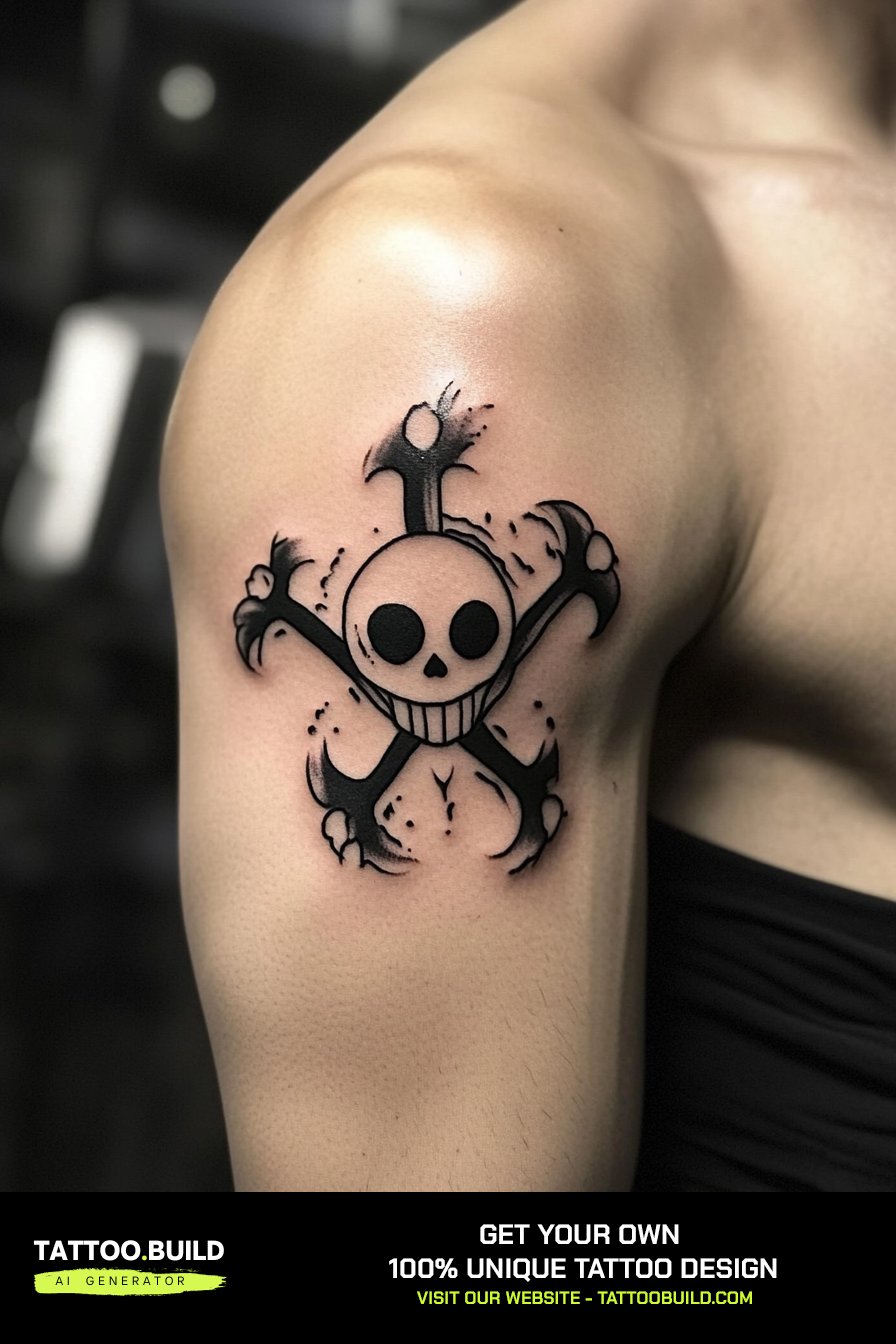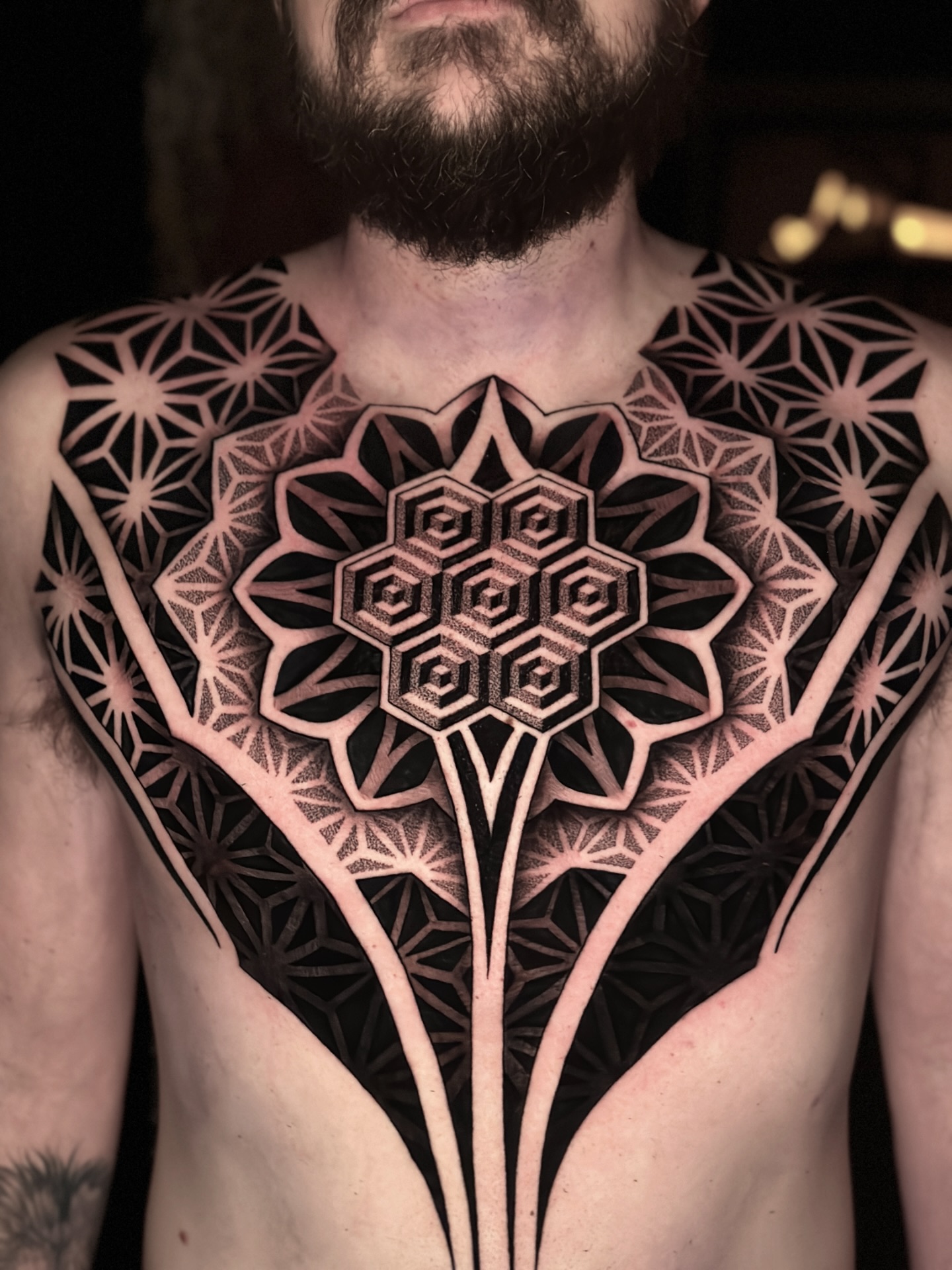
A chest piece is the single most public tattoo you can get that still lives under a shirt. That contradiction is exactly why men keep coming back to it.
I have sat through two chest sessions of my own and watched a lot more from the corner of the shop, and the thing nobody warns you about is how much the placement changes the design. A drawing that looks perfect flat on paper can collapse the moment it curves over a pectoral.
So this guide is not just a gallery. It covers what actually works on chest anatomy, what the sessions feel like, and how to plan a piece now that you can still extend later.
If you want a softer or more botanical direction than the ones below, the floral chest tattoo designs for men guide covers that lane separately.
Which Chest Tattoo Style Is Right for You?
Every style below sits differently on the chest, ages differently, and asks a different amount of you in the chair. This is roughly how they compare.
| Style | Typical Time | Ages Best When | Best For |
|---|---|---|---|
| Japanese (munewari) | Multiple full-day sessions | Bold outlines, generous spacing | Anyone planning a bodysuit or full sleeve later |
| Black & grey realism | 2–4 long sessions | Contrast is pushed harder than looks right on day one | Portraits, animals, religious imagery |
| Blackwork / geometric | 2–3 sessions | Solid fills are packed evenly | Graphic impact and symmetry |
| American traditional | 1–2 sessions | Lines are thick and colours are limited | The most reliable long-term readability |
| Fine line / script | Often a single session | Sized up rather than crammed small | Minimal statements and lettering |
| Biomechanical | 3+ sessions | Depth comes from real contrast, not detail | Wrapping the body rather than sitting flat |
The column that matters most is the third one. Almost every chest piece that disappoints its owner ten years on failed on contrast or line weight, not on concept.
Why Chest Anatomy Changes Everything
The chest is not a flat canvas. It has a hard ridge down the middle, two curved planes on either side, and a bone shelf across the top.
That geometry rewards designs with a natural centre and two mirrored halves. Wings, mandalas, twin animals and split panels all work because the body already suggests that structure.
It punishes designs that were composed as rectangles. A square scene placed on one pec tends to look pinned on rather than grown there.
Skin movement matters too. The chest stretches when you raise your arms, so anything with tight repeating detail near the armpit will distort more than the same detail near the sternum.
Then there is the pain, which is genuinely uneven across the area. The soft outer pectoral is manageable for most people, while the sternum, collarbone and the skin just under the nipple are the spots I hear men complain about every single time. The tattoo pain management tips guide is worth reading before a first chest session rather than after.
Chest Piece Tattoo Ideas That Actually Suit the Placement
These are grouped by design direction rather than as a countdown, because the direction is what you actually take to a consultation.
1. Eagles and Winged Designs
Wings and collarbones are almost the same shape, which is why an eagle with spread wings is close to a default chest composition.
The head sits at the sternum, the wings follow the clavicle line outward, and the tail feathers drop into the space between the pectorals.
The trap is scale. Men often ask for the eagle to sit small and central, and then it reads as a bird stuck to the chest instead of a design built for it.
American traditional handles this best in my experience. Heavy outlines, a limited palette, and feathers simplified into shapes rather than rendered individually will still look sharp in twenty years.
Realistic eagle work can be stunning fresh, but it asks for far more maintenance and far more contrast on day one to survive the same stretch of time.
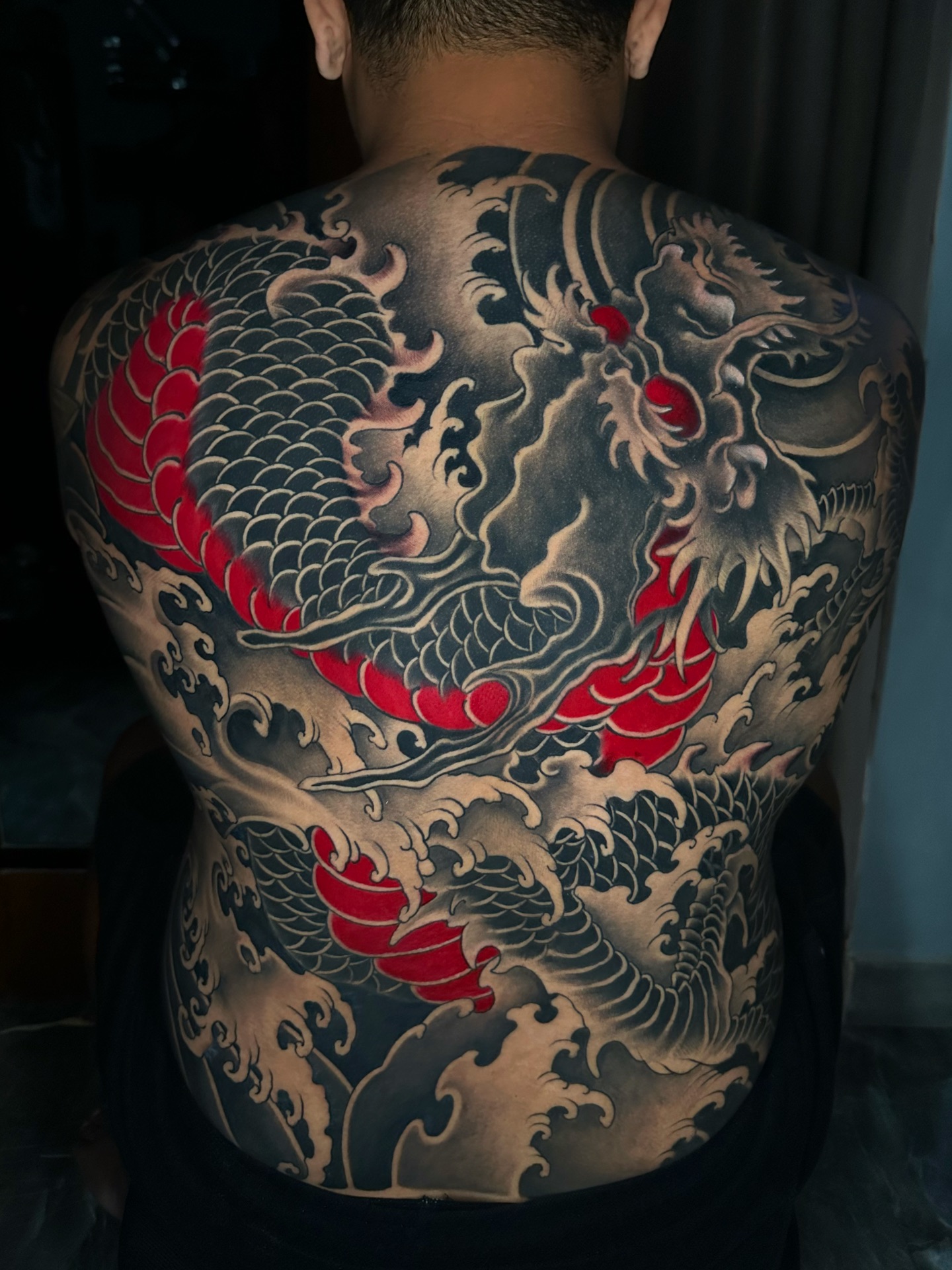
2. Japanese Munewari Chest Panels
Munewari is the traditional Japanese chest panel that runs down each side of the chest and leaves an open strip down the centre.
It exists for a practical reason. The open strip means the piece can grow into a full bodysuit later without a seam where two unrelated tattoos meet.
Common subjects are dragons, koi, hannya masks, tigers and peonies, usually set into a background of wind bars, water or clouds.
Every Japanese specialist I have asked says the same thing: commit to the background early. The background is what ties the chest to the arm, and adding it retroactively rarely looks as clean.
This is not a one-session tattoo. Expect several long sittings, and expect the artist to want to draw on your body rather than hand you a printed stencil. If the style appeals, the Japanese tattoo design guide covers the traditional subject matter in more depth.
3. Lions, Tigers and Big Cats
A lion sits on the chest better than almost any other animal because a mane is a radial shape and the sternum gives it a natural centre.
Placed correctly, the face lands on the flattest part of the chest and the mane spills outward across both pectorals.
Tigers usually work better in pairs, mirrored on each side, or worn Japanese-style prowling across the chest into a shoulder.
Black and grey is the safer choice here. Fur is built from thousands of short strokes, and colour realism in that much detail tends to soften noticeably as it settles.
If you like the structure of the subject but not photo-realism, a geometric lion design keeps the symmetry while ageing more predictably.
4. Geometric, Mandala and Ornamental Work
Ornamental chest pieces treat the body as architecture. A mandala centres on the sternum, and repeating patterns radiate out under the collarbones.
This is the style where artist choice matters most. Symmetry on a curved, moving surface is difficult, and a stencil that was perfect standing up can be crooked lying down.
Ask to see healed photos, not just fresh ones. Dotwork shading in particular can look dense and even on day one and then open up as it heals.
Ornamental work also layers well. Many men start with a sternum centrepiece and add wings, filigree or panel borders over several years.
For the solid-black end of this spectrum, blackwork designs are the most durable thing you can put on skin, provided the fill is packed properly the first time.
5. Skulls, Roses and Dark Traditional
Skull and roses has been a shop staple for over a century, and it has survived because the contrast between hard bone and soft petals reads instantly.
On the chest it usually takes one of two forms: a single large skull centred on the sternum, or a skull on each pectoral framed by foliage.
Daggers, snakes, moths and banners all slot into this family without looking bolted on.
Bold outlines are the whole trick. Dark traditional work stays legible for decades specifically because the structure is drawn, not shaded.
The rose and skull tattoo guide has more on how the two elements get balanced in practice.
6. Wolves, Owls and Wild Animals
A howling wolf head fits the hollow between the pectorals almost as if the placement were designed for it.
Owls are the other strong option, because outstretched owl wings mirror the chest the same way eagle wings do but with far more texture to play with.
Bears, stags and rams all work as well, though they tend to need more chest width than men expect.
In my experience the animal pieces that fail are the ones cropped at the neck with no context. A hint of forest, moon, or geometric framing gives the eye somewhere to go.
If you want structure over realism, geometric wolf designs solve the same composition problem with linework.
7. Sacred Hearts, Anatomical Hearts and Religious Work
Placing a heart over the actual heart is on the nose, and it works anyway.
The sacred heart version comes with built-in radiating rays that fill the upper chest naturally, and it pairs cleanly with a script banner under the collarbones.
The anatomical version is the more contemporary choice, usually rendered in fine black linework over the sternum.
Be honest with yourself about that spot. The sternum is thin skin directly over bone, and it is the part of the chest men most often ask to stop on.
Rosaries, praying hands, angels and cathedral architecture all sit in the same family and share the same advantage: they are vertical, so they use the length of the chest rather than fighting its width.
8. Script, Quotes and Abstract Blackwork
Lettering across the collarbones is the lowest-commitment chest tattoo that still makes a statement.
Size it generously. Small script crammed into a tight line is the single most common chest regret I hear about, because fine lettering thickens as it ages and can close up.
Stick to one language you actually read, and get the spelling checked twice by someone fluent before the stencil goes on.
Abstract blackwork is the opposite approach: brushed textures, gradients and shapes with no literal subject at all.
It suits people who want the visual weight of a chest piece without explaining what it means every time someone asks.
Alternatives and Variations Worth Considering
If a full chest piece feels like too much for a first move, these are the middle grounds men most often take.
Single-Pectoral Pieces
One pectoral, one design, centre of the chest left bare. It is half the commitment and half the chair time, and it can be balanced later with a matching piece.
Just make sure the design is composed to sit on a curve rather than as a flat rectangle.
Chest-to-Shoulder Extensions
Starting on the shoulder and letting the design creep onto the upper chest gives you a chest tattoo that is far easier to hide and noticeably less painful.
This is also the standard first step toward a full sleeve, since the shoulder cap is the joint between the two.
Sternum-Only Work
A narrow ornamental strip down the sternum is a small tattoo with an outsized visual effect, and it leaves both pectorals completely open for later.
It is small in surface area but not gentle. Thin skin over bone is thin skin over bone.
Under-Chest and Rib Continuation
Letting a chest design drop under the pectoral onto the ribs adds depth and makes the piece feel like it belongs to the body rather than sitting on the front of it.
Ribs hurt more than the chest for most people, so plan that as a separate session rather than a bonus at the end of a long day.
Practical Advice Before and After the Session
Eat a real meal beforehand and bring something sugary. Chest sessions run long, and a blood sugar crash in the chair is miserable and avoidable.
Wear a button-up shirt to the appointment. Pulling a t-shirt over a fresh chest piece afterwards is the kind of small mistake you only make once.
For healing, follow the aftercare your artist gives you rather than advice from the internet, and keep it simple: clean, dry, lightly moisturised, out of the sun. The American Academy of Dermatology publishes straightforward guidance on caring for tattooed skin.
Sleep on your back for the first several nights, skip the gym for at least a week, and stay out of pools, lakes and hot tubs until the peeling has fully finished.
If you notice spreading redness, swelling that worsens after the first few days, pus, or a fever, that is a doctor visit, not a message to your artist. Allergic reactions to certain pigments are also possible, and both the FDA and Mayo Clinic cover the known risks. Nothing in this article is medical advice.
Still Not Sure? Common Chest Tattoo Mistakes
Going too small is the mistake I see most. The chest is a large canvas, and a design sized for a forearm gets swallowed by it.
Ignoring future plans is the second. If there is any chance you will want a sleeve one day, tell the artist now so the chest piece is composed with an exit point.
Choosing an artist by price rather than portfolio is the expensive one, because a chest piece is difficult to cover and difficult to remove.
And rushing the design is the quiet one. A good artist will want a consultation, a drawing, and often a stencil session before any needle touches you.
If you are still weighing subjects, it can help to look at how the same imagery reads elsewhere on the body — phoenix designs for men and samurai tattoo ideas are both worth browsing before you commit chest real estate to them.
Frequently Asked Questions
How painful is a chest tattoo?
It varies a lot by spot rather than by person. The outer pectoral is comparable to an outer bicep for most people, while the sternum, collarbone and the skin around the nipple are consistently described as much sharper. Sessions are also long, so fatigue becomes its own kind of pain by hour four. In my experience the outer areas are very manageable and the centre line is where people ask for breaks.
How long does a full chest piece take?
Most full chest pieces are built over multiple sessions rather than in one sitting. A single-pectoral design might be finished in one long day, while a full Japanese panel or a detailed realism piece usually runs across several full-day appointments spaced weeks apart. Your artist will give you a realistic estimate after seeing the drawing. Healing time between sessions is normally two to four weeks.
Will a chest tattoo stretch if I gain or lose weight?
Moderate weight changes usually have little visible effect on chest work. Significant gain or loss, or a large change in chest muscle mass, can distort tight detail more than bold designs. This is one reason artists favour heavier line weight and generous spacing on the chest. It is worth mentioning any planned major body changes at the consultation.
Can I get a chest tattoo as my first tattoo?
You can, and some people do, but it is a demanding place to start. The pain is uneven, the sessions are long, and the cost is high, so you are learning how your body handles tattooing on the hardest possible test. Many artists will suggest a smaller piece first so you know what to expect. That is advice worth taking rather than a gatekeeping move.
Should I get the chest or the sleeve done first?
Artists are split on this, but the common argument for the chest is that it is easier to design a sleeve around an existing chest piece than the reverse. Japanese work in particular is usually planned chest-first for that reason. If you are only ever getting one of the two, the order does not matter. Tell your artist your long-term plan either way.
Quick Summary
- Design for the anatomy — the chest has a natural centre line and two mirrored planes, so use them.
- Go bigger than feels comfortable. Undersized chest tattoos are the most common regret.
- Bold outlines and real contrast are what keep a chest piece readable decades later.
- Decide early whether this will ever connect to a sleeve, and tell your artist at the consultation.
- Expect multiple sessions for anything beyond a single-pectoral design.
- The sternum, collarbone and area under the nipple are the sharpest spots; the outer pec is the easiest.
- Choose the artist on healed portfolio work, not on price or on fresh photos.
- Follow your artist’s aftercare, sleep on your back, and see a doctor rather than a tattooer if something looks infected.