Some of the best tattooing I have ever seen in person was done on deep brown and ebony skin, and almost none of it looked like the flash on the studio wall. Dark skin does not limit what you can get tattooed — it changes which design decisions actually matter.
The short version, learned from years of watching pieces heal rather than reading captions on fresh photos: line weight, value separation and pigment density do the heavy lifting. Subtlety is the thing that struggles, not colour.
I have watched delicate single-needle scripts on rich brown skin blur into an unreadable smudge inside two years, while a heavy blackwork design done on the same person in the same year still looks like it was finished last month.
What follows is 21 ideas that hold up, plus the practical reasoning behind each one — including where the advice runs out and you need an artist to make the call.
Which Tattoo Styles Work Best on Dark Skin?
This is the quick orientation I give friends before they start looking at portfolios. It is a starting point, not a rulebook — a genuinely skilled artist can break any line in this table.
| Style | How It Reads on Deep Skin | Best For | Watch Out For |
|---|---|---|---|
| Bold blackwork | Excellent — the most dependable option | Geometry, silhouettes, large-scale pieces | Negative-space gaps cut too thin |
| Traditional / neo-traditional | Very good — heavy outlines carry it | Animals, florals, classic imagery | Pale or pastel fills inside the outline |
| Tribal and Polynesian | Excellent — designed for this contrast | Shoulders, sleeves, chest panels | Finding an artist trained in the tradition |
| Black and grey realism | Good with an experienced artist | Portraits, animals, statues | Mid-tones collapsing into the skin |
| Saturated colour | Good if pigment is packed densely | Deep reds, purples, blues, forest greens | Yellows and pastels reading muddy |
| Fine line and micro-realism | Hardest to keep readable long term | Small, simple, high-contrast shapes | Blurring and fading within a few years |
| Watercolour and white ink | Poor — the effect largely disappears | Rarely the right call here | Looking great fresh, vanishing healed |
What Actually Changes When You Tattoo Melanin-Rich Skin
Tattoo ink sits in the dermis, underneath the epidermis. Melanin lives in the epidermis, which means every tattoo on darker skin is viewed through a warmer, denser filter.
That filter does two things. It compresses the range between your lightest and darkest tones, and it shifts how certain pigments read once healed.
The practical consequence is that contrast has to be built into the design, not added later. On pale skin an artist can rescue a flat tattoo with a white highlight; on deep skin that highlight rarely does the job.
This is why bold styles dominate the list below. It is not a lack of options — it is a different set of levers, and the ones that work happen to be the ones that also age best on any complexion.
Skin tone also varies enormously within the label “dark skin”. A rich caramel forearm and a deep ebony shoulder behave differently, and so does the same person’s inner arm versus their outer arm. If you want the broader landscape first, our guide to tattoo styles covers what each style is actually trying to do.
One more thing worth naming honestly: the American Academy of Dermatology notes that Black people are the most likely group to develop keloid scars. If you keloid, raise it with your artist and a dermatologist before booking, not after.
21 Tattoo Ideas That Look Incredible on Dark Skin
Each of these has a reason behind it. I have grouped them roughly from most forgiving to most demanding of the artist.
1. Bold Blackwork Geometric
Solid black geometry is the safest bet in tattooing on deep complexions, and it is also some of the most striking. Crisp edges, heavy fills, and deliberate negative space give you a design that reads from across a room.
The one thing to insist on is generous gaps. Every line spreads slightly over the years, so negative-space channels that look elegant at 1mm fresh can close up into a solid mass by year five.
Mandalas, sacred geometry, and abstract compositions all live comfortably here. In my experience this is the category where clients are happiest at the ten-year mark.
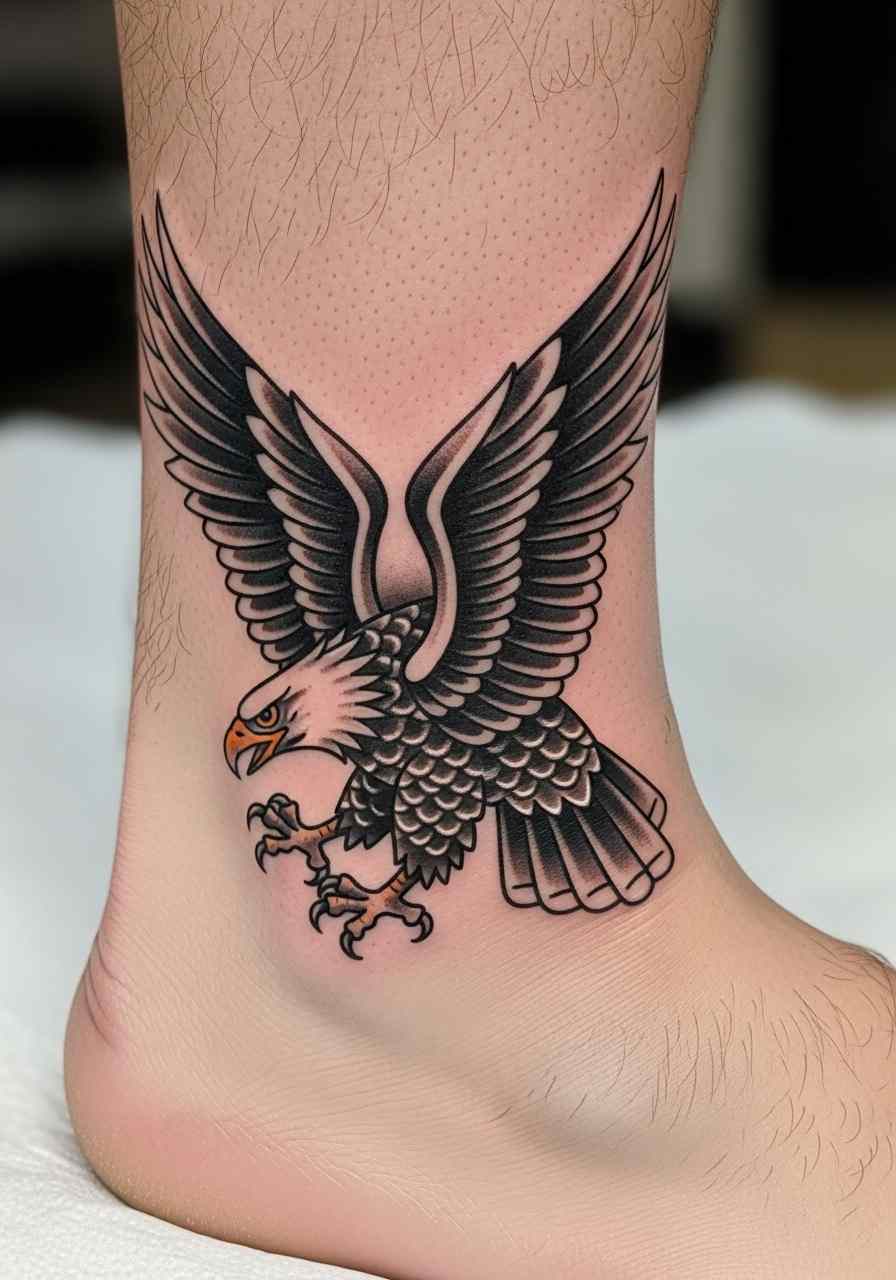
2. Traditional American Bold Lines
American traditional was designed in an era before high-resolution photography, for tattoos meant to be legible after decades at sea. That design brief happens to suit dark skin perfectly.
The heavy black outline does the structural work. Inside it, deep reds, purples and forest greens hold their character; the classic yellows and pale flesh tones are the ones that tend to disappear.
Every artist I have asked about this gives the same advice — swap the pale fills for darker equivalents and keep the outline weight up.
3. Tribal and Polynesian
Traditional Polynesian, Samoan and related tattooing developed on brown skin, by artists working on brown skin, for centuries. The visual language assumes this contrast rather than working around it.
Bands, spirals and dense pattern fields wrap the body and use bare skin as an active design element. Scale up rather than down — these designs are built to occupy a shoulder or a full sleeve.
If you are drawn to this direction, read up on the cultural side first. Our Polynesian tattoo guide covers which motifs carry specific meaning and which do not.
4. Blackwork Animal Portrait
A wolf, panther, raven or bull rendered as a solid black silhouette with negative-space detail is one of the most consistently successful things I see on deep skin.
The trick is that the animal is defined by where the ink stops. No delicate internal shading is required, so nothing gets lost as the piece settles.
Ask to see a healed photo of the artist’s silhouette work before booking. Fresh photos hide the exact failure mode you are trying to avoid.
5. Mandala in Bold Linework
Mandalas translate beautifully, but the standard fine-line mandala template does not. The version that works uses noticeably heavier line weight and wider spacing between rings.
Ask your artist to draw the mandala for your skin rather than resizing a stock design. The difference between the two shows up around year three.
Shoulder caps, forearms and thighs all give enough real estate to keep the geometry open. There are plenty of layout directions in our mandala tattoo collection.
6. Neo-Traditional Botanical
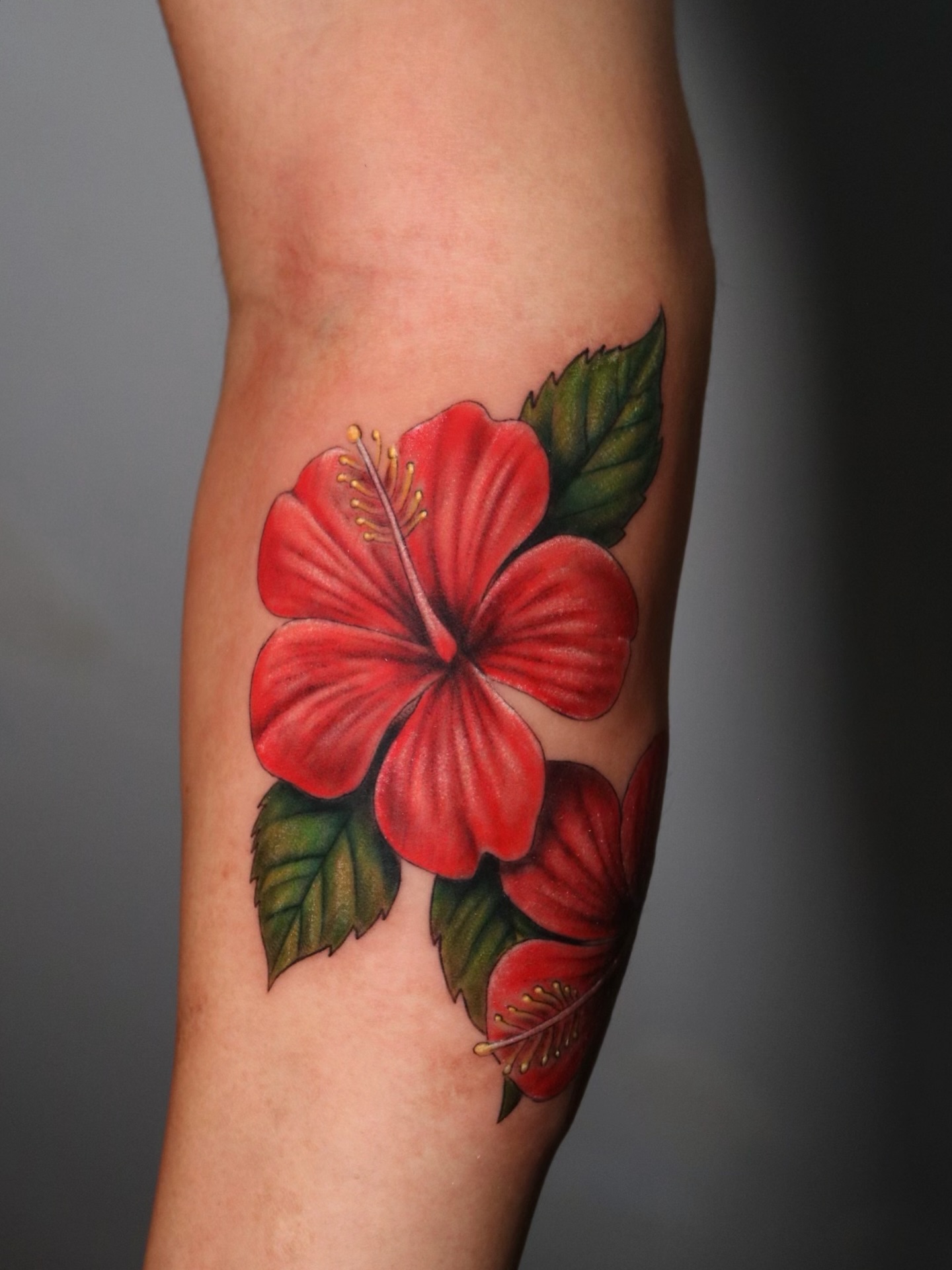
Neo-traditional keeps the bold outline of traditional work but allows more rendering and a richer palette. On dark skin that combination is genuinely underrated.
Roses, peonies, magnolias and protea all work. Push toward deep burgundy, aubergine, teal and ochre rather than pastel pinks.
When I tested this thinking against a few artists’ portfolios, the healed neo-traditional florals that still popped were universally the ones with the darkest colour choices.
7. Dotwork and Stippling
Dotwork is a partial exception to the “bold or nothing” rule, but only when the dots are packed densely enough to read as tone rather than as individual points.
Sparse stippling — the airy, gradient style that looks so good on pale skin — tends to fade into the background here. Dense fields with hard edges do not.
Used as a texture inside a blackwork shape, dotwork adds depth without risking legibility. Browse dotwork tattoo ideas to see the density difference for yourself.
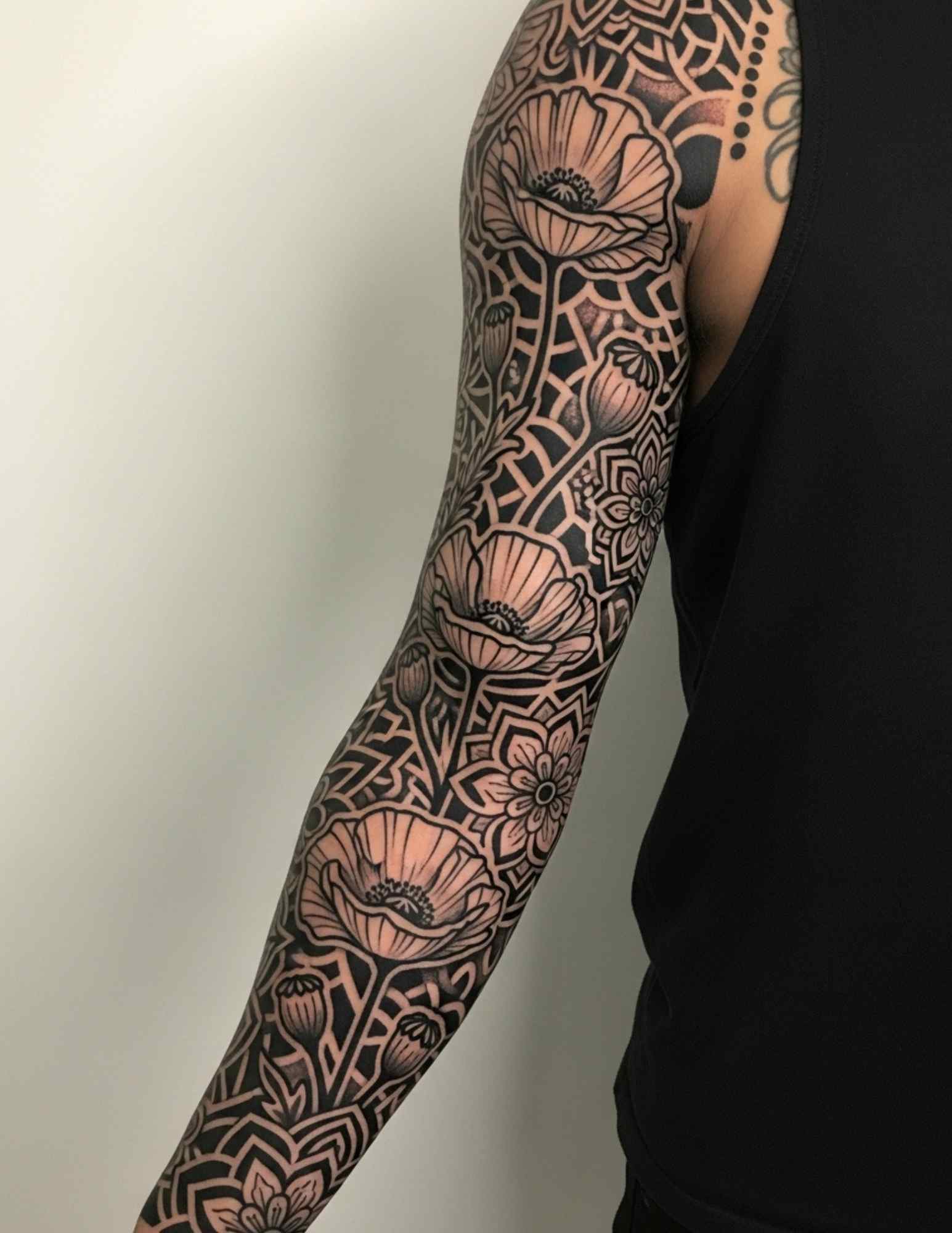
8. Blackwork Sleeve
A full or half blackwork sleeve is, in my view, the single most impressive thing a dark-skinned client can commission. Large areas of solid black against deep skin have a depth that photographs never quite capture.
Plan the whole sleeve before the first session. Blackwork sleeves succeed or fail on how the negative space flows around the arm, and you cannot retrofit that.
Expect multiple long sessions and significant cost. Solid black fill is slow work and it is hard on the skin.
9. Maori-Inspired Patterns
Māori tā moko and the wider family of curvilinear Pacific patterning follow the body’s musculature rather than sitting on top of it.
The koru spiral and related forms build dense, flowing black fields that read cleanly on any complexion and particularly well on deep ones.
Authentic tā moko carries genealogical meaning and is not open to everyone. If you are outside the culture, work with an artist who will tell you plainly where the line sits.
10. Large Scale Illustrative
Illustrative work — comic-influenced, etching-influenced, storybook-influenced — succeeds on dark skin when it is scaled up and the line weight is scaled with it.
The failure mode is shrinking a detailed illustration to fit a forearm. Detail that survives on paper does not survive in skin at the same size.
My rule of thumb from watching these heal: if the artist would normally use a 5-liner, ask what an 9-liner and 30% more size would look like.
11. Script in Bold Font
Lettering is where I have seen the most disappointment, almost always because the client chose a delicate hairline script.
Blackletter, bold brush script, heavy serif and chicano-style lettering all hold. Thin cursive with hairline connectors is the one to avoid.
Read the words out loud in the studio before the stencil goes on. Spelling errors in lettering are the most common regret I hear about, on any skin tone.
12. Black and Grey Realism
Realism is achievable and can be spectacular, but it is the category where the artist matters most.
The technical challenge is that your mid-tones have less room to sit between highlight and shadow. Artists who work regularly on deep skin solve this by pushing the darks darker and simplifying the value structure.
Only book realism with someone whose portfolio shows healed realism on skin like yours. Our black and grey collection shows the range that is possible.
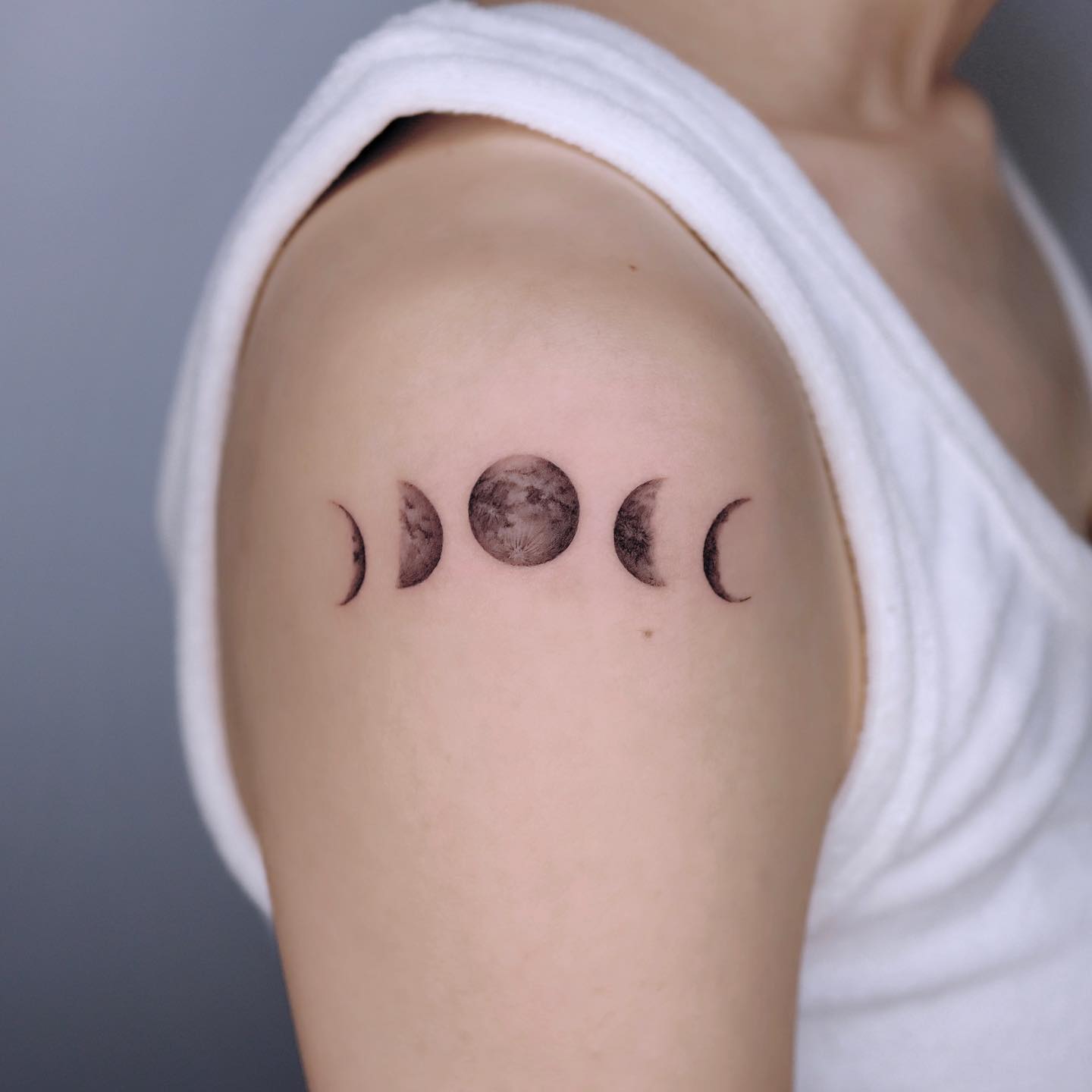
13. Celestial Blackwork
Moons, suns, stars and constellations rendered in solid black are a natural fit, partly because celestial imagery is already built from simple, strong shapes.
Crescent moons with negative-space craters, solid-black suns with radiating spikes, and filled star fields all work at small and large scale.
Skip the tiny dotted constellation lines. They are lovely on pale skin and they disappear here.
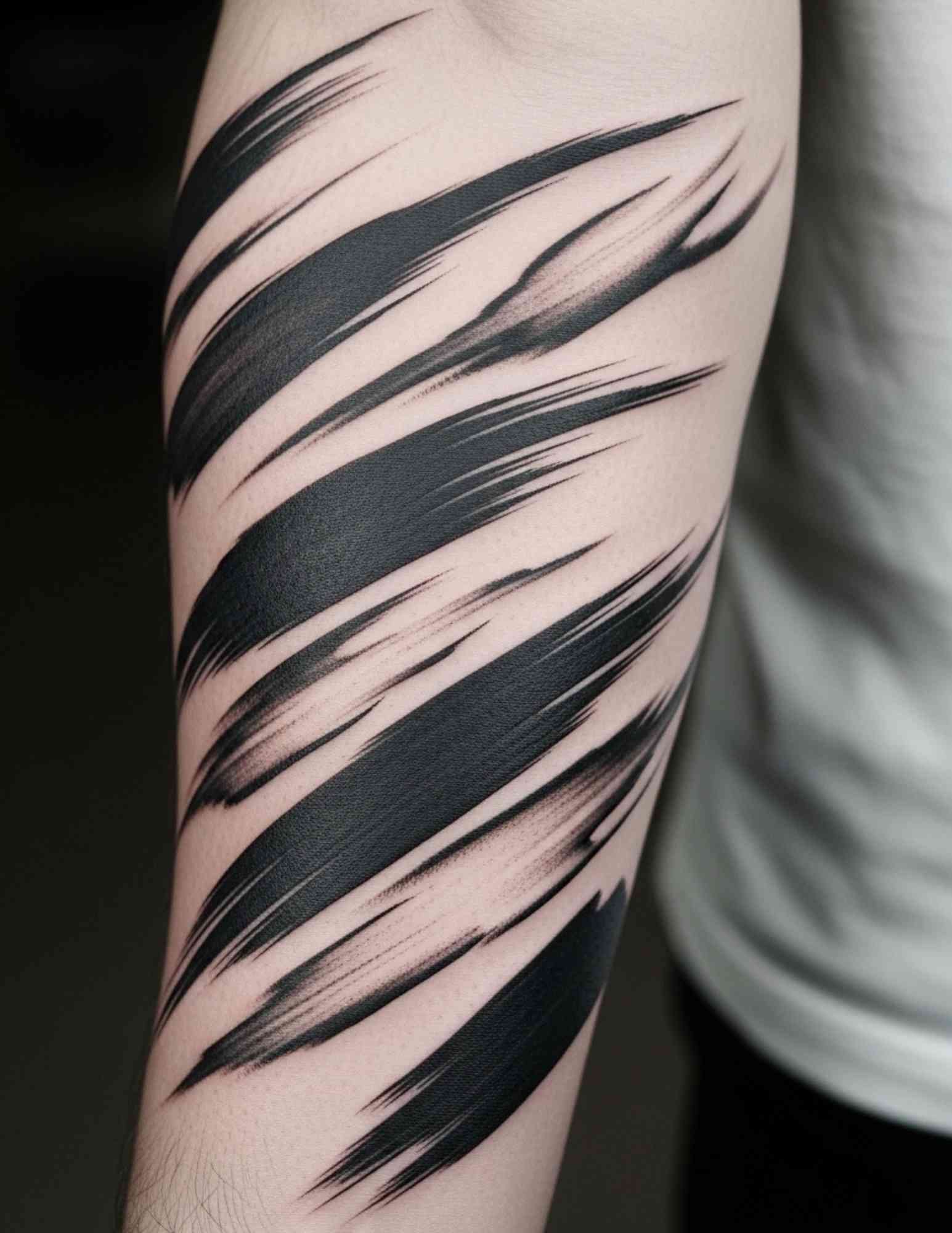
14. Abstract Blackwork
Abstract blackwork treats bare skin as one of the two colours in the composition, which is exactly the right mental model for deep complexions.
Brush strokes, ink washes rendered as solid shapes, and hard-edged organic forms all give you movement without depending on fine detail.
This style also ages unusually well, because there is no small detail to lose.
15. Floral in Rich Colour
Colour absolutely works on dark skin. The requirement is density — the pigment has to be packed to full saturation rather than laid in thinly.
Deep red, magenta, violet, cobalt, emerald and burnt orange all hold their identity. Baby pink, pale yellow and pastel mint generally do not.
Ask your artist directly how many passes they make on colour packing. The ones who are good at this have a specific answer.
16. Scarification-Inspired
Blackwork that borrows the visual language of traditional West African and Pacific scarification — raised-looking parallel lines, dot clusters, geometric bands — carries real weight on dark skin.
To be clear, this means tattooing that references the aesthetic, not actual cutting or branding. Do not attempt scarification at home under any circumstances.
If this direction interests you, look for an artist with a genuine connection to the tradition rather than treating it as a graphic style.
17. Portrait in Bold Black and Grey
Portraits of family members are among the most requested pieces I hear about, and they are demanding on every skin tone.
On deep skin, the portraits that succeed simplify. Fewer value steps, harder edges between light and shadow, more willingness to leave areas as pure black or pure skin.
Bring a high-contrast reference photo taken in strong directional light. A flat, evenly lit photo gives the artist nothing to work with.
18. Blackwork Floral
If you want florals with zero risk of fading into ambiguity, blackwork florals are the answer.
Heavy petals, solid stems and negative-space veining give you botanical softness with graphic strength.
Roses, lilies, chrysanthemums and monstera leaves all suit the treatment. Keep the internal gaps wider than looks necessary on the stencil.
19. Animal in Neo-Traditional Colour
A tiger, snake, koi or moth in neo-traditional colour is a design that rewards the bold-outline-plus-dense-pigment formula perfectly.
The outline holds the silhouette from a distance; the saturated colour rewards a closer look. Both jobs get done.
This is one of the few colour categories where I have consistently seen healed results match the fresh photos.
20. Sacred Geometry
Flower of life, Metatron’s cube, torus forms and nested platonic solids all rely on precise repeating structure — which is the strength, not the risk, when the linework is heavy enough.
The failure mode is the fashionable hairline version. Ask for the same composition at double the line weight and it becomes a completely different, far more durable tattoo.
There are dozens of layouts in our sacred geometry tattoo guide if you want to bring references to a consultation.
21. Blackwork Nature Scene
Forest silhouettes, mountain ranges, waves and night skies built from solid black shapes give you scenic scale without fine detail.
Because everything is silhouette, the composition reads instantly and stays readable indefinitely.
These work especially well as bands — around a forearm, a calf, or wrapping a bicep — where the shapes can flow around the limb.
Placement and Scale Variations Worth Considering
Where a tattoo sits changes how it reads, and on deep skin the effect is more pronounced than most people expect.
Inner Arm and Inner Thigh
These areas are usually a shade or two lighter than the outer surfaces, which gives you slightly more tonal room.
If you want the one detailed piece in an otherwise bold collection, this is where I would put it.
Going Larger Than Planned
The most common adjustment I see clients make after a consultation is scaling up by 20 to 30 percent.
It is almost always the right call. Size buys you line weight, and line weight buys you longevity.
Negative Space as the Subject
Instead of drawing a shape in black, block out the area around it and let bare skin form the image.
This is a distinctly flattering approach on deep complexions and it is badly underused.
Bands and Wraps Instead of Panels
A solid or patterned band around a limb reads cleanly at any distance and works with the body’s shape.
Bands also age extremely well, since there is no internal detail to soften.
Healing and Aftercare on Deep Skin Tones
The healing process itself is the same regardless of complexion, but two things are worth flagging.
The first is post-inflammatory hyperpigmentation. Darker skin is more prone to darkening around a healing wound, and that shadow can sit around a fresh tattoo for weeks or months before settling.
It usually resolves on its own. If it is still obvious after several months, that is a conversation for a dermatologist rather than your artist.
The second is sun exposure. Melanin provides real but partial protection, and it does nothing to stop tattoo ink from fading. Daily broad-spectrum sunscreen on a healed tattoo is the single cheapest thing you can do for it.
Beyond that, standard practice applies — keep it clean, keep it lightly moisturised, do not pick, and follow whatever your artist told you over whatever the internet told you. Our tattoo aftercare guide covers the routine in detail.
Knowing what normal looks like at each stage saves a lot of panic in week two. The tattoo healing stages breakdown walks through the timeline.
If you develop spreading redness, heat, pus, or a fever, that is not a healing stage — see a doctor. The FDA fact sheet on tattoos lists infection and allergic reaction among the risks worth taking seriously. Nothing in this article is medical advice.
Common Mistakes — and Where to Look Next
The mistakes I see repeated are frustratingly avoidable.
Choosing an artist from fresh photos alone is the biggest one. Fresh ink looks vivid on every skin tone; healed ink is the only honest test. Ask specifically for healed work on deep complexions.
Accepting “colour does not work on dark skin” is the second. It is a lazy answer that usually means the artist has not developed the technique — find someone who has.
Shrinking a design to save money is the third, and it costs more in the long run because the piece needs reworking sooner.
If you are still deciding who to book, our guide on how to find a tattoo artist covers the questions worth asking in a consultation.
Frequently Asked Questions
Do tattoos on dark skin fade faster?
Not inherently. Tattoo ink fades at a similar rate regardless of complexion, and melanin actually offers a small amount of extra UV protection. What differs is how visible the fading becomes — a design that relied on subtle tonal separation loses legibility sooner than one built on bold contrast. Choosing a bold style is what protects longevity, not skin tone itself.
Can you get colour tattoos on dark skin?
Yes, and the results can be excellent. The requirement is dense pigment packing and a palette weighted toward deep, saturated colours — reds, purples, blues, greens and burnt oranges. Pale yellows, pastels and white ink are the ones that genuinely struggle. Look for an artist whose healed portfolio shows colour work on skin similar to yours.
Does white ink show up on dark skin?
Rarely in the way people hope. White ink is translucent and sits under the epidermis, so on deep skin it usually heals to something barely distinguishable from the surrounding tone. Used as a small highlight inside a heavily contrasted design it can add a touch of lift, but as a standalone design it almost never delivers. Most artists I have spoken to will talk clients out of it.
Is tattooing more painful on dark skin?
No — pain is driven by placement, session length, your own nerve density and how you are feeling that day, not by melanin. Ribs, sternum, feet and inner arms hurt more than thighs and outer arms for everyone. The one indirect factor is that bold styles often mean more solid black fill, and long fill sessions are tiring in a way that outline work is not.
How do I find an artist experienced with dark skin?
Search hashtags for tattoos on brown and Black skin, then check whether the portfolio includes healed photos rather than only fresh ones. Message the artist directly and ask how often they work on deep complexions. A good answer is specific and confident; vagueness or defensiveness is your signal to keep looking. Consultations are usually free, so meeting two or three artists costs you nothing but time.
Quick Summary
- Bold blackwork is the most reliable and most striking choice on deep skin tones.
- Contrast has to be designed in from the start — it cannot be added with highlights later.
- Colour works well when it is deep, saturated and densely packed; pastels and white ink do not.
- Traditional, neo-traditional, tribal and Polynesian styles all suit dark skin exceptionally well.
- Fine line work and micro-realism are the hardest styles to keep readable over time.
- Scale up and thicken line weight — size and weight buy you longevity.
- Judge an artist only on healed photos of work on skin like yours, never on fresh ones.
- Watch for hyperpigmentation and keloid tendency, and raise either with a doctor rather than guessing.