The third eye is one of the few tattoo subjects that works at almost any size, in almost any style, and still reads instantly as itself. An eye, a triangle, a few rays. That is the whole vocabulary, and it has survived centuries of reinterpretation.
I have watched this design move through my own consulting notes more than almost any other symbol. People arrive wanting something spiritual but not literal, meaningful but not obvious, and the third eye keeps landing in that gap.
What follows is the full set of directions I actually suggest when someone sits down and says they want one: nineteen designs, the styles that suit each, and the honest trade-offs of placement. If you are still deciding on a broader theme, our guide to spiritual tattoo ideas covers the wider field.
A word before the list. The symbol carries real religious weight in Hindu and Buddhist practice, and that is worth knowing before you commit ink to skin, not after.
Photo: @mayurtattoos
Which Third Eye Style Is Right for You?
Style choice affects cost, healing, and how the piece looks in ten years more than the subject does. This is roughly how the main approaches compare.
| Style | Typical size | Sitting time | Ages best on | Best for |
|---|---|---|---|---|
| Fine line | 2-4 in | 1-2 hours | Inner forearm, ribs, sternum | Subtle, first tattoos |
| Dotwork / stippled | 3-6 in | 2-4 hours | Chest, outer arm, thigh | Soft shading without heavy black |
| Blackwork / ornamental | 5-10 in | 4-8 hours | Upper arm, back, thigh | Bold pieces meant to last decades |
| Black and grey realism | 4-8 in | 4-6 hours | Inner forearm, calf, chest | Anatomical detail in the iris |
| Colour / watercolour | 3-6 in | 2-5 hours | Covered areas, away from sun | Flames, cosmic washes, bright irises |
If nothing in that table settles it, the honest answer is usually blackwork or fine line. Those two hold their shape longest in my experience, and the eye is a shape you want to still be readable.
What the Third Eye Actually Means
In Hindu tradition the third eye is the ajna chakra, sitting between the brows, and it is also the eye of Shiva — the one that opens to burn away illusion. That second association is why so many Shiva pieces put the eye vertically rather than horizontally.
Buddhist iconography uses the same position on the forehead as a mark of insight, often shown as a dot or urna rather than a full eye — a mark, not a rendered eye.
Western esotericism took a different route. The eye in the triangle came through Renaissance Christian art as the Eye of Providence, then into Masonic imagery, and only later got folded into the general vocabulary of the occult.
The pineal gland association is more recent still — a nineteenth and twentieth century idea, not an ancient one. It is worth being clear about that if someone asks you what your tattoo means.
Most people getting one today mean something simpler: pay attention, look past the obvious, trust your own read of a situation. That is a perfectly legitimate reason, and every artist I have asked says it is the most common one they hear.
19 Third Eye Tattoo Ideas
1. Classic Third Eye in Triangle
An eye centred in a triangle, point up or point down. It is the format most people picture, and it has the advantage of being self-contained — the triangle gives the design an edge so it does not float on the skin.
It scales unusually well. I have seen the same composition work at two inches on a wrist and at ten inches across a back, which is rare.
Point-up traditionally reads as fire and ascent, point-down as water and receptivity. Most artists will not assume either, so say which you want.
2. Geometric Mandala Third Eye
The eye sits at the centre of a mandala, with geometric pattern radiating outward. The structure does the heavy lifting — the eye becomes a focal point rather than the whole subject.
This is the version I most often recommend to people who want scale without a narrative. There is nothing to explain; it is just balanced.
Expect a long session. Ornamental linework of this density usually runs four hours or more, and the symmetry means a rushed job shows immediately. See our lotus mandala designs for related layouts.
3. Realistic Eye with Sacred Geometry
A photorealistic eye with geometric linework laid over or behind it: Flower of Life, Metatron’s Cube, simple radial constructions.
The tension is the point. The eye is wet and organic, the geometry is flat and exact, and the two fight in a way that holds attention.
This one asks for a specialist. Realism and clean geometric line are different skill sets, and not every artist does both well — check a portfolio for both before booking. Our geometric tattoo guide is a good place to see the range.
4. Shiva Third Eye
The specifically Hindu version: a vertical eye, usually stylised rather than anatomical, often with the crescent moon, trishula, or flame.
Flames around the eye are not decoration. In the mythology the third eye of Shiva destroys what it looks at, and the fire is the standard visual shorthand for that.
If you have a genuine connection to the tradition this is the most precise version available. If you do not, it is worth thinking about — see our Shiva tattoo guide for the broader iconography.
5. Third Eye with Lotus
The eye set beneath, above, or inside a lotus. Both symbols point at the same idea — awakening — so the pairing is coherent rather than decorative.
It suits fine line particularly well. The petals give you soft repeating curves that offset the hard oval of the eye.
Teardrops falling from the eye are a common addition and shift the meaning noticeably, toward grief or release rather than pure insight. Decide whether you want that.
6. Minimalist Open Eye
No triangle, no rays, no frame. Just the eye, clean, usually under two inches.
This is the version I suggest most often to people getting their first tattoo, and it is the one people regret least in my experience.
The caveat with any fine line piece: thin lines soften over years, and very small detail in the iris can blur. Ask your artist to keep the interior simple rather than packing it. Our fine line guide goes into how these age.
7. Third Eye and Moon Phases
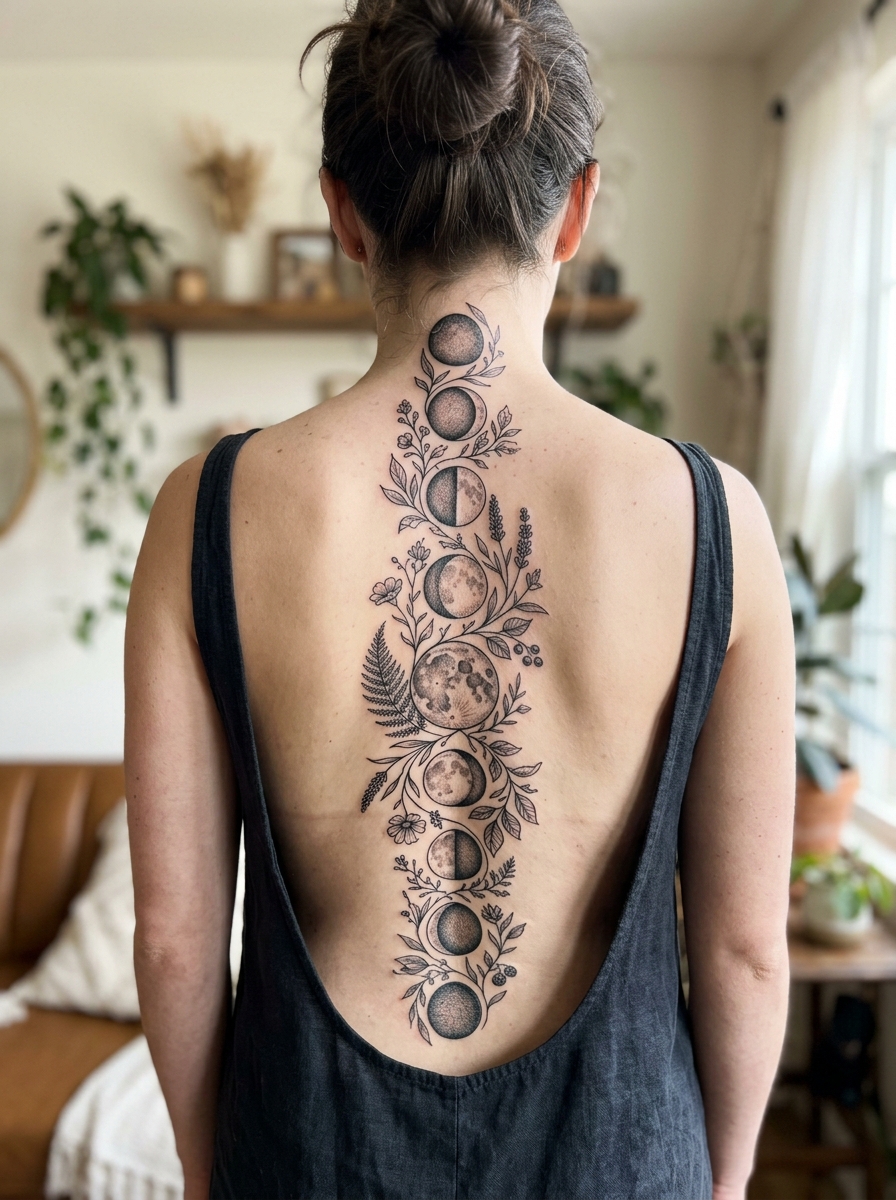
A row of moon phases arcing above the eye, usually along the inner forearm or spine where the vertical line has room.
The arrangement reads as time passing over perception, which is a neater idea than most symbol pairings manage.
Practical note: moon phases need consistent spacing to look right, and they are one of the details that most often gets crowded when a design is scaled down. Give it length.
8. Blackwork Third Eye
Heavy solid black, minimal shading, strong negative space. The eye may be carved out of a black field rather than drawn onto skin.
This is the version that ages best, and it is not close. Solid black holds its edge for decades where fine grey wash does not.
It is also the least reversible. Large areas of saturated black are difficult to cover and difficult to remove, so be more certain than usual before committing. See blackwork designs for what the style can do.
9. Sketch Style and Abstract Line
Loose, unfinished-looking linework where the eye emerges from an abstract form rather than sitting inside a tidy frame.
I like this direction because it sidesteps the symbol’s biggest weakness — how familiar the standard version has become.
It requires trust in the artist. Sketch style is genuinely a drawing style, not a shortcut, and the good ones will want latitude to design it themselves.
10. Celestial Third Eye
The eye placed among stars, clouds, and a crescent moon, sometimes with the iris rendered as a night sky or a planet.
It is the easiest version to expand later. A celestial field gives an artist obvious room to grow the piece into a half sleeve if you want one.
Colour works here more than anywhere else on this list — a red or amber iris against grey cloudwork carries real weight. Our celestial tattoo ideas cover the surrounding elements.
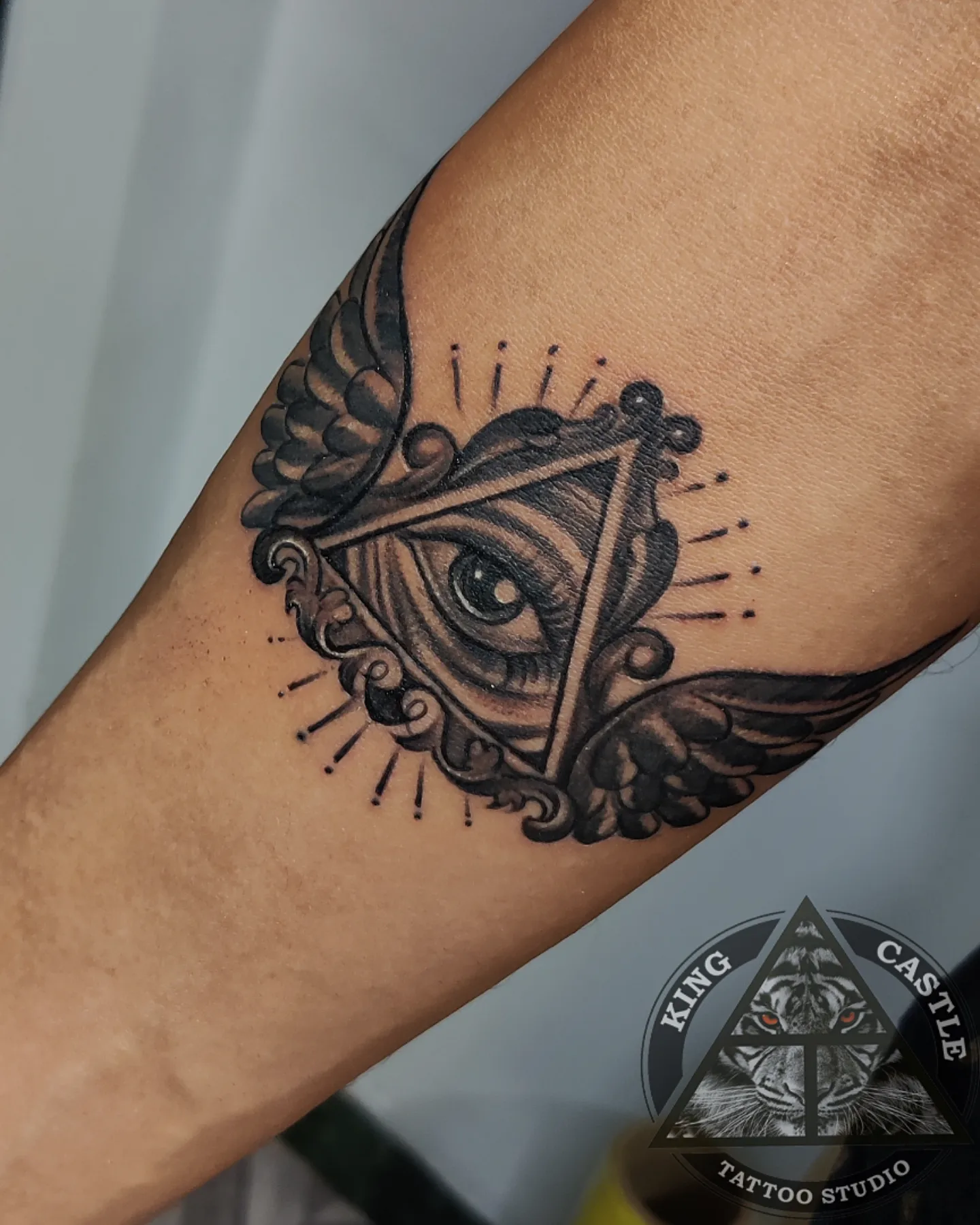
11. Third Eye with Wings
Feathered wings either side of the eye, often with rays. The winged eye is an old motif — it appears in Egyptian revival and Masonic imagery — and it gives the design horizontal spread.
That spread is the practical advantage. The inner forearm, the chest, and the upper back all suit a wide shallow shape better than a tall one.
Wings also let an artist balance the composition without adding more symbols, which keeps the piece from turning into a collage.
12. Third Eye with Crystals
Faceted crystals or a single quartz point framing the eye. The flat planes of a crystal give an artist a reason to use hard-edged shading next to the soft eye.
It has become a common request in the last few years, particularly in fine line and dotwork.
Keep the facet count low. Too many planes at small scale turn into grey mush as the tattoo settles.
13. Third Eye Hand and Palm
An eye on the palm or back of the hand — the hamsa lineage, where an eye set in a hand is a protective sign across several Middle Eastern and North African traditions.
Be realistic about hand tattoos. Palms hold ink poorly and often need touching up, and hands generally fade faster than covered skin because of sun and washing.
Back of the hand holds noticeably better than palm, so if you want it on the hand at all, that is where I would put it.
14. Third Eye and Serpent
A snake coiled around or through the eye. In yogic imagery the serpent is kundalini energy rising to the crown, so the pairing has a real basis rather than being purely aesthetic.
Visually, the snake gives you a long flowing shape to wrap around a limb, which solves the placement problem that a static eye creates.
It is a busier design than most on this list. Give it space — a forearm or calf rather than a wrist.
15. Watercolour Third Eye
Loose colour washes behind a fine black line eye, edges left deliberately soft.
I am cautious recommending this one and I will say so plainly: watercolour without a black line structure underneath tends to lose definition faster than other styles. Ask for a line anchor.
Placed somewhere covered and kept out of direct sun, it holds far better. Our watercolour tattoo guide covers how to keep it sharp.
16. Third Eye Forehead Placement
The anatomically correct location, between and slightly above the brows. Small, usually a simple eye or a dot.
This is a visible face tattoo and should be treated as one. Many reputable artists will decline it outright if you do not already have significant visible work, and that refusal is a good sign about the artist.
If you want the meaning without the visibility, the sternum sits on the same central line of the body and is completely coverable.
17. Ornamental Chest and Sternum Third Eye
The eye centred on the sternum, usually with symmetrical ornamental linework spreading to either side.
Symmetry on the body’s midline is genuinely satisfying when it is done well, and the sternum is one of the few places you get it for free.
It is also one of the more painful spots — thin skin directly over bone. Budget for shorter sessions than you would on an arm. Our sternum tattoo guide has more on placement.
18. Geometric Diamond and Rhombus Frames
Instead of a triangle, the eye sits in a diamond, hexagon, or elongated rhombus. A small change that shifts the piece away from the Eye of Providence association.
The elongated diamond in particular follows the shape of a forearm or a spine better than a triangle does.
If the Masonic and conspiracy associations of the triangle bother you, this is the simplest fix I know of.
19. Third Eye and Lightning
Lightning bolts breaking from the eye, or the eye placed inside a storm. Sudden insight rather than gradual wisdom — the flash of understanding rather than the slow accumulation of it.
It suits bold traditional and blackwork better than fine line, since the bolts need weight to read.
Keep the count of bolts low. Three or five reads as deliberate; a dozen reads as scribble.
If the Third Eye Is Not Quite Right
Sometimes the meaning fits and the imagery does not. These are the substitutions I suggest most often.
The Evil Eye (Nazar)
A protective symbol rather than a perceptive one — it deflects rather than sees. Simpler graphically and less loaded with esoteric baggage. Our evil eye tattoo guide covers the variations.
A Single Anatomical Eye
Just an eye, rendered realistically, with no mystical framing at all. It keeps the visual interest and drops the spiritual claim entirely.
The Lotus Alone
If awakening is the idea you want, the lotus carries it without the surveillance connotation some people read into an eye.
Ornamental Geometry Without the Eye
Mandala or sacred geometry on its own. All of the symmetry, none of the interpretation.
Practical Advice Before You Book
Bring reference for the style, not just the subject. Ten images of eyes tells an artist nothing; three images showing the line weight and shading you want tells them everything.
Ask specifically how the artist handles the iris. It is the part that most often ages badly, because fine detail packed into a small circle tends to blur together over the years.
On healing: follow whatever aftercare your artist gives you rather than what you read online, since it depends on the ink, the technique, and your skin. The American Academy of Dermatology publishes solid general advice on caring for tattooed skin, and its guide to tattoo skin reactions covers what is not normal. Spreading redness, heat, pus, or a fever is a doctor’s question, not a tattoo forum’s.
Never attempt to tattoo or remove one yourself. Home kits and DIY removal are a reliable route to scarring and infection, and professional removal is a medical procedure — the FDA’s consumer guidance on tattoo safety is worth reading first.
Common Mistakes and How to Avoid Them
Cramming too many symbols in. Eye, triangle, lotus, moon phases, crystals, and rays in one four-inch piece is the single most common design problem I see.
Going too small for the detail requested. If the drawing has interior linework, it needs room; scaling it down does not simplify it, it just makes it blur sooner.
Ignoring the religious context. If you are drawing on Hindu iconography specifically, know what you are wearing and be able to say why.
Choosing the style last. Style determines cost, session length, and longevity more than the subject does — decide it early, using the comparison table above.
Frequently Asked Questions
What does a third eye tattoo mean?
Most commonly it stands for intuition, insight, and looking past surface appearances. In Hindu tradition it is the ajna chakra and the eye of Shiva, which burns away illusion; in Buddhist iconography the same position marks awakened perception. Western esoteric versions descend from the Eye of Providence rather than from either of those. In practice, most people wearing one mean something closer to trusting their own judgement, and that is a perfectly valid reading.
Is it disrespectful to get a third eye tattoo?
A generic eye-in-triangle design is not tied to any living religious practice and is uncontroversial. A specifically Hindu version — Shiva’s vertical eye with the trishula, crescent, or flames — is drawn from a tradition people actively practise, and opinions within that tradition vary. The reasonable approach is to know what the imagery means, be able to explain why you chose it, and avoid placements that would be considered disrespectful, such as below the waist. If you are unsure, an artist who works regularly in that iconography will tell you honestly.
Where does a third eye tattoo look best?
The inner forearm and sternum are the two placements I recommend most, because both follow the vertical centre line the symbol implies and both are easy to cover. The upper arm suits larger ornamental versions, and the back of the neck works well for small pieces. Forehead placement is the anatomically correct spot but it is a face tattoo with all that entails. Hands and palms fade faster than covered skin and usually need touch-ups.
How much does a third eye tattoo cost?
It depends far more on style, size, and your artist’s rate than on the subject. A small fine line eye is typically a single short session, while a dense ornamental mandala can run four to eight hours across one or more sittings. Most artists charge by the hour or quote a flat rate for the piece, so ask for the quote in writing before you book. Shop minimums also apply, which is why very small tattoos are rarely as cheap as people expect.
Which style of third eye tattoo ages best?
Solid blackwork holds up best over decades, because saturated black keeps its edge where fine grey wash and thin lines soften. Bold traditional linework is a close second. Fine line and watercolour both look excellent when fresh but lose definition faster, particularly at small sizes and on sun-exposed skin. Whatever you choose, keeping the iris relatively simple is the single best thing you can do for how it looks in ten years.
Quick Summary
- The third eye reads as intuition and insight, with roots in the Hindu ajna chakra and the eye of Shiva.
- The eye-in-triangle format is the most recognisable and the most scalable version.
- Blackwork and bold line age best; fine line and watercolour soften faster.
- Inner forearm and sternum are the strongest placements — central, coverable, and well shaped for the design.
- Ornamental mandala versions need four hours or more and reward a specialist.
- Keep the iris simple; packed interior detail is what blurs first.
- If the Masonic association bothers you, swap the triangle for a diamond or hexagon.
- Treat any sign of infection as a medical question, not a design one.