The back is the largest uninterrupted canvas on the human body, and it is the only place where a tattoo can be composed like a painting rather than fitted around a limb. That single fact changes everything about how a back piece is designed.
I have watched artists plan back pieces on paper, on tracing film, and straight onto skin with a marker, and the thing that separates a good one from a breathtaking one is almost never the subject. It is whether the composition respects the shape of the back underneath it.
A full back piece is a long project. In my experience it runs across multiple sessions spread over months or years, and the cost reflects that. An upper back piece, by contrast, can often be finished in two or three sittings and still read as a complete work.
The 19 ideas below cover the whole range, from a single moth across the shoulder blades to an irezumi phoenix that touches every edge of the torso. If you want a broader look at the area first, the ladies’ back tattoos guide is a useful companion to this one.
Upper Back, Full Back, or Spine: Which Scale Is Right for You?
Deciding the scale before the subject saves a lot of redrawing. These are the general patterns I see in studios, not fixed rules, and a consultation will always beat a table.
| Scale | Area covered | Typical sessions | Relative discomfort | Best suited to |
|---|---|---|---|---|
| Spine / centre line | Narrow strip from nape to lower back | 1–2 | High — bone close to the surface | Fine line botanicals, script, ornamental motifs |
| Upper back | Shoulder blades to nape, sometimes onto the shoulders | 2–4 | Moderate — fleshiest part of the back | Moths, single large flowers, wings, symmetrical designs |
| Upper back plus side | Upper back wrapping onto the ribs or arm | 4–8 | Mixed — ribs are the hard part | Japanese work, neo-traditional scenes, flowing florals |
| Full back | Nape to the top of the glutes, edge to edge | Often 8 or more, across months or years | Varies by region within the same piece | Phoenix, dragon, forest and landscape scenes, portraits |
What Actually Determines How a Back Piece Turns Out
The artist matters more here than on any other placement. A back piece is a composition problem first and a tattooing problem second, and relatively few artists have done many of them.
Flow comes next. The back is not flat: it has the ridge of the spine, two shoulder blades that move, and a natural taper at the waist. A design that ignores those landmarks looks pasted on, no matter how well it is rendered.
Healing is the quiet variable. Because the work happens in stages, parts of your back will be healed while others are fresh, and the colour of a section can look quite different at three weeks than it does at three months.
Budget and calendar are part of the design decision, not separate from it. Every artist I have asked prefers a client who plans for fewer, longer sessions over one who books sporadically and loses the thread of the piece.
Your existing tattoos count too. If you already have a shoulder blade piece, the new work usually has to either incorporate it or give it deliberate breathing room.
19 Back Piece Tattoo Ideas for Women
Each of these has been chosen because it uses the back’s shape rather than merely occupying it. Photographs are credited to the artists who made them.
1. Full Back Floral Garden
Roses, peonies, dahlias and wildflowers filling the entire back in a composition that reads as a garden rather than a formal arrangement. The piece at the top of this guide is a good example of the effect.
What makes it work is varied flower size. When every bloom is the same scale the back flattens out; a mix of large focal flowers and small filler gives the eye somewhere to travel. In rich colour or in black and grey, it is one of the most rewarding large projects there is.
2. Japanese Ho-O Full Back
The Japanese phoenix, or Ho-O, in the formal irezumi tradition: body centred on the spine, wings following the shoulder blades, tail sweeping down toward the lower back.
Japanese back pieces follow established rules about background, framing and how the work ends at the edges of the body, which is exactly why they hold together so well at this size. If the style appeals, it is worth reading about Japanese tattoo designs before your consultation so you can talk about background wind and water rather than just the bird.
3. Angel Wings
Two wings rising from the mid-back and opening across the shoulder blades, with the spine left as the natural centre line between them.
Wings are deceptively hard. The feathers have to shorten and overlap convincingly as they curve, and symmetry has to be judged on a living, moving back rather than on flat paper. When it is done well the effect is unmistakable, which is why it remains one of the most requested wing tattoo ideas for this placement.
4. Botanical Illustration Back
Fine line stems, leaves and seed heads arranged the way a botanical plate would arrange them, often running vertically along and beside the spine.
This style ages best when the linework is not too fine for the area. In my experience very delicate lines on the back hold up reasonably well because the skin there sees less sun and less friction than hands or feet, but I would still ask your artist to go a little heavier than a wrist piece.
5. Japanese Koi and Water
One or two koi swimming against a field of stylised water, the waves doing as much compositional work as the fish themselves.
Direction carries meaning in this tradition: a koi swimming upstream is generally read as perseverance. At full back scale the water background is what makes the piece feel finished rather than like a large sticker, so resist the urge to leave it out to save time.
6. Blackwork Mandala Back
A large symmetrical mandala centred on the spine, built from dense dotwork, linework and solid black, often radiating out toward the shoulder blades and ribs.
Symmetry is unforgiving here, so the stencil stage takes a long time and is worth every minute. If you like the graphic weight of it, the wider world of blackwork tattoo designs includes ornamental and geometric approaches that suit the back just as well.
7. Tree of Life
Roots gathering at the lower back, trunk following the spine, branches spreading across the upper back and sometimes over the shoulders.
The tree is one of the few subjects whose natural shape matches the back’s natural shape, which is why it needs so little forcing. It also leaves obvious room to add later — birds, moons, additional foliage — without redesigning what is already there.
8. Neo-Traditional Nature Scene
Bold outlines, a limited but saturated palette and decorative framing applied to animals, flowers or landscapes.
Neo-traditional is a practical choice for a back piece because heavy outlines and clear value separation keep a large image legible from across a room and, more importantly, keep it legible in ten years. The style’s decorative framing also gives the artist a natural way to resolve the edges.
9. Upper Back Peony
A single peony, or a tight cluster of two or three, covering the area between the shoulder blades.
This is the piece I most often suggest to someone who wants real presence without a multi-year commitment. One large flower at the right scale looks intentional and complete, and it leaves the lower back untouched if you later decide to expand.
10. Full Back Portrait
A face or figure rendered in black and grey realism at a scale the back uniquely permits.
Portraits are the least forgiving tattoo subject, and a large portrait is harder again rather than easier. Look specifically for healed photographs in an artist’s portfolio, taken months after the work, because fresh realism always looks sharper than it will settle.
11. Watercolour Sky
Washes of colour suggesting dawn, dusk or a storm, sometimes with minimal linework and sometimes with none at all.
Watercolour divides artists for a reason. Soft edges with no anchoring line can soften further over the years, so the versions that hold up usually hide some structural linework inside the colour. Ask to see a piece that is at least five years old before you commit to this one.
12. Geometric Pattern Back
Repeating geometry mirrored either side of the spine, from simple linear fields to complex tessellation.
Geometry on the back is a precision exercise: any drift in the pattern reads immediately because the viewer has the spine as a reference line. The payoff is a piece that feels architectural and suits being partly visible under clothing.
13. Spine and Wings
A narrow element running down the spine — a vine, a chain of ornament, a line of script — paired with wings or symmetrical shapes on the shoulder blades.
This combination gives the visual impact of a large piece with far less total ink and far less chair time. If the centre line is what appeals to you, the feminine spine tattoo is worth looking at on its own terms.
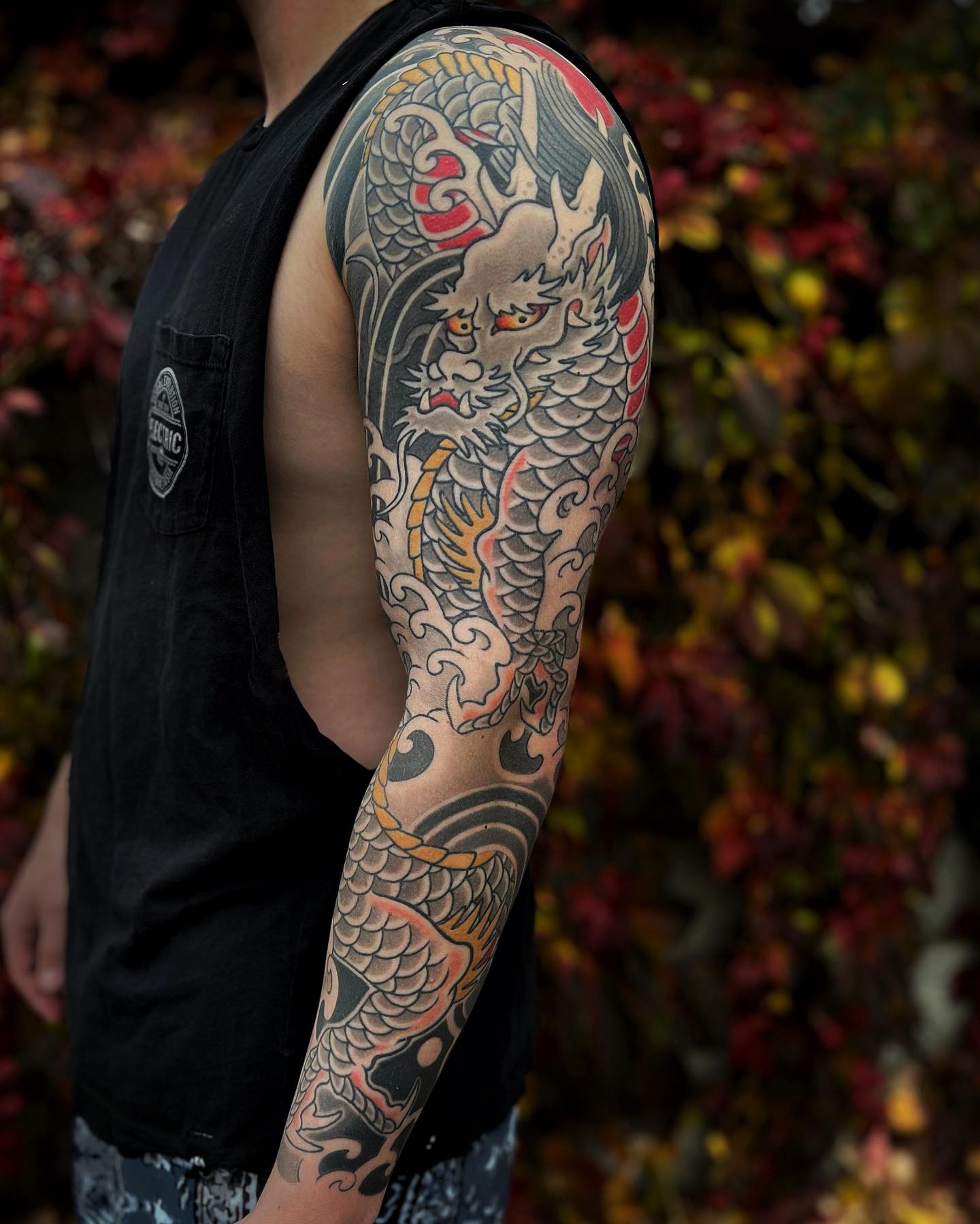
14. Dragon
A dragon coiling from one shoulder down across the back, its body using the diagonal of the torso rather than fighting it.
Both the Japanese and Chinese traditions give the dragon a clear grammar of scales, claws and clouds, and either reads beautifully at back scale. There are plenty of smaller approaches too if you are not ready for this much real estate — the dragon tattoo ideas for women collection shows the range.
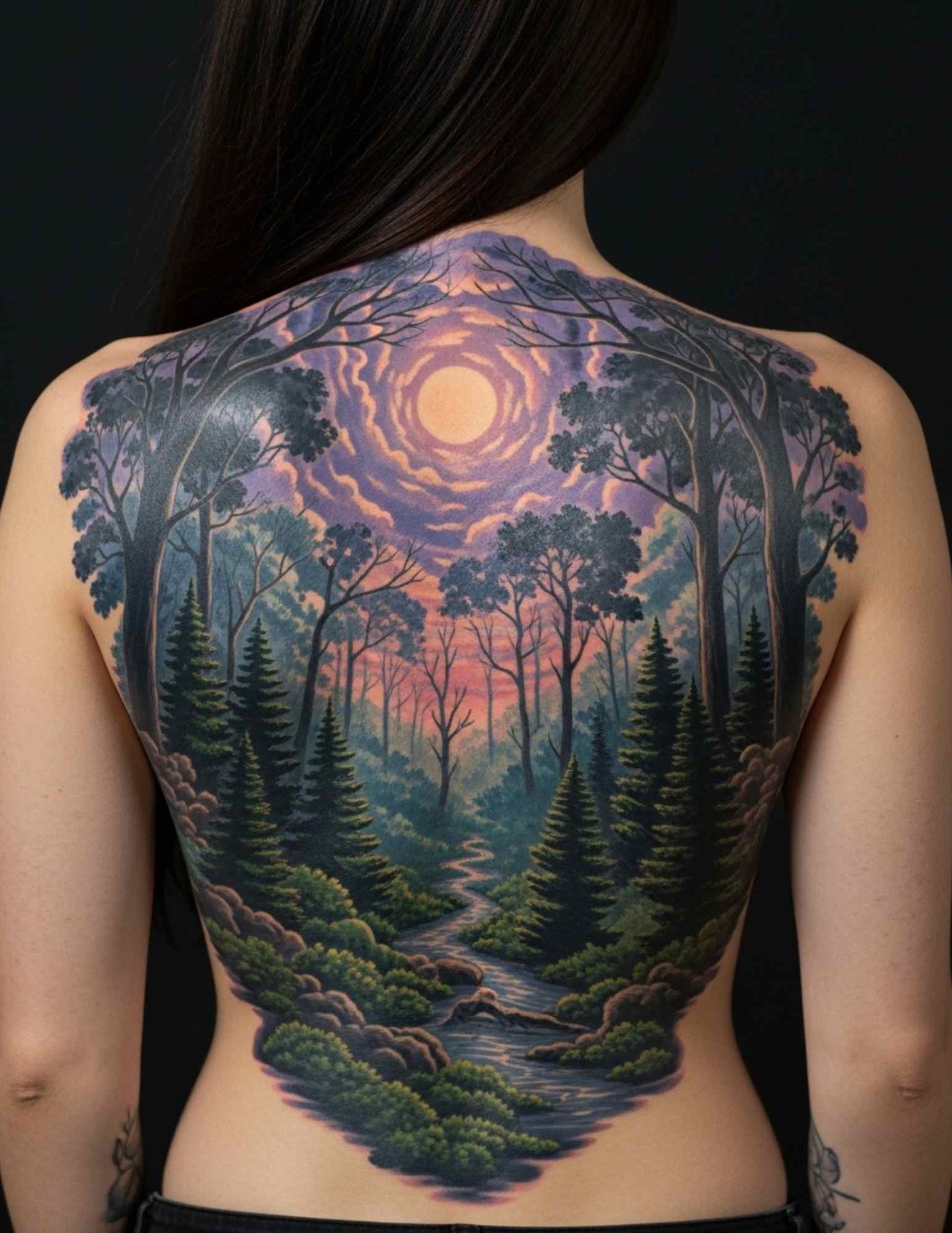
15. Forest Scene
Layered trees creating genuine depth, often with mist, light shafts or mountains in the far distance.
Depth is the whole point, and depth needs value contrast: near trees dark and detailed, far trees pale and simplified. A forest that is uniformly mid-grey across the whole back loses exactly the quality that made the idea appealing.
16. Goddess or Deity
A figure centred on the spine with ornamental surrounds, drawn from mythology, religious iconography or personal symbolism.
If you are drawing on a living tradition that is not your own, it is worth a conversation with your artist about how that will land. Most artists I know would rather have that discussion at the consultation than halfway through the outline.
17. Abstract Expressionist
Brush-style marks, ink splashes and gestural shapes that do not resolve into a recognisable object.
Abstract work asks more of the artist, not less, because nothing is hiding behind a familiar subject. The successful versions I have seen were drawn specifically for that person’s back rather than adapted from a flat design.
18. Upper Back Moth
A large moth with wings spanning shoulder to shoulder and the body running along the spine.
The moth’s proportions match the upper back almost exactly, which is why it has become such a standard choice. It works in heavy black and grey, in fine line, and in the ornamental styles that add mandala detail inside the wings.
19. Japanese Crane
A crane in the irezumi tradition, wings across the upper back, filling either the upper back alone or the full canvas with background.
The crane is associated with longevity and grace in Japanese symbolism, and its long neck and trailing legs give the composition natural diagonals. It is one of the most elegant subjects available at this size.
Variations Worth Considering
Wrapping Onto the Ribs or Shoulder
Letting a design cross onto the ribs or over the shoulder makes it read as part of your body rather than as a rectangle on your back. It also adds the most painful hours of the project, so it is a genuine trade-off.
Negative Space as a Design Element
Leaving skin bare is a decision, not an omission. Deliberate gaps give a large piece room to breathe and make the tattooed areas look darker and more intentional by contrast.
Colour Versus Black and Grey
Black and grey is generally the more forgiving choice over decades, and it keeps later additions easy to blend. Colour gives drama now, and in my experience needs more honest conversation about touch-ups down the line.
Building Outward Over Time
Plenty of the best full backs I have seen started as an upper back piece with a design that anticipated growth. If that is your plan, say so at the first consultation so the composition is drawn with room to extend.
Sitting for a Back Piece: What Actually Helps
Eat a real meal beforehand and bring something sugary. Long sessions fail far more often from blood sugar and fatigue than from pain, and an artist would much rather you ate than toughed it out.
Lying face down for hours is its own discipline. A pillow under the hips, a headrest you can actually breathe into, and deliberate breaks every hour help more than anything else I have tried. Pain management tips are worth reading before a first long sitting.
Aftercare on the back has one specific complication: you cannot see or reach most of it. Arrange for someone to help, or plan for a clean mirror routine, and follow your artist’s instructions rather than internet consensus.
Watch for signs that go beyond normal healing — spreading redness, heat, swelling that worsens after a few days, pus, or fever. Those warrant a doctor, not a forum thread. The American Academy of Dermatology and Mayo Clinic both publish plain guidance on tattoo risks and infection signs. Nothing in this article is medical advice.
Common Mistakes, and What to Do If You Are Still Not Sure
The most common mistake is choosing the subject before the scale. A design drawn for an upper back rarely stretches convincingly to a full back, and one drawn for a full back loses its logic when cropped.
The second is booking with an artist whose portfolio shows beautiful medium-sized work but no completed back pieces. Large-format composition is a separate skill.
The third is underestimating the timeline and then rushing the last sessions. A back piece finished impatiently looks finished impatiently.
If a full back still feels like too much, start smaller and see how you feel after healing. The fine line spine tattoo is a low-commitment way to test how you respond to work on this area, and if the centre line concerns you, it is worth reading whether spine tattoos are dangerous before you book.
Frequently Asked Questions
How long does a full back tattoo take?
Most full back pieces I have seen take many sessions spread over months or years rather than weeks. The exact number depends on the density of the design, how long you can comfortably sit, and how quickly you heal between appointments. Expect your artist to book in blocks of several hours rather than short visits. Healing time between sessions is usually a few weeks at minimum.
How much does a back piece tattoo cost?
Pricing varies enormously by region, artist demand and whether the studio charges hourly or by the day. The honest answer is that a full back piece is one of the larger purchases in tattooing, and any figure quoted without seeing your design is guesswork. Ask for a day rate and an estimated number of days at your consultation. Most artists will also take a deposit that comes off the final session.
Does a back tattoo hurt more than other placements?
It depends where on the back. The fleshy areas over the shoulder blades and the outer upper back are usually among the more tolerable spots, while the spine, the lower back near the tailbone and anywhere the skin sits directly over bone tend to be sharper. Sessions are long, so cumulative fatigue often becomes the bigger issue than peak pain. Breaks and food help more than people expect.
Can I add to a back tattoo later?
Often yes, and plenty of large pieces are built deliberately in stages. The key is telling your artist at the start that you may extend it, so the composition is drawn with logical places to grow. Adding to a design that was drawn as a closed composition is much harder and sometimes means reworking existing areas. Matching style and ink over a gap of years is easiest with the original artist.
Which back piece design is best for a first tattoo?
An upper back piece at moderate scale is a reasonable first tattoo for most people: a single large flower, a moth, or a simple symmetrical design. It gives you a real sense of the sensation and the healing without committing to a multi-year project. If you love it, you have a foundation to expand. If you do not, you have a complete piece rather than an unfinished one.
Quick Summary
- Decide the scale first — spine, upper back, upper back plus side, or full back — then choose the subject that suits it.
- Pick an artist with healed back pieces in their portfolio, not just large work in general.
- Designs that follow the spine, shoulder blades and waist taper always look better than designs dropped onto the back.
- An upper back piece can be finished in a few sessions and still read as a complete work.
- Black and grey is generally the more forgiving long-term choice; colour gives more immediate drama.
- Plan for fewer, longer sessions, and eat properly before each one.
- Back aftercare needs a second pair of hands or a mirror routine, because you cannot see most of the area.
- See a doctor, not a forum, for spreading redness, worsening swelling, pus or fever.