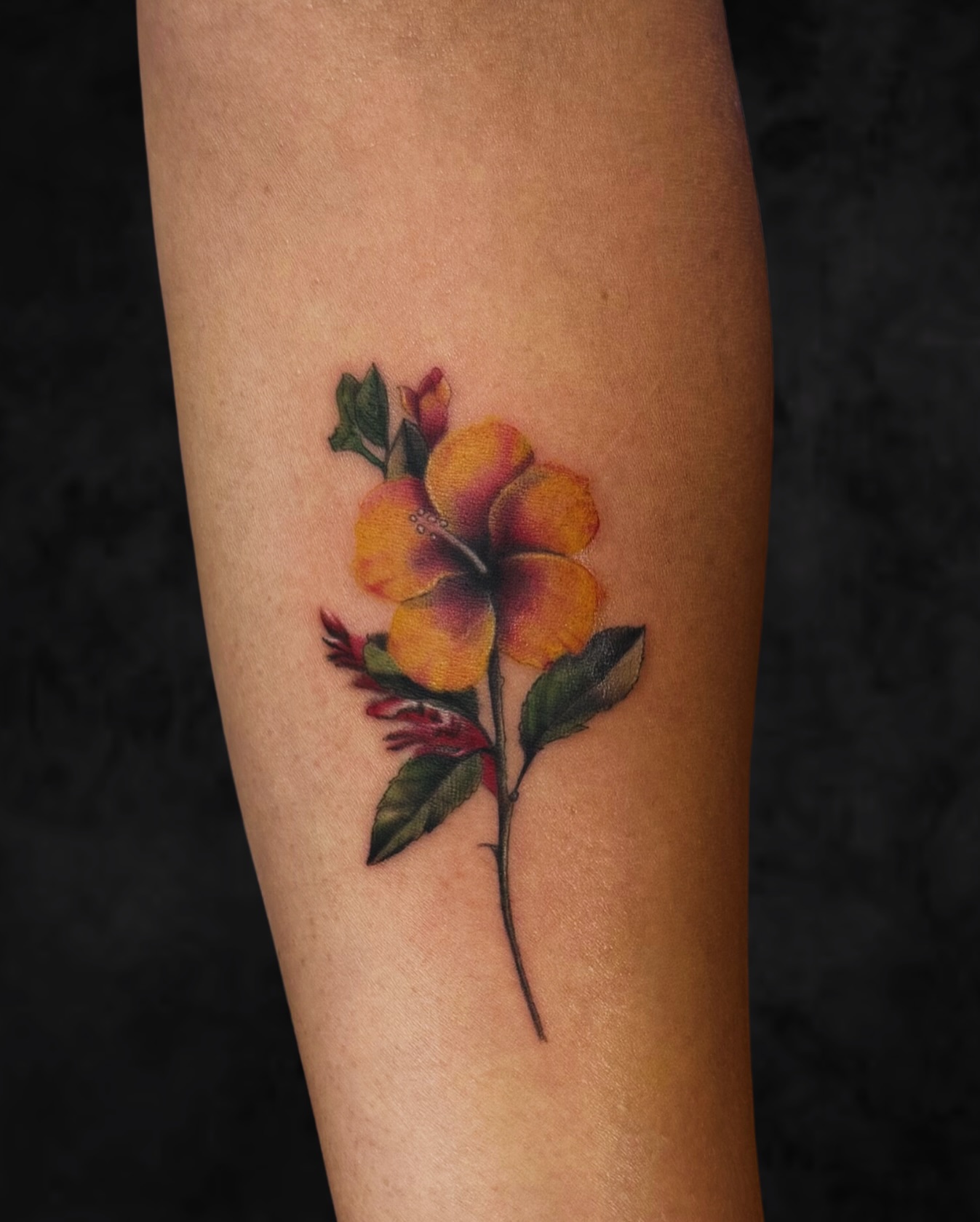
The hibiscus is one of the few flowers that never needs a caption. Five broad petals, one long stamen column pushing straight out of the centre, the whole bloom facing forward with nothing hidden. That open, front-facing shape is exactly why hibiscus tattoos hold up at sizes where most florals turn to mush.
I have watched artists sketch a rose for twenty minutes trying to get the spiral to read. A hibiscus takes a fraction of that, because the silhouette does the work.
What follows is the full range: saturated Hawaiian colour, fine line singles, blackwork, watercolour, and large-scale placements. If you are drawn to the wider tropical family, our guide to Hawaiian flower tattoo ideas covers plumeria, bird of paradise, and the rest.
One thing worth saying up front: the hibiscus carries real cultural weight in Hawaii, Malaysia, and across the Pacific. Knowing which tradition you are drawing from makes the tattoo better, not more complicated.
Which Hibiscus Style Is Right for You?
Every artist I have asked gives roughly the same breakdown when a client cannot decide. This is that conversation, compressed.
| Style | Best size | Typical sitting | How it ages | Best for |
|---|---|---|---|---|
| Hawaiian traditional colour | 4 in and up | 3-5 hours | Holds shape well; reds and yellows usually need a touch-up first | Anyone who wants the flower to read from across a room |
| Fine line | 2-4 in | 1-2 hours | Softens and thickens slightly; avoid the smallest details | A first tattoo, or a subtle placement |
| Blackwork | 3 in and up | 2-4 hours | The most durable option here | High-contrast graphic designs |
| Watercolour | 4 in and up | 3-4 hours | Fades fastest without a line structure underneath | Painterly, soft-edged looks |
| Neo-traditional | 5 in and up | 4-6 hours | Excellent – it is built for longevity | A piece meant to anchor a larger sleeve |
| Black and grey | 3 in and up | 2-4 hours | Very well; grey washes lighten gradually | Anyone unsure about committing to colour |
What Actually Decides How a Hibiscus Tattoo Ages
The hibiscus is a colour flower by reputation, and colour is the part of any tattoo that asks the most of you over time.
Reds and yellows sit near the top of the list for pigments that lighten first, which is why a saturated red bloom on a forearm often looks different at year eight than a blackwork version done the same day. Ask your artist how their specific reds have held on past clients — the honest ones will tell you.
Sun exposure is the bigger variable, and it is the one you control. The American Academy of Dermatology recommends covering healed tattoos with clothing or broad-spectrum sunscreen, and their guidance on caring for tattooed skin is worth reading before you book anything in colour.
Placement matters just as much. In my experience, the same design on an inner bicep and on a hand ages like two different tattoos, because one of them lives in daylight and takes constant friction.
If a full-colour tropical piece is what you are after, plan for a touch-up somewhere between years five and ten and budget for it now. There is a wider look at living with saturated ink in our roundup of colourful tattoo ideas.
20 Hibiscus Tattoo Ideas, Grouped by Style
These are organised the way you will actually choose — by the look you want, not by placement.
1-3. Classic Hawaiian Colour
The Hawaiian red hibiscus is the version most people picture: bold outline, fully packed petals, colour that goes right to the line. It is the least ambiguous design in this entire list, and it is a genuinely good tattoo when the artist commits to solid saturation rather than a light wash.
The yellow hibiscus is the more specific choice. Hibiscus brackenridgei — pua aloalo, or maʻo hau hele — has been Hawaii’s official state flower since 1988, replacing the generic hibiscus used before then. If the Hawaii connection is the reason for the tattoo, yellow says it more precisely than red does.
Hibiscus with plumeria is the easiest pairing to get right. The two flowers have different silhouettes — one flat and open, one soft and cupped — so they stack without visual confusion, and the palettes overlap naturally.
4-5. Fine Line and Minimalist Singles
A single fine line bloom is the most-requested small hibiscus I see, usually on a forearm, ankle, or behind the ear. Done well, it reads as a botanical drawing rather than a tattoo.
The honest caveat: the finest lines are the ones that spread as they settle. When I tested this by comparing fresh and five-year-old fine line work from the same artist, the lines had thickened noticeably and the tightest interior details had partly closed up. Going slightly larger than feels necessary is the standard fix.
A minimalist outline — no shading, no fill — is the most durable small option, because there is nothing inside the shape to blur. It also takes under an hour, which makes it a sensible first tattoo. Our guide to fine line tattoo ideas covers what these designs need long-term.
6-7. Blackwork and Black and Grey
Blackwork hibiscus treats the flower as a graphic shape. Solid black petals, negative space doing the drawing, no attempt at botanical realism. It is the highest-contrast option here and, in most cases, the one that will still look sharp longest.
This style asks a lot of the artist and very little of the viewer, which is a good trade. The risk is heavy black on a small area reading as a blob from a distance, so ask to see healed photos rather than fresh ones — blackwork designs look very different at the two-week mark.
Black and grey is the softer sibling. Smooth grey washes give you the depth and petal texture of a realistic hibiscus without the colour commitment, and grey ages more gracefully than red. Every artist I have asked recommends this to clients who like the flower but are unsure about living with bright colour.
8-9. Watercolour and Painterly Backgrounds
Watercolour hibiscus uses colour washes that spill deliberately past the linework, imitating pigment bleeding on wet paper. At its best it is genuinely beautiful.
It is also the style with the shortest honest lifespan, and any artist telling you otherwise is selling. Washes without a line structure underneath have nothing to hold their shape as they soften. The version that lasts keeps a real black line drawing beneath the colour — see our notes on watercolour tattoo ideas for what to ask for.
Hibiscus against a sunset is the other painterly route: the bloom in the foreground, warm gradients behind it. It adds real depth, and it also adds hours and cost, because backgrounds are slow work. Expect it to roughly double a session.
10-11. Hibiscus With Wildlife
Hibiscus and hummingbird is the pairing I would recommend to anyone who finds a single flower too static. The bird brings direction and motion into a design that otherwise just sits there, and the two are ecologically honest together.
Composition is the whole game here. The bird needs to be doing something — approaching, feeding, mid-hover — rather than parked beside the bloom like a sticker.
Hibiscus with a tropical bird, usually a parrot or toucan, goes bigger and louder. The palettes overlap, so the piece stays coherent instead of turning into two competing tattoos, but plan the size honestly: a detailed bird plus a detailed flower rarely works under about six inches.
12-15. Large-Scale Placements: Sleeve, Back, Thigh, Shoulder
A tropical hibiscus sleeve is where this flower is at its best, because repetition suits it. Blooms at different scales, foliage filling the gaps, one or two focal flowers carrying the composition. Realistically this is multiple sessions over several months, not a single sitting.
A back piece gives the flower room to open at close to life scale. It is also the placement most likely to stay out of sun, which is a quiet advantage for colour.
The thigh is the placement I recommend most often for a first large colour piece: forgiving to tattoo, easy to cover, and it holds saturation well. Many people also find it less painful than ribs or the outer arm, though pain is individual enough that I would not promise it.
The shoulder works when the design follows the deltoid rather than fighting it — a bloom set slightly off-centre with foliage trailing toward the bicep. Our floral half sleeve guide covers how these grow outward later.
16-20. Wraparound, Framed and Structured Designs
An ankle bracelet of small hibiscus blooms is one of the prettiest designs here and the one I would think hardest about. Ankles take sock friction, shoe rub, and sun, and small linked elements are the first to blur. Sizing up and simplifying the chain helps — as does reading our notes on flower ankle tattoos before you commit.
A geometric frame — a circle, hexagon, or fine line arch containing the bloom — sharpens everything. The hard edge gives the eye somewhere to rest and makes an organic shape look intentional rather than floating.
Neo-traditional hibiscus is the longevity pick: heavy outlines, a restricted palette, stylised petals instead of literal ones. It is built to be readable a decade out.
Hibiscus with palm foliage fills negative space without adding another focal point, and the hibiscus worn as a hair flower — tucked behind the ear of a portrait — is the most personal variation, though it needs an artist confident with faces.
Alternatives and Variations Worth Considering
If the hibiscus is close but not quite right, these are the flowers people usually land on instead.
Plumeria
Softer, smaller, and less graphic. Plumeria suits delicate work where a hibiscus would overwhelm the space, and it carries much of the same Pacific association.
Lotus
A similar open, symmetrical structure but a completely different meaning set. If you want the shape without the tropical reading, lotus flower designs are the closest structural match.
Sunflower
Bold, front-facing, and yellow-dominant — the nearest thing to a hibiscus outside the tropics. Sunflower tattoos read warm rather than exotic.
Birth Flowers
If the appeal is personal meaning rather than the tropical look, a birth month flower gives you specificity a hibiscus cannot. Hibiscus is not a birth flower in the standard lists.
Getting the Most Out of a Hibiscus Tattoo
Bring reference photos of real hibiscus blooms, not just other tattoos. Artists work better from the actual flower, and you avoid ending up with a copy of someone else’s piece.
Ask specifically to see healed colour work in that artist’s portfolio. Fresh photos flatter everyone; healed photos tell you whether their saturation actually holds.
During healing, follow the aftercare your artist gives you rather than advice from the internet, and keep the piece out of direct sun entirely until it has fully settled — usually two to four weeks, though it varies. Our tattoo aftercare guide covers the basics.
Once healed, sunscreen is the single highest-return habit for keeping tropical colour bright. It costs nothing compared with a touch-up session.
Still Not Sure? Common Hibiscus Tattoo Mistakes
The most frequent one is going too small for the style chosen. A detailed colour hibiscus at two inches will lose its interior structure; the same design at four inches will not.
The second is picking watercolour purely from fresh healing photos. Judge that style on ten-year work or skip it.
The third is ignoring the cultural side. A Hawaiian-styled hibiscus is a specific thing, and it is worth a conversation with your artist about whether a Polynesian-influenced design is appropriate to what you want it to mean.
And on the medical side: red pigments in particular are associated with allergic and other reactions in a minority of people. The FDA’s tattoo and permanent makeup fact sheet is a reasonable starting point, and if you have a history of pigment or metal sensitivities, ask your artist for a patch test and speak to a doctor before booking. If a healing tattoo becomes hot, spreading, or increasingly painful after the first few days, that is a medical question, not a tattoo question — see a doctor.
Frequently Asked Questions
Do hibiscus tattoos have a specific meaning?
Meanings vary by culture rather than being fixed. In Hawaii the hibiscus is associated with hospitality and aloha, and the yellow variety is the state flower. In parts of the Pacific a hibiscus worn in the hair has traditionally signalled relationship status, and in Malaysia it is the national flower. Most people choosing one today mean beauty, warmth, or a personal connection to a place, which is a perfectly legitimate reason on its own.
How much does a hibiscus tattoo cost?
It depends far more on size, style, and your artist’s rate than on the subject. A small fine line single bloom is typically an hour or less of work; a full colour piece on the thigh or shoulder is usually a multi-hour session; a tropical sleeve is several sessions over months. Ask for a quote based on a rough size and reference rather than a per-inch estimate, and factor in a possible touch-up later if you are going with saturated colour.
Will a colour hibiscus tattoo fade?
All tattoos lighten over time, and reds and yellows are generally among the first colours to show it. Sun exposure is the biggest accelerator, followed by placement in high-friction areas like hands and feet. Consistent broad-spectrum sunscreen on healed skin makes a real difference. Plan on the possibility of a touch-up rather than assuming the piece will look identical in a decade.
Where does a hibiscus tattoo look best?
The flower’s wide, flat, front-facing shape needs a surface that can show it without wrapping too hard. Thighs, shoulders, upper arms, backs, and forearms all work well. Ankles, wrists, and hands can carry a hibiscus, but small linked designs there tend to blur faster because of friction and sun. In my experience the thigh is the most forgiving spot for a first large colour piece.
Is a hibiscus tattoo appropriative?
The flower itself is grown and loved worldwide and is not restricted. What deserves care is specific cultural styling — particularly Polynesian and Hawaiian tribal motifs, which carry meaning tied to family and identity in those traditions. A botanical or decorative hibiscus is generally uncontroversial. If you want a design that draws on a specific tradition, talk it through with an artist who works within that tradition.
Quick Summary
- The hibiscus works as a tattoo because its open, front-facing silhouette stays readable at almost any size.
- Hawaiian colour is the most recognisable version; yellow specifically references the state flower, pua aloalo.
- Fine line and minimalist outlines suit small placements and first tattoos, but size up slightly to allow for line spread.
- Blackwork and black and grey are the most durable options and the safest bet if you are unsure about colour.
- Watercolour is the most beautiful and the least durable — insist on a line structure underneath it.
- Thighs, shoulders, backs, and upper arms hold large colour work best; ankles and hands fade fastest.
- Budget for a possible touch-up on saturated colour, and use sunscreen on healed skin.
- For anything involving healing problems, allergies, or specific cultural styling, ask a professional artist or a doctor rather than the internet.