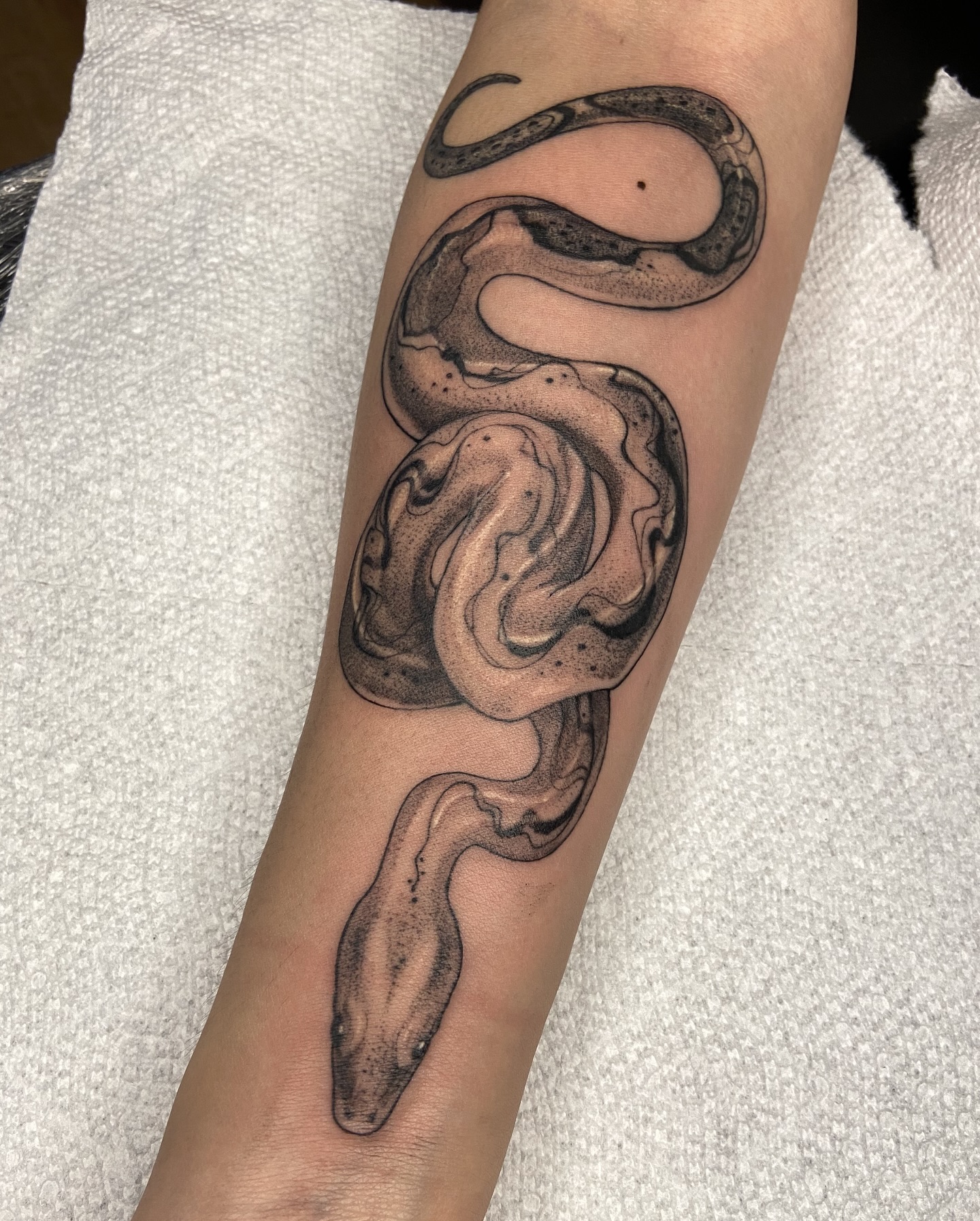
A snake is one of the few designs that works at almost any size, on almost any part of the body, in almost any style. That flexibility is exactly why the snake has stayed a default choice for men’s tattoos for more than a century, and why it rarely looks dated five years later.
I have sat through three snake pieces of my own and watched dozens more get done, and the pattern is consistent: the ones that age well are the ones with a clear body path and confident linework, not the ones packed with detail.
A serpent naturally follows a limb. It wraps a forearm, curls around a calf, and fills the awkward space above the elbow without the artist having to force it — which is more than you can say for most subjects.
Below are 20 directions worth considering, what each one actually costs you in time and pain, and how to pick between them. If you want the symbolism side first, the guide to snake tattoo meaning covers it in more depth than I will here.
Which Snake Style Is Right for You?
Most of the decision comes down to style before it comes down to species. Here is how the five most common approaches compare in practice.
| Style | Best Placement | Time Commitment | How It Ages |
|---|---|---|---|
| Japanese (Irezumi) | Full sleeve, back, thigh | Multiple long sessions | Excellent — built for it |
| American Traditional | Forearm, bicep, calf | Often a single sitting | Excellent — heavy outlines hold |
| Blackwork | Upper arm band, shin, ribs | Moderate, but saturation hurts | Strong, though solid black may need a touch-up |
| Fine line / single line | Inner arm, wrist, ankle | Short — often under two hours | Softens fastest; plan on touch-ups |
| Black and grey realism | Forearm, chest, back | Long — shading is slow | Good if the contrast was pushed hard enough |
What a Snake Tattoo Actually Says
The snake is not a single symbol, and anyone who tells you it means one thing is selling you a flash sheet.
In Japanese tattooing the serpent (hebi) is largely protective — a guardian against illness and misfortune, and a marker of resilience. That reading sits comfortably alongside the wider Japanese tattoo tradition that share the same visual language.
In Greek and Egyptian material the ouroboros — the snake swallowing its own tail — stands for cycles, renewal and things that have no clean beginning or end. Britannica’s entry on the Ouroboros traces that image back through alchemical and ancient sources if you want the long version.
And in Western traditional flash, the snake is closer to a warning: temptation, danger, or a straightforward “don’t tread on me” defiance.
The practical upshot is that you get to choose the meaning by choosing the style — a coiled traditional rattlesnake and a soft fine-line serpent say completely different things on the same arm.
20 Snake Tattoo Ideas for Men
These are ordered roughly from most classic to most experimental, not from best to worst.
1. Japanese Snake (Hebi)
The benchmark. A thick-bodied serpent with a raised head, exaggerated scales and a curl that follows the muscle rather than fighting it.
What makes these work is negative space — the wind bars, clouds or water that surround the snake are doing as much design work as the snake itself.
Every Japanese-trained artist I have asked says the same thing: bring a placement, not a picture. The composition has to be drawn for your specific arm to flow properly.
Expect this one to take several sessions if you go past the elbow. It is not a lunch-break tattoo.
2. Coiling Forearm Snake
The most requested version, and for good reason — the forearm is a cylinder, and a snake is the only subject that genuinely wants to wrap one.
The head usually sits on the inner wrist or the back of the forearm, with the body spiralling up toward the elbow.
When I tested placements with a stencil before committing, the difference between a head that lands on the wrist bone and one that sits an inch higher was significant — the bone version was noticeably sharper going in.
If you are weighing up the area generally, the roundup of forearm tattoo ideas is worth a look.
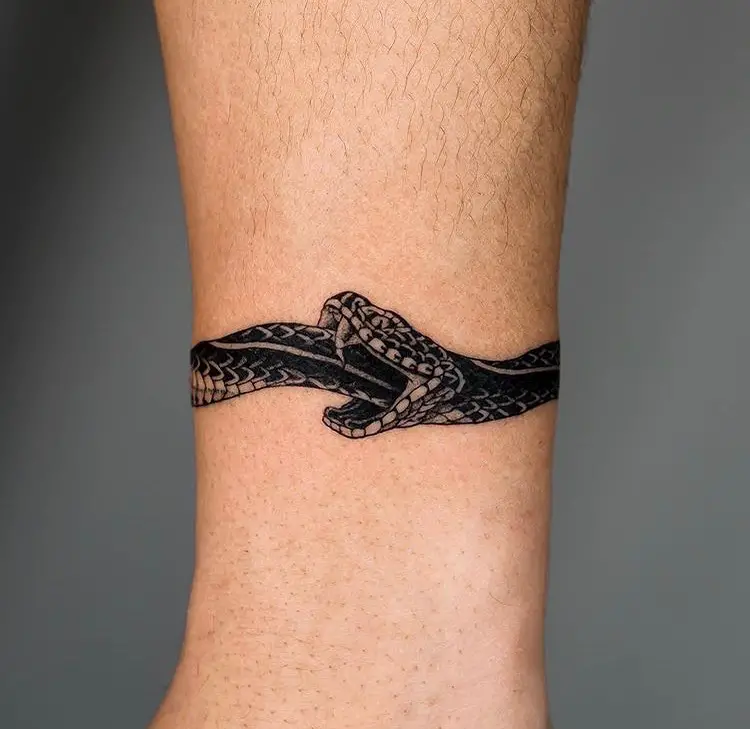
3. Ouroboros
A closed circle, the snake’s jaws on its own tail. Clean, self-contained, and it reads as intentional even at a small size.
It suits the inner forearm, the outer bicep or the back of the hand, and it is one of the few circular designs that does not look like a logo.
The risk is scale. Go too small and the head detail closes up as the ink settles — in my experience anything under roughly two inches across starts to lose the jaw.
4. King Cobra
The flared hood gives you a wide, symmetrical shape, which is why cobras land so well on the chest, the shoulder cap and the upper back.
A raised cobra also reads as defensive rather than predatory, which is a distinction some people care about and others do not.
The hood is where the detail budget should go — the pattern on the back of it is what separates a good cobra from a generic snake with a triangle head.
5. Rattlesnake
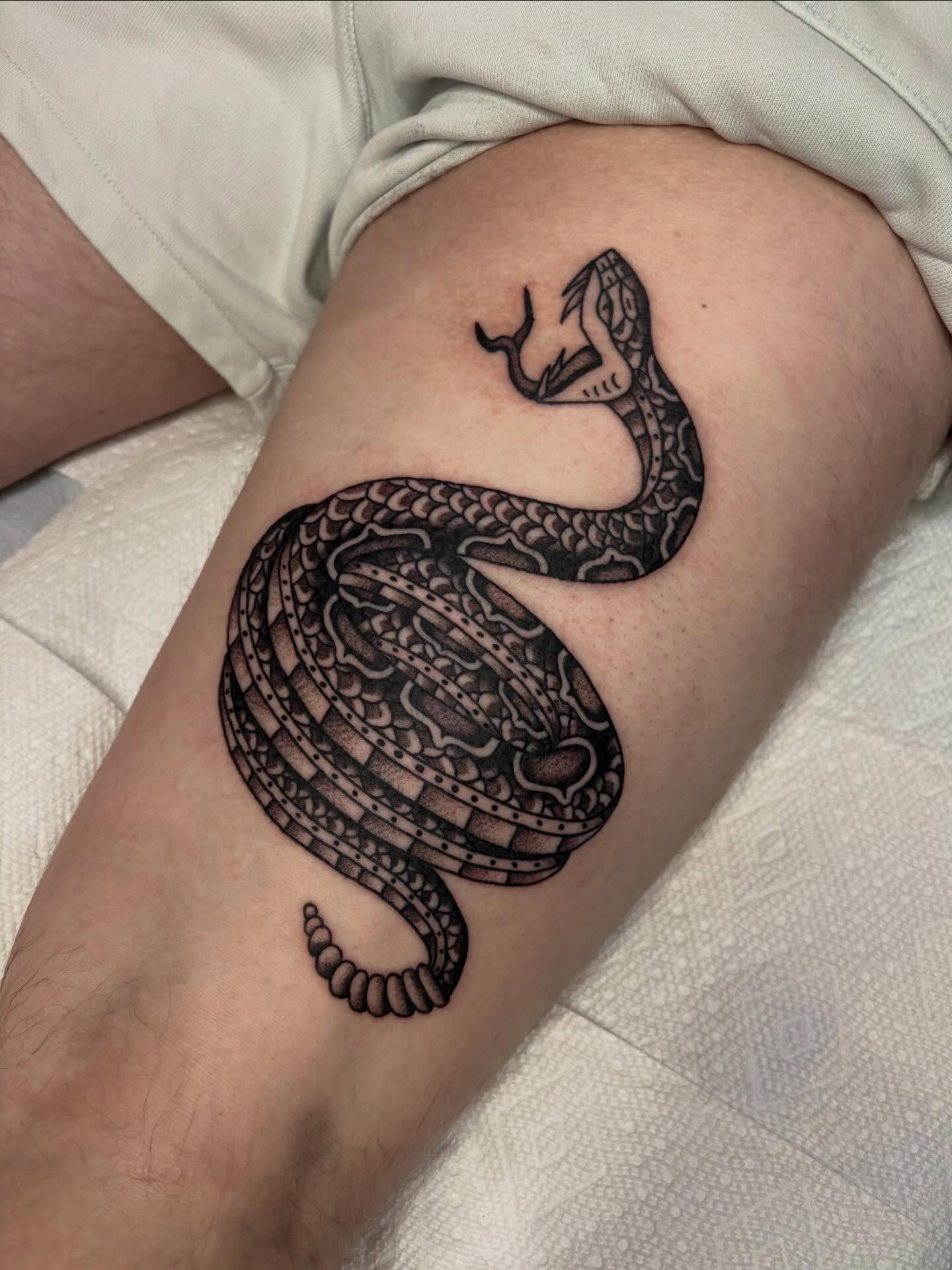
The most American of the options, and the one with the clearest attitude. A coiled rattler mid-strike is pure traditional flash territory.
The diamond-back pattern gives an artist a repeating motif to work with, which holds up unusually well as the tattoo softens over the years.
I have seen these done small on a calf and huge across a back, and both worked — the shape is forgiving.
6. Snake and Skull
A serpent threading through an eye socket is one of those pairings that has been done thousands of times and still looks good.
It gives you two contrasting textures in one piece — hard bone against soft, moving coils.
Keep the skull simple. When both elements compete for detail the tattoo reads as noise from a few feet away, which is the only distance most people will ever see it from.
7. Snake and Dagger
The classic. A blade with a serpent wound around it is about as old-school as tattooing gets, and it fits a forearm or outer calf almost perfectly.
The vertical dagger gives the composition a spine, so the snake can be as loose as you like without the piece falling apart.
If the symbolism side interests you, the piece on dagger tattoo meaning covers the overlapping traditions.
8. Serpent Sleeve
A full-arm snake is the most committed version of this idea, running shoulder to wrist with filler carrying the gaps.
The advantage over a collage sleeve is coherence — one subject, one flow, no arguing about how to connect unrelated pieces later.
Budget realistically. Sleeves run over many sittings, and the guide to what a sleeve tattoo costs is a more honest starting point than most shop quotes.
9. Black Mamba
Long, lean and fast-looking. Where a python is about mass, a mamba is about line.
Rendered in heavy blackwork it becomes almost graphic, which suits the outer arm and the shin.
Solid black over a large area is genuinely demanding to sit through, and it is the fill that hurts, not the outline.
10. Snake and Rose
The softest of the traditional pairings, and the one that stops a snake piece from reading as purely aggressive.
Layered petals give the artist somewhere to put shading, which balances out the flat scale work.
In my experience this combination photographs better than almost any other on this list, if that matters to you.
11. Geometric Snake
Angular facets, straight-line construction, and a body broken into planes rather than curves.
It is a modern look that pairs well with existing geometric work, and it sits neatly alongside existing geometric sleeve work if you already have some.
The trade-off is that geometry is unforgiving — a wobble in a straight line shows in a way it never would in an organic one.
12. Python
Mass over speed. A python gives you thick coils and dense, repeating scale patterns across a large surface.
That pattern work is the whole point, so this design needs room — thigh, back or a full outer arm rather than a wrist.
Ask to see healed photos of the artist’s scale work specifically. Fresh scales look incredible on everyone; healed scales separate the good from the average.
13. Medusa Head with Snakes
A portrait subject with snakes built in, which lets you get a face and serpents into one composition without them fighting.
Black and grey suits it best — colour tends to make the snakes read as decoration rather than threat.
This is a specialist piece. Book someone whose portfolio is full of faces, not someone whose portfolio is full of snakes.
14. Snake and Flower Sleeve
A serpent weaving through botanical filler, which solves the hardest problem in any sleeve: what goes in the gaps.
Peonies, chrysanthemums and roses all work; the flowers carry the colour and the snake carries the movement.
Men often skip floral elements entirely and end up with a sleeve full of undifferentiated black, which is a harder problem to fix later than it is to avoid now.
15. Minimalist Single Line Snake
One unbroken stroke, no shading, no fill. It is the fastest tattoo on this list and often the cheapest.
It suits an inner forearm, the side of a calf or a ribcage where you want something present but quiet.
Be honest about longevity though. Thin single lines soften more than heavy ones do, and single line designs tend to need a touch-up sooner than traditional work.
16. Japanese Snake and Peony
The traditional pairing in irezumi — the peony reads as prosperity and boldness, the snake as protection.
The colour contrast does the heavy lifting: a red or pink bloom against a green or black-grey serpent.
If you want one piece from this list that will still look intentional in twenty years, this is my pick.
17. Blackwork Snake Band
A serpent circling the upper arm as an armband, its head and tail meeting or overlapping at the front.
It is a strong option if you want something bold that stops cleanly rather than sprawling toward a sleeve.
Heavy black holds up well over time, which is part of why blackwork designs remain popular for men who want low-maintenance ink.
18. Snake Eye Detail
A tight crop — just the head and eye, blown up large. It is an unusual choice and it stands out for exactly that reason.
The vertical slit pupil is the whole design, so it needs an artist comfortable with fine detail at scale.
Works best on the inner forearm or over the shoulder blade where there is a flat, uninterrupted surface.
19. Yin-Yang Snake
Two snakes curled into each other, one light and one dark, forming a balanced circle.
It is a cleaner way to get a duality concept onto skin than most symbolic shortcuts, and it scales down better than an ouroboros does.
Keep the two bodies clearly different in value — if they end up the same darkness the whole idea collapses.
20. Traditional Green Snake
Bold black outlines, flat green fill, minimal shading. Pure old-school flash and almost impossible to get wrong.
Green ink holds reasonably well, though it will shift slightly warmer over the years like most colour does.
It sits comfortably next to other American traditional animal work if you are building a traditional half sleeve.
Placement Variations Worth Considering
The same design changes character completely depending on where it lands.
The Wrap
Forearm, calf and bicep. The snake circles the limb so part of it is always hidden, which makes the tattoo feel bigger than it is.
It is the most flattering option for most builds, and the easiest for an artist to compose well.
The Vertical Run
Spine, outer thigh, side of the ribs. A snake running head-down along a long flat plane, usually without a wrap.
It is a dramatic option, though ribs and spine are among the harder places to sit through.
The Contained Panel
Chest, shoulder blade or a single forearm panel with a clear border. The snake coils inside a defined shape instead of following the body.
Useful if you want something that will never expand into a sleeve.
The Small Accent
Inner wrist, ankle, behind the ear. A snake reduced to a simple curve and a suggestion of a head.
Good as a first tattoo — the first tattoo ideas for men guide has more in this size range.
Getting a Snake Tattoo Done Well
Pick the artist before you pick the design. A snake drawn for your arm by someone who understands flow beats a perfect reference photo handed to someone who does not.
Ask specifically for healed photos, not fresh ones. Fresh work always looks sharp; healed work tells you whether the linework and the scale detail actually survived.
Eat properly beforehand and expect the wrap sections to be the worst part — inner arm, inner bicep and anywhere over bone. If that is a concern, the pain management tips are practical rather than motivational.
Aftercare is the part you actually control. Follow the artist’s instructions rather than internet advice, keep it clean, and treat unusual swelling, spreading redness, fever or a rash as a reason to see a doctor rather than something to wait out. The Mayo Clinic’s overview of tattoo risks outlines the real risks, including allergic reactions to colour inks and infection.
Nothing here is medical advice. A licensed artist and, where it matters, a doctor are the people to ask.
Common Mistakes and Where to Look Next
The most frequent error I see is cramming too much detail into too little space — a snake with individually rendered scales at three inches long will be a grey smudge in a decade.
The second is placing the head somewhere it gets cut off by a sleeve or a watch, so the tattoo only reads properly when you are shirtless.
The third is choosing a species without checking what it looks like from the front. Some snakes are far more recognisable in profile than head-on.
If you are still weighing options, the piece on whether snake tattoos read masculine or feminine is a useful reality check.
Frequently Asked Questions
Do snake tattoos have a negative meaning?
Not inherently. In Japanese tattooing the snake is protective and associated with resilience, while in Greek and Egyptian symbolism the ouroboros represents renewal and cycles. Western traditional flash leans more toward danger and defiance, so the reading depends heavily on the style you choose. If the meaning matters to you, tell your artist what you want it to say and let that guide the style.
How much does a snake tattoo usually cost?
It depends on size, placement, style and your artist’s rate, so any fixed number is misleading. A small single-line snake is typically a shop-minimum job, while a full serpent sleeve runs across many sessions and costs accordingly. Most artists charge by the hour for larger work and by the piece for small flash. Ask for a written estimate before you book.
Where does a snake tattoo hurt the most?
Because snakes wrap, they often cross areas that are more sensitive than the ones people expect. Inner arm, inner bicep, ribs and anywhere directly over bone tend to be the hardest sections. The outer forearm, outer thigh and calf are usually more manageable. Splitting a large piece across sessions helps more than any single pain trick.
How long does a snake sleeve take?
A full sleeve is a multi-session project rather than a single appointment, and the total depends on the density of the design and how long you can sit comfortably. Japanese sleeves with full backgrounds take longer than sparse blackwork ones. Your artist can give a realistic session count once the composition is drawn. Rushing it is the most common way to end up with uneven work.
Will a fine-line snake tattoo hold up?
It will, but not in the same way heavier work does. Thin lines soften and spread slightly as the ink settles into the skin over the years, so fine-line pieces generally need touch-ups sooner than traditional or blackwork ones. Sun exposure accelerates that noticeably. If you want something you can largely forget about, heavier linework is the safer choice.
Quick Summary
- Snakes wrap limbs naturally, which makes them one of the most placement-flexible subjects available.
- Choose the style before the species — Japanese, traditional, blackwork, fine line and realism say very different things.
- Japanese hebi reads as protective; the ouroboros reads as renewal; traditional flash reads as warning or defiance.
- The forearm wrap and the coiled traditional rattlesnake are the two safest choices for a first snake piece.
- Detail needs space — scale work below roughly two inches tends to close up as the tattoo heals.
- Fine-line snakes are fast and cheap but need touch-ups sooner than heavy-outline work.
- Ask for healed portfolio photos, not fresh ones, when judging an artist’s scale and line work.
- Follow your artist’s aftercare instructions, and see a doctor for spreading redness, fever or a rash.