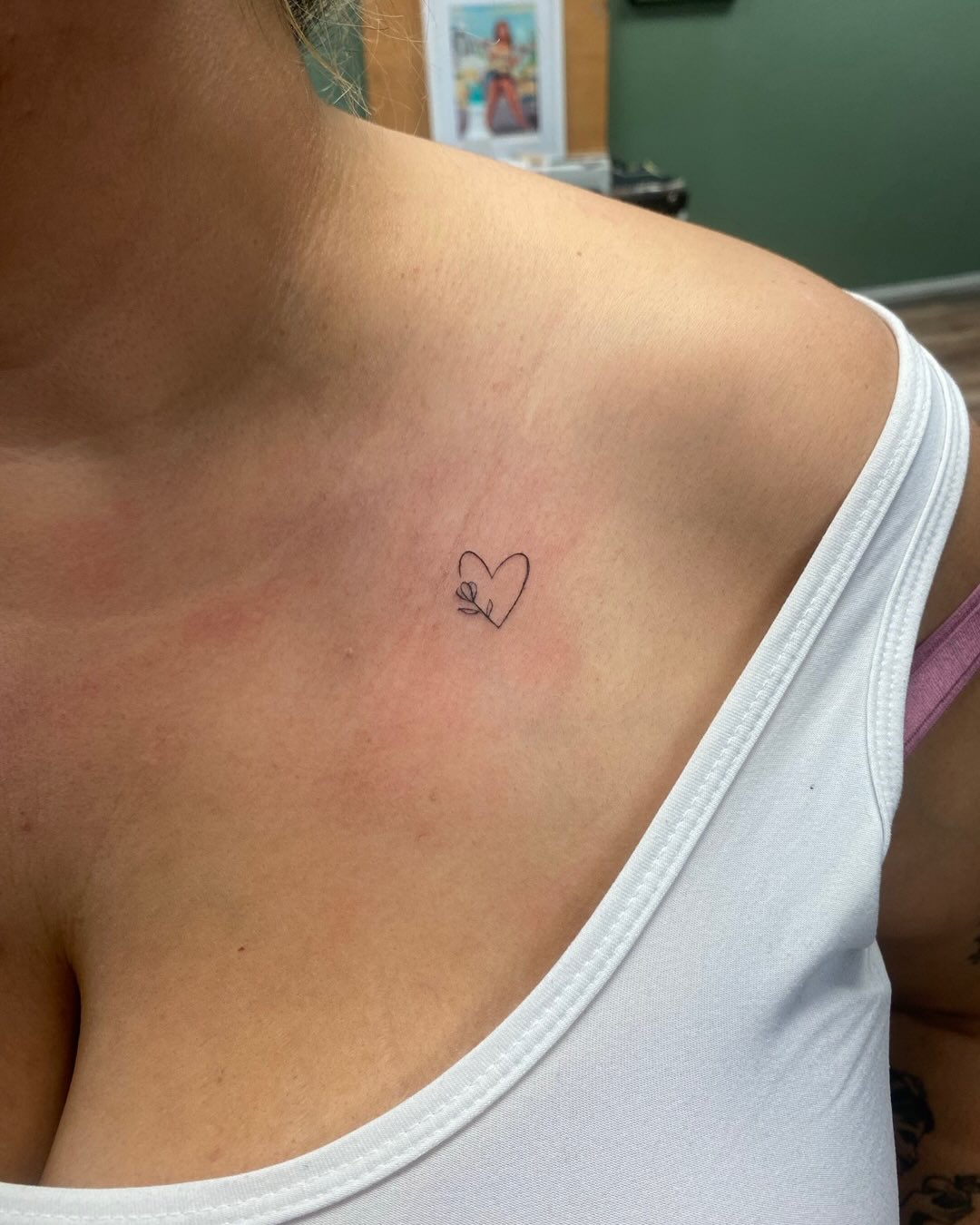
Micro tattooing is the most technically demanding corner of the craft, and the one where the gap between a good artist and a great one shows up fastest. A micro tattoo done well is detail that should not be possible at the scale it is achieved; the same design done poorly is an illegible smudge within five years.
I have spent a lot of time looking at healed micro work rather than fresh-off-the-needle photos, and the difference between the two is where the honest advice lives.
What separates the pieces that last is not the machine or the ink. It is whether the artist understood how much detail to remove before they started, and whether they have done enough micro work to know where their own limits are.
Below are 21 ideas built specifically for the micro format, each with a note on the design decision that makes it survive. If you are still deciding on scale, it is worth browsing broader small tattoo ideas alongside these.
Which Placement Is Right for Your Micro Tattoo?
Placement affects a micro tattoo more than it affects any other kind. The same design will behave completely differently on an inner forearm than on a finger.
| Placement | How micro detail holds | Best suited designs | Realistic expectation |
|---|---|---|---|
| Inner forearm | Very good | Sprigs, dates, lettering, constellations | Softens slowly; often no touch-up needed for years |
| Outer bicep / shoulder | Very good | Almost anything on this list | The most forgiving area for fine detail |
| Wrist | Good | Hearts, semicolons, small symbols | Sun exposure is the main variable; expect some fading |
| Behind the ear | Good | Moons, stars, single letters | Thin skin; usually needs a lighter hand and can heal patchy |
| Ankle / foot | Mixed | Solid silhouettes, bold simple shapes | Footwear friction; touch-ups are common |
| Fingers / hands | Poor for detail | Solid hearts, single bold marks only | Expect fading and patchiness; plan for repeat touch-ups |
| Ribs / sternum | Mixed | Simple silhouettes, short lettering | Skin movement blurs fine internal detail faster |
This table reflects general patterns rather than guarantees. Your own skin, sun habits and immune response all shift the outcome, which is why a consultation with your artist matters more than any chart.
What Works and What Does Not at Micro Scale
Tattoo ink does not sit still. Over years it migrates outward by a small, fairly predictable amount as the body continues to interact with the pigment.
On a large piece that migration is invisible. On a micro piece it is the entire story, because the distances between marks are measured in fractions of a millimetre.
This produces a simple rule that governs everything else on this page: the space between your lines matters more than the lines themselves.
Clean subjects with clear silhouettes outlast detailed subjects with fine internal markings. Bold negative space outlasts dense linework. Simple geometry outlasts complex geometry.
The best micro tattoos are subjects reduced to their essential form, not subjects rendered in miniature at full complexity. That distinction is the one most people get wrong when they walk in with a reference photo. If you want to see what the same principles look like with more room to work, our linework tattoo ideas guide is a useful contrast.
21 Micro Tattoo Ideas
Each of these is chosen because it survives the reduction. Where an example is shown, the caption notes the specific decision that makes it work.
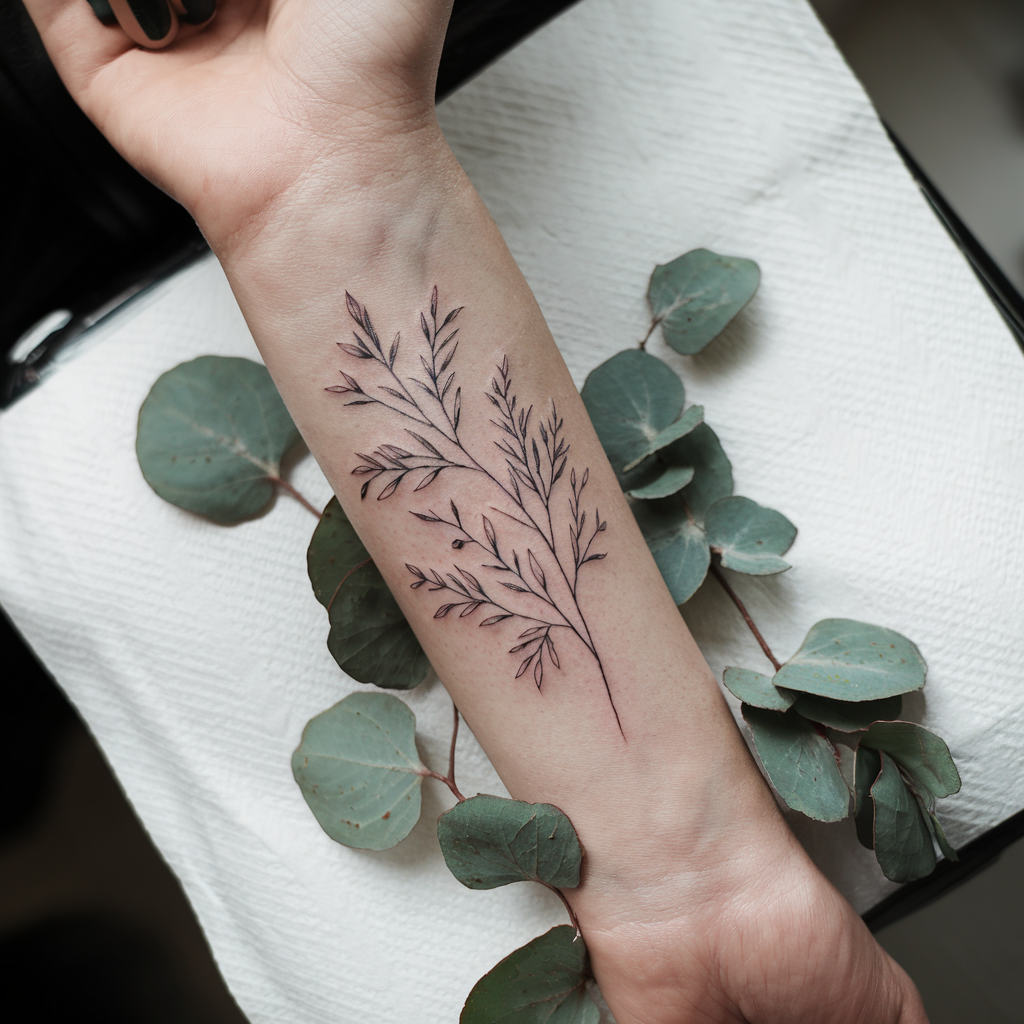
1. Micro Botanical Sprig
A tiny botanical sprig is the single most requested micro design I hear artists complain about, and the reason is always the same: people bring in a reference with fourteen leaves on it.
At micro scale the sprig has to be cut down to its essential marks. One main stem, three or four leaves suggested rather than fully drawn, and a single bloom at the tip.
What makes a micro sprig survive is the visible skin between the leaves, not the leaves themselves. If two leaves sit closer together than roughly a millimetre of clear skin, the ink will eventually bridge the gap and read as one blob.
In my experience the sprigs that still look sharp after five years are the ones that looked almost too sparse on the day they were done.
2. Tiny Constellation
Constellations are close to a perfect micro subject because dots are the most stable mark a tattoo machine makes.
A dot has no thin section to collapse and no adjacent line to merge with. It just softens slightly at the edges over the years.
The risk sits in the connecting lines. Hairline strokes between stars are the part that fades first, and some artists deliberately make them slightly heavier than the reference so they survive the first decade.
When I have asked artists about this, most say they would rather do the dots alone and let the eye connect them than fight thin lines at that scale.
3. Micro Moon
A crescent moon is one shape with one silhouette and nothing inside it, which is exactly what micro work rewards.
The design choice that matters is the thickness of the crescent at its narrowest point, usually the two tips.
If the tips taper to nothing, they will disappear. Artists who do a lot of micro work tend to blunt the tips very slightly, which nobody notices but which keeps the shape intact.
A solid filled crescent is more durable than an outlined one at this size, though the outlined version reads as more delicate on the day.
4. Single Letter
A single initial is small, meaningful and far harder to execute well than it looks.
The failure point is the counters, the enclosed white spaces inside letters like a, e, o and g. At micro scale those spaces fill in with ink migration and the letter turns into a solid mark.
Choosing a typeface with open counters matters more than choosing a beautiful one. Simple serif and clean sans faces hold up better than heavily scripted ones.
Every artist I have asked about micro lettering says the same thing: they would rather go slightly larger than fight a client over the font.
5. Micro Butterfly
The butterfly is one of the most common small tattoo requests, and one of the easiest to ruin at micro size.
A butterfly rendered in miniature at full complexity, with wing veins, spots and body segments, has too many marks in too little space.
The version that works is a silhouette. Two wing shapes, a slim body, and either nothing inside the wings or a single suggested vein each.
If you want the detailed version, the honest answer is that it needs to be bigger. There is no technique that makes a densely detailed butterfly hold at micro scale.
6. Tiny Heart
A tiny heart is one of the few micro designs I would happily put on a finger, which is not a sentence I write often.
It is a single closed shape with a strong silhouette, so even when the edges soften it still unmistakably reads as a heart.
Solid fill outlasts outline here by a wide margin. An outlined micro heart on a high-friction placement can lose definition within a couple of years.
If you are considering a finger placement, it is worth reading through other finger tattoo ideas first, because the placement matters more than the design.
7. Micro Star
A five-point star lives on its points, and points are the first thing to go at micro scale.
The trick most micro specialists use is to keep the star slightly fatter than the reference drawing, so that the points have material to lose.
Open negative space between the points is what stops the whole thing collapsing into a dot. Crowd several stars together and they will eventually read as a cluster of smudges.
Three stars with clear space between them almost always ages better than seven stars packed into the same area.
8. Micro Wave
A wave reduced to two or three curved lines is a genuinely good micro subject, because a curve has no fragile terminal point.
The temptation is to add foam, spray or a second breaking crest. Resist it.
Two curves say wave; six curves say smudge in five years. The recognisable form of a breaking wave survives extreme simplification better than almost any other natural subject.
This is one where I would push a client toward the sparser draft even if the busier one looks better on paper.
9. Micro Feather
A feather at micro scale needs a central spine and a small number of clearly separated barbs.
The mistake is drawing the barbs as they appear on a real feather, dozens of them, tightly packed. At this size those lines merge into a grey mass within a few years.
Six to ten barbs, unevenly spaced with visible skin between them, will still read as a feather long after the dense version has gone soft.
If you want that level of detail rendered properly, fine line work at a larger scale gives the linework room to breathe.
10. Tiny Geometric Shape
Geometry is unforgiving in a useful way: a wobbly micro triangle is obvious, a wobbly micro flower is not.
That makes simple geometric shapes a good test of an artist’s micro capability, and a good choice if you have found someone whose line quality you trust.
Open shapes hold better than nested ones. A single triangle outline will still be crisp long after a triangle-inside-a-circle-inside-a-hexagon has filled in.
Corners are the weak point. Artists doing careful micro work tend to slightly round interior angles, which reads as intentional and prevents ink pooling at the joint.
11. Micro Floral
A single small bloom is a different problem from a botanical sprig: here everything is concentrated in one dense area.
The petals need to be separated by visible skin rather than stacked as adjacent linework.
Internal shading is usually the first thing to go. A micro floral with stipple shading inside the petals frequently reads as a solid dark shape within a few years.
In most cases the outlined-only version is the one that still looks like a flower a decade later.
12. Tiny Animal Silhouette
Solid silhouettes are the most reliable micro tattoos I have watched heal, and animals are the best use of them.
There is no internal detail to lose, no thin line to collapse. The design is one shape, and shapes are stable.
The whole job is choosing an animal with a distinctive outline. A cat, a hare, a bird in flight and a wolf all read instantly at silhouette.
A subject you can identify from its shadow is a subject that works at micro scale. If you cannot, pick something else.
13. Micro Date
Dates carry real weight and take up very little room, which is why they are such a common micro request.
Roman numerals are the popular choice, but they are also the more fragile one. A long numeral string packs a lot of vertical strokes very close together.
Standard numerals with generous spacing between characters usually age better. The spacing is not a style decision here, it is structural.
Whichever you choose, ask the artist to write it out at final size before you commit, and look at it on your skin rather than on paper.
14. Tiny Arrow
An arrow reduced to a straight shaft and a small head is close to the simplest meaningful mark you can get tattooed.
Skip the fletching detail. Feather barbs at the tail are the part that turns into a blur.
A straight line is also the hardest thing to do badly-but-invisibly, so an arrow is a fair way to assess an artist’s steadiness before committing to something more ambitious.
Arrows work particularly well on the forearm and the outer bicep, where the skin does not fold much.
15. Micro Lightning Bolt
A bolt is angular, solid and bold, which is close to ideal at this size.
Bold and solid beats fine and clever every time at micro scale, and the lightning bolt is the clearest illustration of that principle on this list.
The zigzag needs clean angles rather than sharp needle points. Very acute angles pool ink at the joint and soften first.
This is a design where a slightly heavier line weight than you expected is a good sign, not a compromise.
16. Tiny Lotus
A lotus is recognised by its symmetry more than by its detail, which is what makes a micro version possible.
Petals reduced to simple outlines, arranged symmetrically, with clear skin between each one.
The centre is where micro lotuses fail. If the petals all converge to a single point, that point fills in and the flower loses its structure.
Good micro artists open up the centre slightly, leaving a small clear area where the petals meet. It is barely visible at first and it is the reason the design survives.
17. Micro Portrait
I want to be direct about this one: micro portraits are the highest-risk item on this list.
A recognisable face depends on very small relationships between features, and those relationships are precisely what shifts as ink spreads over years.
The version that can work is a minimal profile outline, a handful of marks describing a jaw, a nose and a hairline, rather than a rendered likeness.
If you want a portrait that will still be a portrait in twenty years, it needs to be considerably larger. That is not a limitation of your artist, it is a limitation of skin.
18. Tiny Compass
A compass rose reduced to four cardinal points is a strong micro subject with a clear silhouette.
The full version, with a ring, degree markings, intercardinal points and a decorative centre, is not.
Four points, no ring detail, no lettering. That is the version that stays legible.
If the meaning matters more than the miniature, a larger compass on the forearm gives you the ornate version without the compromise.
19. Micro Infinity
The infinity symbol is a single continuous line, which sounds ideal for micro work until you look at the crossover in the middle.
That crossover is where two lines meet at a shallow angle, and it is the point that fills in and turns the symbol into a solid knot.
Artists who do this well keep the crossover deliberately open, often exaggerating the gap slightly beyond what looks natural on paper.
A wider, flatter infinity holds better than a tall narrow one, because the loops stay further apart.
20. Tiny Semicolon
A semicolon is a mark whose meaning does not depend on being large, which makes it genuinely well suited to micro work.
It is also structurally simple: one dot and one comma, with clear space between them.
That gap is the whole design. If the dot and the tail merge, it reads as a colon or a smudge, so ask for slightly more separation than typographically correct.
If the symbolism is what draws you, there are more layouts worth looking at in our guide to semicolon tattoo ideas.
21. Micro Map Detail
A tiny fragment of a map, a coastline, an island outline, a single river bend, is one of the most personal micro tattoos you can get.
It also demands the most ruthless editing, because a map is nothing but fine detail.
What works is a single recognisable contour. The outline of one island, or the shape of one lake, with no interior lines at all.
Anything that requires a viewer to zoom in is not a micro tattoo, it is a temporary one. Pick the one line that carries the meaning and let the rest go.
Variations Worth Considering Instead
If none of the 21 quite fits, these three approaches solve the same brief from a different angle.
Go slightly larger and keep the detail
The most common good outcome I see is a client who arrives wanting micro and leaves with something two or three centimetres across.
That extra centimetre buys an enormous amount of durability, and on most placements it still reads as a small, discreet tattoo.
Cluster several micro pieces
Rather than one detailed micro tattoo, three or four very simple micro marks placed with space between them.
Each individual mark is simple enough to last, and the composition carries the visual weight that a single detailed piece would have tried to carry alone.
Use solid black instead of fine line
A solid filled shape at micro scale is dramatically more durable than the same shape outlined.
It reads bolder on the day, which some people do not want, but it is the version that still looks intentional in fifteen years.
Choose a placement that protects the work
Moving a design from the finger to the inner forearm changes its expected lifespan more than any change to the design itself.
If the placement is negotiable and the design is not, move the placement. behind-the-ear placements and inner-arm spots both offer good compromises between discreet and durable.
Getting a Micro Tattoo That Lasts
Ask to see healed photographs, not fresh ones. A fresh micro tattoo always looks perfect; a two-year-old one tells you whether the artist actually understands the format.
Expect the stencil to look bigger than you imagined. Artists who work at micro scale routinely size up slightly from the reference, and that instinct is worth trusting rather than arguing with.
Aftercare for micro work is the same as for anything else, but the consequences of getting it wrong are magnified. Keep it clean, keep it moisturised without smothering it, and keep it out of the sun. The American Academy of Dermatology publishes clear guidance on caring for tattooed skin that is worth reading before your appointment.
Sunscreen is the single highest-return habit for a micro tattoo. UV exposure breaks down pigment, and on a design this small there is very little pigment to lose.
If you notice spreading redness, swelling that increases after the first few days, discharge or a rash, that is a matter for a doctor rather than a forum thread. The FDA maintains a useful fact sheet on tattoo risks and reactions, and nothing on this page is a substitute for medical advice.
Common Mistakes and How to Avoid Them
The first is booking a generally excellent artist who does not specialise in micro work. Micro is a distinct skill, and a superb traditional or realism artist may simply not have it.
The second is bringing a reference photo of a fresh micro tattoo and expecting that appearance to be permanent. Almost every viral micro tattoo image online is a few hours old.
The third is refusing to let the artist simplify. When a micro specialist says a design needs fewer marks, that is the expertise you are paying for.
The fourth is choosing a placement for discretion alone. Fingers, feet and the sides of hands are the hardest places on the body to keep fine detail, and choosing one of them for a detailed design guarantees disappointment. Our guide to finger tattoo ideas covers what genuinely works there.
The fifth is not planning for maintenance. Micro tattoos on high-wear placements often need periodic attention, and knowing how often a tattoo needs a touch-up ahead of time makes that feel like upkeep rather than failure. Mayo Clinic also has a plain-language overview of tattoo risks worth understanding before any session.
Frequently Asked Questions
How small can a micro tattoo actually be?
In practice most artists treat anything under roughly two centimetres as micro work, and many will not go below about one centimetre for anything with internal detail. The limiting factor is not the needle, it is how ink behaves in skin over decades. A single dot or a solid silhouette can go very small and stay clean, while a design with lines inside it needs the space for those lines to stay separate. Ask your artist for their own minimum for your specific design rather than a general number.
Do micro tattoos fade faster than normal tattoos?
They do not fade faster in the sense of losing pigment more quickly, but they lose legibility much sooner. The same amount of natural ink spread that is invisible on a large piece can close the gap between two lines that were a millimetre apart. This is why a micro tattoo can look blurred at ten years while a full-size tattoo done the same day still looks sharp. Placement, sun exposure and skin type all affect how fast this happens.
Are micro tattoos more painful because the needle is finer?
Generally no, and most people find them easier simply because the session is short. A single-needle or three-needle grouping usually feels sharper and more scratchy than a larger grouping, but it covers far less area and takes far less time. Bony placements like fingers, ribs and the tops of feet are uncomfortable regardless of how small the design is. Our tattoo pain management tips guide covers what actually helps.
How much should I expect to pay for a micro tattoo?
Most studios charge a shop minimum rather than by size, so a micro piece often costs the same as something several times larger. Artists who specialise in micro work frequently charge above the minimum, because the skill is scarce and the margin for error is nil. That premium is worth paying; a cheap micro tattoo from a generalist is the most common way these go wrong. We break the numbers down in what a small tattoo actually costs.
Can a micro tattoo be covered up or removed later?
Covering a micro tattoo is usually straightforward because there is so little ink to work with, and most artists can absorb one into a larger design. Removal by laser is also generally quicker than for a large piece, though it still takes multiple sessions and results vary by ink colour and skin type. Never attempt removal at home with creams, salt abrasion or any DIY method, as these can cause scarring and infection. Speak to a licensed practitioner or a dermatologist about your options.
Quick Summary
- Micro tattoos fail through lost legibility, not lost pigment, so spacing between marks matters more than the marks.
- Reduce the subject to its essential form rather than shrinking a detailed design.
- Solid silhouettes and dots are the most durable micro marks; dense internal detail is the least.
- Placement changes lifespan more than design does, with inner forearm and outer bicep the most forgiving.
- Book an artist who specialises in micro work and ask specifically for healed photographs.
- Expect the artist to size up slightly and simplify, and treat that as expertise rather than compromise.
- Sun protection is the highest-value long-term habit for any micro piece.
- Take any sign of infection or allergic reaction to a doctor, and never attempt DIY removal.