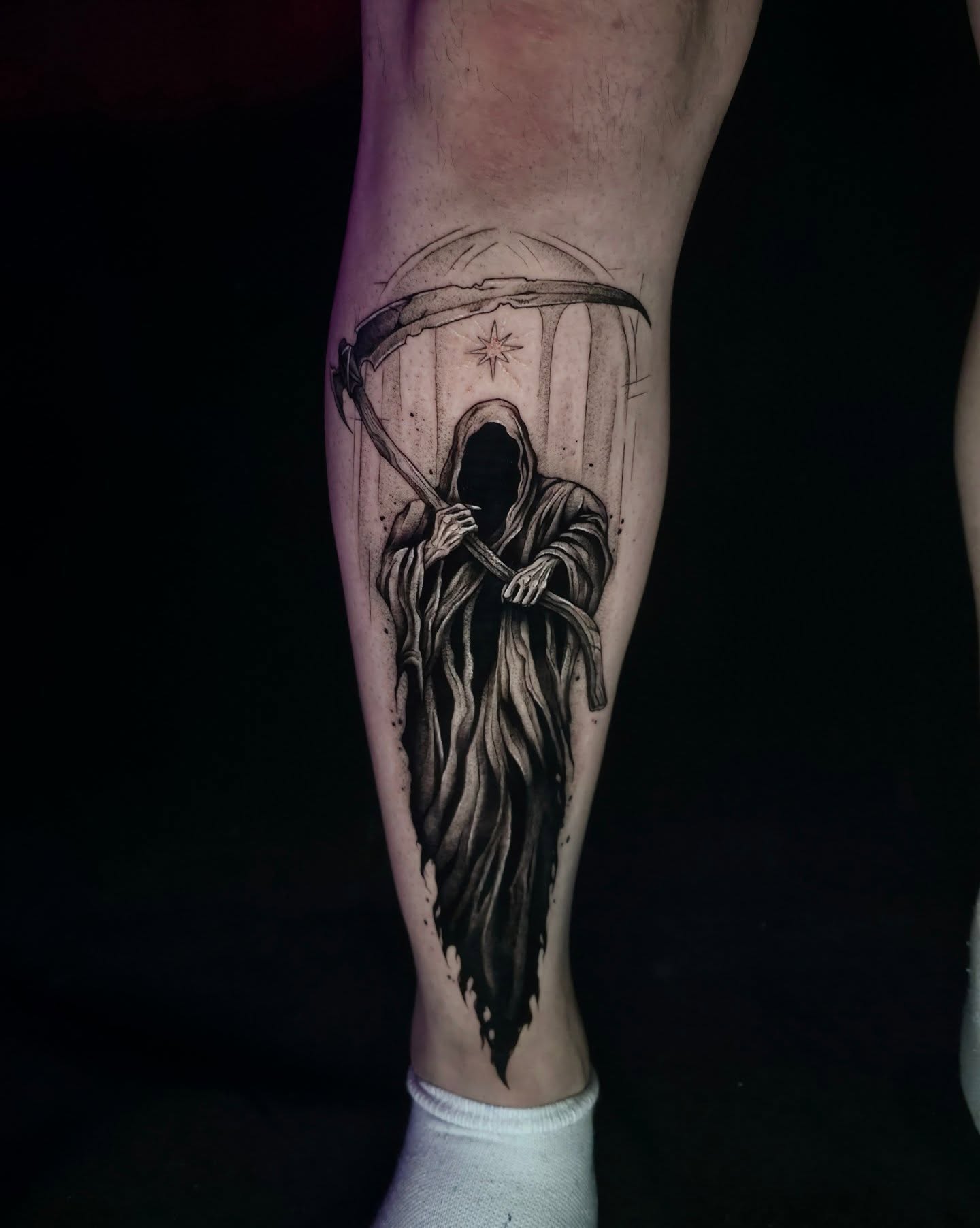
The grim reaper is one of the few tattoo subjects that says something serious without needing a single word of text. It is a hooded figure, a scythe, and an idea most people understand instantly.
I have been writing about and looking closely at tattoo design for years, and the reaper is a subject I keep circling back to. It is requested constantly, and it is also one of the easiest designs to get wrong.
The difference usually comes down to style and scale rather than the concept itself. A reaper drawn small and busy turns into a grey smudge within a decade, while the same figure drawn bold and simple still reads perfectly at twenty years. If you are still deciding on a direction, it helps to understand how the major tattoo styles differ before you book anything.
Below are nineteen directions worth considering, grouped by how they actually look on skin rather than by how they sound in a list.
Which Reaper Style Is Right for You?
This is the comparison I find most useful when someone is torn between approaches. It is about trade-offs, not rankings.
| Style | Best For | How It Ages | Typical Size |
|---|---|---|---|
| American traditional | A first reaper, bold statement pieces | Excellent, by design | 4-6 inches |
| Blackwork / silhouette | Graphic impact, minimal fuss | Excellent, needs occasional touch-up on edges | 3-8 inches |
| Black and grey realism | Detailed faces, fabric folds, drama | Good if large; softens if small | 6 inches and up |
| Neo-traditional | Colour with structure, ornate props | Very good | 5-8 inches |
| Fine line | Subtle, small placements | Weakest of the group, expect blur | 2-4 inches |
| Illustrative / cartoon | Humour, personality, softer tone | Good when outlines stay bold | 3-6 inches |
Why the Grim Reaper Keeps Coming Back
The reaper is not a modern invention. The skeletal figure carrying a scythe took its familiar shape in Europe during and after the plague years, and it has stayed remarkably stable ever since.
That stability is exactly why it tattoos so well. A subject the whole culture already recognises does not need explaining, which frees the artist to focus on composition instead of clarity.
Most people I have spoken to who wear one do not read it as morbid. They read it closer to memento mori — a reminder that time is limited, worn somewhere they will see it.
Others get one after a loss, and the figure becomes less about fear and more about acceptance. That reading is very common and worth knowing before you assume the tattoo means something aggressive.
It is also worth saying that the reaper is not universally read as neutral. In some workplaces and some families it lands harder than a rose does, and placement is your main lever for controlling that.
19 Grim Reaper Tattoo Ideas
The first eight are the directions I would push almost anyone toward. They are proven, they hold up, and every competent artist can execute them.
1. Classic American Traditional Reaper
This is the safest strong choice in the entire category. Heavy black outlines, a limited palette of red, green and yellow, and almost no small detail.
The look descends directly from mid-century flash, and it survives because it was drawn to survive. Line weight is doing the work, not shading.
If you want a reaper that still looks sharp in 2050, this is the answer. In my experience it is also the version artists are happiest to draw, because the rules are clear.
Expect four to six inches on a forearm or outer bicep. Smaller than that and the bold lines start crowding each other.
2. Hooded Reaper in Blackwork
Here the face is either empty shadow or absent entirely, and the hood carries the whole design.
It is a genuinely graphic approach — large areas of solid black against untouched skin, with very little grey in between.
When I have compared healed blackwork against healed grey wash on the same person, the blackwork almost always looks crisper. Solid saturation simply holds better than gradient.
If this direction appeals to you, it is worth reading more about blackwork tattoo designs before committing, because the aftercare and the healing look are slightly different.
3. Reaper with an Hourglass
Adding an hourglass changes the message. The reaper stops being a threat and becomes a timekeeper.
Compositionally it also solves a problem: the reaper is a tall vertical figure, and an hourglass gives the artist something to balance the lower half with.
This is the version I most often recommend to people who want the symbolism without the menace. It reads as reflective rather than dark.
There is a lot of design range in the prop itself, and hourglass tattoo ideas are worth browsing separately if the timekeeping angle is what draws you in.
4. Reaper and Rose
The pairing is old and it works for a simple reason: the rose supplies curves where the reaper supplies angles.
It also gives a black and grey artist somewhere to put mid-tones, which stops the piece from becoming a flat black mass.
Most artists I have asked about this combination say it is the easiest reaper request to make look finished, because the rose fills negative space without extra invention.
If you like the contrast, the wider rose and skull tattoo family works on the same principle and offers more compositions to borrow from.
5. Scythe on Its Own
You can skip the figure entirely and tattoo just the scythe. It is a surprisingly effective piece of shorthand.
The long curved blade suits narrow placements — the outer forearm, the calf, along the spine — where a full figure would have to shrink too much.
It is also the most subtle option here. Plenty of people read it as a farm tool first and a death symbol second, which is sometimes exactly the point.
Detail lives in the blade and the wood grain of the handle, so give the artist at least five inches to work with.
6. Reaper in Neo-Traditional Style
Neo-traditional keeps the bold outline of traditional work but allows richer shading, dimensional props and a broader colour range.
Reapers suit it well because the cloak becomes an excuse for elaborate fabric folds and ornamental borders.
This is the style to pick if you want colour but do not trust colour to age. The heavy line acts as a frame that holds everything together as pigment softens.
Budget more time than you expect. A neo-traditional reaper of six or seven inches is commonly a full-day sitting.
7. Reaper and Clock
A pocket watch or clock face does much the same job as an hourglass, but with a different visual rhythm.
Many people set the hands to a time that matters to them, which quietly turns a generic design into a personal one.
The technical warning is real: clock faces contain small numerals, and small numerals blur first. Ask for Roman numerals or no numerals at all if the piece is under five inches.
There is a whole design tradition here, and clock tattoo ideas cover the placement and sizing questions in more depth.
8. Cloaked Silhouette
Strip out the face, the hands and the interior detail and you are left with a shape. That shape is still unmistakably a reaper.
Silhouettes are the single most durable option in this entire article. There is nothing fine enough to fall apart.
When I have looked at ten- and fifteen-year-old work, solid silhouettes were consistently the pieces that still looked deliberate rather than faded.
They also scale in both directions, working at three inches on a forearm or twelve inches down a thigh.
More Reaper Variations Worth Considering
The remaining eleven are narrower ideas. Some are excellent, a couple come with real caveats.
9. Reaper and Crow
A crow or raven on the scythe adds a second focal point and fills awkward space above the shoulder.
The bird carries its own weight of meaning, and raven tattoo ideas show how much variation is possible in the pose alone.
10. Reaper in Flames
Flames wrap around the figure and turn a vertical design into something that follows the curve of an arm.
Choose either colour flames or black smoke, not both. Mixed treatments tend to muddy after healing.
11. Smiling or Friendly Reaper
A grinning, waving reaper is a legitimate design choice and far more common than people expect.
It works best in an illustrative or cartoon style where the exaggeration is obviously intentional.
12. Reaper with Scales
Swapping the scythe for a set of scales shifts the meaning from death toward judgement and fairness.
The scales are geometrically fussy, so this one needs a steady hand and reasonable size.
13. Full Reaper Sleeve
At sleeve scale the reaper becomes the anchor and everything else — landscape, script, secondary figures — supports it.
Plan the whole sleeve before the first session, not after. Retrofitting a sleeve around an existing reaper is much harder, as half sleeve tattoo ideas tend to demonstrate.
14. Reaper with a Quote
Short is better. Two or three words hold up; a full sentence in small script rarely does.
Have the artist letter it by hand rather than importing a font, so the weight matches the drawing.
15. Chibi or Cute Reaper
A small, rounded, big-headed reaper reads as affectionate rather than dark, and suits the ankle or the back of the arm.
Keep the outline bold. Cute designs fail when they are drawn too thin.
16. Reaper on Horseback
The mounted reaper borrows from the Four Horsemen imagery and needs real estate — a back piece or a thigh.
Attempted small, the horse turns into an unreadable shape. This is not a forearm design.
17. Watercolour Reaper
Soft colour washes behind a black figure look striking fresh. I am honest with people about the trade: watercolour without a strong black structure underneath is the least durable option here.
If you want it anyway, insist on a solid black anchor and accept that touch-ups are part of the plan.
18. Reaper Chest Piece
The chest suits the reaper better than almost any other placement, because the figure can be centred and drawn symmetrically.
It is also one of the more painful sittings, particularly over the sternum.
19. Abstract or Geometric Reaper
Breaking the figure into shards, dot work or geometric planes gives you a reaper that does not look like anyone else’s.
It asks more of the artist than the other eighteen. Look for a portfolio with healed abstract work, not just fresh photos.
Getting a Reaper Tattoo That Ages Well
Size is the decision that matters most. Every reaper I have seen fail was drawn too small for the amount of detail packed into it.
Ask your artist directly what the piece will look like at ten years. A good one will tell you which elements they expect to soften, and will offer to simplify them now.
Placement affects longevity too. Areas with heavy sun exposure and high friction — hands, feet, the outer forearm — fade faster than the inner arm or the chest, in most cases.
If pain is on your mind, the ribs and sternum are the harder sittings for a chest piece, and tattoo pain management tips are worth reading before a long session rather than during it.
Common Mistakes and What to Do Instead
The most frequent mistake is bringing a highly detailed digital illustration and asking for it at four inches. Detail that works on a screen does not survive in skin.
The second is choosing an artist by follower count rather than by healed work. Ask to see photographs taken months after the session, not the day of.
The third is rushing the aftercare. Tattoos are open wounds while they heal, and the US Food and Drug Administration notes that infection and allergic reaction are real risks. If a healing tattoo becomes hot, swollen, or increasingly painful after the first few days, see a doctor rather than waiting it out.
And never let anyone talk you into a home or unlicensed setup for a piece this size. Sterile equipment and a licensed studio are not optional extras.
Still Not Sure?
If the reaper feels like too much, there are subjects that carry a similar weight with a lighter touch.
A skull and dagger gives you mortality symbolism in a smaller, more traditional package.
If it is the colour palette pulling you in rather than the figure, black and red tattoo ideas deliver the same graphic intensity without the skeleton.
Frequently Asked Questions
What does a grim reaper tattoo mean?
Most commonly it functions as a memento mori — a reminder that life is finite and time should not be wasted. Some people choose it after losing someone, in which case it reads as acceptance rather than fear. A smaller group simply likes the imagery and does not attach a personal meaning to it, which is a perfectly valid reason. The meaning is not fixed by tradition, so it is largely whatever you decide it is.
How much does a grim reaper tattoo cost?
It depends far more on size, style and your artist’s hourly rate than on the subject itself. A small blackwork silhouette might be a single short session, while a detailed chest piece or sleeve panel is usually several full days. Most studios quote by the hour for larger custom work and by the piece for smaller flash. Ask for a written estimate before the first session so there are no surprises.
Does a grim reaper tattoo hurt more than other designs?
The subject makes no difference — placement does. Areas over bone and thin skin, like the ribs, sternum, spine and ankles, are generally reported as the harder sittings, while the outer arm and thigh are usually easier. Because reapers are often large pieces, the length of the session tends to matter more than the peak intensity. Eating properly beforehand and scheduling breaks helps more than most people expect.
What style lasts the longest for a reaper tattoo?
American traditional and solid blackwork silhouettes hold up best, because both rely on bold lines and saturated black rather than fine detail. Black and grey realism ages well too, but usually only when it is drawn large enough. Fine line and watercolour are the most likely to soften noticeably over the years. In every style, a bigger piece with fewer small elements will outlast a small piece packed with detail.
Where is the best placement for a grim reaper tattoo?
The forearm, outer bicep, thigh and chest are the most common choices, and all four give the vertical figure room to breathe. The chest works particularly well because the design can be centred symmetrically. If visibility at work is a concern, the upper arm and thigh are the easiest to cover. Avoid placements like hands and feet for a detailed reaper, since friction and sun exposure tend to break down detail faster there.
Quick Summary
- The grim reaper reads as a memento mori for most people who wear one, not as a threat.
- American traditional and solid blackwork are the two most durable styles for this subject.
- Props change the message — an hourglass or clock reads reflective, a scythe reads direct, scales read as judgement.
- Size is the decision that matters most; almost every failed reaper was drawn too small.
- The chest, forearm, outer bicep and thigh all suit a tall vertical figure.
- Watercolour and fine line look best fresh and age the least gracefully of the options here.
- Choose your artist on healed photographs, not on fresh work or follower count.
- Treat a healing tattoo as an open wound and see a doctor if it worsens after the first few days.