The best first tattoo is the one you would still choose if you had to wait another two years to get it. That is the test I give every young guy who asks me where to start, and it removes about half the ideas on the spot.
I have sat in on more first sessions than I can count, and the pattern almost never changes. The people who love their tattoo a decade later picked something bold, simple and personal. The people who cover theirs picked something detailed, trendy or borrowed from a photo they saw that week.
The 21 ideas below are aimed at teen boys and young men getting their first piece. They range from century-old traditional designs to quiet personal marks, and every one of them is something a competent artist can execute well at a first-tattoo size and budget. If you want a wider spread of options, our guide to first tattoo ideas for men covers the same ground for older beginners.
One thing before the list: age and consent laws are not optional, and I have covered them properly further down rather than burying them at the end.
Which First Tattoo Style Is Right for You?
Style matters more than subject for a first tattoo. The same wolf looks completely different in traditional, blackwork or realism, and each one ages differently and costs differently.
This is the comparison I sketch out for people who are stuck between styles.
| Style | How It Ages | Typical First-Tattoo Size | Best For |
|---|---|---|---|
| American traditional | Excellent. Heavy outlines stay readable for decades. | Palm-sized on the arm or calf | Eagles, anchors, daggers, skulls |
| Blackwork / geometric | Very good, provided the black is packed solidly. | Forearm panel or upper-arm band | Mountains, faceted animals, armbands |
| Black and grey realism | Good with a specialist, poor with a generalist. Soft grey can fade. | Outer bicep or half-forearm | Lions, wolves, portraits |
| Fine line | Fair. Thin lines soften and can blur over the years. | Inner arm, small | Compasses, constellations, dates |
| Lettering / script | Depends entirely on font weight and letter spacing. | Inner forearm or ribs | Quotes, initials, Roman numerals |
If you are genuinely torn, I would point most first-timers toward traditional or blackwork. They are the two styles most likely to still look sharp when you are thirty.
Age, Consent and the Rules Nobody Explains Properly
This section exists because a lot of teenagers get the wrong answer from friends and end up somewhere they should not be.
In the United Kingdom, the Tattooing of Minors Act 1969 makes it a criminal offence to tattoo anyone under 18. There is no parental-consent exception, and no reputable UK studio will bend on it.
In the United States the rules are set state by state rather than nationally. Many states set a hard minimum of 18, several allow tattooing at 16 or 17 with a parent physically present and signing consent, and a handful add extra conditions on top. Check your own state’s health department page before you book, because studio staff sometimes get this wrong too.
Any artist willing to tattoo you outside the law where you live is also willing to cut corners on things you cannot see, like single-use needles and sterilisation. That is the real reason the rule matters, not the paperwork.
If you are still under age, use the time. Save for a better artist, sit with your design idea for a year, and see whether you still want it. In my experience the wait improves the tattoo far more often than it kills the idea.
Home tattooing and stick-and-poke kits are a genuinely bad idea here. The US Food and Drug Administration documents infection and allergic-reaction risks tied to unsterile equipment and unregulated inks, and none of that is worth saving a few hundred dollars over.
21 Tattoo Ideas for Teen Boys and Young Men
Each of these has been chosen because it works at first-tattoo scale, does not depend on a trend, and can be executed well by a solid mid-level artist rather than only by a superstar.
1. Geometric Animal
An animal broken into faceted triangular planes: a wolf, bear, eagle or lion built out of clean geometry rather than fur and muscle.
The style flatters a first tattoo because it hides nothing and demands nothing. There is no rendering to fade, only lines and solid black. I have seen ten-year-old geometric pieces that still look like they healed last month.
If you like the look, our geometric wolf tattoo ideas gallery shows how much variation is possible inside one subject.
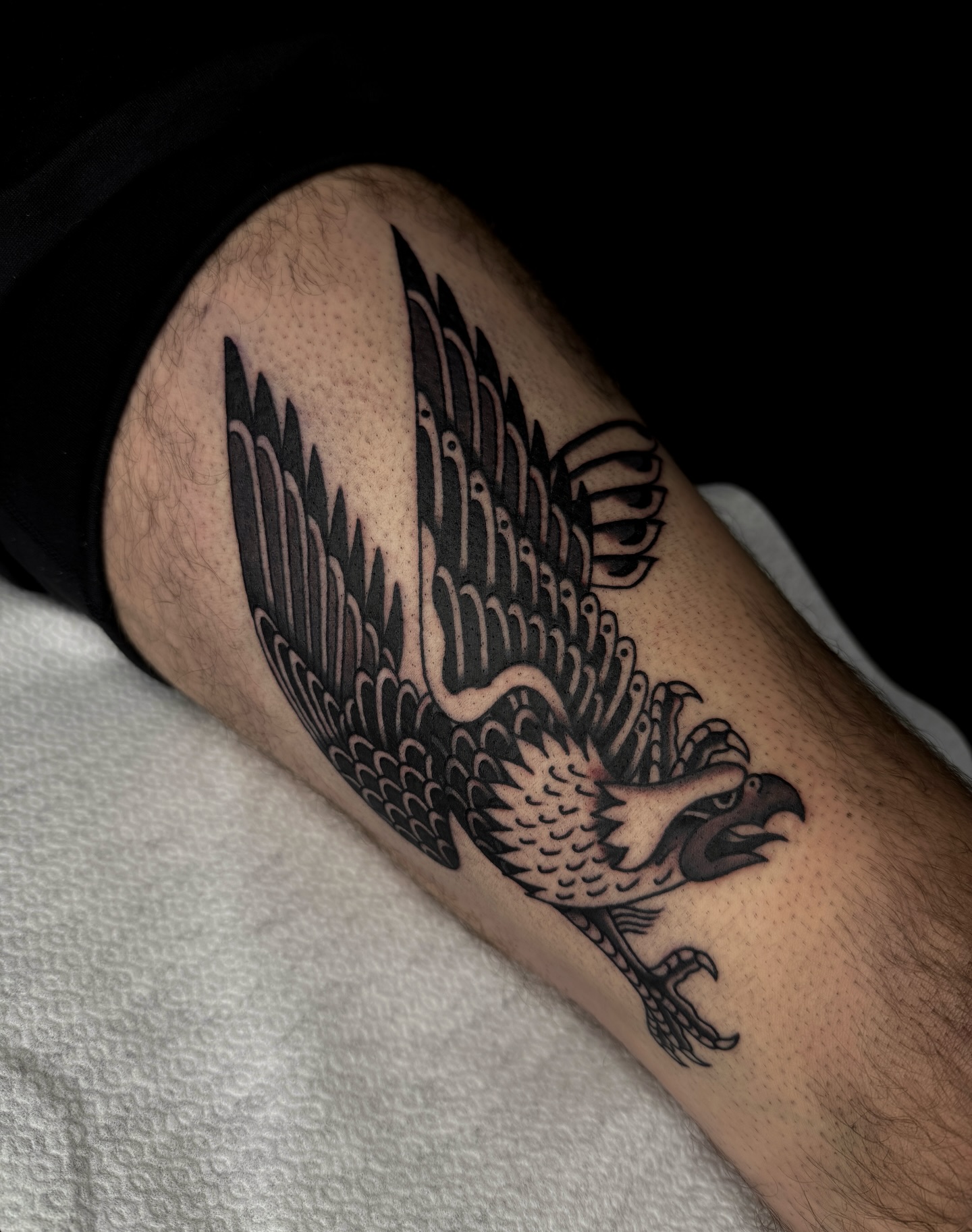
2. Classic American Eagle
Bold outlines, wings spread or locked into a dive, a small amount of solid colour in the tail and beak.
The traditional eagle is one of the oldest continuously tattooed subjects in Western tattooing, and that longevity is the point. A design that has survived a hundred years of changing taste is unlikely to embarrass you in ten.
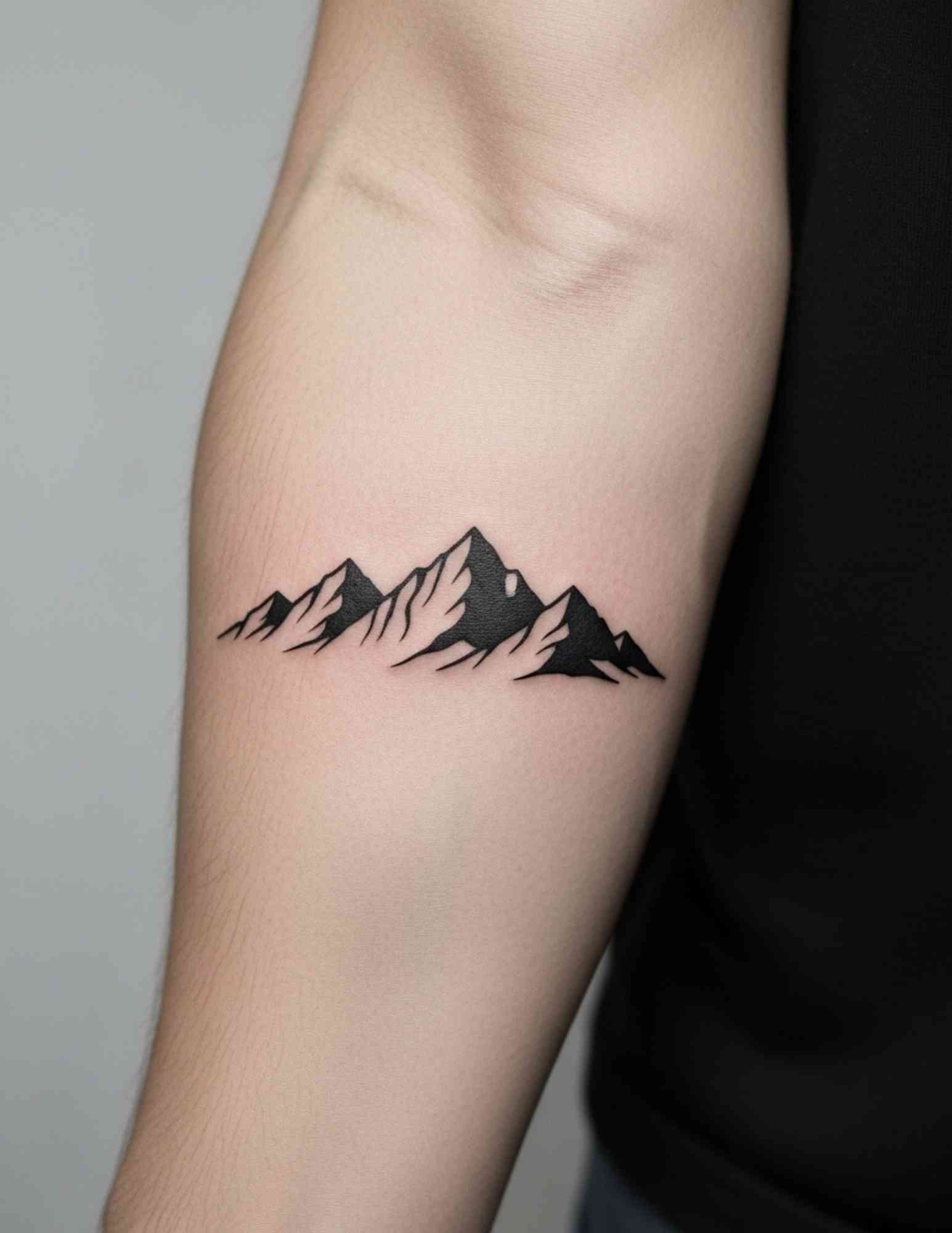
3. Mountain Silhouette
A ridgeline in solid black or heavy blackwork, usually sitting across the forearm or wrapping the upper arm.
It reads instantly, needs no colour, and holds meaning without announcing it. Every artist I have asked names mountains as one of the easiest requests to execute cleanly for a first-timer.
There is a fuller spread of compositions in our mountain tattoo ideas for men guide.
4. Minimalist Compass
A compass rose in clean linework, four or eight points, no shading.
The metaphor is obvious but it is obvious for a reason. It also happens to be one of the few small fine line designs that survives well, because the internal shapes are geometric rather than delicate.
Keep it above roughly two inches wide. Below that the internal points start closing up as the ink spreads over time. The symbolism is unpacked properly in our piece on compass tattoo meaning.
5. Wolf
Either a black and grey portrait or a stylised head in heavy line.
The wolf is the single most requested subject I see from young men, which cuts both ways. It is genuinely strong imagery, but a mediocre wolf is very obviously a mediocre wolf.
Ask specifically to see healed animal portraits before you book this one. Fresh photos hide almost every weakness. Our wolf tattoo design ideas collection is a good place to calibrate what good looks like.
6. Roman Numerals
A date that mattered, rendered in Roman numerals on the inner forearm, inner bicep or ribs.
Dates are the safest personal tattoo because their meaning does not drift. A birth date, a date you got clean, a date something ended: the number stays true regardless of how you feel about it later.
Ask for a font with some weight to it. Hairline numerals blur into each other faster than most people expect.
Photo: @kristintattooer
7. Anchor
The traditional anchor, usually with rope, sometimes with a banner across it.
Stability, and the thing that stops you drifting. It is also a technically forgiving design: heavy outline, simple internal shading, no fine detail to lose.
This is the design I most often recommend to someone who wants a traditional piece but is not sure they can commit to a full eagle or dagger.
8. Lion Head
A lion in black and grey or in bold traditional line, typically on the outer bicep or the outer forearm.
The mane gives an artist somewhere to put texture, which is why lions look impressive even at moderate size. It also means a weak artist has plenty of room to make a mess.
The outer bicep is the natural home for this one, and our outer bicep tattoo ideas guide shows why the curve of the muscle suits a head-on subject.
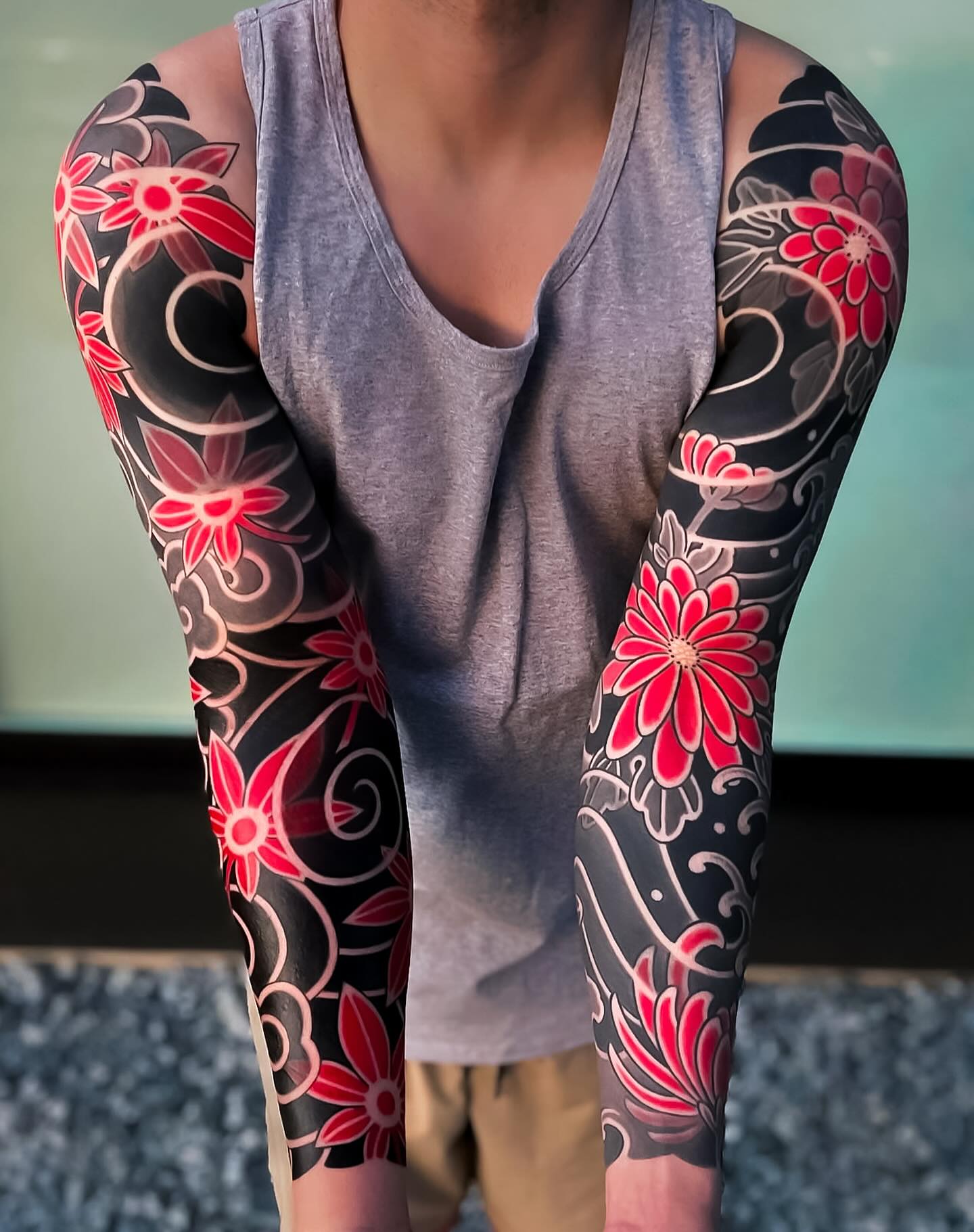
9. Japanese Wave
A wave in the Japanese tradition: bold outline, controlled internal movement, white or negative-space foam caps.
Waves are designed to flow along a limb rather than sit on it, so they wrap the forearm more naturally than almost any other subject on this list.
If you think you might eventually want a sleeve, this is one of the few first tattoos that extends into a larger composition without needing to be reworked.
10. Skull
A skull in traditional or black and grey style, front-facing or three-quarter.
Read it as memento mori rather than as anything darker. The point of the image historically has been that time is finite, not that the wearer is morbid.
Contrast is everything here. Deep black in the sockets against clean highlight on the cheekbone is what keeps a skull readable from across a room.
11. Family Initials
The initials of a parent, sibling or grandparent, set simply on the inner forearm or inner bicep.
It is quiet, it is cheap, and it is the first tattoo I have seen regretted least often. Nobody grows out of their family.
Keep the letterforms simple and reasonably large. Ornate monograms at small scale are the ones that need fixing later.
12. Sword
A sword running vertically down the forearm, in traditional outline or a more illustrative black and grey.
The shape of the design matches the shape of the limb, which is a bigger deal than most people realise. Designs that fight the body always look slightly wrong.
Blades carry a long symbolic history, covered in our piece on blade tattoo meaning if you want the background before you commit.
13. Constellation
Your birth constellation as accurate dots and connecting lines, usually small and placed on the inner arm or shoulder.
It is discreet enough for almost any workplace and personal without being legible to strangers, which suits a lot of young men who want ink but not attention.
Ask for slightly larger dots than the reference image suggests. Tiny dots are the first thing to soften as a tattoo settles.
14. Blackwork or Tribal Armband
A solid or patterned band wrapping the upper arm.
If you have a real connection to a specific tradition, such as Polynesian or Maori work, go to an artist who practises within that tradition and understands the meaning of what they are putting on you. Our Polynesian tattoo guide explains why that matters.
If you do not have that connection, a geometric or solid blackwork band gives you the same visual weight without borrowing someone else’s culture.
15. Eagle and Snake
An eagle gripping a snake in its talons, one of the set-piece compositions of American traditional tattooing.
It is more ambitious than most first tattoos, and it needs a decent amount of space to work. Anything smaller than a hand’s width tends to collapse into noise.
Budget for a longer session on this one than you think. Two subjects means twice the linework.
16. Minimalist Animal Line Art
An animal reduced to a handful of confident lines instead of a full rendering.
Done well it is elegant. Done badly it looks unfinished, and there is very little middle ground, so the artist’s portfolio matters more here than the concept does.
Look for line work with visible confidence and consistent weight. Wobble shows immediately in a design this stripped back.
17. Vintage Compass and Map
An antique-style compass sitting over faded cartographic detail, in black and grey.
This one needs room. The charm is in the small engraved detail, and detail needs physical space or it turns into grey mush within a few years.
I would treat it as a half-forearm piece minimum rather than a small first tattoo.
18. Tree of Life
A tree with roots below and branches above, typically in blackwork or black and grey.
The roots-and-branches structure gives the design an obvious top and bottom, which makes placement straightforward on a forearm, calf or spine.
It appears across a lot of separate cultural traditions, which is part of why it does not feel tied to any particular moment in fashion.
19. Dagger
A traditional dagger, sometimes plain, sometimes through a rose or a skull.
There is no subtlety here and that is the appeal. It is direct, it is simple, and it is one of the foundational images of the traditional canon.
Pairings change the reading considerably, as our piece on skull with dagger tattoo meaning lays out.
20. Quote or Lyric
A short line from a book, a song or a person you trust, set in a well-chosen font.
Two rules. Keep it short, because long script wraps badly and blurs first. And pick something you could say out loud in a job interview without wincing.
Lettering is a genuine specialism. An artist who is brilliant at animals may be mediocre at script, so check that specific part of the portfolio.
21. Portrait of Someone Important
A parent, grandparent or mentor, rendered in black and grey realism.
This is the one design on the list I would tell most first-timers to postpone. Portraits are the hardest thing in tattooing, and a portrait that is 90 percent right is worse than no portrait at all.
If you are set on it, find a portrait specialist and look only at healed work photographed at least a year out. Expect to travel, wait and pay properly for it.
If None of Those Fit: Other Directions Worth Considering
Not every first tattoo needs to come off a list. These are the directions I suggest when nothing above lands.
Something from your own hand
A drawing you made, cleaned up by your artist. It is unrepeatable and it costs nothing to develop.
Most artists are happy to redraw a rough sketch into something tattooable, and many enjoy it more than copying a reference photo.
A tool or object from something you actually do
A climbing carabiner, a guitar headstock, a specific engine part, a chess piece. Objects date far less than symbols do.
They also sidestep the biggest first-tattoo problem, which is picking imagery because it looks tough rather than because it means anything.
Negative space and pattern
Abstract blackwork that follows the muscle rather than depicting anything at all.
It suits people who like the way tattoos look but do not have a subject they feel strongly about, and there is no shame in that being the honest answer.
A small piece now, a plan for later
Get one modest tattoo, live with it for a year, then decide whether you want more.
Nearly everyone I know who is happy with a full sleeve started this way rather than committing to a large plan on day one.
Practical Advice Before Your First Session
Eat a proper meal in the two hours before you sit down, and bring something sugary. Most of the people I have watched go pale in a chair skipped breakfast.
Skip alcohol the night before and do not take painkillers that thin the blood beforehand unless a doctor has told you to. Thinner blood means more bleeding, which means the artist fights the skin to get ink in.
Expect a first forearm or bicep piece to take one to three hours, not fifteen minutes. Book a day where you have nothing after it and you will enjoy the process far more.
Follow your artist’s aftercare instructions rather than advice from the internet, because it varies with the product they use and the way they work. If your tattoo shows spreading redness, heat, swelling that worsens after a few days, or you feel unwell, that is a doctor’s job and not a forum’s. Our tattoo pain management tips cover the sitting itself in more detail.
Still Not Sure? Avoid These Mistakes
Picking the studio by price. The gap between a cheap tattoo and a good one is usually a couple of hundred dollars and about fifteen years of difference in how it looks.
Copying another person’s tattoo exactly from a photo. Bring it as a reference and let the artist build something for your body and your placement.
Going too small. Almost every first-tattoo regret I have heard involves a design that was shrunk down until the detail had nowhere to live.
Choosing a hand, neck or face placement first. Those are high-visibility, high-pain, fast-fading spots and they close doors you may want open later.
Booking while you are still deciding. If you cannot describe why you want the design in one sentence, wait. The idea costs nothing to keep thinking about.
Frequently Asked Questions
How old do you have to be to get a tattoo?
It depends entirely on where you live. In the UK the Tattooing of Minors Act 1969 sets a hard limit of 18 with no parental-consent exception. In the US the age is set by each state, and while many require 18, several permit 16 or 17 with a parent present and signing consent. Check your state or country’s health authority rather than relying on what a studio tells you, because staff sometimes get this wrong.
What is the best first tattoo for a teenage boy or young man?
Something bold, simple and personal, placed on the upper arm, outer bicep or forearm. Designs with heavy outlines and minimal fine detail hold up best over decades, which is why traditional and blackwork pieces dominate the list above. Avoid portraits and heavily detailed realism for a first tattoo. In my experience the people happiest with their first piece years later picked the simpler option.
How much does a first tattoo cost?
Most studios have a minimum charge that covers a small piece, and beyond that they bill by the hour or by the piece. A palm-sized traditional design on the arm typically falls into one or two hours of work. Rates vary enormously by city and by artist reputation, so ask for a quote before booking rather than guessing. Getting a written quote up front also avoids awkward surprises at the end of the session.
Does a first tattoo hurt a lot?
Less than most people expect on the outer arm and calf, and more than they expect on ribs, sternum, hands and feet. The sensation is closer to persistent scratching than to a sharp stab, and most people settle into it within the first twenty minutes. Pain also depends on sleep, food and nerves on the day. Choosing a forgiving placement for a first tattoo makes the experience much easier.
Will I regret my first tattoo?
Some people do, and the common thread is usually rushing the decision or choosing an artist on price. Sitting with an idea for six months to a year filters out most impulse choices without costing you anything. Picking a design that means something to you personally rather than one that looks impressive also helps a great deal. Regret is far more often about execution and haste than about the subject itself.
Quick Summary
- Check your local law first. The UK bans tattooing under 18 outright; US rules vary state by state.
- Choose bold over detailed. Heavy outlines and solid black age better than fine line and soft grey.
- Pick the artist before the design, and judge them on healed work rather than fresh photos.
- Traditional and blackwork are the safest style bets for a first tattoo.
- Go bigger than feels necessary. Shrinking a design is the most common first-tattoo regret.
- Start on the outer arm, bicep, forearm or calf, not the hands, neck or ribs.
- Postpone portraits until you can afford a genuine specialist.
- Sit with the idea for at least six months. If it still holds up, book it.