The phoenix is one of the few tattoo subjects that means roughly the same thing to almost everyone who gets one. It is a bird that burns down and comes back, and people get it when they have done some version of that themselves.
I have watched this design get booked more often than almost anything else in the mythology category, and the reason is rarely decorative. It usually follows an illness, a divorce, getting sober, leaving a career, or coming out the other side of a bad few years.
What surprises most people is how differently the same bird gets drawn depending on which tradition an artist is working from. A Japanese Ho-O, a Chinese fenghuang and an American traditional phoenix are three genuinely different animals, and picking the wrong one for the look you want is the most common mistake I see. If you want the gendered angle on it, we cover phoenix tattoo ideas for men and phoenix tattoos for women separately.
This guide walks through twenty directions the design can go, what each one costs you in space and healing time, and how to brief an artist so you get a phoenix that still reads as a phoenix in fifteen years.
Which Phoenix Style Is Right for You?
Style choice matters more than subject choice here. The same idea in four different styles gives you four completely different tattoos, with different price tags and different ageing behaviour.
| Style | Best size | Typical sittings | How it ages | Choose it if |
|---|---|---|---|---|
| American traditional | Palm-sized to half sleeve | 1–2 | Excellent — built for it | You want it readable from across a room, forever |
| Japanese (Ho-O) | Half sleeve and up | 4–10+ | Very good with proper black | You want flow, scale and a design that owns the whole limb |
| Black and grey realism | Forearm and up | 2–5 | Good, softens gradually | You want feather detail without colour |
| Fine line / minimal | Wrist, ankle, ribs | 1 | Weakest — expect a touch-up | You want something subtle and cheap to start with |
| Watercolour | Upper arm, thigh, back | 1–3 | Fades fastest without a black base | You want colour movement more than crisp shape |
| Geometric / blackwork | Forearm, calf, spine | 1–3 | Strong if lines are heavy enough | You want the idea of a phoenix, stylised |
What the Phoenix Actually Means Across Cultures
The Greek and Egyptian phoenix — the one that self-immolates and hatches from its own ashes — is the version most Western clients have in mind. Britannica’s entry on the mythological phoenix traces that story back through Herodotus, and it is where the rebirth reading comes from.
The Japanese Ho-O is a different creature. It is closer to a bird of peace and imperial virtue than a bird of destruction, and it is almost never drawn on fire in classical work.
The Chinese fenghuang is different again — ornamental, associated with the empress, and traditionally paired with the dragon rather than with flames. If you brief an artist for a “phoenix” and hand them a fenghuang reference, you will get a very different result than you expected.
None of these are wrong to get. But you should know which one you are actually asking for, especially if you are borrowing from a tradition that is not yours. Reading around Japanese tattoo designs first is worth an hour of your time.
The other thing worth understanding is that the phoenix sits in a wider family of symbolic bird tattoos, and swallows, eagles and cranes all carry their own baggage. Our guide to bird tattoos and their meanings is a decent primer if you are still deciding.
20 Phoenix Tattoo Ideas
These are grouped by approach rather than listed flat, because in practice you pick a direction first and the specific design falls out of it.
1–2. Traditional and Neo-Traditional Phoenix
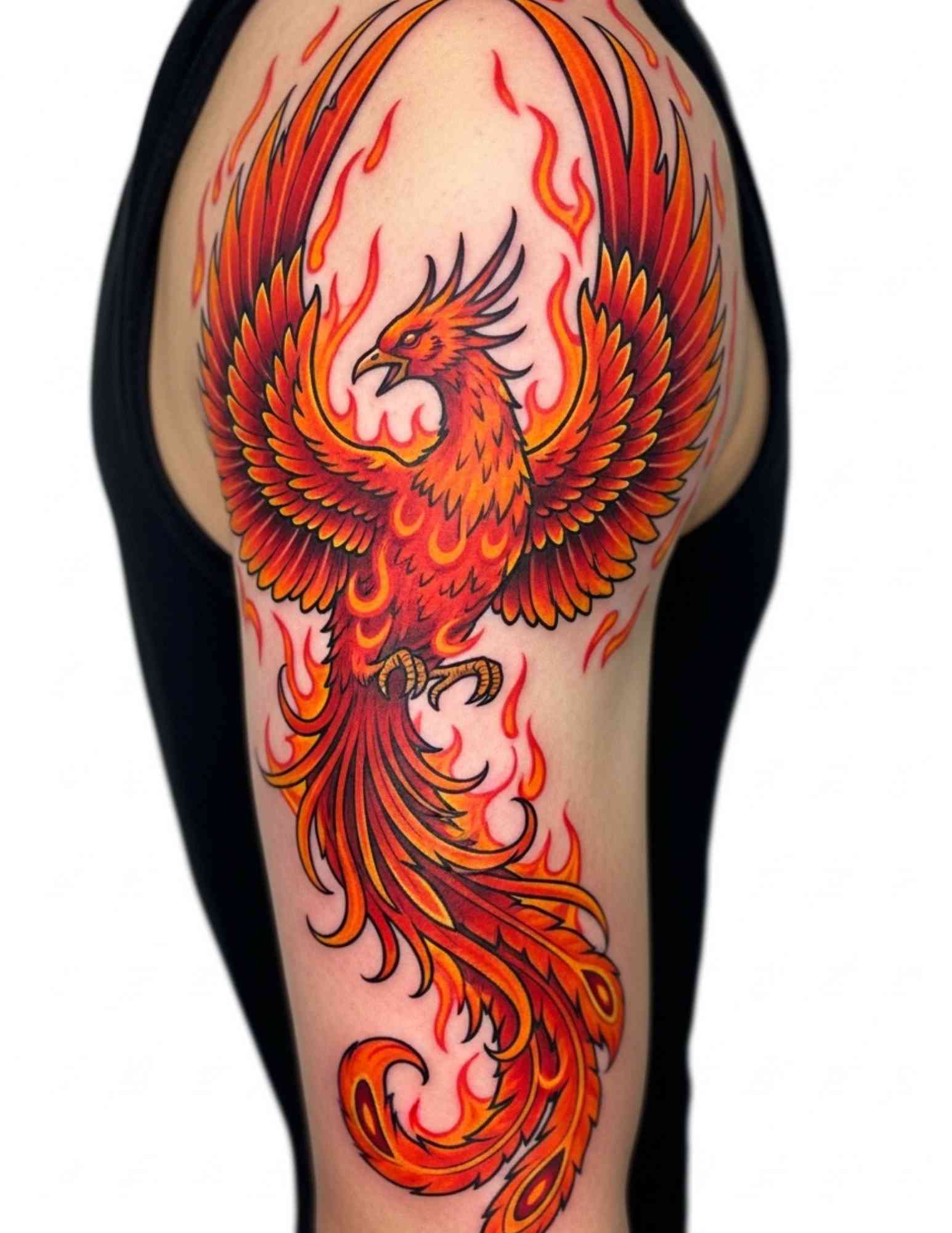
The American traditional phoenix is heavy black outline, a tight palette of red, yellow and green, and very little rendering. It is the most durable phoenix you can get.
In my experience this is also the version people underestimate. It looks simple on paper, then you see a fifteen-year-old one still snapping at full contrast and the appeal makes sense.
Neo-traditional keeps the bold outline but opens up the shading and the colour range. You get jewel tones, layered feathers and more depth, at the cost of a slightly softer look over time.
If you want one tattoo that will never need explaining or restoring, traditional is the safe pick. If you want the same reliability with more detail, neo-traditional is the upgrade.
3–4. Japanese Ho-O and Chinese Fenghuang
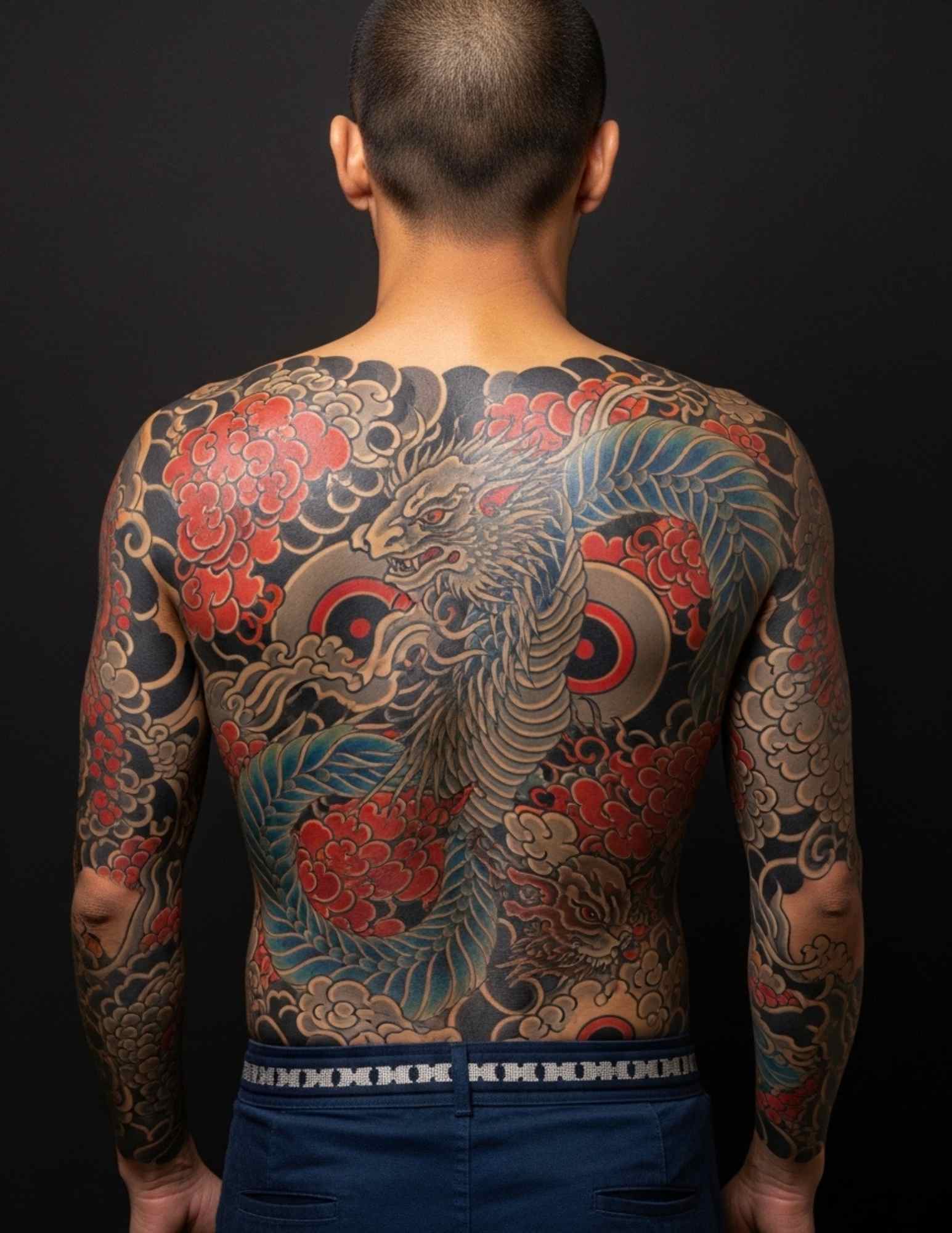
The Ho-O is built around its tail. In classical Japanese work the body is compact and the tail feathers do most of the compositional work, usually flowing with wind bars or clouds.
This is a style that wants space. Every Japanese specialist I have asked has said the same thing: do not try to fit a Ho-O onto a forearm panel, because the tail is the whole point and cramming it kills the design.
The fenghuang is more ornamental and more symmetrical, with elaborate plumage and a curling tail. It reads as regal rather than violent.
Both pair naturally with dragon work, which is why you so often see them together on large pieces. Our Chinese dragon spine designs guide covers how that pairing gets laid out.
5–6. Phoenix in Flames and Rising from Ashes
These are the two most literal interpretations and the two that go wrong most often. Flames and feathers are both busy shapes, and stacking them without a plan produces mud.
When I have seen this done well, the fire is doing less than you would expect. A few committed flame shapes with real negative space between them beats a solid orange field every time.
The “rising from ashes” version usually puts grey ash and scattered embers at the base, which gives the eye somewhere to start and a direction to travel.
Ask your artist to show you the design in black only before any colour goes in. If it does not read as a bird in black and white, colour will not rescue it.
7–8. Minimal Outlines and Small Wrist Phoenixes
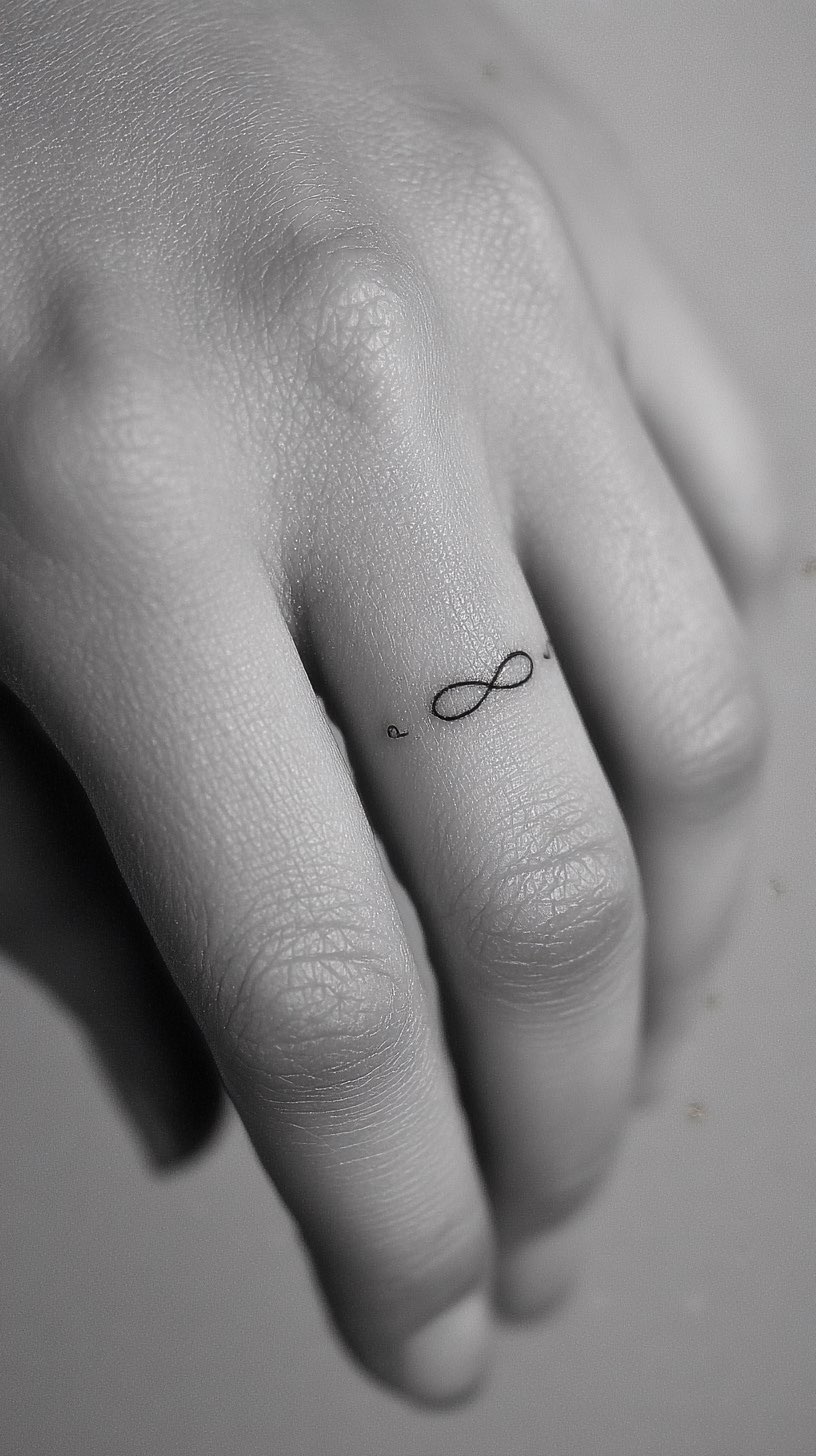
A minimal phoenix is a single-weight outline with no fill — usually a simplified body and two or three sweeping tail feathers.
The trick with small work is fewer feathers, not smaller ones. Detail that sits under about two millimetres tends to blur together as the ink settles over the first few years.
Wrist and inner-forearm placements suit this best. Ribs and ankles work too, but both hurt more and heal slower than people expect.
This is also the cheapest entry point by a wide margin, usually a single short sitting. If you are budgeting, what a small tattoo actually costs is a realistic starting reference.
9–11. Back Pieces, Chest Pieces and Sleeves
Large-scale is where the phoenix genuinely shines, because you finally have room for a full wingspan and a tail that does not have to be cut short.
On a back piece the wings can follow the shoulder blades, which means the tattoo moves when you move. That is the single best argument for going big.
Chest pieces work when the wings mirror the collarbones and the tail drops toward the sternum. Fighting the body’s own lines here is what makes chest work look pasted on.
Sleeves need filler — smoke, wind bars, clouds — or the phoenix floats in dead space. Budget for multiple sittings and a healing gap of at least three to four weeks between them.
If you are leaning this direction, our back piece tattoo ideas guide covers layout and session planning in more detail.
12–13. Phoenix with Dragon and Phoenix with Lotus
The phoenix-and-dragon pairing is traditional in Chinese work and represents balance rather than conflict. It is a big commitment: two complex animals need real estate.
I have seen this attempted on a single forearm and it almost never works. Back, thigh or full sleeve is the honest minimum.
The lotus pairing is gentler and much easier to fit. A phoenix rising above an open lotus stacks two rebirth symbols without repeating the same shapes.
If you like that direction, lotus flower tattoo designs is worth browsing for the flower half before you commit.
14–16. Geometric, Watercolour and Abstract
Geometric phoenixes trade feathers for straight lines, triangles and mirrored shapes. They are clean, modern, and completely unforgiving — a wobbling line has nowhere to hide.
Watercolour treats the bird as colour movement, with washes bleeding past the edges. It is beautiful fresh and it is the style most likely to need attention later.
My honest advice on watercolour: insist on a real black underline underneath. Washes without structure fade into a bruise-coloured smudge faster than anyone wants to admit.
Abstract phoenixes suggest the bird with a handful of brush-stroke marks. Done well they are striking; done badly they are unreadable. If you like heavy stylised work generally, blackwork tattoo designs covers the same territory with more staying power.
17–20. Tail-Only, Eye Detail, Black and Grey, Forearm
A tail-only phoenix is the most underrated idea on this list. Long flowing feathers down the spine or along the ribs give you the phoenix language without the full bird.
Close-up eye detail works the same way — a single fierce eye surrounded by feather texture, usually on the forearm or calf.
Black and grey is the most conservative colour choice and the most predictable one. It ages smoothly and it reads cleanly on a much wider range of skin tones than saturated colour does.
The forearm is the placement I recommend most often to first-timers. It heals well, you can see it, it is easy to cover for work, and it holds a mid-size phoenix comfortably.
If the Phoenix Is Not Quite Right
Sometimes the meaning fits but the imagery does not. These are the substitutions I suggest most often.
The Firebird
Slavic folklore has its own glowing bird, and it carries a quest-and-transformation reading rather than a death-and-rebirth one. Visually it is lighter and less aggressive.
The Crane
If what you actually want is the Japanese aesthetic without the phoenix’s intensity, a crane gives you the same elegance and a longevity meaning instead.
The Moth or Butterfly
Metamorphosis rather than resurrection. Smaller, cheaper, and easier to place, and it sidesteps the “everyone has a phoenix” problem entirely.
Fire Alone
A few people I have talked out of a full phoenix ended up with abstract flame work instead. It keeps the burning-and-continuing idea without the literal bird.
Ash and Ember Motifs
Scattered embers, a burnt feather, or a single ash trail can carry the whole story in a fraction of the space. This is the quietest version of the idea.
Getting a Phoenix Tattoo Right: Practical Advice
Bring reference for the style, not just the subject. Handing an artist five phoenixes in five different styles is the fastest way to end up with something that satisfies nobody.
Ask to see healed work, not just fresh photos. Fresh colour looks incredible on everyone; healed colour is where the difference between artists shows up. This matters more for watercolour and colour packing than for anything else.
On aftercare, follow the instructions your artist gives you over anything you read online, including this article. General guidance from the American Academy of Dermatology on tattoo safety is a reasonable baseline, but your artist knows what they put in your skin.
If a healing tattoo develops spreading redness, swelling, heat, pus or a fever, that is a doctor visit, not a forum question. Most healing irritation is normal; infection and allergic reaction are not, and neither is something to wait out. Red pigment in particular causes reactions in some people, which is worth mentioning to your artist if you have reacted to anything before.
Common Mistakes and Still Not Sure?
The most common mistake is sizing. People pick a design with full feather rendering and then ask for it at half the size it was drawn for, and the detail collapses within a couple of years.
The second is mixing traditions without meaning to — a Japanese tail on an American traditional body on a fenghuang colour palette. It usually just looks unresolved.
The third is rushing the flames. Fire is the part clients care least about at the consultation and complain most about afterwards.
If you are still weighing it up, it is worth looking sideways at related Japanese subject matter like koi fish tattoo drawings before committing, and at how the same bird is handled at different scales in our other guides.
Frequently Asked Questions
What does a phoenix tattoo symbolise?
In the Western tradition it symbolises rebirth, survival and starting over after destruction, drawn from the myth of a bird that burns and rises from its own ashes. In Japanese work the Ho-O carries associations with peace, virtue and imperial authority instead. The Chinese fenghuang is closer to grace, prosperity and balance, and is usually paired with the dragon. Most people who get one are marking a personal turning point rather than a cultural one, which is a perfectly legitimate reason. The meaning is yours to define, but knowing which tradition your design borrows from is worth the reading.
How much does a phoenix tattoo cost?
It depends almost entirely on size and sittings rather than on the subject itself. A small fine-line phoenix on the wrist is usually a single short session, while a full back piece or a Japanese half sleeve runs across multiple sittings over months. Hourly rates vary widely by city and by artist demand, so get a quote in person rather than trusting an online estimate. Ask whether the quote covers the design time as well as the tattooing. Expect to pay a deposit that comes off the final total.
Where is the best place to put a phoenix tattoo?
The back, chest and upper arm suit large designs because the wings can follow the body’s natural lines. The forearm is the most practical mid-size placement: it heals well, it is easy to see, and it is straightforward to cover. Wrists, ankles and behind the ear work for minimal versions only. Ribs and the sternum look striking but are among the more painful and slower-healing spots, so they are a poor choice for a first tattoo.
Does a phoenix tattoo have to be in colour?
No, and black and grey is often the more durable choice. Greywash shading ages predictably, reads cleanly across a wide range of skin tones, and does not depend on colour saturation holding up over decades. Colour gives you the fire, which is a real part of the appeal for many people, but it asks more of both the artist and your aftercare. Blackwork and geometric versions drop colour entirely and lean on line weight instead. Ask your artist which they think suits your skin and the placement you have in mind.
How long does a large phoenix tattoo take to finish?
A full back piece or a Japanese sleeve typically runs across several multi-hour sittings spread over months, not weeks. Artists usually want three to four weeks of healing between sessions before working the same area again. Outlining is normally done first, then shading, then colour, so the piece looks unfinished for a while in between. Plan around holidays, swimming and sun exposure, because healing tattoos should stay out of both. Rushing the gaps is the fastest way to compromise the final result.
Quick Summary
- Decide which tradition you are drawing from first — Greek phoenix, Japanese Ho-O or Chinese fenghuang are three different birds.
- Pick the style before the pose; style drives cost, sittings and how the tattoo ages.
- American traditional and black and grey are the most durable choices; watercolour and fine line need the most maintenance.
- Size the design for the detail it contains, not for the space you feel like giving it.
- Large phoenixes belong on the back, chest, thigh or a full sleeve, where the wings can follow the body.
- Insist on seeing the design in black before any colour is added — if it does not read there, it will not read later.
- Ask every artist you shortlist for healed photographs, not just fresh ones.
- Follow your artist’s aftercare, and see a doctor for spreading redness, heat, pus or fever rather than waiting it out.