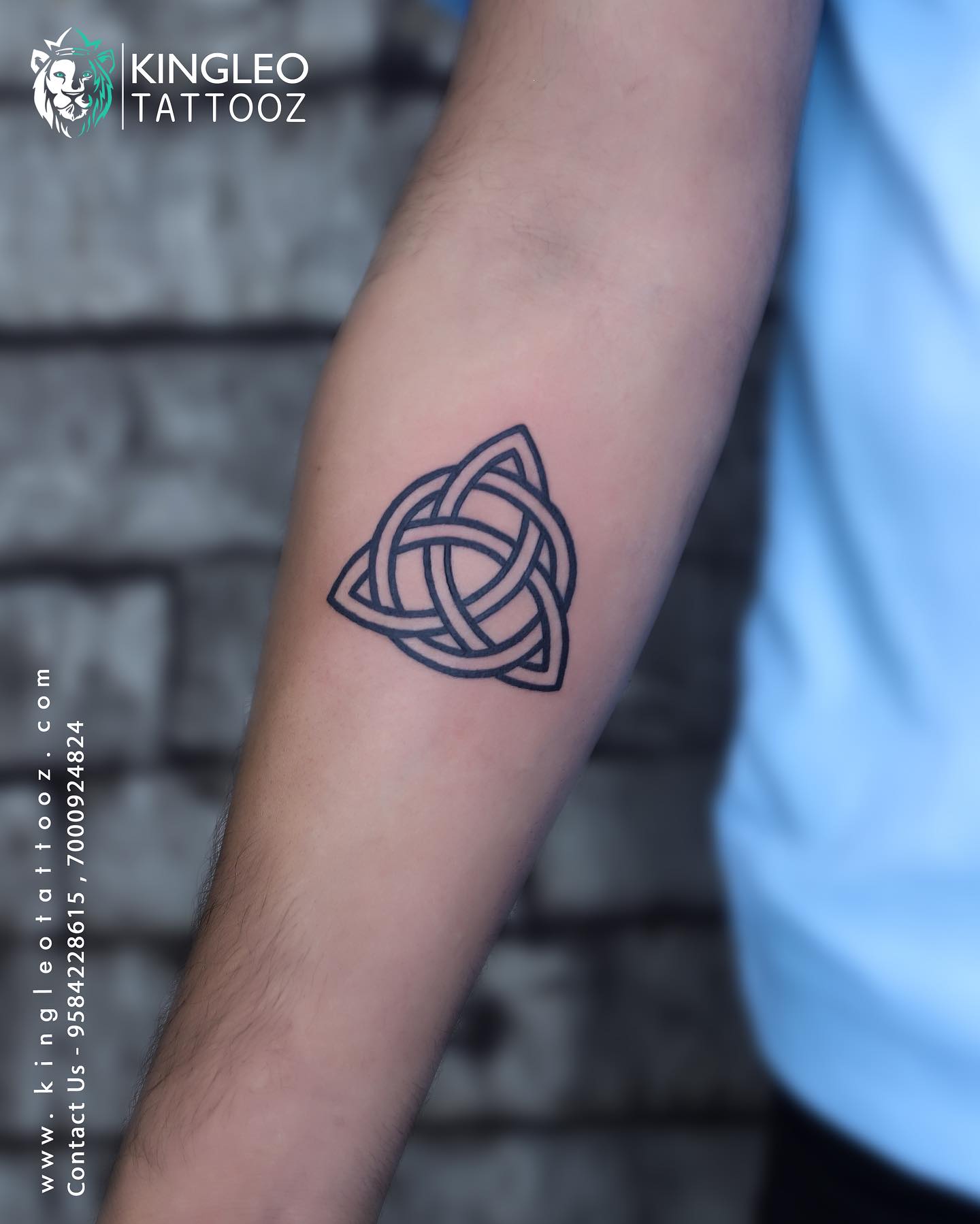
A Celtic knot tattoo is one of the few designs where the meaning is built into the geometry rather than bolted on afterwards. The line has no beginning and no end, and that single fact carries the whole symbolism.
I have spent a lot of time looking at these tattoos both healed and fresh, and the gap between the two is bigger here than in almost any other style. A knot that looks stunning on day one can turn into a black smudge in five years if the spacing was wrong.
That is really what this guide is about. Not just twenty pretty patterns, but which knots hold up, where they sit best on the body, and what to ask an artist before the needle comes out. Much of what makes knotwork work is the same discipline you see in good blackwork tattoo designs — negative space treated as seriously as the ink.
The tradition itself is genuinely old. Interlace patterns survive in Irish and Scottish stone carving, in metalwork, and most famously in the Book of Kells held at Trinity College Dublin, and people are still wearing versions of them on skin today.
Which Celtic Knot Is Right for You?
Different knots suit different placements and different reasons for getting one. This is roughly how I would steer someone choosing between the main families.
| Knot Type | Common Association | Works Best At | Ages Well? |
|---|---|---|---|
| Trinity knot (triquetra) | Threefold unity; Christian Trinity in later use | 2-4 inches, forearm or ankle | Very well — few crossings, open centre |
| Dara knot | Oak roots, inner strength, endurance | 3-5 inches, forearm or shoulder | Well, if the strands stay thick |
| Endless band / armband | Continuity, no beginning or end | Full wrap, bicep or forearm | Depends entirely on strand width |
| Shield knot | Protection, four directions | 2-3 inches, hand, ankle, sternum | Very well — compact and symmetrical |
| Tree of Life | Ancestry, family, connection | 4-8 inches, back, thigh, upper arm | Moderately — fine branches can blur |
| Zoomorphic knotwork | Manuscript tradition, animal symbolism | 5 inches and up | Only at size; poor when shrunk |
| Full panel or sleeve | Heritage, commitment | Back, chest, full sleeve | Very well when properly spaced |
What Actually Makes Knotwork Work
True Celtic interlace is built from continuous strands that pass over and under each other in a consistent rhythm. The rule is simple and unforgiving: if a strand goes over at one crossing, it must go under at the next.
Break that alternation and the pattern stops reading as woven. It becomes a tangle. This is the single most common flaw I see in cheap knotwork, and it is visible from across a room even to people who could not name why it looks wrong.
The second thing that matters is the gap. Ink spreads slightly over the years, so the negative space between strands has to be at least as wide as the strands themselves — often wider if the tattoo is small or sits somewhere with heavy sun exposure.
Different knot families carry different associations, though it is worth being honest that a lot of the tidy one-line meanings circulating online are modern. The historical record tells us where the patterns appear and how they were used decoratively; it is much thinner on what each individual knot was supposed to signify.
Museums with strong early medieval Irish collections, including the National Museum of Ireland, are a far better reference for artists than a search-results image board. In my experience the artists who bring in actual manuscript or metalwork photos produce noticeably better knots.
Celtic Knot Tattoo Ideas Worth Considering
1. Trinity Knots and Dara Knots
The triquetra is three interlocking arcs and nothing else, which is exactly why it works. It has an open centre, few crossings, and it stays legible down to about two inches.
It is often read as the Christian Trinity, though the shape predates that use and appears in earlier Insular and Norse ornament too. Plenty of people wear it simply for the threefold idea — mind, body, spirit, or past, present, future.
The Dara knot is the other one I recommend constantly. It is built on the image of oak roots, from the Irish doire, and it reads as strength drawn from below rather than displayed on the surface.
The Dara knot is more forgiving at medium size than almost any other complex knot, because its strands are naturally thick. When someone wants something that looks substantial without committing to a full panel, this is usually where I point them.
2. Celtic Crosses and Christian-Era Knotwork
A Celtic cross is a Latin cross with a ring joining the arms, and the interesting versions are the ones where knotwork fills the form rather than decorating its edges.
This is the design most likely to be done badly. Rushed versions leave the interlace as a vague texture inside the cross shape, and after a few years it heals into a solid dark mass.
Ask for the knot pattern to be drawn at full scale before the stencil is made. If the artist cannot show you every over-under crossing on paper, they will not manage it on skin.
Placement matters too. The upper arm, the shoulder blade and the calf all give a cross the vertical room it needs. If you want to see how this reads at different scales, the Celtic cross tattoo gallery covers a wide spread of sizes.
3. Endless Bands and Knotwork Armbands
A band that wraps the limb is the purest expression of the endless-line idea, because the design genuinely has no start and no finish.
The catch is arithmetic. The repeat has to divide evenly into the circumference of your arm at that exact spot, or you end up with a visible seam where the pattern does not meet itself.
Good artists measure the limb, calculate the repeat, and adjust the pattern width rather than squeezing the last unit. Every artist I have asked about armbands mentions this measurement step first, before anything about style.
Bands sit well on the bicep, the forearm and above the ankle. Wrists are tempting but tight — the circumference changes sharply over a short distance, which makes a clean repeat harder.
4. The Tree of Life and Nature Knotwork
The Celtic Tree of Life, or Crann Bethadh, shows roots and branches curving out and meeting to close a circle. The symbolism is about balance between what is visible and what is not.
It is the design people most often choose for family and ancestry, and it holds that weight well because the form is genuinely circular rather than just decorated.
Be careful with branch thickness. Thin outer branches are what makes the tree look delicate on paper, and they are also the first thing to blur. Ask for the outermost lines to be drawn heavier than they look right in the stencil.
If you want to compare this against non-Celtic treatments of the same idea, the broader Tree of Life tattoo collection is a useful contrast — it shows how much the Celtic version relies on the closed circle.
5. Zoomorphic Knotwork: Animals in the Interlace
Zoomorphic knotwork is where an animal’s body, limbs or tail dissolve into the interlace. It is the most technically demanding kind of Celtic work and the most impressive when it lands.
The manuscript tradition is full of it — hounds, birds and serpents whose necks stretch into ribbon and knot back on themselves. It is not a modern invention.
This does not shrink. Below about five inches the animal reads as a blob with a suggestion of an eye. If you want zoomorphic work, plan for scale from the start rather than negotiating downwards.
Dragons and serpents suit it best because their bodies are already long and flexible. Wolves and hounds work when the artist is willing to stylise heavily — see how much variation exists in wolf tattoo designs before deciding how literal you want the animal to be.
6. Shield Knots and Protective Symbols
The shield knot is a compact four-cornered pattern, historically associated with protection and with the four directions or four elements.
Practically, it is the best small Celtic tattoo there is. Four-fold symmetry means the eye can complete the pattern even after ink spread, so it stays readable where a complex knot would not.
The quaternary knot is its more elaborate cousin — same four-fold logic, more crossings, needs a little more room. Three inches is a sensible floor for it.
Both suit the sternum, the back of the hand, the ankle and the inside of the forearm. I have seen shield knots done at barely an inch on a finger, and while they looked sharp fresh, finger work fades fast regardless of design.
7. Large-Scale Work: Backs, Chests and Sleeves
Knotwork is one of the few styles that genuinely improves with size, because a repeating pattern needs room to actually repeat before the rhythm becomes visible.
A full back panel can carry three or four different knot families arranged around a central motif. That is where interlace stops being an ornament and becomes architecture.
Sleeves have one specific problem to solve: a pattern with no end has to meet a wrist that clearly does. The usual answers are a band, a taper into negative space, or a deliberate fade rather than a hard stop.
Budget several sessions and expect the linework alone to take multiple sittings. If you are weighing up a full back piece, the back tattoo design guide is a reasonable place to compare layouts before committing.
8. Modern Geometric and Fusion Celtic
Newer work strips the interlace back to its structure — clean strands, wide gaps, sometimes combined with hard geometric shapes or solid blocks of black.
Purists dislike it and I understand why, but it solves a real problem. Simplified knots hold their shape over decades far better than dense traditional panels.
The most successful fusions I have seen keep the over-under rule intact and only simplify the ornament. The moment the weave logic breaks, it stops being Celtic and becomes a pattern that vaguely resembles one.
If this direction appeals, looking through geometric tattoo designs alongside traditional knotwork makes the trade-off obvious: you lose historical density and gain longevity.
Related Traditions and Variations
Celtic interlace is not the only knotwork tradition, and several neighbouring styles get grouped under the same label.
Norse and Viking Interlace
Norse ornament uses interlace too, but the strands are typically more angular and often terminate in animal heads rather than looping endlessly.
If your interest is Scandinavian rather than Irish or Scottish, the Viking tattoo collection is a closer match than anything in this guide.
Runic Additions
People often want runes worked into knotwork borders. It is visually workable, though historically the two traditions belong to different cultures and periods.
If you go this route, check the meaning of every character with more than one source — mistranslated rune tattoos are common and permanent.
Pictish and Insular Variants
Pictish stone carving from northeast Scotland uses spirals, key patterns and abstract symbols alongside interlace. It is a distinct visual language and worth looking at if standard knotwork feels overused.
Claddagh and Figurative Combinations
The Claddagh — hands, heart and crown — is Irish but not knotwork. It combines well when the knot is used as a frame or band rather than fighting the figurative element for attention.
Getting a Celtic Knot Tattoo That Lasts
Ask to see healed photographs, not fresh ones. Fresh knotwork almost always looks crisp; healed work at three to five years old is the only honest test of whether an artist spaces their lines properly.
Sun is the main enemy of fine interlace. Once healed, sunscreen on the piece is the single most effective thing you can do to keep the gaps open, and it matters more here than on a solid-colour tattoo.
Larger knotwork means longer sessions, and long sessions on the ribs, sternum or spine are demanding. The tattoo pain management guide covers the practical side of sitting through them.
For healing itself, follow your artist’s instructions rather than internet consensus, and see a doctor promptly if you get spreading redness, swelling, heat, pus or a fever. General guidance on tattoo safety and reactions is available from the American Academy of Dermatology, but nothing online replaces a professional looking at your skin.
Common Mistakes — and What to Do If You Are Still Unsure
The mistake I see most often is going too small. A knot that needs eight crossings to read cannot deliver them in two inches, no matter who is holding the machine.
The second is choosing an artist by portfolio breadth rather than by knotwork specifically. Excellent realism artists frequently produce mediocre interlace, because it is a completely different discipline.
The third is chasing a meaning that was assigned to a knot by a jewellery catalogue rather than by history. Pick the pattern because it looks right on your body and because the endless-line idea speaks to you; that is enough.
If you are not sold on knotwork specifically, it is worth comparing against linework tattoo ideas, which shares the same black-and-negative-space logic without the historical baggage.
Frequently Asked Questions
Do Celtic knot tattoos have specific meanings?
Some associations are well established and some are modern inventions. The endless line representing continuity is genuinely rooted in how the patterns were made, and the Dara knot’s link to oak comes from the Irish word itself. Many of the tidy one-sentence meanings attached to individual knots online cannot be traced to any historical source. In my experience the honest position is that the tradition is decorative and symbolic in a broad sense, and the specific meaning you attach is largely yours to choose.
How small can a Celtic knot tattoo be?
It depends entirely on how many crossings the pattern has. A trinity knot or shield knot works at around two inches because both have open centres and few overlaps. Dense interlace or zoomorphic work usually needs five inches or more to stay readable once healed. If an artist tells you a complex knot will not shrink to the size you want, they are protecting the tattoo rather than upselling you.
Do Celtic knot tattoos blur over time?
They can, more than most styles, because the design depends on visible gaps between strands. Ink spreads slightly in the skin over years, and once the gaps close the weave stops reading. Wide spacing at the design stage and consistent sun protection afterwards are what prevent it. Well-spaced knotwork can still look sharp decades later, so this is a design decision more than an inevitability.
Do I need Irish or Scottish heritage to get one?
There is no consensus that Celtic knotwork is closed to outsiders, and the patterns circulated widely across Insular, Norse and Anglo-Saxon art long before modern national identities existed. Most people I have spoken to treat it as an open tradition. If it matters to you, learning where a specific pattern comes from is a reasonable way to wear it respectfully.
How long does a Celtic knot tattoo take?
A small trinity or shield knot is usually under an hour. A detailed Dara knot or Tree of Life often runs two to four hours. Full sleeves, back panels and chest pieces are multi-session projects, and the linework alone can take several sittings before any shading begins. Ask for a session estimate rather than a total, since knotwork linework tends to run longer than artists first predict.
Quick Summary
- Celtic knotwork is built on continuous strands that alternate over and under at every crossing — break that rule and it stops reading as woven.
- Negative space matters as much as line. Gaps should be at least as wide as the strands to survive years of ink spread.
- Trinity knots, Dara knots and shield knots are the most forgiving at small and medium sizes.
- Zoomorphic knotwork and dense panels need five inches or more; they do not shrink gracefully.
- Armbands and endless bands require the artist to measure the limb and calculate the repeat so the pattern closes cleanly.
- Choose an artist by their healed knotwork, not by portfolio breadth — interlace is its own discipline.
- Sun protection is the single most effective way to keep a knot legible over decades.
- Treat specific knot “meanings” with healthy scepticism; the endless line is the symbolism that is genuinely built in.