Getting tattooed with a friend is one of the few things you can do that permanently ties a piece of your body to a specific person. The best matching tattoos for best friends are not the ones that look identical — they are the ones that only make full sense when you are standing next to each other.
I have been in the chair for two of these, and I have watched a lot more happen from the waiting-room side of a shop.
The pattern I keep seeing is simple: the pairs who spend an evening talking before they book almost always walk out happy, and the pairs who pick something off a phone screen in the lobby usually do not.
So this guide is organised by idea family rather than as a random list of 22 pictures. If you want something you can be inked with in under an hour, our roundup of small best friend tattoos is a good companion to this page.
Matching vs Complementary: Which Is Right for You?
There are really three ways to do this, and choosing between them up front saves a lot of arguing later.
Identical designs age the most predictably; split designs carry the most meaning but depend on both people staying committed to the idea.
| Approach | What It Looks Like | Best For | The Catch |
|---|---|---|---|
| Identical | The same design, same size, same placement on both people | Friends who want the tattoo readable on its own | Two artists or two sittings can produce noticeably different line weight |
| Split | One image cut in half, or a phrase divided across two arms | Pairs who see each other often and like the reveal | Each half can look unfinished by itself |
| Complementary | Two different designs in one shared style or theme | Friends with different taste, body types or pain tolerance | Needs a strong shared rule or it just looks like two unrelated tattoos |
| Shared style only | Totally separate subjects, matched linework and palette | Groups of three or more | The connection is subtle enough that strangers may miss it |
When I have helped friends decide, complementary wins more often than people expect. It survives the awkward case where one of you wants a two-inch wrist piece and the other wants something the size of a hand.
What Actually Makes a Matching Tattoo Work
The single biggest predictor of a good result, in my experience, is whether the design still holds up as a tattoo when the other person is not in the room.
A half-heart on your ribs looks like a mistake on its own. A crescent moon does not.
The second factor is line weight relative to size. Very fine, very small linework is beautiful on day one and tends to soften and spread over the years, especially on high-friction spots like fingers and the outer edge of the hand.
Every artist I have asked about this says the same thing in different words: give the design a little more room than you think it needs, and it will still read in fifteen years.
Third is honesty about the friendship. Matching ink does not have to mean forever, and plenty of people are perfectly happy carrying a tattoo that marks a chapter that has since closed.
But if a small part of you is already worried about that, pick a design that means something to you first and to the pair of you second. That is the version you will not resent.
22 Matching Tattoo Ideas for Best Friends
I have grouped these into eight families. Pick a family first, then argue about the details — it is a much faster conversation.
1. Celestial Pairs: Sun and Moon, Planets, Stars
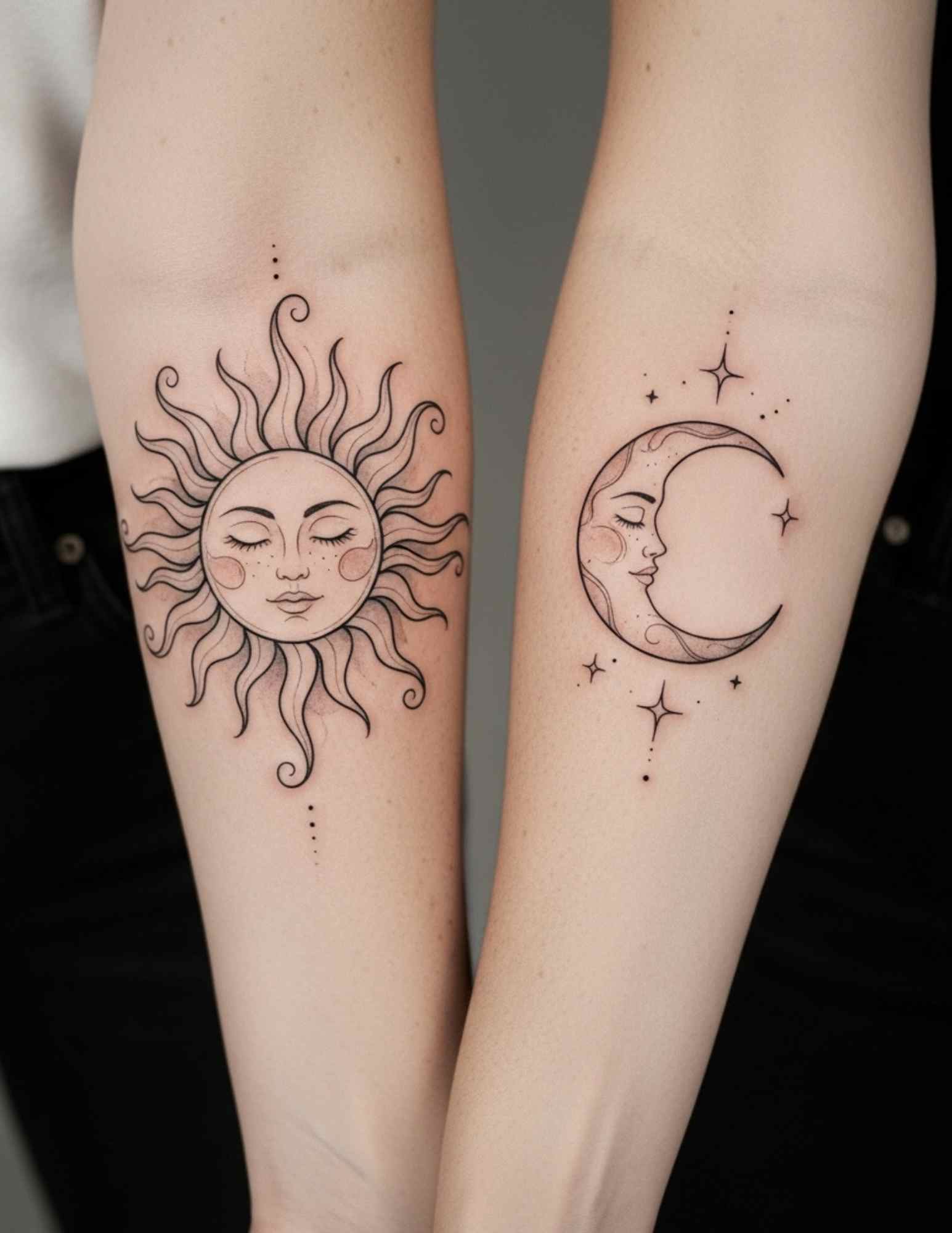
This is the most common request in the category and it earns the spot. A sun and a crescent moon are two complete images that happen to belong together.
The variations are where it gets interesting. One friend takes a full sun with rays, the other a moon with the same ray language, so the linework is obviously from the same hand.
Planets work the same way — Saturn with its ring for one person, a small cluster of stars for the other. I have also seen a pair take the same constellation, each person getting the half that sits over their own birth month.
Keep celestial designs at least two inches across. Tiny suns with eight or ten thin rays are the pieces I most often hear people complain about at the five-year mark, because the rays start to merge into the body of the circle.
If you like the theme but want it larger and more dramatic, the sun and moon spine tattoo treatment gives the same symbolism a lot more room to breathe.
2. Split Quotes, Single Words and Script
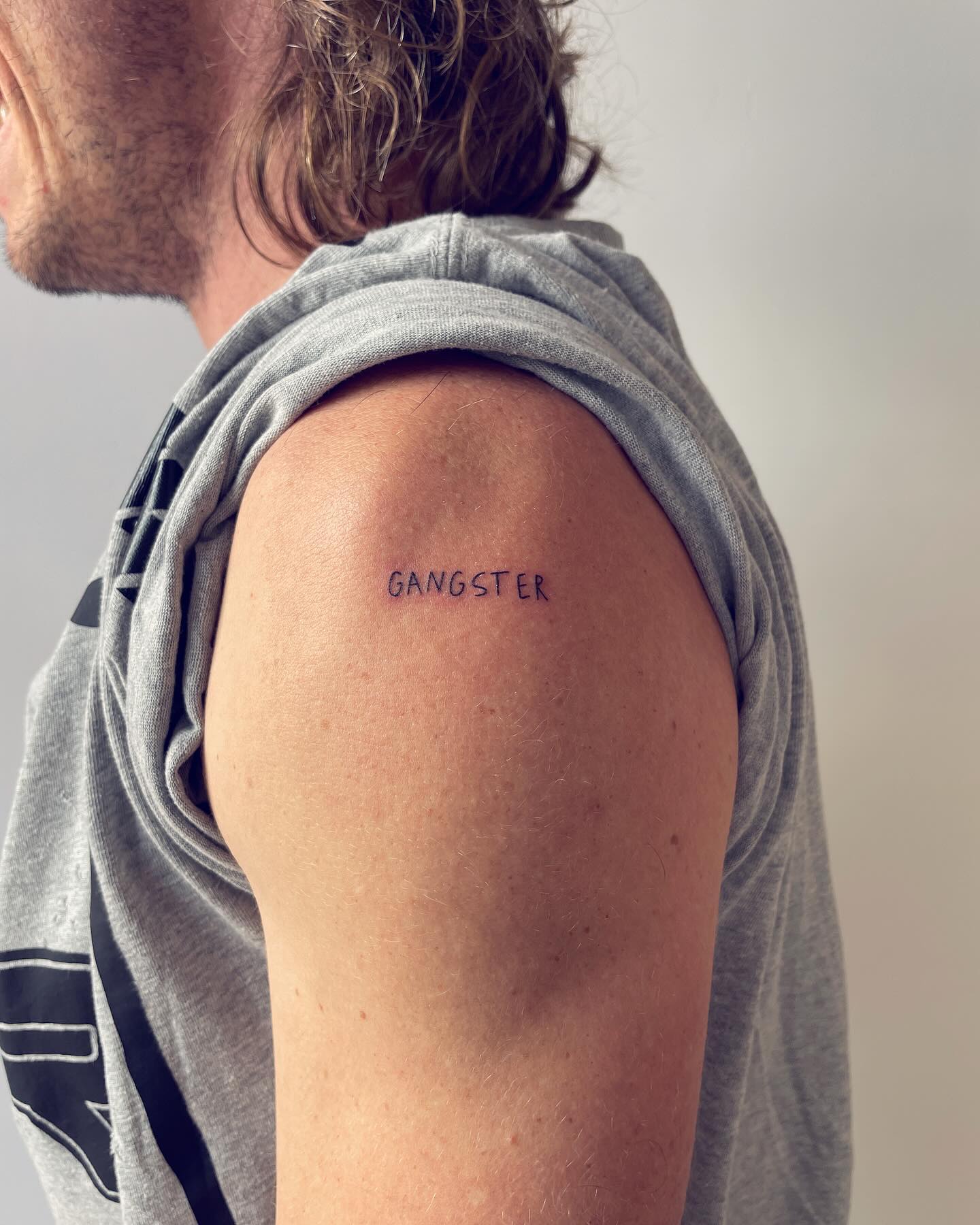
Text is the easiest matching tattoo to get right and the easiest to get wrong, usually in the same way: the font.
A split quote — half the phrase on each person — is a genuinely lovely idea when the two of you actually see each other regularly. When you live in different cities, it is a tattoo that is almost never whole.
The safer version is one shared word, inked identically on both of you. Something from a conversation you both remember beats a lyric that will date.
Ask your artist to letter the word by hand rather than tracing a downloaded font. Hand-lettered script holds its shape as it settles because the artist controls where the thick and thin strokes fall.
One more thing I would tell anyone: get the spelling checked by a third person before the stencil goes on. I have seen a stencil approved twice by two excited friends who both missed a doubled letter.
3. Two Halves of One Object
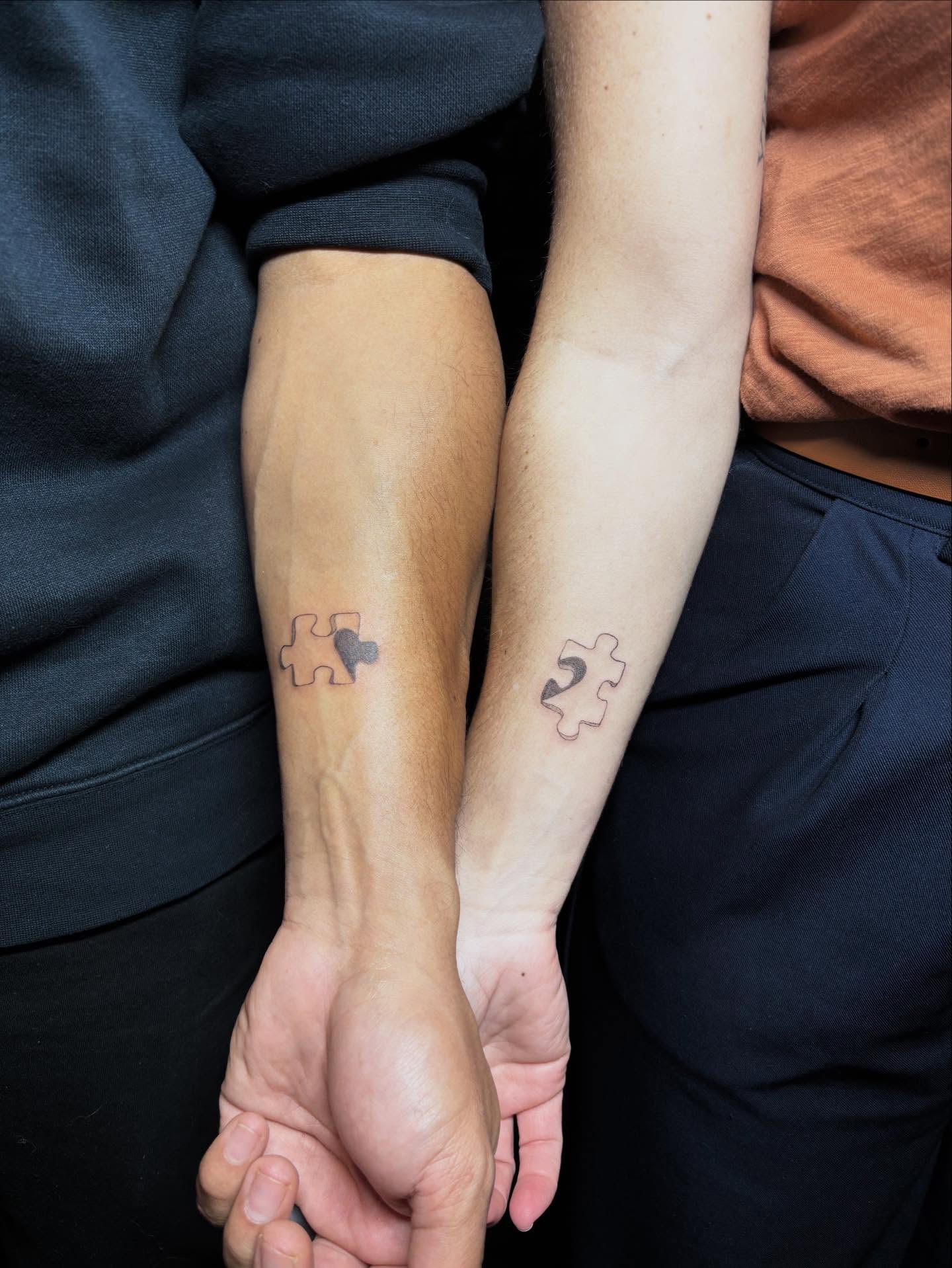
Avocado halves, puzzle pieces, a lock and its key, yin and yang. These are the designs people picture first when they hear “matching best friend tattoo”.
They work because the halves are not symmetrical. One of you gets the pit, the other gets the hollow, and there is a small ongoing negotiation about who takes which.
Yin and yang is the most forgiving of the four, because each half is already a balanced shape with a dot of the other colour inside it. It never looks amputated.
Puzzle pieces are the least forgiving. A single puzzle piece on a forearm is quite hard to read as anything meaningful, so if you go this route, ask for two or three interlocked pieces each rather than one.
Lock and key is the pair I would pick if I wanted the idea to survive a distance. Both objects are ornate enough to stand alone, and there is a long decorative tradition to draw from — the key and lock tattoo guide covers the styles worth considering.
4. Matching Animals and Birds
Animal matches split into two approaches: the same animal twice, or two animals that belong to a shared story.
Same-animal pairs are simple and hard to ruin — two small foxes, two bees, two frogs in the same illustrative style.
The more personal version is picking the animal each of you has been compared to for years. When I have seen friends do this, the tattoos rarely match visually at all, and they are far more interesting for it.
Two birds on a wire is the classic composition here. Each person carries the same wire and the same bird, and held side by side the wire appears to continue between you.
If you go with birds, agree on the direction they face. Two birds both facing left looks accidental; two facing each other looks designed. It is a two-second decision that changes the whole piece.
5. Coordinates, Dates and Places
This family covers anything that pins the friendship to a point in space or time: latitude and longitude, a date in roman numerals, a compass rose, a skyline reduced to a single line.
Coordinates are the one I would think hardest about. They are elegant, they are subtle, and they are also a set of numbers that means nothing to anyone who has not been told the story.
That is either the appeal or the problem, depending on your taste. If it appeals, the coordinate tattoo guide has notes on formatting and how many decimal places actually stay legible.
Check the coordinates against a map before the stencil goes on, not after. Transposed digits are the single most common permanent error I have heard artists describe in this style.
Dates are lower risk. Roman numerals in a clean serif hold up well at small sizes, and a shared date is one of the few matching tattoos that stays true no matter what happens to the friendship.
Compass roses sit between the two — decorative enough to work as pure ornament, with the shared meaning available if you want to explain it.
6. Botanicals, Waves and Natural Forms
Nature gives you the easiest route to complementary rather than identical, because two different plants drawn by the same artist obviously belong to the same set.
Birth flowers are the standard move and there is a reason for it. Each of you gets a genuinely different image, and the connecting rule is invisible until you explain it.
Waves are the other strong option in this family, especially for friends who met somewhere coastal. A single-line wave is one of the fastest tattoos in this whole article to sit for.
Fine-line botanicals need more space than they look like they need. When I have watched artists work on these, they routinely talk clients up in size, because a stem drawn at hairline weight on a two-centimetre flower will thicken as it heals and swallow the gaps between leaves.
A reasonable compromise: keep the fine-line style, but scale the whole design up by about a third from whatever looked right on your phone.
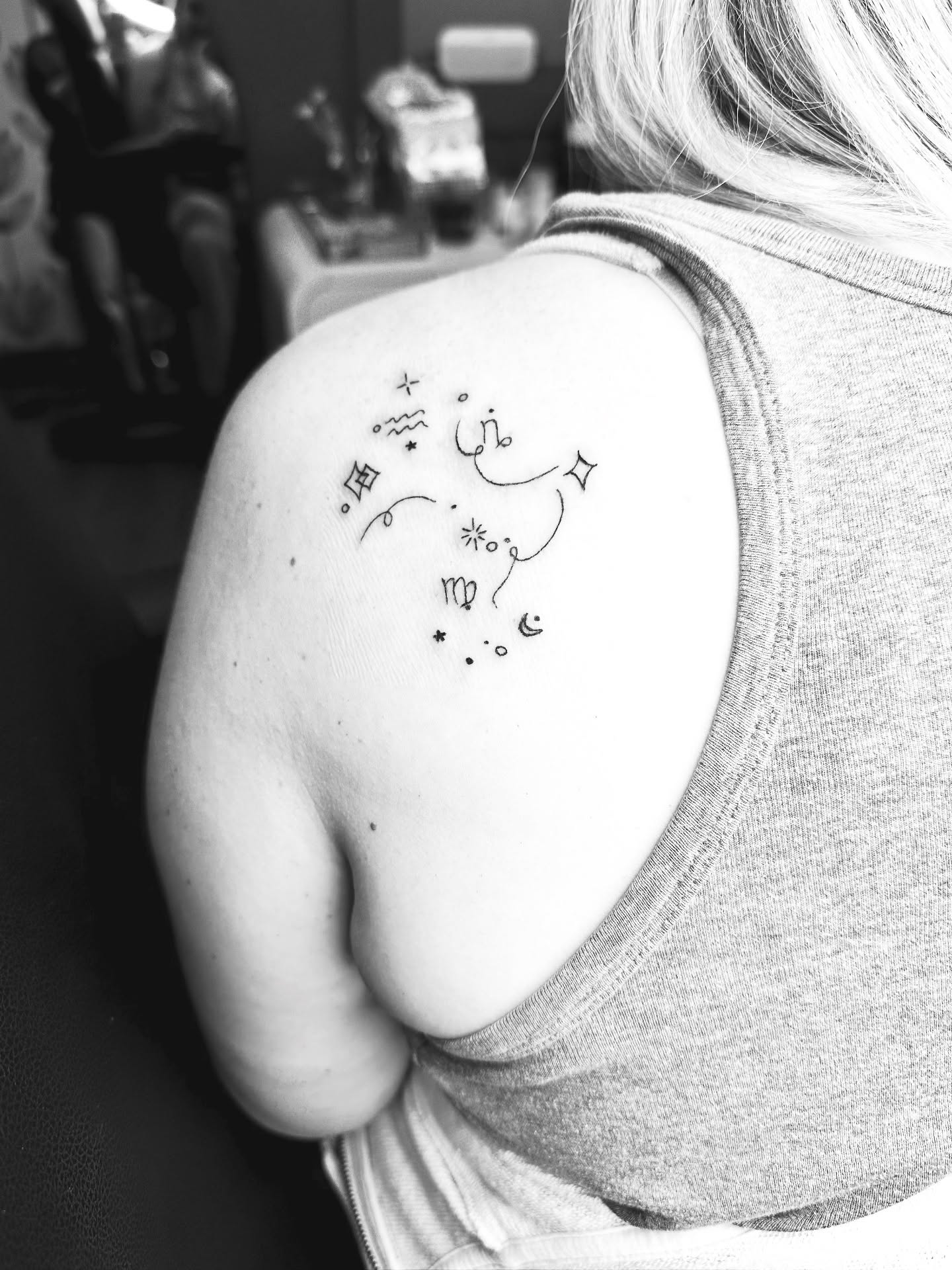
7. Handwriting, Inside Jokes and Private Symbols
This is my favourite family and the one most people skip, because it takes more thought than picking an image.
You write a word; your friend gets it tattooed in your handwriting, and you get theirs. The result is unrepeatable — nobody else on earth has that exact tattoo.
Practically: write the word about ten times on plain white paper with a fine black pen, photograph it in daylight, and let the artist pick which version will actually tattoo well. Not every handwriting sample translates — very light or very scratchy strokes need cleaning up, and a good artist will tell you which one to use.
The inside-joke variant is similar in spirit. A specific object, a bad drawing one of you made years ago, a symbol that means nothing to anyone else.
The reason I rate these so highly is that they cannot be copied off a search results page, which means you are far less likely to see the identical tattoo on a stranger in a coffee shop.
8. Characters and Shared Stories
Two characters from a book, film or game you both love. One takes each.
This is the family with the highest ceiling and the highest risk. Done well, it is a genuinely personal pair. Done carelessly, it is a fandom tattoo you got at nineteen.
The filter I would apply is age. If the story has mattered to both of you for more than five years, it will probably keep mattering.
There is also a stylistic trick worth knowing: ask the artist to render the characters in their style rather than copying the original artwork. An abstracted version ages far better than a literal screenshot, and it sidesteps the awkwardness of tattooing someone else’s copyrighted illustration line for line.
The same logic covers matching heartbeat lines, shared line drawings and any other design where the two halves complete a single continuous shape.
Variations Worth Considering
Matching Tattoos for Three or More
Two-part designs collapse the moment you add a third person, so groups need a different rule: one shared style, one shared element, separate subjects.
The versions I have seen work best use a repeated frame — the same small circle, the same box, the same single-line border — with something different inside it for each person.
Same Design, Different Placement
Matching does not require matching placement, and forcing it is a common source of regret when one person’s job or body shape makes the agreed spot a bad fit.
An identical design on one person’s inner forearm and another’s ankle still reads as a pair when you photograph them together, which is realistically how you will most often see them side by side anyway.
One Design, Two Colour Treatments
The same linework, one in solid black and one with a colour fill, is an underused option for friends with different taste.
Worth knowing before you commit: colour behaves differently across skin tones and generally needs touching up sooner than black and grey. Ask your artist how the specific pigments they use tend to hold on your skin rather than relying on a photo of somebody else’s arm.
Getting Them at Different Times
There is no rule saying you have to be tattooed on the same day, and doing it separately can be the better call if one of you is not sure yet.
A matching tattoo one person got out of momentum rather than desire is the version I would most want to avoid. Booking two appointments a month apart costs nothing and removes that pressure entirely.
Booking, Pain and Aftercare
Book both of you with the same artist if you possibly can. Two artists produce two different line weights, and on a design meant to match, that difference is what you will notice first in photos.
On budget: small matching pieces usually fall near a studio’s minimum charge, which means two tiny tattoos often cost close to what one medium tattoo would. Our breakdown of how much a small tattoo costs explains why the minimum exists and what it actually covers.
Pain is genuinely lower on the outer forearm, outer thigh and calf, and genuinely higher on ribs, sternum, feet and the inside of the upper arm. Eat properly beforehand — the sessions where I have seen people struggle most were the ones where they skipped lunch. There are more practical tattoo pain management tips if this is your first time.
For healing, follow the written instructions your artist gives you rather than advice from the internet, including this page — they know what they put in your skin and what they have seen work in their studio. General tattoo healing and ointment guidance is useful background, not a substitute.
Any sign of spreading redness, heat, swelling that worsens after the first few days, pus or fever is a reason to see a doctor rather than to wait it out. Infections and pigment allergies are uncommon but real, and they are treated far more easily early. The FDA’s tattoos and permanent makeup fact sheet is a sober summary of the known risks, and the American Academy of Dermatology can point you to a board-certified dermatologist if something is not settling.
Do not let anyone tattoo either of you outside a licensed studio, and do not attempt a home or “stick and poke” version of a matching tattoo. The equipment sterilisation is the entire point of a professional shop.
Common Mistakes — and What to Do Instead
Deciding in the shop. The design you settle on in a waiting room is the design you had least time to think about. Agree on a family of ideas at home, then bring two or three references to the consultation.
Going too small. Almost every regret I have heard in this category is about size, not subject. Very few people wish their matching tattoo were smaller.
Choosing a half that cannot stand alone. Test it: cover your friend’s design with your hand and look at yours. If it reads as an unfinished shape, redesign it.
Copying a photo line for line. Bring references as direction, not as a template, and let the artist draw it in their own hand.
Still weighing it up? It is worth reading the neighbouring guides before you book — matching tattoo ideas for sisters covers designs built around shared family history, and matching tattoo ideas for couples handles the same design problem with a different set of stakes.
Frequently Asked Questions
Do matching best friend tattoos have to be identical?
No, and in most cases they are better when they are not. Complementary designs — two different subjects rendered in one shared style, size and line weight — read clearly as a pair while still fitting each person’s body and taste. Identical designs are the right choice when you want each tattoo to be fully legible on its own. Split designs sit at the other end: highest meaning, most dependent on the two of you being together.
Should we use the same artist?
Where possible, yes. Line weight, needle grouping and shading habits vary noticeably between artists, and on a design meant to match, those differences are what your eye lands on in a side-by-side photo. If you live in different cities and one artist is not realistic, send both artists the same reference and ask them to agree on line weight and overall dimensions in millimetres before either of you sits down.
How small can a matching tattoo be?
Most artists will tattoo down to roughly two or three centimetres for a simple shape, but the practical floor depends on detail rather than overall size. A solid crescent moon holds up small; a moon with a face, texture and eight thin rays does not. Ink spreads slightly in the skin over the years, so gaps between lines close up. If you want small, choose a simpler subject rather than shrinking a detailed one.
What if the friendship ends?
It is a fair thing to think about before you book rather than after. The lowest-risk designs are the ones that mean something to you independently — a moon, a wave, a flower, a date — because they simply become a tattoo you like if the friendship changes. Designs that are obviously half of something, or that carry another person’s name, are harder to live with. Cover-ups and laser removal both exist, but both are slower, more expensive and less certain than choosing well the first time.
Where is the least painful place to get one?
The outer forearm, outer thigh and calf are the areas most people find most manageable, because there is muscle and fat between the needle and the bone. Ribs, sternum, feet, hands and the inner upper arm are consistently reported as harder. Pain tolerance varies a lot between individuals, so treat this as a general ranking rather than a promise. For a small matching piece the whole session is often under an hour anyway.
Quick Summary
- Decide first whether you want identical, split, complementary or shared-style designs — it settles most of the later arguments.
- Check that each half still works as a tattoo on its own before you approve the stencil.
- Go about a third larger than the version that looked right on your phone, especially for fine-line work.
- Book the same artist where you can, so line weight matches between the two pieces.
- Have a third person proofread any text, and check any coordinates against a map.
- Handwriting and inside-joke designs are the least copyable and, in my experience, the most loved long term.
- Expect two small tattoos to cost close to a studio’s minimum charge each rather than half price.
- Follow your artist’s written aftercare, and see a doctor promptly for spreading redness, worsening swelling, pus or fever.