The crow is the rare tattoo subject that is genuinely as interesting as its symbolism claims. This is a bird that uses tools, remembers individual human faces for years, and teaches its young which people to avoid — behaviour documented at length by ornithologists at the Cornell Lab of Ornithology.
I have spent a lot of time looking at bird tattoos, and the crow is the one I keep coming back to. Its silhouette is instantly readable at any size, its plumage gives an artist somewhere to put real black, and the mythology behind it runs deep enough that the design never feels decorative for its own sake.
It is also the most forgiving bird to tattoo across styles. A crow works in American traditional, in black and grey realism, in Japanese, in fine line, and in blackwork, which is not true of most animals. If you like the bird but are torn between a crow and its larger cousin, my raven tattoo ideas guide covers where the two diverge.
Below are 19 crow tattoo directions, each one drawn from work I have looked at closely, with notes on what actually makes each approach hold up on skin over time.
Which Crow Tattoo Style Is Right for You?
Style choice matters more than subject choice with crows, because the same bird reads completely differently depending on how it is rendered. Here is how the main options compare.
| Style | Best size | How it ages | Choose it if |
|---|---|---|---|
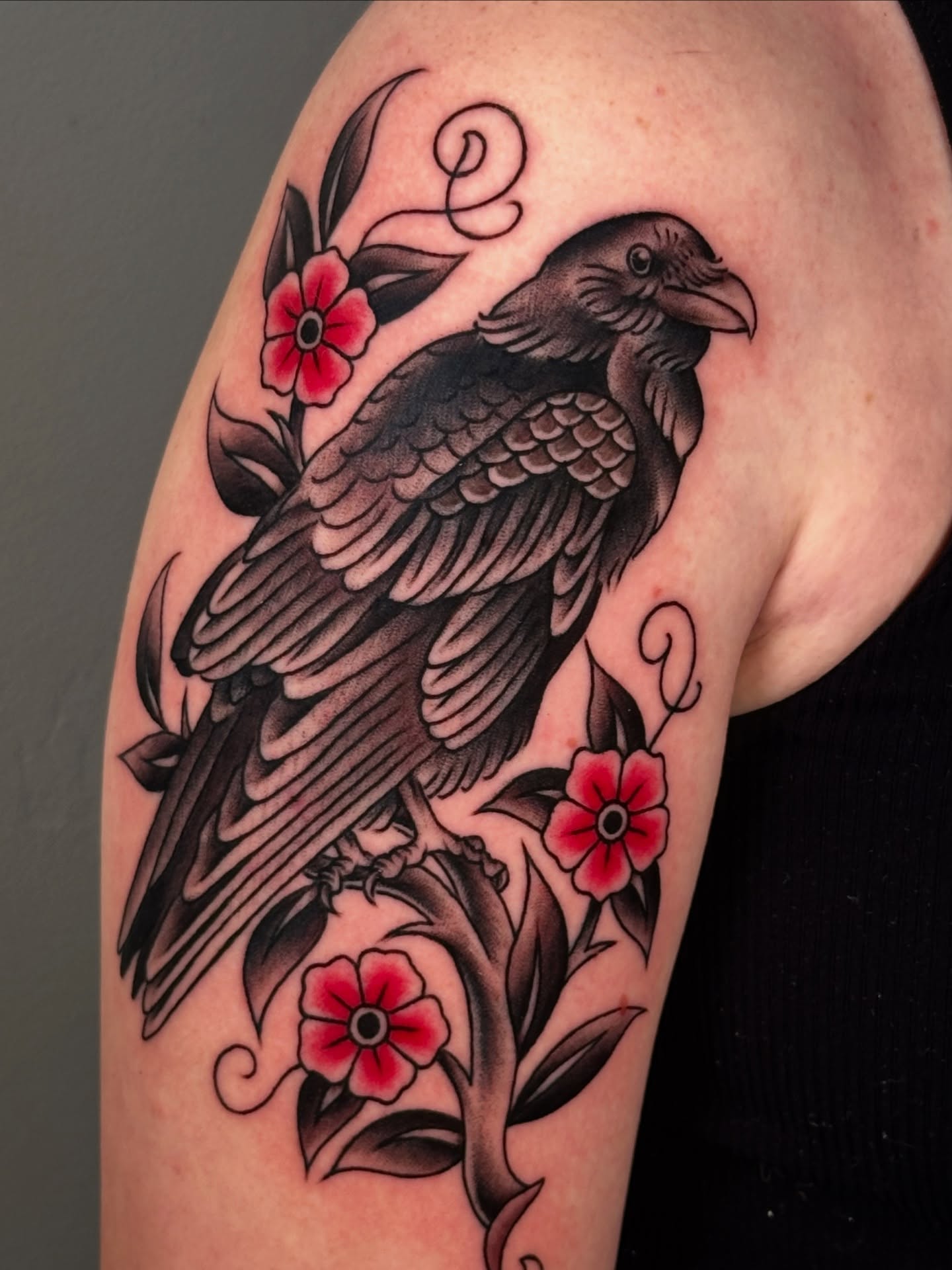
| American traditional | 3-6 inches | Excellent — built for it | You want it readable in 20 years with no fuss |
| Black and grey realism | 5-9 inches | Good with strong contrast; soft shading fades first | You want the bird to look like the actual animal |
| Japanese (karasu) | 6 inches and up | Excellent — heavy line and solid black | You want it to sit inside a larger body suit later |
| Fine line / minimalist | 1-3 inches | Softens noticeably; may need a touch-up | You want something quiet and small |
| Blackwork / silhouette | 2-8 inches | Very well, if the black is packed evenly | You like graphic shapes over rendered detail |
| Watercolour | 4-7 inches | Weakest of the group without a black anchor | You want colour and accept future touch-ups |
What the Crow Actually Symbolises
The striking thing about crow symbolism is how consistent it is across cultures that had no contact with one another. Intelligence, prophecy, transformation, and the boundary between the living and the dead come up again and again.
In Norse tradition, Odin’s two ravens — Huginn and Muninn, thought and memory — fly out across the world each day and return with what they have seen. That is where the paired-bird tattoo comes from, and it is usually why people ask for two rather than one.
Celtic myth attaches the crow to the Morrigan, a goddess associated with fate and battle who appears in bird form. In several Native American traditions Crow is a trickster and a keeper of law, which is a different register entirely — clever rather than ominous.
The common thread is a bird that crosses thresholds and comes back knowing something. That is a more interesting brief for an artist than “dark bird,” and it is worth saying out loud in the consultation.
Worth being honest about the other half of it: in a lot of Western folklore the crow is simply an omen of death, and some people will read your tattoo that way regardless of what you intended. If that bothers you, the softer compositions further down the list — crow with flowers, crow with moon — shift the tone considerably.
19 Crow Tattoo Ideas
1. Classic American Traditional Crow
A crow in American traditional: bold black outlines, flat fill, the bird perching or caught mid-flight with a bit of exaggeration in the wing.
This is the version I recommend most often to people getting their first bird. The heavy outline and limited palette are what let traditional work stay legible after decades, and the crow’s silhouette is strong enough to survive the stylisation. It sits comfortably alongside other American traditional animal tattoos if you plan to build outward later.
Ask for it slightly larger than feels necessary. Traditional line weight needs room, and a cramped traditional crow loses the very thing that makes the style work.
Photo: @tattoo.jackie
2. Realistic Crow Portrait
A photorealistic head-and-shoulders crow in black and grey, with feather texture built up in layers and the eye as the focal point.
Crow feathers are not flat black in real life — there is a blue-green iridescence that catches the light. A skilled black and grey artist implies it entirely through where the highlights land, which is the hardest part of this piece to get right.
Contrast is what keeps realism readable at a distance. When I have seen realistic crows go muddy after a few years, it is almost always because the artist kept everything in the mid-tones instead of committing to true black in the shadows and clean skin in the highlights.
Photo: @thesolidink
3. Crow in Flight
Wings spread, tail fanned, the bird viewed from below or side-on. This is the most dynamic crow composition and the one that fills a placement best.
A flying crow suits a shoulder blade, an outer forearm running lengthwise, or a chest panel, because those areas give the wingspan somewhere to go. Squeezed onto a narrow spot, the wings have to fold and the whole point is lost.
One detail worth asking your artist about: real crows have distinctly separated primary feathers at the wingtips, like fingers. Getting those right is what makes a flight pose read as a crow rather than a generic bird.
Photo: @a.g.tattoos
4. Two Crows
Two birds facing each other, or one above the other, most often referencing Huginn and Muninn.
The pairing carries real weight if the Norse reading matters to you, and it works just as well as a simple design about balance, or about two people. I have seen it done as matching tattoos between siblings more than once.
The composition question is whether the birds mirror each other exactly or sit in different poses. Mirrored reads as formal and symbolic; varied poses read as observed and alive. Neither is wrong — decide which one you actually want before the stencil goes on.
Photo: @dylanaiello
5. Crow and Moon
The bird silhouetted against a full moon, or perched with a crescent behind it.
This is the most reliable crow composition for people who want atmosphere without a heavy scene. The moon gives the artist a pale disc to contrast the black bird against, which solves the readability problem that plain black silhouettes sometimes have on their own.
Ask for the moon to be rendered with actual surface detail rather than left as a blank circle. In my experience the ones with mare and crater texture hold interest far longer than a plain white disc.
Photo: @starfruit_ink
6. Skull and Crow
The bird perched on a human or animal skull, sometimes with the beak lowered toward it.
This is memento mori in its most direct form, and it has been a tattoo staple for a century for good reason. The risk is that two dense subjects compete — a skull is visually heavy, a black crow is heavier, and stacked carelessly they turn into one dark mass.
The fix is tonal separation: skull rendered light with fine shading, crow kept dark and solid. If you like the darker end of this territory, there is a lot more of it in the skull tattoo drawings collection.
Photo: @christhayerjr
7. Japanese Karasu
The crow — karasu — rendered in Japanese style, with sumi-e influenced brush linework, bold black feathering, and often wind bars or maple leaves around it.
Japanese work is designed to be read across a room, so the line weight is heavier and the negative space is deliberate. A karasu piece also slots naturally into a larger sleeve or back piece later, which is worth thinking about now if you suspect you will keep going.
Go to an artist who actually works in the style rather than one who will draw a crow with a few maple leaves added. The rules about flow, background, and composition in Japanese tattoo designs are what make the style work.
Photo: @brunoyoshiotattoo
8. Crow and Flowers
A crow paired with botanical work — roses, poppies, wildflowers, or bare branches in bloom.
This is the composition I point people to when they love the bird but not the funereal association. Flowers reframe the whole piece: the crow becomes a creature in a landscape rather than an omen.
The practical benefit is contrast. Botanical linework is fine and open, the crow is solid and dark, and the two set each other off. It is also the easiest crow design to expand later, because flowers can grow in any direction.
Photo: @loverseyetattoo
9. Minimalist Crow Silhouette
The bird reduced to a solid black shape — no interior detail, no shading, just the outline of a crow in profile or flight.
Small crow silhouettes work on the wrist, ankle, behind the ear, or on the ribs. Because there is no detail to lose, they age better than most small tattoos, though the edges will soften slightly over the years like any fine work.
Everything depends on the silhouette being genuinely crow-shaped: heavy beak, squared tail, thick neck. Get that wrong and you have a sparrow. If you are weighing up which bird says what, different bird tattoo meanings is a useful comparison.
Photo: @inkjoytattoos
10. Crow and Branches
A crow perched on a bare branch, sometimes with a second bird further along, sometimes with a few leaves left clinging.
The branch does two jobs. It gives the bird a believable place to stand, and it gives the composition a horizontal line that follows the natural direction of a forearm, collarbone, or spine.
Bare winter branches suit the crow better than leafy ones — the mood matches, and the thin negative space between twigs sets off the density of the bird. I would keep the branch delicate; if it is as heavy as the crow it stops being a frame.
Photo: @matthewgreskiewicz
11. Crow and Eye
A surreal composition merging the bird with a human eye, or an eye set into the wing, or the crow carrying an eye in its beak.
This leans directly into the crow’s association with watching, knowing, and carrying information. It is the most conceptual idea on this list and it needs an artist comfortable with surrealism rather than straight rendering.
Be specific in the consultation about which reading you want, because the same image can look protective or unsettling depending on the eye’s expression. Bring reference for the mood, not just the elements.
Photo: @luizboothtattoo
12. Murder of Crows
Several birds scattered across the skin, usually decreasing in size as they recede, often flying away from a single larger crow.
This is the design that uses placement best, because the birds can follow the curve of a shoulder, spill down a ribcage, or trail up a forearm in a way a single subject cannot.
The trap is even spacing. A flock drawn at regular intervals looks like a pattern; real birds cluster and gap. Ask for irregular grouping and varied wing positions — the asymmetry is what sells it as movement.
Photo: @tattooist_mate
13. Geometric Crow
The bird constructed from clean geometric planes, or set inside a circle, triangle, or hexagonal frame with linework radiating behind it.
Geometry gives the crow a modern, deliberate feel and pulls it away from the folk-horror register entirely. The frame also solves the composition question, which is useful if you want something that reads as designed rather than sketched.
Precision is everything here — a wobbling circle is far more obvious than a wobbling feather. Look through an artist’s healed geometric tattoo designs before booking, not just their fresh photos.
14. Crow and Clock
The bird perched on or beside an antique clock face, often a pocket watch, sometimes with the hands set to a meaningful time.
The pairing is about time and mortality, and it is popular for memorial pieces where the hands mark a specific moment. That personal detail is what lifts it above being a stock combination.
Two dense subjects again, so the same rule applies: let the clock face carry the light tones and keep the crow dark. There are more compositions in the clock tattoo ideas guide if the timepiece is the part you care about.
Photo: @gillbarnettetattoo
15. Three Crows
Three birds together, in a row, a triangle, or staggered in flight.
Three is a satisfying number visually — it avoids the rigid symmetry of a pair while still reading as a deliberate group rather than a flock. In folklore, groups of three crows carry their own set of superstitions, which people often like as a private layer of meaning.
Stagger the sizes and poses. Three identical birds in a line look like clip art; three birds at different distances look like a moment someone actually saw.
16. Watercolour Crow
A crow with loose colour washes bleeding out behind it — usually blues, purples, or reds that suggest the iridescence in real crow feathers.
This is the most visually striking option and the most demanding over time. Watercolour without an underlying black structure tends to lose definition faster than any other approach, which is why the best versions keep a solid black bird at the centre and let the colour sit behind it.
Go in expecting a touch-up somewhere down the line, and keep it out of direct sun. That is not a reason to avoid it — just plan for it honestly.
Photo: @karlshutt_tattoo
17. Crow and Celtic Knotwork
The bird framed by or woven into Celtic interlace, tying it to the Morrigan and to Irish and Scottish tradition.
Knotwork is unforgiving. Every strand has to pass over and under correctly and stay evenly spaced, and errors are permanently visible to anyone who knows the form. This is a piece to book with someone who has done a lot of it.
Leave more space between strands than the reference photo shows. Linework spreads slightly as it heals and settles, and tight interlace can close up into a solid band over the years.
Photo: @onemoretattoolu
18. Crow in Storm
A crow flying through wind and rain, feathers pushed back, sometimes with lightning or heavy cloud shading behind it.
The storm gives the piece narrative — this is a bird enduring something rather than posing. It suits people who want the tattoo to mean persistence rather than mystery.
The best versions I have seen suggest the weather through the bird itself: feathers blown out of alignment, wings angled against the wind. Adding a literal rain-and-lightning background usually makes the composition busier without making it clearer.
Photo: @brunoyoshiotattoo
19. Crow Eye Close-Up
An extreme close-up of the crow’s eye and surrounding feathers, cropped so the bird’s face fills the whole design.
This is realism at its most demanding and its most rewarding. The eye is where the crow’s intelligence lives, and a close crop puts all the attention on it.
It needs size — I would not attempt this under about five inches, because the detail that makes it work simply cannot be packed into a small area and stay clean as it heals.
Variations Worth Considering
If none of the 19 is quite it, these are the adjustments people most often land on after a consultation.
Crow or Raven?
Ravens are larger, with a heavier beak, shaggy throat feathers, and a wedge-shaped tail; crows are neater, with a fan-shaped tail. Symbolically the raven carries more of the Norse and gothic weight, the crow more of the trickster and everyday-intelligence reading.
Most artists will tattoo whichever you ask for, but say the word out loud in the consultation — the two get conflated constantly, and the tail shape is the giveaway.
Negative-Space Crow
Instead of a black bird on skin, a solid black field with the crow left as bare skin inside it. It is a striking effect and it holds up well, since the black is packed and even.
It requires a large enough area to make sense, and it commits you to a lot of saturated black, so it is not a decision to make casually.
Crow with Lettering
Nevermore is the obvious one, and it is obvious enough that a lot of artists will gently steer you elsewhere. A line that means something specifically to you almost always ages better than a quotation everyone recognises.
Matching Crow Tattoos
The two-crow idea splits naturally between two people, one bird each. In my experience these work best when both birds are drawn by the same artist in one sitting, so the line weight genuinely matches.
Placement, Sizing and Aftercare
Crows suit placements with a directional line: the outer forearm, the calf, the shoulder blade, the ribs, the spine. A perched bird wants a vertical or horizontal anchor, and a flying bird wants width.
On sizing, be realistic about detail. A crow under about two inches has to be a silhouette; feather rendering starts working at roughly four inches and up, and full realism wants five or more. Detail packed too tightly will blur as the tattoo settles over the first year or two.
Ribs, spine, and the inner arm are among the more uncomfortable spots for a long session, which matters for a large detailed crow. If that is your plan, the tattoo pain management tips guide covers how to get through a longer sitting.
Follow your artist’s aftercare instructions over anything you read online, including this page. General guidance from the American Academy of Dermatology is a reasonable baseline, and the FDA’s overview of tattoo safety is worth reading before a first tattoo. If you develop spreading redness, swelling that worsens after a few days, pus, or a fever, see a doctor rather than waiting it out — that is a medical question, not a tattoo question.
Sunscreen once healed is the single cheapest thing you can do for a black tattoo. UV exposure is what turns crisp black into soft grey, and it does it slowly enough that most people do not notice until it has happened.
Common Mistakes, and What to Do Instead
The most common one is going too small for the style chosen. A realistic crow at two inches is not a smaller version of a realistic crow — it is a smudge waiting to happen.
The second is stacking heavy subjects without planning tone. Crow plus skull plus clock plus roses, all rendered dark, becomes an unreadable block. Decide which element is the focal point and let the others sit back.
The third is choosing an artist by their drawings rather than their healed work. Ask to see photos of pieces a year or more old, in the same style you want.
Still weighing it up? If it is the density of black that appeals, look through blackwork tattoo designs. If placement is the sticking point rather than the subject, the forearm tattoo ideas collection shows how much composition changes with the space available.
Frequently Asked Questions
What does a crow tattoo mean?
A crow tattoo most commonly stands for intelligence, transformation, and the boundary between life and death, drawing on Norse, Celtic, and Native American traditions that all treat the bird as a messenger or keeper of knowledge. In Western folklore it also carries an association with omens and death that some people embrace and others deliberately soften. What it means on you is largely set by the composition — a crow with flowers reads very differently from a crow on a skull. It is worth deciding which reading you want before the design is drawn.
Is a crow tattoo bad luck?
No. The bad-luck association comes from European folklore where crows were linked to battlefields and death omens, but that is one cultural reading among several. Many traditions treat the crow as a clever, protective, or sacred figure instead. Plenty of people get one specifically because they like the bird’s reputation for outsmarting everything around it.
How much does a crow tattoo cost?
Cost depends far more on size, style, and your artist’s rate than on the subject itself. A small silhouette is typically a shop-minimum piece, while a detailed realistic crow can run several hours of shop time. Rates vary widely by city and by artist experience, so the only reliable answer comes from a consultation with the artist you actually want. Ask for an estimate in hours rather than a flat figure, since that is how most artists price larger work.
Which crow tattoo style ages the best?
American traditional and Japanese age best, because both are built on heavy outlines and solid black that hold their shape as the skin changes. Blackwork silhouettes also do well when the black is packed evenly. Fine line and watercolour are the ones most likely to need a touch-up somewhere down the line — not a reason to avoid them, just something to plan for.
Where is the best place for a crow tattoo?
The outer forearm, calf, shoulder blade, and ribs all suit crows well because they give the bird a directional line to sit along. Flying poses want width, so shoulder blades and chest panels work better than narrow spots. Small silhouettes are flexible and go almost anywhere. In my experience the placement conversation is best had with your artist in person, with the stencil actually on your skin.
Quick Summary
- The crow works across more tattoo styles than almost any other animal — traditional, realism, Japanese, fine line, blackwork and geometric all suit it.
- Its symbolism is remarkably consistent across cultures: intelligence, transformation, and the threshold between worlds.
- American traditional and Japanese hold up best over decades; fine line and watercolour will likely need a touch-up.
- Size to the style — silhouettes work small, feather rendering needs about four inches, full realism wants five or more.
- When pairing the crow with a skull, clock, or moon, keep one subject dark and let the other carry the light tones.
- Flocks and pairs should be irregular in spacing and pose; even spacing reads as a pattern rather than movement.
- Choose your artist from healed photos in the style you want, not from fresh work or drawings.
- Sunscreen after healing is the cheapest way to keep a black crow looking black.