Día de los Muertos is not a Mexican Halloween, and the tattoos that come out of it are not spooky decoration. Day of the Dead tattoos are memorial work first and ornament second — an image of a person you still talk to, dressed in the visual language of a holiday built around their return.
I have sat in on a lot of these consultations, and the pattern is consistent: the client arrives with a reference photo of a sugar skull and leaves with a design that has somebody’s name, birth flower, or handwriting worked into it.
The imagery is unusually well suited to skin. Calaveras are symmetrical, the patterning is already decorative, and the colour palette — marigold orange, cobalt, magenta — was designed to be seen from across a room. If you have ever wondered why skulls and flowers keep appearing together in tattooing, this tradition answers the question more directly than most.
Below are 20 directions the work goes in, from the strictly traditional calavera to contemporary geometric interpretations, with notes on what each one actually costs you in sessions and how it holds up over a decade.
Photo: @alldaytattoobkk
Which Day of the Dead Tattoo Style Is Right for You?
Most of the decision comes down to one question: do you want the colour, or do you want the piece to still read clearly in fifteen years? You can usually have both, but not in the same square inch.
| Style | Best suited to | Typical size & sessions | How it ages |
|---|---|---|---|
| Full-colour calavera | Anyone who wants the holiday’s actual palette | Forearm to thigh, 1–3 sessions | Bright colours soften first; usually wants a touch-up eventually |
| Black and grey calavera | Darker skin tones, memorial pieces, subtle wearers | Anywhere, 1–2 sessions | The most forgiving option over ten-plus years |
| La Catrina portrait | People who want a figure, not just a face | Thigh, back or full forearm, 2–4 sessions | Holds well at size; poor at small scale |
| Fine-line / minimalist | First tattoos and discreet placements | Palm-sized or smaller, one short sitting | Fine lines thicken and blur; plan for a refresh |
| Neo-traditional or geometric | Wearers who want the symbolism in a modern language | Medium to large, 2–3 sessions | Bold outlines and flat colour age very well |
What the Imagery Actually Means
Every element in a Day of the Dead tattoo has a job. Getting them right is the difference between a design that reads as a tribute and one that reads as a costume.
The calavera — the decorated skull — is not a memento mori warning. It is a portrait of the dead as they are imagined to return: cheerful, adorned, and welcome.
The marigold, cempasúchil, is the flower whose scent is said to guide the dead back to the ofrenda. Monarch butterflies carry a similar role, arriving in central Mexico around the same weeks and traditionally understood to carry returning souls.
Candles mark the path, papel picado marks the celebration, and the ofrenda itself — photographs, pan de muerto, a favourite drink — is the reason the whole thing exists. UNESCO inscribed Mexico’s Indigenous festivity dedicated to the dead on its Representative List of the Intangible Cultural Heritage of Humanity in 2008, which is a useful reminder that this is a living practice and not a design trend.
This matters practically, not just ethically. A calavera with someone’s real features in it works the same way a memorial tattoo for a mother does — it needs the artist to understand who the person was before the decoration goes on top.
Traditional Calavera and Sugar Skull Designs
1. Sugar Skull Portrait
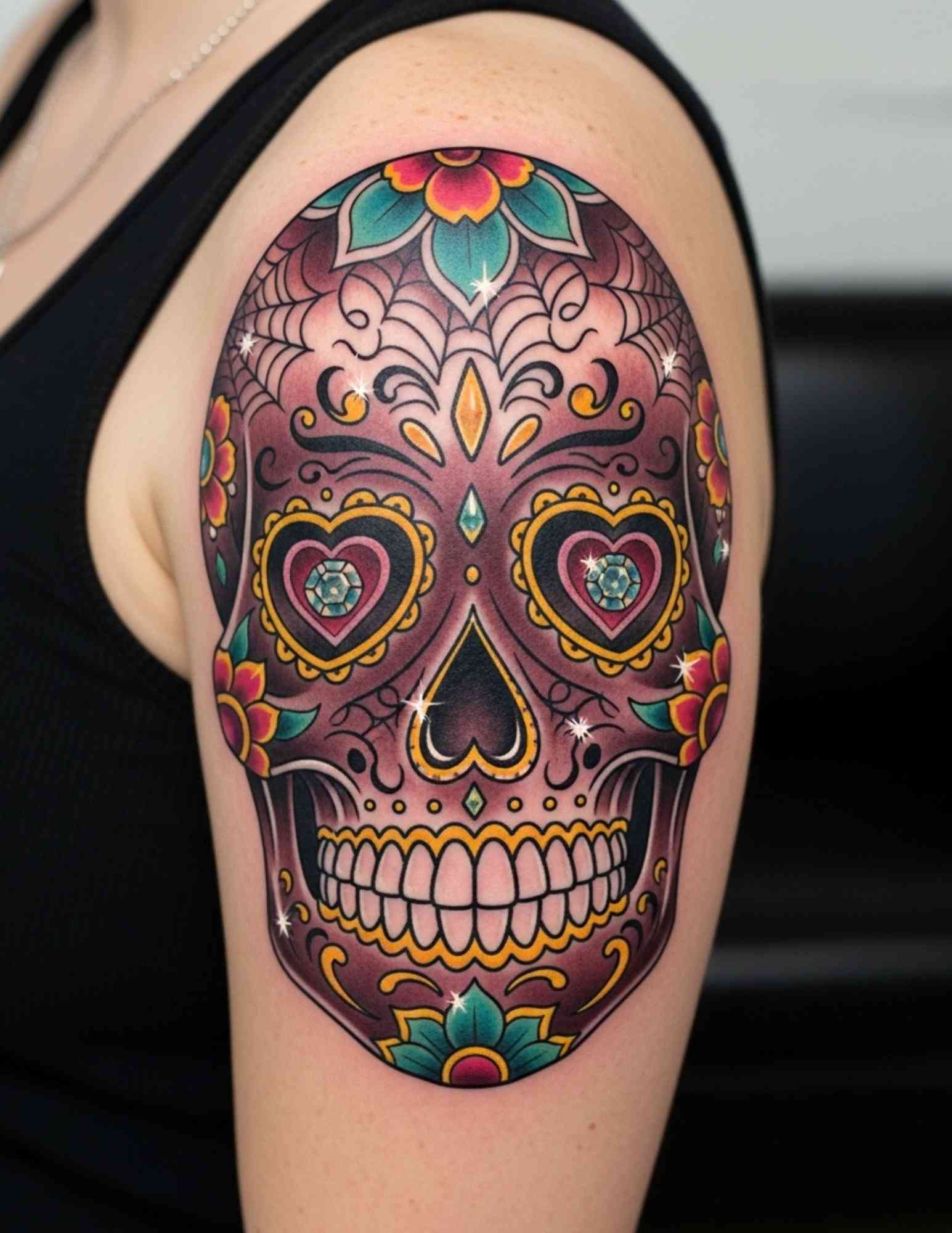
The single most requested piece in this category, and the one every artist has a portfolio of. A calavera skull carries floral patterning around the eye sockets, ornamental linework across the cheeks and forehead, and usually marigolds worked into the crown.
Full colour or black and grey both work. In my experience the colour version needs a forearm or larger to breathe — anything smaller and the eye-socket flowers turn into a smudge within a few years. If you want it small, ask the artist to reduce the number of pattern elements rather than shrinking them all proportionally. That single instruction saves more sugar skull tattoos than any other piece of advice I give.
2. Female Calavera
A feminine calavera in full decorative makeup, often called a Catrina face after José Guadalupe Posada’s original etching. Lashes, brow flowers, and a patterned jaw do most of the work.
What makes these succeed is restraint on the lower half of the face. Every artist I have asked about Catrina faces says the same thing: the jaw is where clients want more detail and where more detail reads worst. Keep the mandible pattern simple and let the eyes carry the piece. Rendered well, the female calavera does something very few tattoo subjects manage — it is genuinely beautiful and unmistakably a skull at the same time.
Photo: @borrowedtimetattoos
3. Sugar Skull and Marigolds
The most symbolically complete composition available in this tradition, because the skull and the flower that guides it home appear together. Marigolds are also forgiving to tattoo: layered petals hide the seams where colour packing overlaps.
Orange is the obvious palette, though I have seen excellent versions where the marigolds are done in soft red and the skull left in black and grey. If you like this pairing, it is worth looking at skull-and-rose combinations more broadly, since the mechanics of building flowers around a skull are the same regardless of which tradition the design comes from.
Photo: @jhobsontattoo
4. Memorial Calavera Portrait
A specific person’s face, rendered with real likeness, then given the decorative treatment of the holiday. This is the most demanding piece on the list and the one with the least room for a mediocre artist.
Bring several photographs, ideally including one that is not a posed smile. Portrait work depends on the shape of the skull under the face, and a three-quarter reference gives the artist that information. Expect two to four sessions and expect the artist to want a healed check-in before adding the calavera patterning. Rushing the decoration onto an unhealed portrait is the most common way these go wrong.
Photo: @troytucktattoo
5. La Catrina Full Portrait
The full figure rather than the face alone: the elegant skeleton in her wide-brimmed hat, feathers, lace collar and all. Posada drew her as satire of Mexicans who imitated European aristocracy, and that origin still gives the image an edge.
Catrina needs vertical space. Thigh, outer arm, back and ribs all work; forearm works only if you are willing to lose the hat brim. When I tested reference sizes with an artist for a friend’s piece, anything under about seven inches tall meant the lace and the feather detail collapsed into grey. Plan the placement around the hat and the rest follows.
Photo: @poly_tattoo
Symbols, Scenes and Companions
6. Sugar Skull and Monarch Butterfly
The monarch is the second great symbol of the return, and pairing it with a calavera doubles the meaning without crowding the design. It also solves a compositional problem — butterflies give the artist somewhere to put colour that is not the skull itself.
Wings above the crown, wings resting on the cheekbone, or a single butterfly at the base all read well. The meaning behind butterfly and skull tattoos is worth understanding before you commit, because the pairing carries a specific reading about transformation and return that not everyone intends.
Photo: @tattoosbyamandabv
7. Day of the Dead Sleeve
A sleeve lets the whole holiday appear at once: calaveras, marigolds, candles, papel picado banners and an ofrenda, arranged as a single scene rather than a stack of separate tattoos.
Sleeves live or die on the background. Ask for the papel picado or the smoke to be planned first, because that is what ties disconnected elements together. Most sleeves in this style run four to eight sessions depending on colour density. Book them as a single project with one artist rather than collecting pieces over years — mixed hands show badly in a tradition this stylistically specific.
Photo: @jessica_bank_
8. Sugar Skull with Roses
Roses were in tattooing long before Día de Muertos arrived in Western shops, and the combination is now standard. It is a good choice if you want the skull to feel classic rather than folkloric.
Traditional bold-line roses with heavy black shading suit the calavera better than realism does, because both elements then share a visual language. Red is the default, but a deep burgundy holds its shape longer against sun exposure. This is one of the more forgiving designs on the list — it works at a wide range of sizes and looks intentional in colour or black and grey.
Photo: @unknowntattooco
9. Ofrenda Scene
The altar itself: framed photograph, candles, marigold petals, pan de muerto, a glass of something the person liked. Of everything here, this is the design that most directly reproduces the practice rather than the iconography.
It suits people who observe the holiday. When I have seen these done, the strongest versions include one specific object — a particular bottle, a particular saint’s card — that nobody outside the family would recognise. Composition is the challenge; an ofrenda has a lot of small objects and needs a placement with real surface area, usually thigh, back or upper arm.
10. Two Calaveras
Paired calavera faces, usually a couple, sometimes two parents or two siblings. The pairing is a natural fit for the holiday, which is about relationships continuing rather than ending.
The design decision worth making early is whether the two faces share a patterning system or contrast deliberately. Matching patterns read as unity; contrasting ones read as two distinct people. Both are valid, and artists will usually have a preference. If one of the pair is living and one is not, say so — good artists change the composition to reflect it, often subtly.
Photo: @troytucktattoo
Placement-Led Day of the Dead Pieces
11. Black and Grey Calavera
Strip out the colour and the calavera becomes an exercise in pattern and shading. It is the most durable version of this tattoo and the one I most often recommend for a first piece in the style.
Black and grey also solves a real problem: bright Día de Muertos palettes were designed against paper and sugar, not skin, and they behave differently on different skin tones. If colour saturation is a concern for you, black and grey designs show how much decorative detail survives without any pigment at all.
Photo: @albertocoronadotattoos
12. Day of the Dead Hand
A calavera on the back of the hand with patterning running down the fingers. Visually it is one of the strongest placements available — and practically it is the hardest to maintain.
Hands fade. They see more sun, more washing and more friction than anywhere else on the body, and most artists will tell you to plan on a touch-up every few years. Some shops decline hand work entirely for clients without existing visible tattoos. That is not gatekeeping; it is an artist trying to make sure you have thought about the job interviews.
Photo: @feelinkart
13. Calavera and Candle
A skull beside a lit candle, usually in fine black linework. The candle is the light on the ofrenda that marks the way home, so this is a quieter memorial design than the full-colour work.
It scales down better than most ideas on this list. Forearm, calf and upper arm all work at modest size, and the simplicity means it holds up. If you want something readable in ten years without a touch-up, this and the minimalist skull below are the two safest bets in the whole article.
Photo: @briar.celeste.art
14. Minimalist Sugar Skull
The calavera reduced to essential shapes: outline, eye sockets, a handful of pattern marks. It suits people who want the reference without the full decorative weight of the tradition.
Be honest with yourself about fine lines. They spread over time — a hairline stroke at twenty is a noticeably thicker stroke at forty. Asking for slightly heavier linework than the reference image is not a compromise, it is the version that will still look like a sugar skull in two decades. Minimal does not have to mean fragile.
Photo: @hudsonvalleytattooco
15. Day of the Dead Back Piece
The largest canvas available, and the only one where a full ofrenda, a Catrina figure and a papel picado border can all coexist without competing.
Back pieces are a commitment of many sessions and real money, and they are also the placement where this imagery makes the most sense, because the decorative patterning finally has room to be read. If you are weighing it up, browsing back piece tattoos is a useful reality check on scale before you talk to an artist about a quote.
Photo: @mexicanstyle_tattoos
Contemporary Interpretations
16. Sugar Skull Animal
A cat, deer, wolf or bird skull given calavera treatment — floral eye sockets, patterned bone, marigolds in place of fur. It has become common in shops over the last several years.
Worth saying plainly: this is a modern hybrid, not part of the traditional iconography. That does not make it a bad tattoo, and plenty of people get it for a pet they have lost, which is entirely in the spirit of the holiday. Just know what you are wearing so you can answer the question when someone asks. Deer and cat skulls take the decorative patterning most naturally, because the elongated planes give the artist room to work.
17. Day of the Dead Clock
A calavera paired with a clock face or a sheet of calendar dates, marking the specific point where the living and the dead are said to meet.
Done well, the clock reads as a date rather than as a generic time-and-mortality motif — a birth date, a death date, or the first and second of November. Vague clocks are the weaker version. If you like the mechanics of this pairing, there is more on how hands, numerals and framing get handled in clock tattoo designs.
18. Calavera with Tears
A decorated skull with a teardrop or spiral tear pattern beneath the eye. It is a traditional sugar skull motif and it does something the rest of the imagery deliberately avoids.
The holiday is a celebration, but it is a celebration built out of loss. The tear acknowledges that directly without turning the piece mournful. Most artists render it as a small spiral or a chain of dots rather than a realistic drop, which keeps it inside the decorative language of the calavera. Note that a realistic teardrop under the eye carries separate connotations in some contexts — worth a conversation with your artist about placement and style.
19. Day of the Dead Thigh Piece
A large calavera on the thigh, at a scale where the eye-socket florals, cheek patterning and forehead work all render at their intended size.
The thigh is quietly the best placement in this article. It has surface area, it is protected from sun, the skin holds ink well, and it is easy to cover or show at will. Sessions are long, though — expect three to five hours for outline and initial shading on a piece this size, and expect the inner thigh portion to be the part you remember.
Photo: @edwinalexandertattoo
20. Geometric Day of the Dead
The calavera rebuilt from angular facets, with the floral decoration expressed as geometric pattern: mandala eye sockets, dot-work shading, symmetrical linework in place of organic flowers.
This is the most contemporary reading on the list and the one that ages best after black and grey, because geometric work relies on strong straight lines and negative space rather than fine gradients. The risk is losing the warmth — a calavera that becomes purely geometric can stop feeling like a person. Ask the artist to keep at least one organic element, usually a marigold, so the piece stays tied to the tradition it came from.
Variations Worth Considering
If none of the twenty is quite right, these adjustments come up often enough in consultations to be worth naming.
Papel Picado Framing
Perforated paper banners make an excellent border or background. They fill space cheaply in terms of session time, they are unmistakably part of the holiday, and they give a smaller central image visual weight.
Monarch-Only Designs
Some people want the meaning without the skull. A cluster of monarchs, done in the holiday’s palette and placed with intent, carries the return-of-souls symbolism on its own — and it is far easier to explain at work.
Family Calaveras Over Time
Rather than one large memorial, a growing set of small calaveras — one per person, added as the years require — is a design that stays open. Agree the style, size and spacing with your artist at the start so the tenth one still matches the first.
Calavera Cover-Ups
The dense patterning and heavy black of traditional calavera work makes it genuinely good cover-up material. Bring the existing tattoo to the consultation rather than a photograph; artists need to see how dark the old ink actually sits under the skin.
Getting a Day of the Dead Tattoo That Lasts
Sun is the enemy of every colour on the Día de Muertos palette, and orange in particular. Once healed, a high-SPF sunscreen over the piece whenever it is exposed does more for its lifespan than anything else you can do.
Through the healing weeks, follow the artist’s instructions rather than internet advice — the American Academy of Dermatology’s guidance on caring for tattooed skin covers the basics well, and its rundown of tattoo skin reactions is worth reading before you sit down, especially if you are getting heavy red or yellow.
Some people react to specific pigments, most commonly red, and a reaction can appear weeks or even months after the tattoo heals. Raised, itchy, weeping or spreading skin is a doctor’s problem, not a forum’s — see a physician or dermatologist rather than trying to manage it yourself, and tell your artist so they know.
On the day itself, eat properly beforehand and accept that a thigh or back session will be long. If you are worried about sitting through it, our notes on managing tattoo pain are practical rather than heroic, which is what actually helps.
Common Mistakes, and What to Do If You Are Still Not Sure
The most frequent error is scale. People bring in a reference of a large, densely patterned calavera and ask for it at half the size, which asks the artist to fit detail that skin cannot hold.
The second is treating the imagery as generic. A calavera with no personal element is a fine tattoo, but it will not do the job people usually want it to do — and the ones that mean the most always have something specific in them.
The third is cultural carelessness. This is a living tradition for millions of families, not an aesthetic. Wearing it is not off-limits to anyone, but understanding what each element means before you commit is the minimum, and it makes for a better tattoo anyway.
If you are drawn to the memorial side but not the holiday itself, our guide to grief tattoo ideas covers designs that carry loss without the specific iconography. If it is the skull you actually like, our collection of skull tattoo drawings is a broader starting point for shapes and styles before you narrow down.
Frequently Asked Questions
Are Day of the Dead tattoos disrespectful if I am not Mexican?
Most Mexican artists and cultural commentators do not treat the imagery as closed, but they do draw a line between wearing it with understanding and wearing it as decoration. Learning what the calavera, the marigold and the ofrenda actually represent is the practical step that makes the difference. Getting the work done by an artist who knows the tradition helps too. In my experience, people who can explain their tattoo never have a problem with it.
How much does a Day of the Dead tattoo cost?
Prices vary far too much by city and artist for a single figure to be useful, but the structure is predictable: a small black and grey calavera is a single short sitting, a full-colour forearm piece is usually one to three sessions, and a back piece or sleeve runs into many. Most shops quote by the hour or by the day for larger work. Ask for the estimate in sessions rather than dollars — it is the number that tells you what you are signing up for.
Do colour Day of the Dead tattoos fade faster than black and grey?
Generally yes. Bright pigments, especially the oranges and yellows that this palette depends on, tend to lose saturation faster than black, and sun exposure accelerates it considerably. That does not mean colour is a mistake; it means colour is a maintenance commitment. Sunscreen and an occasional touch-up keep a colour calavera looking close to new for a long time.
What is the difference between a sugar skull and a calavera?
Calavera is the general Spanish word for skull and covers the whole family of Día de Muertos skull imagery, including La Catrina. A sugar skull, calaverita de azúcar, is specifically the moulded sugar confection that families decorate and place on the ofrenda, often with a name written on the forehead. In tattooing the terms get used interchangeably, but the decorated-skull look most people picture comes from the sugar version.
Where does a Day of the Dead tattoo look best?
Thigh, outer arm, forearm and back all work well, because the decorative patterning needs surface area to be read. The thigh is the standout for large pieces since it is protected from sun and holds detail well. Hands and fingers look striking but fade fastest and need regular touch-ups. Ribs and the inner arm are viable but hurt considerably more for the same result.
Quick Summary
- Day of the Dead tattoos are memorial work — the strongest ones carry something specific to a real person.
- The calavera is the core image; marigolds, monarchs, candles and papel picado are its supporting cast.
- Full colour delivers the holiday’s real palette but needs sunscreen and, eventually, a touch-up.
- Black and grey calaveras are the most durable option and the safest first piece in the style.
- Portrait calaveras need two to four sessions and an artist with genuine portrait work in their book.
- Thigh, back and outer arm give the patterning room to read; hands look best and fade fastest.
- Ask the artist to reduce detail rather than shrink it if you want the design smaller.
- Learn what each element means before you commit — it is the difference between a tribute and a costume.