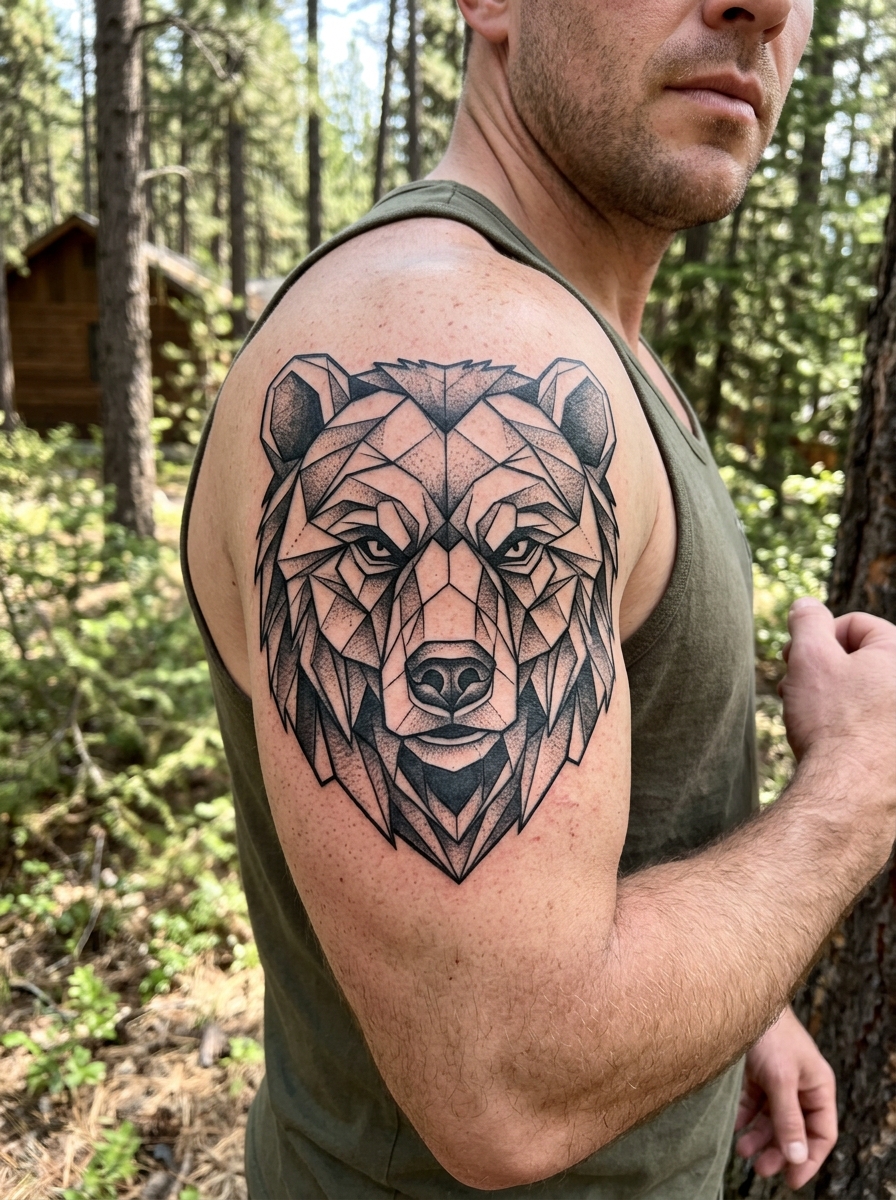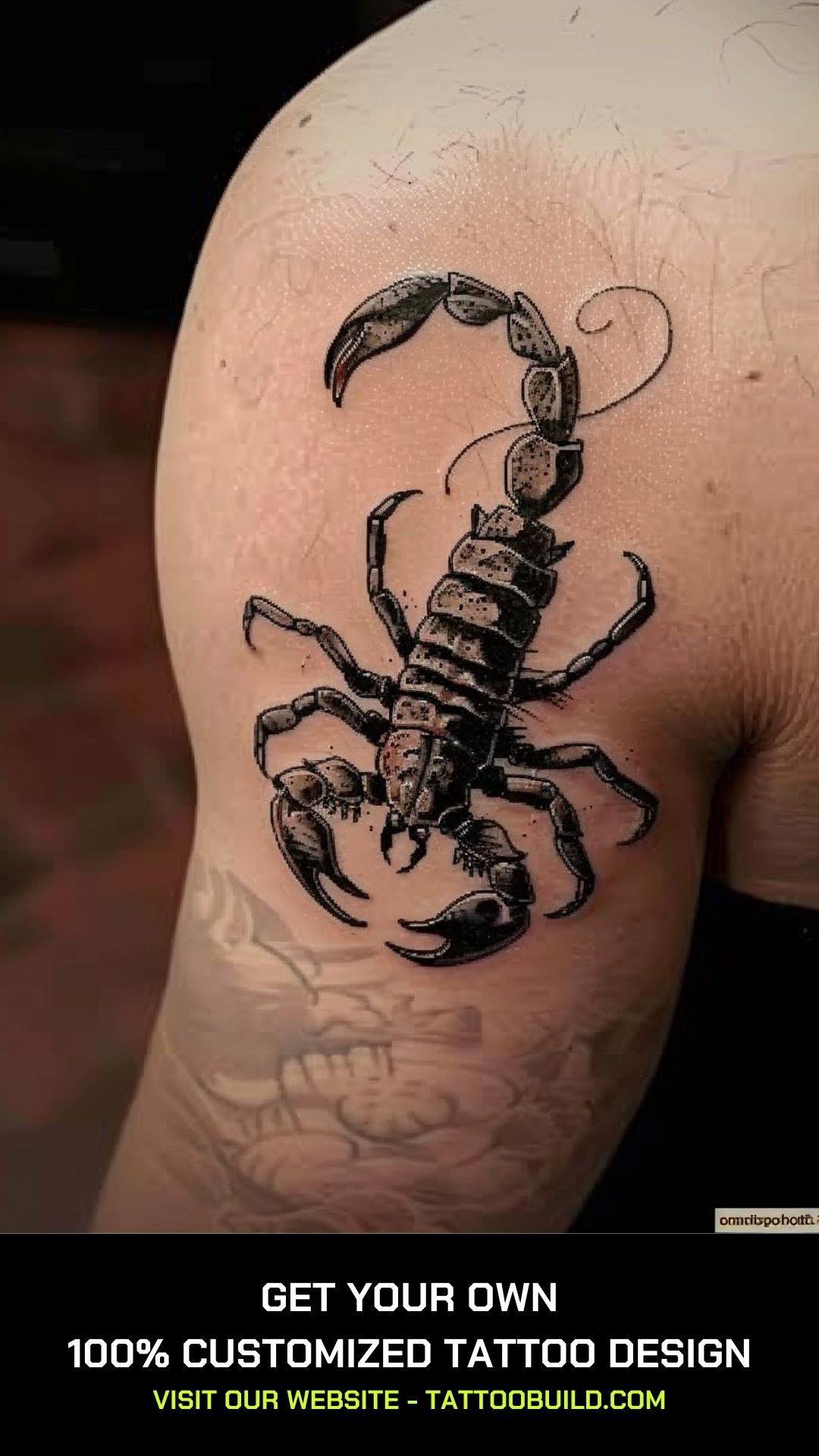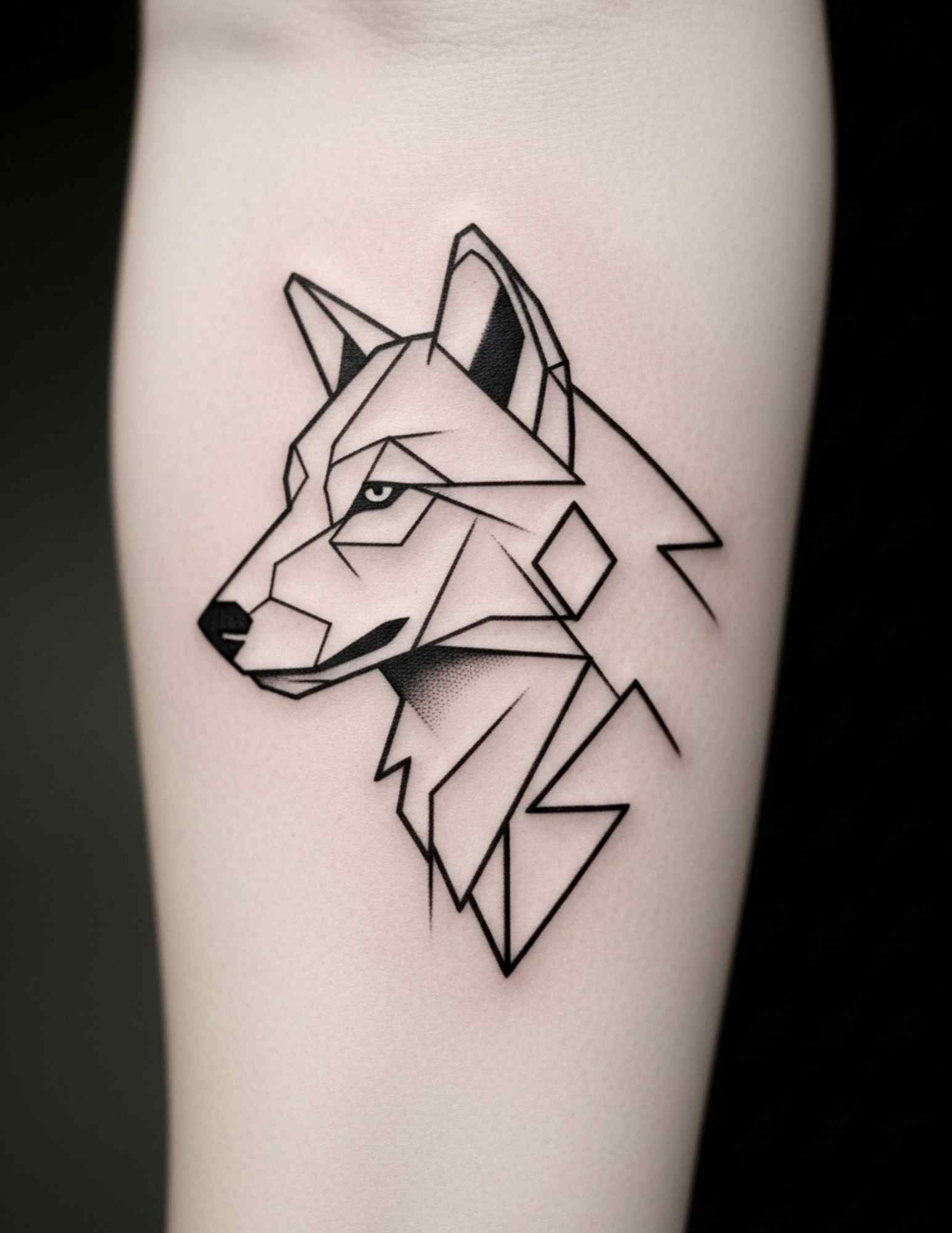
A geometric wolf tattoo works because the wolf’s head is already geometric — the angular muzzle, the triangular ears, the flat planes of bone under the fur. Good geometric work does not impose shapes on the animal. It finds the ones that were there and sharpens them.
I have watched a lot of these designs come out of a machine over the years, and the difference between the ones that land and the ones that do not almost never comes down to the concept. It comes down to whether the facets are sized and angled consistently enough to read as deliberate.
Below are 19 directions, from a three-line minimalist wolf to a full back piece. If you want the broader animal category first, the wider wolf tattoo design ideas guide covers non-geometric approaches too.
Each idea includes the placements it suits and the practical catch, because in my experience that second part is what people actually need before they book.
Which Geometric Wolf Style Is Right for You?
These five approaches all get called “geometric wolf,” and they behave very differently on skin. The right one depends more on how much space you have than on which looks best on a screen.
| Style | Best For | Placement That Suits It | How It Tends to Age |
|---|---|---|---|
| Full facet / low poly | Bold, sculptural presence | Thigh, chest, back, outer arm | Holds well at size; small versions blur where facets meet |
| Geometric linework | Clean, architectural look | Forearm, calf, upper arm | Lines soften slightly; spacing matters more than weight |
| Dotwork geometric | Softer shading inside hard shapes | Forearm, shoulder, thigh | Dots can merge over time; needs generous spacing |
| Sacred geometry overlay | Symbolic depth beyond the animal | Forearm, chest, back | Fine background patterns fade first; keep them simple |
| Minimalist geometric | Small, discreet, quick to sit for | Inner arm, ankle, ribs, behind the ear | Very dependent on line spacing; may need a touch-up |
What Makes a Geometric Wolf Work — and What Breaks It
The wolf carries a lot of symbolic weight already: intelligence, loyalty, pack instinct, a certain comfort with solitude. Geometry does not add meaning to that. It changes the register — it makes the animal feel constructed rather than observed.
The single most common failure I see is inconsistent facet size. When some planes are large and others are tiny with no logic to the transition, the eye reads it as noise rather than structure.
The second is scale. Facets need room. A design that looks razor-sharp as a 2,000-pixel drawing can lose its internal edges entirely when it is shrunk to fit a wrist.
The third is line consistency. Straight geometric lines are unforgiving — a wobble that would vanish inside an illustrative tattoo is obvious here. That is why geometric tattoo designs tend to expose an artist’s technical level faster than most other styles.
None of this is a reason to avoid the style. It is a reason to look specifically for healed geometric work in a portfolio, not just fresh photos taken the day of the appointment.
19 Geometric Wolf Tattoo Ideas
1. Full Geometric Wolf Head
The whole face resolved into triangular planes of varying darkness, as in the piece at the top of this guide. Nothing is left illustrative — even the eyes become shapes.
This is the purest version of the style and the one that reads best from a distance. It works because the tonal variation does the job that shading would normally do.
It needs size. On a thigh, chest or outer arm the facets stay distinct. Below about the width of a forearm, the smallest planes start fighting each other. Blackwork with real negative space is the usual approach; some artists add a soft grey mid-tone to suggest depth.
2. Geometric Wolf and Mandala
A faceted wolf head emerging from or laid over a mandala. The appeal is the collision: the wolf is asymmetric and restless, the mandala is perfectly ordered.
When it works, the mandala reads as the world the wolf sits inside. When it fails, it is usually because the mandala is too dense and swallows the animal. Look at mandala tattoo ideas for a sense of how much detail a given size can actually carry.
Best on the chest, upper back or outer thigh, where the mandala has room to be a full circle rather than a cropped one.
3. Low Poly Wolf
The low-polygon look borrowed straight from 3D modelling: visible planes, each holding one flat tone, the whole head reading like a crystalline sculpture.
Of every variation here this is the one that photographs best and the one most dependent on tonal accuracy. Each plane must be a different enough value from its neighbours to stay separate as the ink settles.
I would ask specifically to see a healed low poly piece before booking one. Flat grey planes that sit too close in value can merge into a single grey mass after a year or two.
4. Geometric Wolf with Sacred Geometry
A wolf head integrated with the Flower of Life, Metatron’s Cube, or a geometric star pattern. If the symbolism matters to you, it is worth reading up on what those figures traditionally represent rather than picking one on looks.
The strongest versions weave the pattern through the wolf rather than parking it behind the head like wallpaper.
Keep the background geometry simpler than you think you need. Fine repeated linework is the first thing to soften over the years.
Geometric wolf designs and the prompts behind them
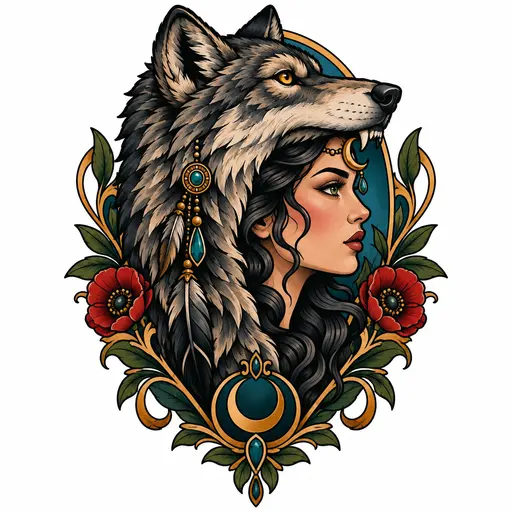
A woman's profile wearing a wolf-head headdress, a jewelled crescent moon on her brow
Use this idea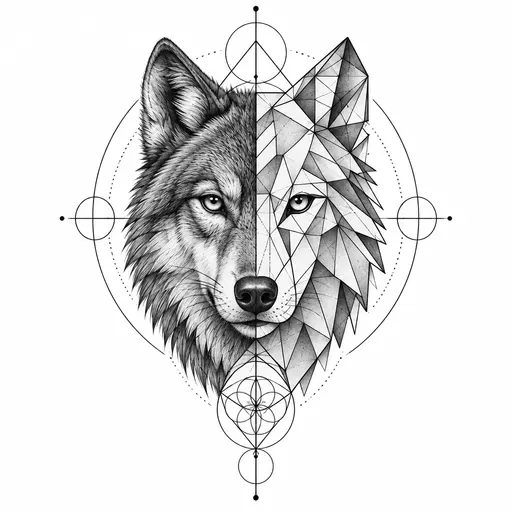
A wolf's head built from triangles and fine linework, one half realistic and the other pure geometry
Use this idea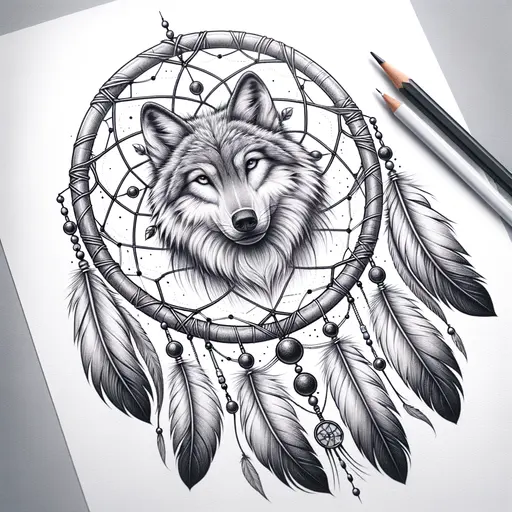
Dream catcher with wolf inside
Use this idea
5. Geometric Wolf Forearm
The forearm is probably the most requested placement for this style, and it deserves the popularity — the outer forearm is close to a flat plane, which keeps straight lines straight.
Inner forearm reads as more personal and hurts a little more for most people. Outer forearm is the one you see all day.
Vertical compositions suit the arm better than horizontal ones. A wolf head oriented down the limb sits naturally; one turned sideways tends to distort when the arm rotates.
6. Wolf and Geometric Moon
The oldest pairing in wolf tattooing, brought up to date by faceting both elements in the same language.
The trick is unity. If the moon is a smooth circle and the wolf is all hard planes, they look like two separate tattoos sharing a space.
A crescent works better than a full circle for most placements, because it gives the composition an asymmetric edge to sit against.
7. Half Geometric, Half Realistic
A wolf split down the centre: soft realistic fur on one side, hard geometry on the other.
Symbolically it does a lot of work — instinct against reason, the animal against the constructed self — without needing a single word of explanation.
This is genuinely difficult. The artist has to be strong in two very different disciplines and has to make the transition line feel intentional. In my experience this is the design most worth travelling for a specialist.
8. Geometric Wolf Pack
Three or more wolves in the same faceted style, arranged as a group rather than a single portrait.
The pack reads differently from a lone wolf — family, team, the people you actually run with. It is a common choice for anyone who finds the lone-wolf symbolism a poor fit for their life.
Needs a long canvas: a full sleeve, a back piece, or a thigh. Three geometric wolves crammed into a small space lose the individual facet detail that makes the style work.
9. Geometric Wolf Chest
A chest piece built symmetrically around the sternum, the wolf’s head centred with the geometry spreading across both pectorals.
The chest gives you scale, and scale is what this style wants. It also gives you full control over visibility.
Worth knowing: the sternum and the area near the collarbone are among the sharper spots to sit through, and a piece this size is usually multiple sessions.
10. Dotwork Geometric Wolf
Geometry for the structure, dotwork for the shading inside it. The result is softer than solid black without giving up any hard edges.
Dotwork takes longer than solid fill and costs accordingly, because the artist is placing tone one point at a time.
Ask about dot spacing. Stippling packed too tightly can blur into a flat grey as the ink spreads over the years, which loses exactly the texture you paid for.
11. Geometric Wolf with Forest
The wolf’s head containing or framed by a faceted pine forest — habitat and animal in a single shape.
Usually the trees sit inside the silhouette of the head, which keeps the outline clean and the interior busy.
It scales down better than most ideas on this list, because the forest can be simplified to a handful of triangles without losing the reference.
12. Geometric Wolf Thigh
The thigh is a tall, broad, relatively flat canvas, and for a large geometric composition it is hard to beat.
It is also easy to cover, which matters for people whose work has a view on visible ink.
Most people find the outer thigh among the more tolerable places to sit for a long session — closer to the inner thigh and the knee, that changes quickly.
13. Geometric Wolf and Compass
Wolf plus compass rose: direction, instinct, finding your way. The compass is already a geometric object, so the two share a visual language from the start. There is a full guide to wolf and compass tattoo designs if this is the direction you are leaning.
Match the line weights. If the compass is drawn finer than the wolf, it reads as an afterthought stuck on afterwards.
Forearm and outer arm suit this best, since a compass wants to be seen as a circle rather than an ellipse.
14. Minimalist Geometric Wolf
A wolf suggested by a small number of clean lines — sometimes fewer than ten. It sits closer to fine line work than to blackwork.
The appeal is obvious: small, discreet, a short sitting, and easy to place on an inner arm, ankle or behind the ear.
The catch is that minimalist geometric work is the most touch-up-prone version of this style. With so few lines carrying the whole design, any spreading is immediately visible. Ask your artist about line spacing before you commit to the smallest possible size.
15. Geometric Wolf Skull
The skull instead of the living head. The bone is already angular, so the geometry has real structure to follow rather than shapes to invent.
It reads darker than the standard wolf head, and it pairs naturally with the mortality symbolism people usually want from it.
Works well as a filler or anchor inside a larger blackwork sleeve, and it holds up better at a medium size than a fully faceted living head does.
16. Geometric Wolf and Mountains
Faceted peaks behind or inside the wolf. Mountains reduce to triangles more naturally than almost any other subject, so the two styles agree immediately.
It is a good option for anyone whose attachment to the wolf is really an attachment to a place.
Keep the mountain range simpler than the wolf. When both compete for detail, neither wins.
17. Full Back Geometric Wolf
The largest version: a wolf spanning shoulders to lower back, geometry scaled so even the smallest facets stay readable. Anyone considering a piece this size should look at how large blackwork designs are structured across the back.
This is a multi-session commitment, usually spread over months, and it needs a proper consultation with a drawn plan before the first needle.
The reward is that at this scale the style finally has room to do everything it can do — deep facet variation, real negative space, a design that reads from across a room.
18. Geometric Wolf and Feathers
A geometric wolf head with fine line feathers extending below or beside it.
This combination draws on Native American traditions of animal medicine and spiritual connection. If that heritage is yours or genuinely part of your story, it carries specific weight; if it is not, it is worth thinking honestly about whether you want to wear it.
Visually, keep the feathers lighter in line weight than the wolf so the head stays the focal point.
19. Abstract Geometric Wolf
Shapes that suggest a wolf without ever quite drawing one — an ear angle, a muzzle line, a suggestion of eyes, and the viewer’s brain completes it.
This is the most personal option on the list, and the one that ages best, because there is very little fine detail to lose.
It also asks the most of the artist at the design stage. Expect to pay for drawing time and to go through more than one draft.
Variations Worth Considering
If none of the 19 is quite it, these three adjustments change the character of the design without leaving the style.
Colour Instead of Blackwork
Most geometric wolves are black and grey, but faceting takes colour well — each plane can hold a different flat tone, which is exactly how the low poly look is built digitally.
Expect colour to need more maintenance than blackwork over the long run, and expect it to sit differently on different skin tones. A good artist will tell you honestly which palettes will hold on you.
Negative Space as the Subject
Instead of drawing the wolf, the artist fills the space around it, leaving the animal as untouched skin. It is striking and it ages cleanly, since there is no fine interior detail to blur.
It commits you to a lot of solid black, so it is worth deciding early whether that fits the rest of your ink.
Geometric Wolf in a Larger Piece
A faceted wolf head can work as one element inside a sleeve rather than as a standalone tattoo, the way a geometric bear often anchors a forest-themed half sleeve.
If a sleeve is anywhere in your future, mention it at the first consultation. Planning the wolf as a component from the start is far easier than retrofitting it later.
Getting One That Still Looks Sharp in Ten Years
Geometric work lives or dies on line quality, so the portfolio question matters more here than in most styles: ask to see healed geometric pieces, ideally a year or more old, not just fresh photographs.
Give the design more room than feels necessary. Every artist I have asked about this says the same thing — the pieces that come back for repair are almost always the ones that were sized down at the last minute.
Standard aftercare applies: keep it clean, follow the artist’s specific instructions rather than internet advice, and keep it out of the sun. The American Academy of Dermatology’s guidance on caring for tattooed skin is a reliable starting point, and long-term sun protection genuinely does slow the softening of fine lines.
If anything looks wrong while it heals — spreading redness, heat, swelling that increases after the first few days, pus, or a fever — contact your artist and see a doctor. The FDA tattoo fact sheet covers the risks worth knowing about, including delayed reactions to certain inks. Nothing in this article is medical advice, and infections and allergic reactions need a professional, not a home remedy.
Common Mistakes — and What to Do If You’re Still Not Sure
Going too small is the mistake I see most often. The second is booking with an artist whose portfolio is strong but not specifically geometric — clean traditional work does not guarantee clean straight lines.
The third is over-designing. A wolf head, a mandala, a moon, mountains and sacred geometry in one composition is not five times as meaningful; it is a piece with no focal point.
If the geometric angle is the part you are unsure about, browse other wolf tattoo approaches first — realistic, traditional and illustrative wolves all carry the same symbolism with a very different feel.
And if you are torn between two directions, ask for both as drawings. Most artists will charge a deposit for design time, and it is money well spent compared with sitting through the wrong tattoo.
Frequently Asked Questions
How much does a geometric wolf tattoo cost?
It depends entirely on size, placement and your artist’s rate, so the honest answer is that only your artist can quote you. As a rough frame, a small minimalist geometric wolf is usually a single short session, a forearm piece often runs a few hours, and a back piece is a multi-session project priced by the day. Dotwork shading adds time, and therefore cost, compared with solid fill. Always confirm the quote and deposit terms before booking.
Do geometric tattoos age well?
In most cases yes, provided the linework was clean and generously spaced from the start. The failure mode is not fading so much as merging — lines and dots placed too close together gradually spread into each other. Larger designs with fewer, better-spaced elements hold up best. Sun protection and normal skin care meaningfully slow the softening.
Where does a geometric wolf tattoo hurt least?
Pain varies a lot between people, but the outer thigh, outer upper arm and outer forearm are generally reported as more tolerable, because there is more muscle and fat between the needle and bone. Ribs, sternum, the inner arm and anywhere close to a joint are usually sharper. Longer sessions get harder regardless of placement, so ask your artist how they like to break up a big piece.
Is a minimalist geometric wolf a good first tattoo?
It can be a good first tattoo, because the session is short and the placement options are flexible. The one thing to weigh is that very small line-based designs are the most likely to need a touch-up down the line. If you want something that will need the least maintenance, going slightly larger than the minimum is usually the better call.
What does a wolf tattoo actually symbolise?
There is no single fixed meaning, and anyone who tells you otherwise is overselling it. Common associations include loyalty, family and pack bonds, intelligence, independence and a comfort with solitude — and the wolf carries genuine cultural and spiritual significance in a number of traditions, which is worth respecting rather than borrowing casually. Geometric styling does not change the symbolism; it changes the tone from observed to constructed.
Quick Summary
- The wolf’s skull is naturally angular, which is why geometry suits it better than most animals.
- Consistent facet size and angle is what separates a deliberate design from a noisy one.
- Size is the biggest practical constraint — facets need room to stay readable.
- Full facet and low poly want the thigh, chest, back or outer arm; minimalist versions suit small placements.
- Dotwork softens the shading but needs generous dot spacing to survive the years.
- Match line weights when combining the wolf with a moon, compass, mandala or mountains.
- Ask specifically for healed geometric work in a portfolio, not just fresh photos.
- Follow your artist’s aftercare, protect it from the sun, and see a doctor for any sign of infection.