A dragon tattoo does not command a room because of the dragon — it commands a room because of how much space the artist was allowed to use.
I have watched a lot of men walk into a shop with a dragon reference on their phone and walk out with something half the size they imagined, because the placement they picked could not hold the design.
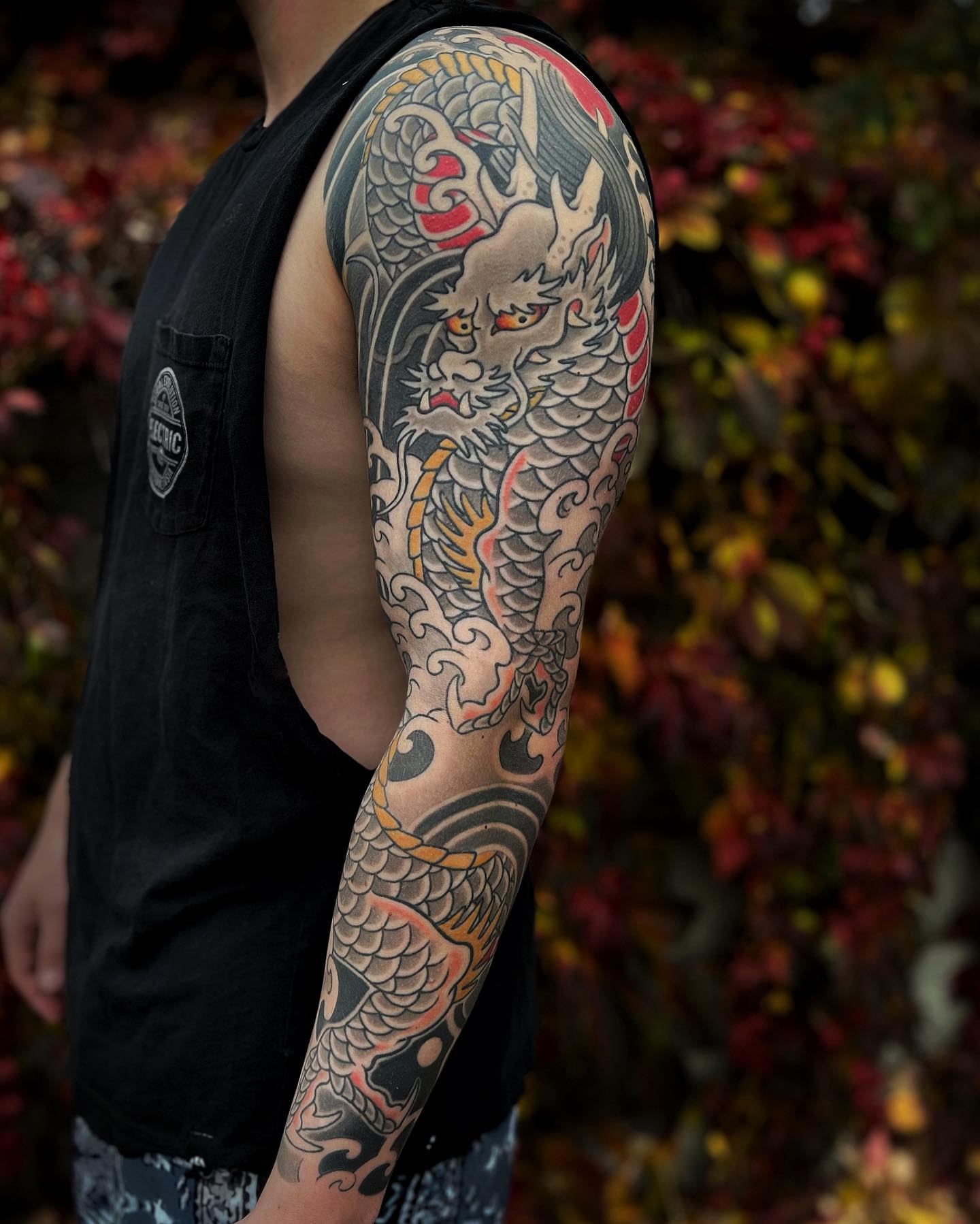
Dragons are long, coiling, directional creatures. They were drawn for backs, ribs and full arms long before anyone tried to squeeze one onto a wrist, and the Japanese tattoo tradition that produced most of these shapes assumed a body-sized canvas.
What follows is 20 dragon directions worth considering, with an honest note on where each one actually works. I have flagged the ones that tend to disappoint at small sizes, because that is the mistake I see most often.
Which Dragon Style Is Right for You?
These are the five families most artists will steer you toward. The differences matter less in the drawing and more in how they hold up a decade later.
| Style | Best Placement | Typical Sessions | Ages Well? | Watch Out For |
|---|---|---|---|---|
| Japanese ryū | Back, full sleeve, ribs to thigh | 4–12+ | Very well — built for it | Cost and commitment; hard to shrink |
| Chinese long | Arm wrap, spine, calf | 3–8 | Well, if lines stay bold | Thin whiskers and claws blurring |
| European / winged | Back, chest, outer thigh | 3–8 | Depends on shading density | Wings need width; cramped wings look broken |
| Blackwork / tribal | Shoulder, chest, outer arm | 2–6 | Usually the most durable | Solid black is difficult to cover later |
| Fine line / minimal | Forearm, calf, ribs | 1–2 | Softens fastest | Detail closing up as lines spread |
Why Dragons Work Best Large
A dragon is mostly body. The head is the part everyone photographs, but the design only reads as a dragon because of the length behind it.
Compress that length and the coils stack on top of each other. In my experience that is the single most common reason a dragon tattoo looks muddy at five years old — not bad linework, just too many turns in too little space.
There is also a practical reason. Every line you put into skin spreads slightly over the decades, and scales, whiskers and claw detail are exactly the elements that close up first.
Every artist I have asked about this says a version of the same thing: give the dragon one more panel than you think it needs. A back piece that runs onto the shoulder, a sleeve that carries onto the chest, a spine piece that starts at the neck.
None of this means small dragons are a mistake. It means small dragons need to be drawn as small dragons from the start, not as shrunken big ones.
20 Dragon Tattoo Ideas for Men
1. Japanese Ryū Full Back Piece
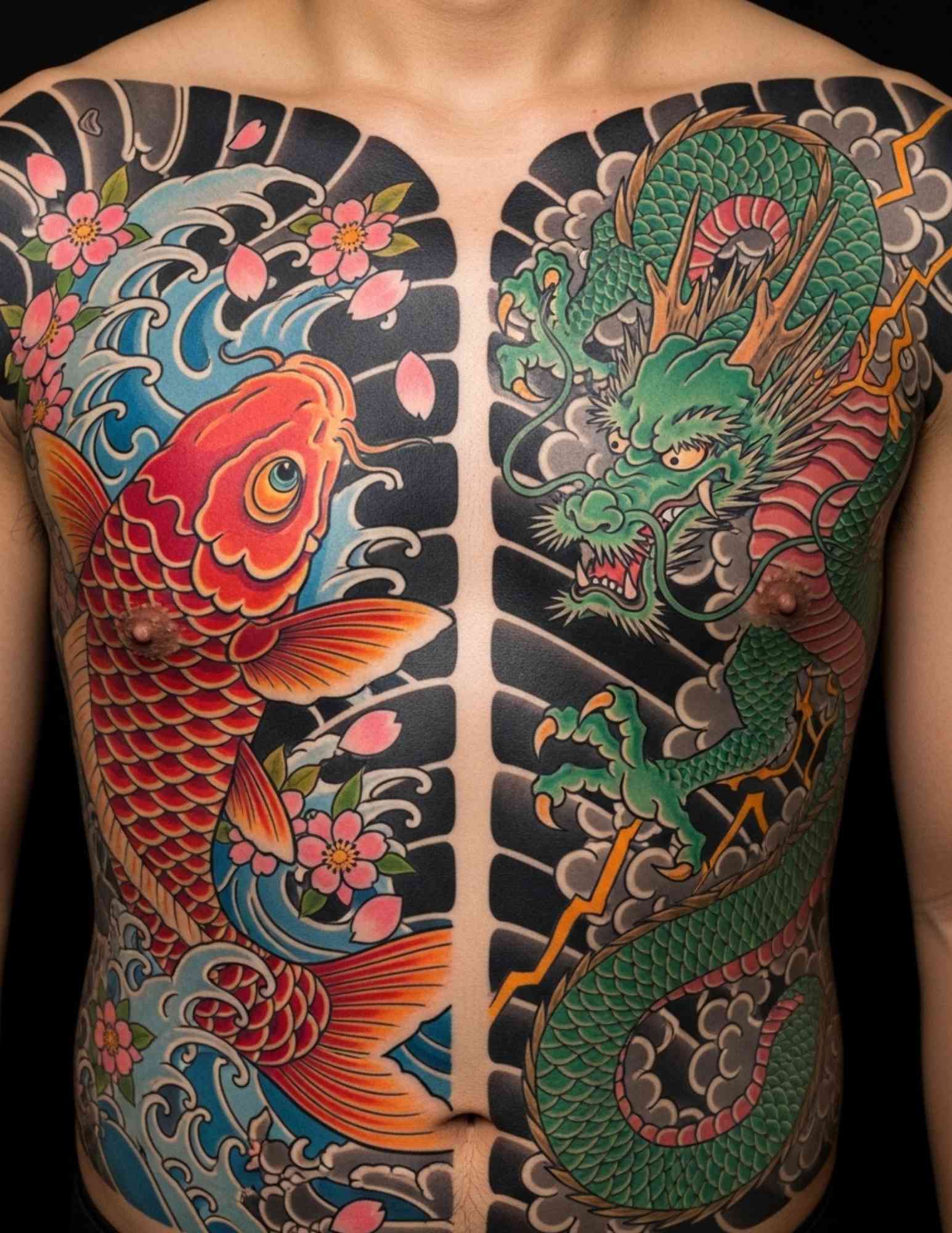
The benchmark. A ryū running from the shoulders to the lower back, framed with wind bars, clouds or waves that give the body somewhere to travel.
Expect this to be a multi-session project measured in months rather than weeks, usually with a full outline session before any shading begins.
When I have seen these done properly, the composition follows the wearer’s own shoulder line — the dragon looks like it fits that back specifically, not like a print laid on top of it.
2. Dragon Sleeve
The body spirals; the head lands somewhere deliberate, usually the outer shoulder or the back of the forearm.
A good sleeve design from a dragon avoids the flat-panel look by making sure the tail actually disappears around the arm rather than stopping at the silhouette.
Ask to see the stencil wrapped on your arm before the needle starts. The drawing on paper is always more flattering than the drawing on a cylinder.
3. Chinese Dragon (Long)
Wingless, serpentine and whiskered. The long is a weather and water creature rather than a hoarder of gold, and the shape reflects that — all movement, no bulk.
It suits wraps: an arm, a calf, a spine. Anywhere the body can travel a distance and still turn back on itself.
The detail that dates a long fastest is the whiskers. Ask for them slightly heavier than the reference so they still read in ten years.
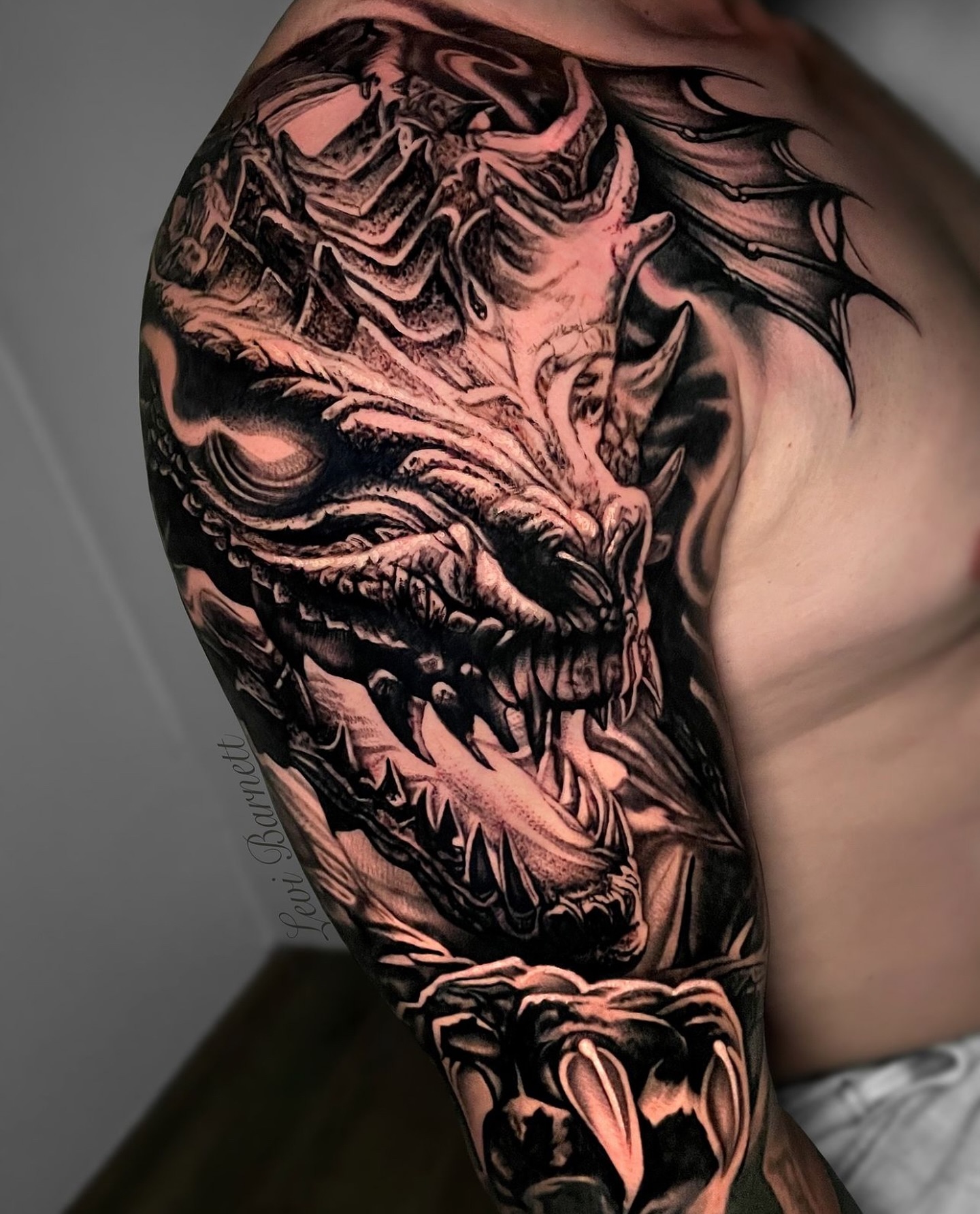
4. European Dragon With Wings
Heavier, four-limbed, bat-winged. This is the dragon most Western readers picture, and it needs width more than length.
Chest and back are the natural homes. On an arm, the wings usually have to fold or the composition breaks.
In my experience this style benefits from restraint in the wing membrane — too much internal detail and the wings turn into grey haze after a few years.
5. Dragon Spine Piece
The dragon runs vertically down the centre of the back, using the vertebrae as its own spine.
It is one of the more painful placements, particularly over the lower spine and shoulder blades, so plan for shorter sessions than you would book for an outer arm.
Symmetry matters here more than anywhere else. Any drift off centre is obvious in a mirror.
6. Blackwork Dragon
Solid black, negative space, no grey wash. Blackwork tends to be the most durable choice on this list because there is no delicate mid-tone to fade.
The trade-off is permanence in a different sense: heavy black areas are genuinely difficult to cover or lighten later.
I would only go this route if you are sure about the subject, not just the style.
7. Dragon and Phoenix
A paired composition, traditionally read as balance between two opposing forces. It works as a back piece, or split across both arms or both thighs.
The risk is competition — two busy subjects fighting for attention. Most artists solve it by giving one of them dominance and the other a supporting role.
If you like the pairing but not the scale, a phoenix piece on one arm and a dragon on the other lets you stage it over two separate projects.
8. Geometric Dragon
The dragon abstracted into facets, line grids or repeated shapes. It reads as design first and creature second.
Geometric tattoos live on precision, so an artist with a steady, mechanical line is worth waiting for.
Be aware that geometric linework shows aging clearly: when straight lines soften, the eye notices in a way it does not with organic shapes.
9. Dragon Skull
Skeletal rather than living — horns, jaw, eye socket. It swaps motion for anatomy.
Because there is no coiling body to carry the design, the skull itself has to be strong, which usually means a bigger head than you would draw for a full-body piece.
This one photographs well on the outer forearm and the chest.
10. Dragon Wrapped Around a Sword
The sword gives the composition a spine. The dragon supplies the curves against it.
It is a natural fit for the forearm, where the blade can follow the length of the arm and the dragon can wrap.
When I tested layouts like this on paper, the version that worked best had the hilt at the elbow and the point toward the wrist — upside down looks odd when your arm hangs at your side.
11. Fire-Breathing Dragon
The flame is the hard part. Solid colour fire can go flat, and heavy grey fire can turn into an indistinct cloud.
The versions I have seen hold up best use negative space and smoke rather than filling every flame shape.
Give the fire somewhere to go — across the chest, down the ribs — instead of stopping it abruptly at the edge of the design.
12. Minimalist Dragon
A single continuous line, or a stripped silhouette. Fast to sit for, easy to place, and the most forgiving entry point.
The honest limitation is longevity of detail: fine lines soften, and a minimal dragon has nothing to spare.
Ask for slightly thicker line weight than the reference photo. It will look marginally bolder on day one and considerably better on year ten.
13. Tribal Dragon
Bold black curves, tapered points, no shading. It is a graphic reading of the creature rather than a portrait.
Shoulders and chest panels suit it because the shape can follow muscle rather than fight it.
If you are drawn to this style, ask your artist about the specific tradition the design borrows from — a lot of what gets called tribal is a generic pastiche, and some of it belongs to cultures with real rules about who wears it.
14. Dragon and Koi
The koi that climbs the waterfall and becomes a dragon. It is one of the few dragon designs with a narrative already built in.
That story is why it is such a common choice for people marking a hard stretch they came out the other side of.
It reads best as a vertical composition — a koi design at the bottom, water in the middle, the transformation at the top.
15. Dragon Chest Piece
The head sits high near the collarbone, the body runs down and across. On a chest piece the dragon usually spans both pectorals or claims one side and continues onto the arm.
Chest skin moves a lot. A composition that ignores that will look fine in the mirror and strange when you raise your arms.
Sternum work is among the sharper spots on the body for most people, so pace the sessions.
16. Two-Headed Dragon
Mirrored heads facing opposite directions, usually read as two sides of the same temperament.
It needs a symmetrical placement — centred on the back, chest or stomach — or one head ends up looking accidental.
This is a design worth seeing drawn on your body in stencil form before you commit, more so than most on this list.
17. Dragon in Clouds
Clouds do quiet structural work. They fill space, hide the joins where the body passes behind itself, and give the piece a place to fade out at the edges.
In traditional Japanese layouts this is not decoration; it is how the composition breathes.
If your dragon has awkward gaps, clouds are usually the fix your artist will reach for first.
18. Realism Dragon
Textured scales, real light behaviour, believable weight. It is the most technically demanding style here.
Realism needs size. Scale texture rendered small will merge into grey as it heals and settles.
Look hard at an artist’s healed work before booking this one — fresh realism looks incredible on almost everybody’s portfolio.
19. Dragon With Runes or Script
Text woven through the body, along a banner, or set behind the composition.
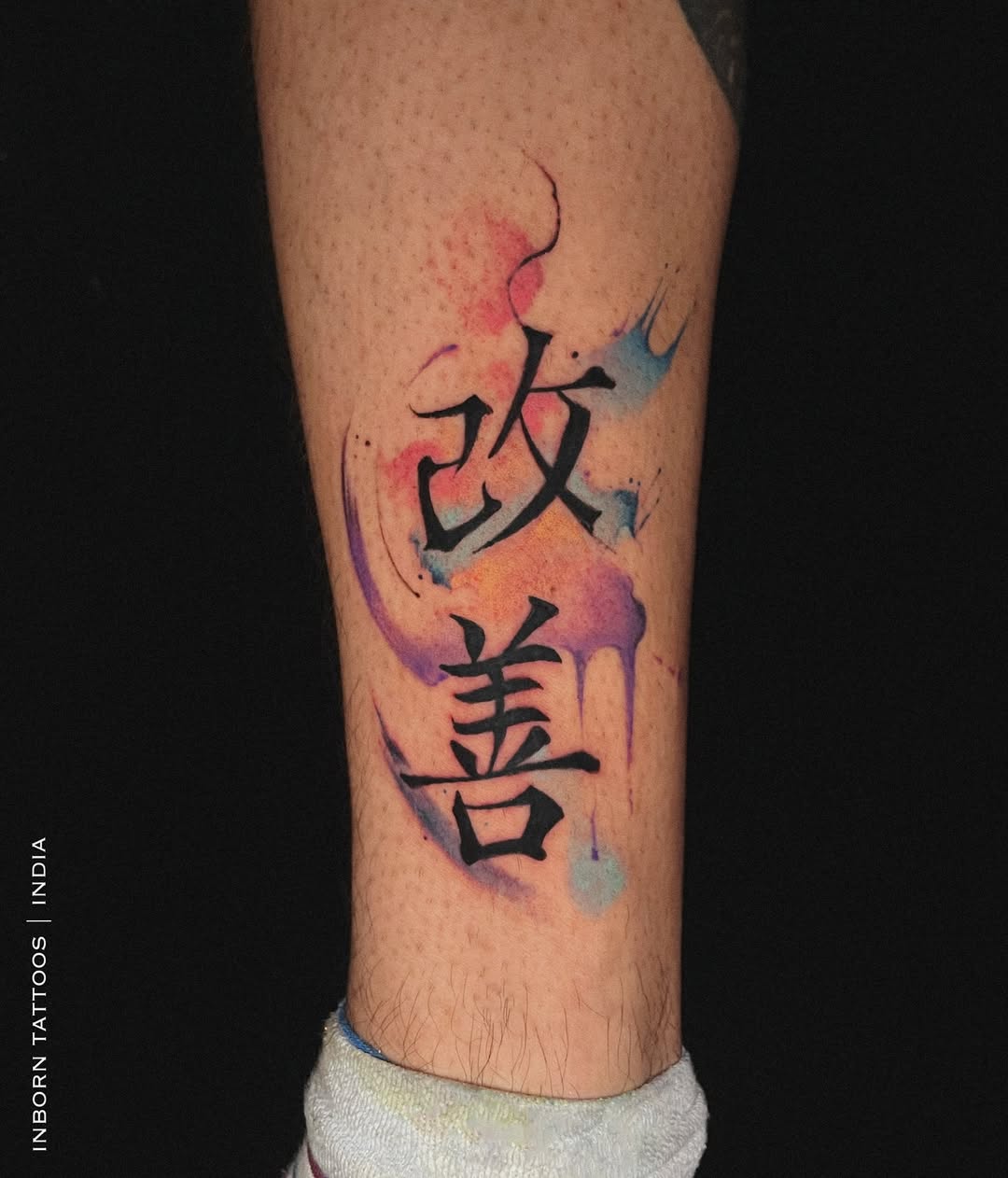
Have any non-English script checked by someone who actually reads the language, not by a translation app. I have seen more than one piece that says something close to but not quite what the wearer intended.
Keep the lettering large enough to survive. Small script is the first element to lose legibility.
20. Dragon Eye Close-Up
Just the eye and the scales immediately around it, cropped tight.
It is the smallest way to get the presence of a dragon without committing to a body, and it works on the inner forearm or the back of the calf.
The eye has to be genuinely well drawn, because there is nothing else in the design to look at.
Variations Worth Considering
If none of the twenty land exactly right, these are the adjustments most artists will happily make.
Scale It Down Without Shrinking It
Rather than shrinking a back-piece design, ask for a redraw at the size you actually want. A dragon drawn for a forearm has fewer coils and heavier lines, and it will look better than a miniature of something else.
Half the Creature
Head and shoulders only, or the tail disappearing under a sleeve. Cropping is a legitimate compositional choice, not a compromise.
Black and Grey Versus Colour
Colour dragons are striking and generally need more maintenance — reds and yellows in particular tend to need touch-ups sooner than black and grey. If low upkeep matters to you, that is a real factor.
Leave Room to Extend
Ask your artist to design an exit point. A tail that trails into open skin means you can carry the piece further later without a visible seam.
Getting a Dragon Tattoo Done Well
Book a consultation before the tattoo. Bring three references you like and, more usefully, one you dislike — artists learn more from what you reject.
Eat properly and stay hydrated before a long session. Large dragon work runs long, and low blood sugar is the usual reason someone taps out early.
For healing, follow the aftercare your artist gives you rather than advice from the internet, since it is tuned to the products and technique they used. The American Academy of Dermatology has plain general guidance on caring for tattooed skin if you want a second reference.
If a healing tattoo becomes hot, increasingly painful after the first few days, swollen, or starts weeping pus, that is a doctor’s call, not an artist’s. The US Food and Drug Administration also publishes a plain-language overview of tattoo risks, including allergic reactions to specific pigments.
Nothing here is medical advice. For anything that looks like an infection or a reaction, see a doctor, and talk to your artist about pigment sensitivities before your appointment rather than after.
Still Not Sure? Common Mistakes to Avoid
The mistake I see most: picking the image before picking the placement. Decide where it goes, then let the design be drawn for that space.
Second: booking on price alone. A dragon is a large project, and the difference between a good and mediocre artist compounds across every session.
Third: underestimating the sitting. If this is early in your tattoo history, starting smaller is worth reading, and some pain management basics will give you a realistic sense of what to expect from the longer spots.
Fourth: assuming dragons are a men’s design. They are not, and the women’s dragon guide covers placements and compositions that often get overlooked in men’s galleries.
Frequently Asked Questions
How much does a dragon tattoo cost?
It depends almost entirely on size, style and your artist’s rate, so any number quoted online is close to meaningless. A small minimalist dragon is usually a single short session. A full back piece is a multi-session project that many shops price by the day rather than the hour. The honest answer is to ask your chosen artist for an estimate after they have seen the placement, because they are the only person who can give you a real figure.
How long does a dragon sleeve take?
Most dragon sleeves run several sessions rather than one. Outlining is typically done in one sitting so the composition is locked in, then shading and detail follow over subsequent appointments. Healing time between sessions matters as much as chair time, and rushing it tends to show. Your artist will set the spacing based on how your skin recovers.
Do dragon tattoos have a specific meaning?
It varies a lot by tradition. In Japanese and Chinese imagery dragons are generally associated with water, weather and protective power rather than menace, while European dragons carry more of a threat-and-conquest reading. Many people choose one for resilience or transformation, particularly the koi-to-dragon composition. There is no single correct meaning, and it is fine for yours to be personal.
Where does a dragon tattoo hurt the most?
For most people the sharper areas are the ribs, sternum, spine, inner arm and anywhere close to bone. The outer arm, outer thigh and calf are usually more comfortable. Pain is genuinely individual, though, so treat this as a general pattern rather than a rule. Tell your artist if you need to break — on a long dragon session it is expected.
Can a dragon tattoo be covered up or reworked later?
Fine-line and lightly shaded dragons are usually reworkable into something larger. Heavy blackwork and dense solid areas are much harder to cover and often need laser lightening first, which adds time and cost. If you think you might change your mind, keep the design open rather than filling everything solid. A cover-up specialist can tell you what is realistic for your specific piece.
Quick Summary
- Pick the placement first, then have the dragon drawn for that space.
- Japanese ryū and Chinese long designs need length — back, sleeve, spine or calf.
- European winged dragons need width, which means back, chest or outer thigh.
- Blackwork lasts longest but is the hardest to cover or change later.
- Fine-line and minimal dragons are the easiest entry point, with the shortest detail lifespan.
- Ask for slightly heavier line weight than your reference on any small design.
- Have your artist design a natural exit point so the piece can be extended.
- Follow your artist’s aftercare, and see a doctor for anything resembling infection or a reaction.