Finger tattoos are the only ink you will look at every single day without trying. They are visible when you type, gesture, drive and hand over your card — which makes them the least private tattoo you can get, and the one that ages the fastest.
I have watched friends fall in love with a hairline finger design on a Saturday and message me eight months later asking why it looks like a smudge. That is not a bad artist. That is finger skin doing what finger skin does.
So this guide does two things at once. It gives you 22 designs that genuinely suit the placement, and it stays honest about which of them will still look sharp in three years and which will not.
If you want the wider view before committing, our roundup of classy women’s finger tattoos is a good companion piece to this one.
Which Finger Placement Is Right for You?
Not all finger real estate behaves the same way. The side of a finger holds ink far better than the top of a knuckle, and the inside of a finger is the hardest surface on the hand to keep legible.
Here is how the four common placements compare, based on what artists consistently tell me and what I have seen heal in practice.
| Placement | How Well It Holds | Visibility | Best Suited To |
|---|---|---|---|
| Side of finger | Best of the four — least friction | Semi-discreet, seen at angles | Initials, short words, small symbols |
| Top of finger (between joints) | Good, if lines are kept bold | Fully visible | Stars, moons, hearts, bolts |
| Knuckle | Poor — skin stretches constantly | Very visible | Bold single letters, thick dots |
| Inside / palm side | Worst — expect heavy fading | Hidden until you open your hand | People who accept it as temporary |
| Base of finger (ring band) | Moderate, protected by hand position | Reads as jewellery | Bands, infinity loops, wedding ink |
Why Finger Tattoos Fade Faster Than Anywhere Else
Finger skin turns over quickly, and it does so under constant mechanical stress. You wash your hands, grip things, and expose them to sunlight more than any other part of your body.
The practical result is that ink on fingers migrates, blurs and lifts on a timeline measured in months rather than decades. Fine hairline work is the first casualty, because there is very little pigment in the line to begin with.
Every artist I have asked gives roughly the same answer: expect a touch-up on finger work, and expect it sooner than you would for an arm piece. Many quote the first year, some the first six months.
There is also a real chance of patchy healing regardless of aftercare. Ink can simply drop out of a section of a finger line while the rest holds perfectly, which is why some studios have a stated no-guarantee policy on hands and fingers.
None of this is a reason to skip the placement. It is a reason to design for it — simpler shapes, slightly thicker lines, and a willingness to sit for a touch-up. Our guide to how often a tattoo needs a touch-up covers the realistic intervals.
22 Finger Tattoo Ideas for Women
I have grouped these by theme rather than listing them one by one, because the choice you are actually making is a category — letters, celestial, bands, symbols — and the specific motif follows from it.
1–3. Initials, Letters and Short Words
A single initial on the side of a finger is the most requested finger tattoo I see, and for good reason: it is small, personal, and sits in the placement that ages best.
Your own initial reads as a signature. Someone else’s reads as devotion, which is worth thinking about honestly before you sit down.
Short words work too, but there is a hard limit. Anything past about six letters on a single finger forces the lettering so small that the strokes will close up as they heal.
A word in a non-Latin script — Arabic, Hebrew, Sanskrit, Japanese — is a popular variation and a genuinely risky one. Have the meaning confirmed by a fluent speaker rather than by the artist’s reference sheet, and check the direction the script runs before it is stencilled.
My honest advice on lettering: go one size up from whatever looks right on paper. At finger scale, legibility is the whole design.
4–7. Stars, Moons and Constellations
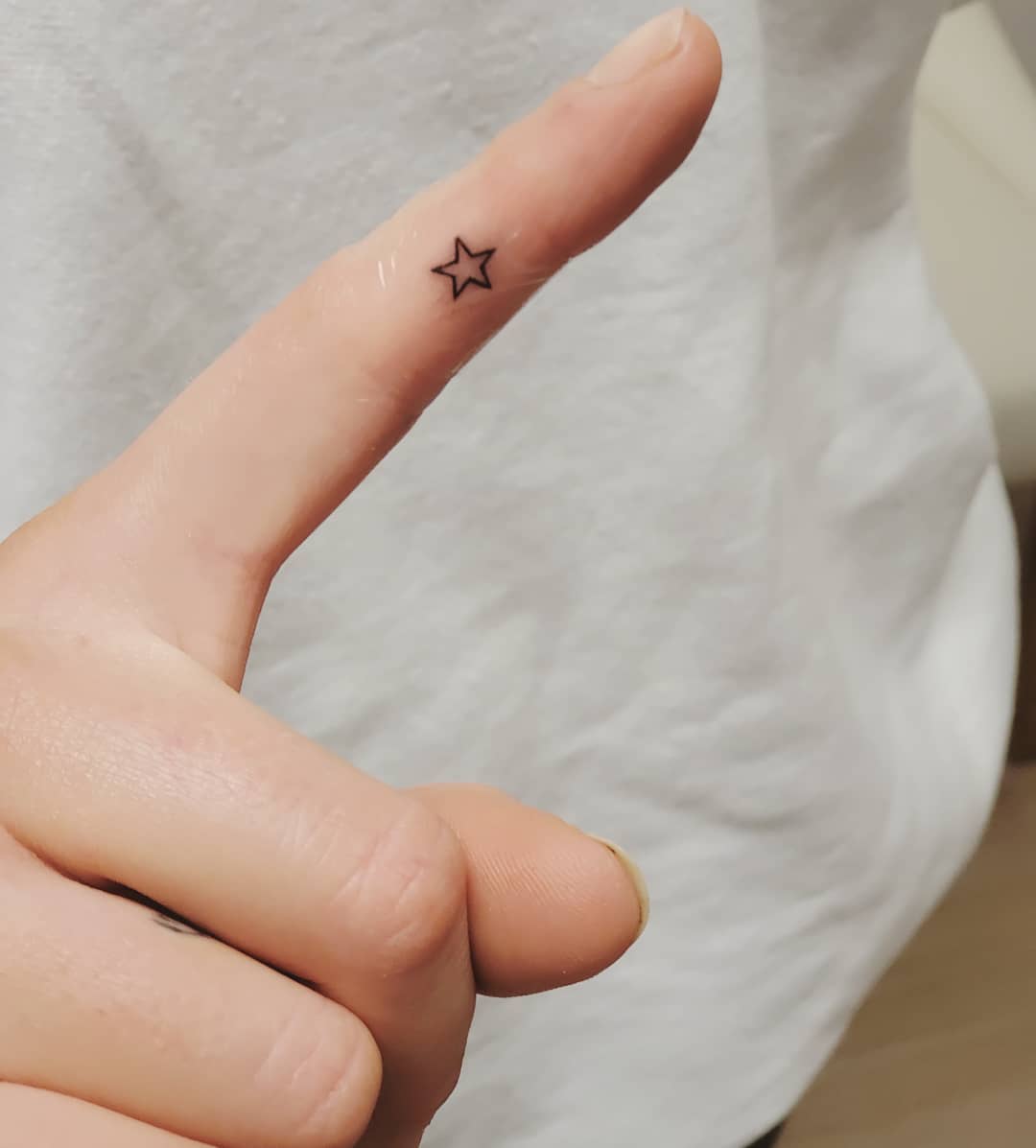
Celestial motifs suit fingers because they are built from shapes that stay readable when they soften — a five-point star, a crescent, a small cluster of dots.
A tiny star between the first and second knuckle is about as low-commitment as a visible tattoo gets. It takes a few minutes and reads clearly from conversational distance.
The crescent moon is the version I have seen hold up best over several years, because the shape is a single thick curve rather than a set of thin intersecting lines.
Constellation dots spread across two or three fingers are beautiful when fresh, though the hairline strokes connecting them are usually the first thing to fade. Many artists will do the dots heavy and the connecting lines light, knowing the lines are effectively optional.
If the celestial theme is what pulled you in, our constellation tattoo ideas guide has larger-format versions that will hold detail far longer.
8–9. Bands, Rings and Infinity Loops
A band at the base of the finger is the one finger tattoo that most people over forty do not read as a tattoo at all. It reads as jewellery.
Solid bands hold better than any other finger design in my experience, because the ink sits in a protected crease and the shape has no fine detail to lose.
Couples increasingly choose a band over a physical ring, particularly people who work with their hands and cannot safely wear metal. It is worth understanding that a tattooed band is permanent in a way a ring is not — the full wedding ring tattoo ideas guide walks through the tradeoffs.
The infinity loop is the middle ground: band placement, but with a symbol rather than a plain line. Ask for it slightly thicker than feels necessary — the two crossing points are where a thin infinity blurs into a solid blob.
10–12. Hearts, Dates and Devotion Marks
A small heart outline is the classic, and it survives fading gracefully because even a blurred heart still reads as a heart.
Roman numerals for a date are the more grown-up version of the same idea. They run naturally along the length of a finger, which suits the shape of the placement.
Numerals do need care, though. Strings of I’s and V’s set too close together merge into a single bar within a couple of years, so ask for generous spacing even if it means using two fingers.
A single dot is the most understated option on this entire list. Some people use it as a full stop, a period of grief, or a private marker — and because it is pure solid pigment, it is arguably the most durable finger tattoo you can get.
For more symbols in this register, our collection of small meaningful tattoos for women covers designs that carry weight at tiny scale.
13–15. Lightning, Arrows and Waves
These three share a design logic: they are all single continuous strokes, which is exactly what a finger handles well.
The lightning bolt has stayed popular for years because it is naturally angular and naturally bold. There are no thin passages in it to lose.
An arrow follows the length of the finger, so it uses the placement’s shape instead of fighting it. Pointing toward the fingertip suggests forward motion; pointing back toward the hand is the quieter, more introspective read.
A wave is the softest of the three and the most likely to blur, since a wave line is usually drawn thin. I would ask for two or three millimetres more amplitude than the reference photo shows, so the peaks stay distinct as the ink spreads.
All three of these age better in solid black than in grey wash. Grey wash on fingers tends to lift unevenly and can look mottled within a year.
16–17. Botanical Sprigs and Feathers
A sprig of leaves running along the finger is one of the prettiest options here and one of the most fragile.
The problem is that a botanical design is mostly negative space between thin lines, and finger ink spreads into negative space. A sprig with six leaves at three years often looks like a sprig with three.
The fix that works is reduction: fewer leaves, drawn larger, with visible gaps. An artist who is honest with you will suggest this before you ask.
The same applies to a feather. A feather with individually drawn barbs will not stay separate; a feather drawn as a silhouette with three or four notches will.
If you love the botanical look but want it to last, the tiny wrist tattoo ideas collection shows the same motifs on skin that holds detail far better.
18–20. Snakes, Crowns and Eyes
These are the designs with the most personality on the list, and the most technical demand.
A snake wrapping the finger is genuinely clever design, because the wrap does the work — the body disappears around the side and reappears, which creates depth without needing shading.
A small crown above the knuckle is a long-standing favourite. Keep the points few and chunky; a crown with seven fine spikes will read as a scribble sooner than you would like.
The eye is the one I would think hardest about. It relies on the contrast between the iris, the pupil and the white of the eye, and on a finger those three zones are only a few millimetres apart.
When I have seen finger eyes hold up, it is because the artist committed to a heavy black pupil and a bold outer line and let everything else stay open. Detail is not your friend at this scale.
21–22. Matching Sets and Everyday Marks
Matching knuckle tattoos across a pair of hands — sisters, partners, close friends — are one of the few cases where fading almost does not matter, because the meaning is in the pairing rather than the linework.
A tiny portrait is technically possible on a finger and I would gently steer you away from it. Portraits need tonal range, and finger skin will not hold tonal range.
The last idea on this list is not a motif at all. It is a question: choose something you will be happy to see several hundred times a day, because that is what this placement guarantees.
In practice the people I know who are happiest with their finger tattoos chose something small and neutral — a shape, a letter, a dot — rather than something loaded. The loaded ones are the ones that get covered.
For inspiration that spans the whole hand rather than just the fingers, see our women’s hand tattoo ideas.
Alternatives Worth Considering First
If the fading trade-off bothers you, there are three routes that get you most of the look with far less maintenance.
Move It to the Wrist or Hand
The same motif on the inner wrist or the back of the hand will keep its detail for years longer. You lose a little of the constant-visibility appeal, and you gain a design that still reads clearly at ten years.
Go Bigger, Not Smaller
A finger tattoo drawn at 150% of the size you first imagined is not less delicate — it is simply legible for longer. Almost every regret I have heard about finger work traces back to something being drawn too small.
Test It Temporarily First
Reputable semi-permanent options and simple henna let you live with a finger design for a week or two before committing. For a placement this visible, that fortnight is genuinely informative.
Browsing tiny tattoo ideas for women alongside this list is a useful way to see how the same motif behaves in different placements.
Aftercare and Healing on Fingers
Finger aftercare is harder than arm aftercare for one obvious reason: you cannot stop using your hands.
For the first two weeks, keep the area clean with unscented soap, pat it dry rather than rubbing, and use a thin layer of a fragrance-free healing ointment. Thin is the operative word — a thick layer traps moisture and can pull ink out.
Wear gloves for dishes and cleaning, and keep the fresh tattoo out of pools, hot tubs and open water until it is fully healed. Sunscreen on healed finger ink, every day, is the single biggest factor in how long it stays sharp.
Some redness and light scabbing is normal. Spreading redness, heat, swelling that worsens after day three, pus, or a fever are not — those need a doctor, not a forum thread. The Mayo Clinic and the American Academy of Dermatology both publish plain-language guidance on tattoo risk and skin care, and the US FDA covers ink safety and reactions.
This article is general information, not medical advice. Your artist is the right first call for healing questions about their work, and a doctor is the right call for anything that looks like infection or an allergic reaction. Our full tattoo aftercare guide goes step by step.
Common Mistakes — and What to Do If You Are Still Not Sure
The most common mistake is choosing a design based on a photo taken the day it was done. Ask your artist for healed photos of their finger work, ideally a year or more old.
The second is booking finger work with an artist who does not specialise in it. Fingers are a specific skill, and an excellent large-scale artist is not automatically good at them.
The third is underestimating the visibility. Some workplaces still have policies on visible tattoos, and fingers are the hardest placement to cover.
If you are undecided, the useful question is not which design — it is whether you are comfortable maintaining it. If the answer is no, move the design to a placement that does not need maintenance and you will be happier for a decade.
Frequently Asked Questions
How much do finger tattoos hurt?
Fingers are widely considered one of the more painful placements because the skin is thin and sits directly over bone and nerve endings. That said, most finger designs take only a few minutes, so the total discomfort is short. In my experience people describe it as sharp and scratchy rather than deep. If pain is a concern, our tattoo pain management tips are worth reading before your appointment.
How long do finger tattoos actually last?
They stay crisp for a shorter period than any other placement, and artists commonly flag the first year as when touch-ups become likely. Bold, simple designs hold noticeably better than fine hairline work. Sun exposure and frequent hand washing are the two biggest accelerators. Expect maintenance rather than a one-and-done tattoo.
Will an artist even do a finger tattoo?
Many will, but some studios decline hand and finger work entirely, and others will do it only with a written no-guarantee agreement. This is not artists being difficult — it is them being honest about a placement that heals unpredictably. Call ahead rather than turning up and hoping. Artists who specialise in fine line and micro work are usually the ones who take it on.
Do finger tattoos get infected more easily?
Hands come into contact with more surfaces than almost any other body part, so keeping a fresh finger tattoo clean takes more effort. Following your artist’s aftercare instructions and keeping the area covered where practical reduces the risk considerably. Signs like spreading redness, heat, pus or fever warrant a doctor’s visit promptly. Do not wait it out.
Can a finger tattoo be removed or covered up?
Laser removal does work on fingers, though it usually takes multiple sessions and results vary with ink colour and skin tone. Cover-ups are harder here than elsewhere, because there is so little surface area to work with. The most realistic option is often a slightly larger, bolder design over the top. Speak to a qualified laser technician or a dermatologist before deciding.
Quick Summary
- Finger tattoos are the most visible placement you can choose — treat that as the first decision, not an afterthought.
- The side of the finger and the base band hold ink best; knuckles and the palm side hold it worst.
- Bold, simple shapes age well. Fine hairline detail, grey wash and tiny lettering do not.
- Expect a touch-up, and expect it sooner than on any other placement — often within the first year.
- Initials, stars, crescents, hearts, bands and single dots are the most reliably durable motifs on this list.
- Portraits, detailed feathers and multi-leaf botanicals are the least likely to stay legible.
- Daily sunscreen on healed finger ink is the cheapest thing you can do to slow fading.
- Book with an artist who does finger work regularly, and ask to see healed photos at least a year old.