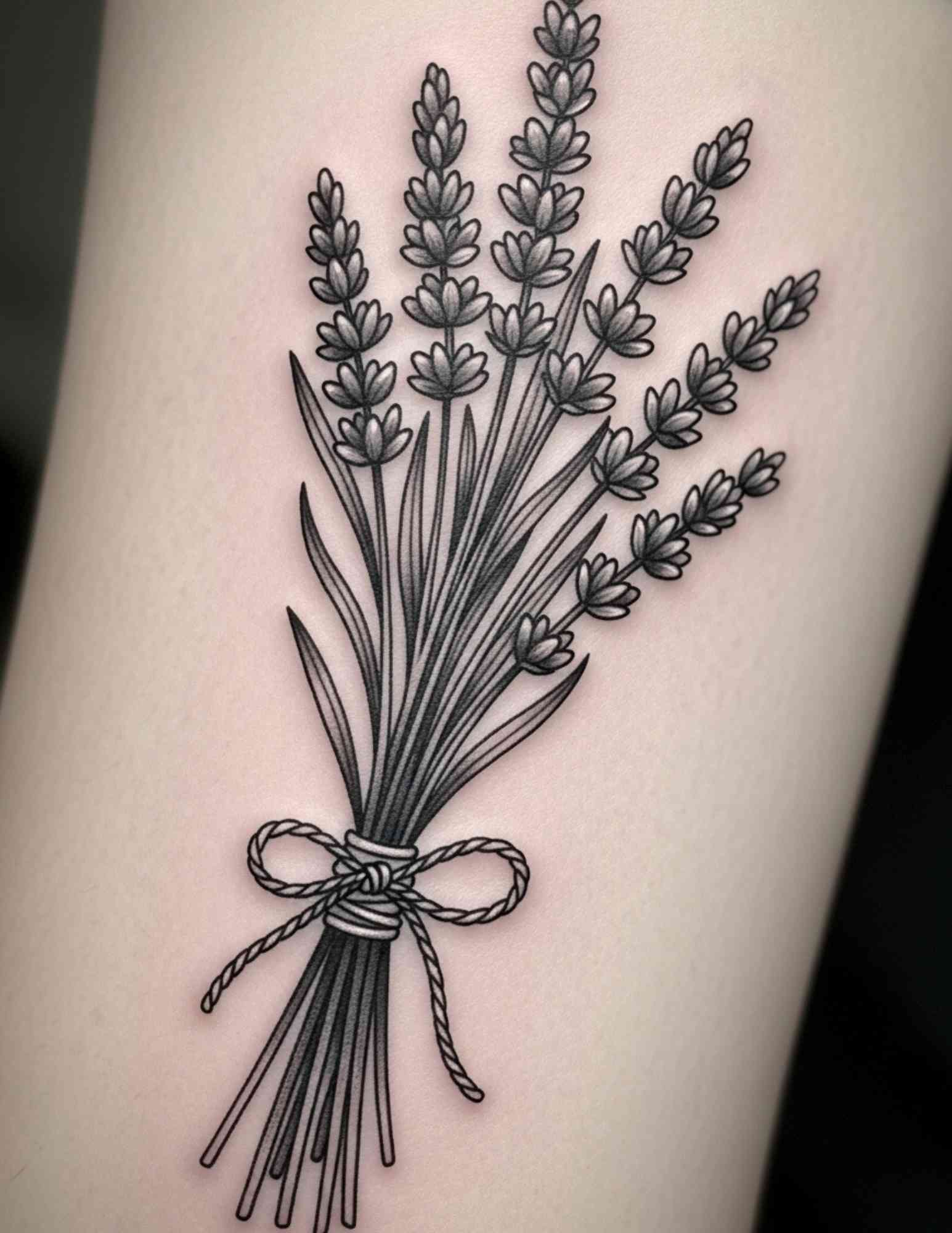
Lavender is one of the few florals that still looks like itself at a small size, which is exactly why it keeps showing up on wrists, ankles and ribs rather than on full sleeves.
I have watched this design go from an occasional request to something artists now have three or four versions of pre-drawn in their flash books.
The appeal is not complicated. It is a soft plant with a strong silhouette, it carries calm, sleep and steadiness as meanings without needing a caption, and it works in black and grey just as well as it does in colour.
Below are 21 directions worth considering, from a single sprig to a full spine piece, with honest notes on what each one actually costs you in healing and upkeep. If you want a wider spread of designs first, our general lavender tattoo ideas guide covers styles for everyone, not just women.
Which Lavender Tattoo Style Is Right for You?
Every artist I have asked describes the same trade-off: the prettier a lavender tattoo looks in the first week, the more maintenance it usually needs by year five.
| Style | Best size | Typical sitting | How it ages | Suits you if |
|---|---|---|---|---|
| Fine line black | 2-4 inches | 45-90 minutes | Lines soften; usually still readable at 10 years if not too tight | You want something quiet you will not tire of |
| Black and grey shaded | 3-6 inches | 2-3 hours | Ages the most gracefully of any option here | You want depth without colour upkeep |
| Soft colour realism | 4-8 inches | 3-5 hours | Purples fade earliest; expect a touch-up around year 5-8 | You want the real plant colour and accept the upkeep |
| Watercolour | 4-7 inches | 2-4 hours | Softest edges blur first; needs an anchoring line to survive | You love the painted look and will book touch-ups |
| Botanical illustration | 4-9 inches | 3-5 hours | Holds well if bud spacing is generous | You want detail and have the room for it |
| Single line minimal | 1-3 inches | 30-60 minutes | Very stable, though tiny gaps can close over decades | This is your first tattoo or you want it discreet |
What Actually Makes a Lavender Tattoo Age Well
The plant most people picture is Lavandula angustifolia, the narrow-leaved species that Kew’s Plants of the World Online records as a Mediterranean native. Its shape is the reason it tattoos well.
A lavender stem is a straight line with a loose cluster of small buds at the top, so the eye reads it instantly even when the detail has softened.
That said, those buds are where designs go wrong. Pack twenty tiny dots into a two-inch stem and, in my experience, they merge into a grey smudge within a few years.
The fix artists keep repeating is bud spacing: fewer buds, drawn slightly larger, with visible gaps of skin between them.
Colour is the second variable. Purple pigments sit at the lighter end of the range and generally fade sooner than black, especially on skin that gets regular sun.
If lavender is your birth month flower or carries a family association, it is worth reading how other people handle that in our birth flower tattoo ideas before you commit to a style.
21 Lavender Tattoo Ideas for Women
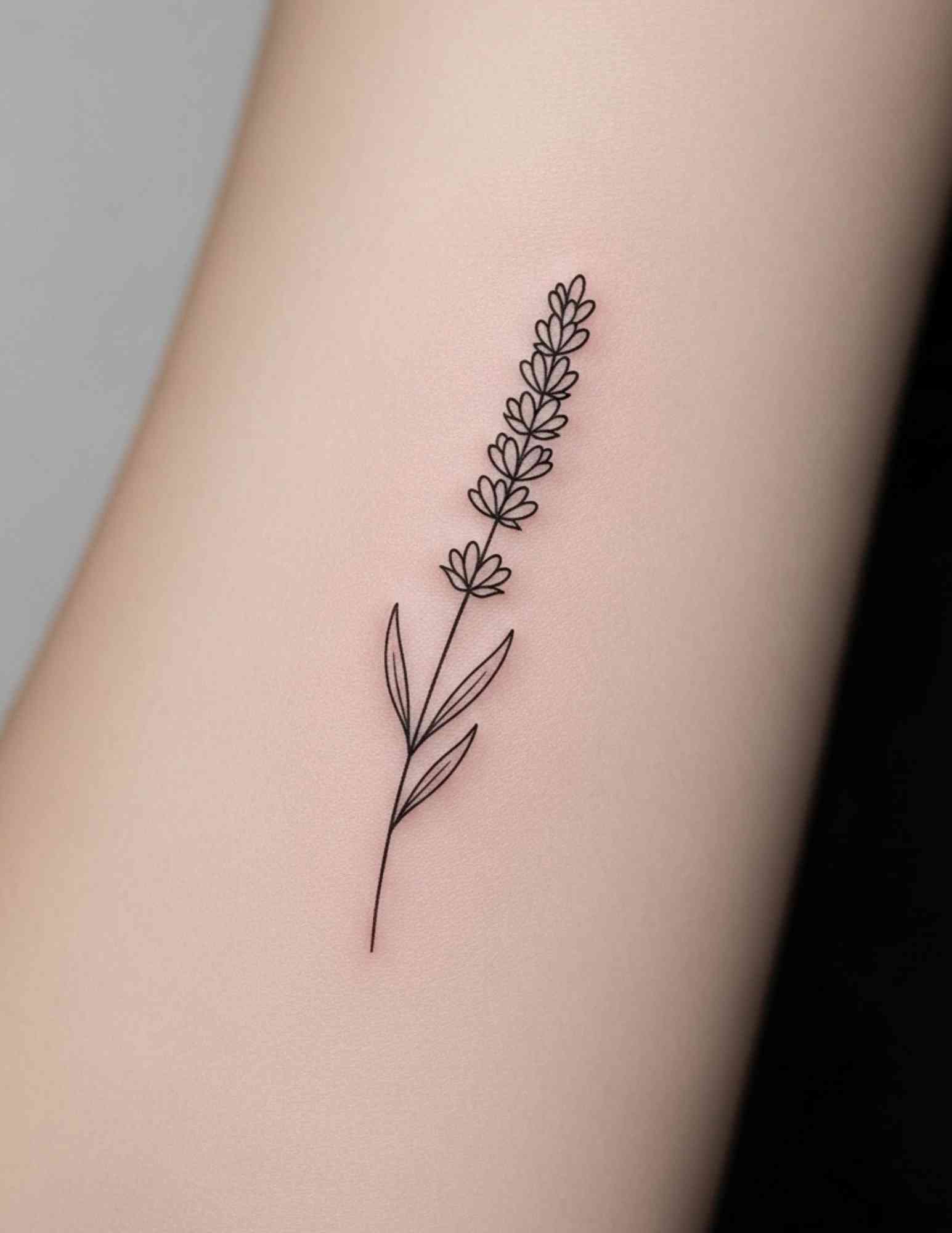
1. Single Lavender Sprig
One stem, nothing else. This is the version I recommend most often to people getting their first floral piece.
It sits happily on the inner forearm, the outer ankle or the back of the upper arm, usually finishing in under an hour.
The whole design lives or dies on bud spacing. Ask for six to nine buds rather than fifteen, and ask the artist to leave real skin between them.
The trade-off is that a single sprig can look unfinished on a large flat area like a thigh. It needs a boundary to sit against, such as the line of a bone or the edge of a limb.
2. Lavender Bundle Tied with Twine
Three to five stems gathered and wrapped, the way you would hang them to dry.
The twine wrap does useful structural work: it gives the piece one dark anchor point so the eye has somewhere to land.
I find this reads better than a single sprig at medium sizes, roughly four to six inches, because the grouped stems form a solid silhouette.
Ask for the wrap to be drawn slightly off-centre. A bundle tied exactly in the middle tends to look stiff.
3. Lavender and Honey Bee
Adding a bee changes what the tattoo is doing. Instead of a plant study you now have a small moment.
Practically, the bee also gives the stem a sense of scale, which stops a small lavender tattoo from reading as an abstract squiggle.
Keep the bee tight and simple. Detailed wing venation at half an inch is exactly the kind of detail that closes up over time.
If the insect is the part you care about most, our bee tattoo designs guide has more on how to draw one that lasts.
4. Lavender Field Landscape
Rows of lavender running to a horizon, usually banded across the upper arm or the ribs.
This one trades bud detail for depth. You are not tattooing a plant any more, you are tattooing perspective.
It needs width more than height, so it suits the outer bicep, the collarbone area or a horizontal band on the forearm.
Expect a longer sitting than the size suggests, because the gradient work between the rows is what sells it.
5. Watercolour Lavender
Soft purple washes bleeding past the linework, imitating paint on wet paper.
It is a genuinely beautiful fresh tattoo. I will also be honest that it is the highest-maintenance option on this list.
The washes are applied lightly, and light pigment in the upper dermis is what fades first. Most artists I have spoken to expect a refresh somewhere in the five to eight year range.
The version that survives longest has a real black or dark grey stem underneath the colour. Without that anchor, a faded watercolour piece has nothing left to read as. Our watercolor tattoo ideas page goes deeper on that trade-off.
6. Lavender Wrist Bracelet
Stems that wrap the wrist rather than sitting flat on one face of it.
The trick is that the design has to work on a curve, so the artist needs to see your arm in a neutral position before finalising the stencil.
Wrist skin is thin and moves constantly, which means this placement is on the sharper end of the pain range for most people.
It also fades faster than most spots, largely because forearms and wrists get more sun than almost anywhere else on the body.
7. Lavender and Moon
A crescent or full moon behind the stems, usually in fine line with light stipple shading.
Lavender and sleep are already linked in most people’s minds, so the moon reinforces the idea rather than adding a competing one.
Keep the moon as an outline or a light fill. A solid black moon behind a delicate stem will swallow it visually.
If the lunar half is the part you want to build around, moon phase tattoo ideas covers the layouts that work.
8. Lavender Bouquet with Ribbon
A larger, looser arrangement than the twine bundle, with a thin ribbon trailing off one side.
The ribbon is doing something specific here: it breaks the vertical repetition of the stems with a curve.
This suits the thigh, the outer forearm or the shoulder blade, where there is room for the design to be six inches or more.
Ask the artist to vary bud size between the stems. Identical stems side by side is the single fastest way to make a bouquet look printed rather than drawn.
9. Botanical Illustration Style
Modelled on old herbal plates: precise stem structure, stipple shading, sometimes a labelled name underneath.
This is the most technically demanding version on the list, and it is worth choosing an artist whose healed portfolio shows fine dotwork rather than just fresh photos.
Healed matters here more than usual. Stipple shading looks crisp on day one and tells you the truth about the artist at year two.
Give it room. Under four inches, the illustration detail simply cannot survive.
10. Lavender and Butterfly
A butterfly resting on or lifting off the stem, which softens the strong vertical of the plant.
The pairing is popular enough that most artists will have drawn it before, so ask to see their own version rather than bringing a reference from social media.
Placement-wise this wants a slightly wider area than a bare sprig: the shoulder blade, the outer thigh or the ribs.
One honest note: butterfly-and-flower is a common combination, so if you want something distinct, ask for an unusual butterfly species rather than a generic silhouette.
11. Lavender Behind the Ear
The smallest placement worth attempting, and the one that demands the most restraint in the design.
Three or four buds on a short stem is the realistic ceiling. Anything more and the buds will merge.
It is a quick tattoo, often twenty to thirty minutes, but the skin over the mastoid bone is thin and most people find it sharp.
Bear in mind that behind-the-ear pieces are partly hidden by hair, which is either the appeal or the problem depending on what you want from it.
12. Lavender Ankle Piece
A sprig curving along the line of the ankle bone rather than sitting straight across it.
Following the bone is what makes this placement work. A horizontal stem across the ankle tends to look pasted on.
Ankles heal slower than most placements in my experience, mostly because socks, shoes and walking all irritate the area.
Plan the timing around footwear. Getting this done a week before a holiday that involves sandals or hiking boots is a mistake people make often.
13. Lavender with Script
A name, a date or a short phrase set alongside the stems.
The most common error is crowding: script and buds placed so close together that they blur into each other as both soften.
Ask for a clear gap, and ask for the script to be a size the artist is comfortable with rather than the smallest thing they can technically do.
Small script is the element most likely to need a touch-up, so keep it short. One word usually beats a full sentence.
14. Minimalist Lavender Outline
One continuous line, no shading, no fill. The most durable option here by a wide margin.
There is nothing to blur, because there is no gradient. What you get at week four is broadly what you have in a decade.
It is also the cheapest and quickest, which makes it a sensible first tattoo if you are still deciding how you feel about being tattooed at all.
The limitation is that it is quiet. If you want something that reads from across a room, this is not it. Our fine line tattoo ideas guide covers what this style can and cannot do.
15. Lavender and Rosemary Together
Two herbs with different textures, which is exactly why they work side by side.
Rosemary’s needle-like leaves contrast against lavender’s soft buds, so the piece has visual variety without needing colour.
Both are Mediterranean kitchen herbs, so the pairing also carries a domestic, garden association that a single stem does not.
Ask the artist to differentiate the two clearly. Drawn too similarly, most viewers will just read it as two lavender stems.
16. Lavender Spine Piece
Stems running vertically down the spine, usually eight to sixteen inches depending on how far you take it.
The spine is the natural home for a tall plant, and lavender’s straight stem suits it better than almost any other flower.
Be realistic about the pain. Direct bone contact along the vertebrae is consistently rated among the harder placements, and most people split it across more than one session.
It is also awkward to care for during healing, since you cannot see it. Our feminine spine tattoo guide goes through the practical side.
17. Lavender with Dragonfly
A less common alternative to the butterfly, and one that suits the thin vertical stem better.
Dragonfly wings are long and narrow, so they echo the stem rather than fighting it the way broad butterfly wings can.
Keep the wing detail loose. Fine crosshatched venation at a small scale is the first thing to close up.
This one tends to look best in black and grey, where the wing translucency can be suggested with light shading rather than colour.
18. Dried Lavender
Stems drawn slightly bent, with a few buds falling loose below them.
It is a quieter, more melancholy version of the same plant, and it suits people who want the piece to mean something about time rather than calm.
The falling buds are useful compositionally too, because they extend the design without adding another stem.
Ask for the bend to be subtle. Overdone, dried lavender starts to look wilted rather than preserved.
19. Lavender and Honeycomb
Hexagonal comb behind or beneath the stems, usually as a partial cluster rather than a full grid.
The geometry gives the soft plant something rigid to sit against, which is a genuinely effective contrast.
Keep the comb cells generous in size. Small hexagons packed tightly will fill in over the years and turn into a grey block.
A partial, broken-edged comb almost always looks better than a neat complete one.
20. Matching Lavender with a Friend or Sister
Two people, two halves of the same design, or the same sprig at different sizes.
The version that holds up best over time is the same design on both people rather than two interlocking halves.
Interlocking pieces depend on the relationship staying intact to make visual sense, which is a lot to ask of a permanent decision.
The same sprig, drawn by the same artist on the same day, carries the connection without that dependency.
21. A Sprig from a Specific Garden
Bring your own photograph rather than a reference from Pinterest.
A stem from your grandmother’s garden or your own back step has a particular shape, and an artist can draw from your photo directly.
This is, in my experience, the version people are happiest with five years later. The design is not fashionable or unfashionable, because it is not a trend.
Send the photo to the artist ahead of the consultation so they have time to draw from it properly.
Variations Worth Considering
If none of the twenty-one land exactly right, these adjustments change the feel of the piece without changing the plant.
Negative Space Lavender
The stem drawn as unshaded skin inside a filled block. It is bold, unusual, and it holds its shape better than fine detail does.
It only works at a reasonable size, though, because the black fill needs room to read as deliberate rather than accidental.
Single-Colour Accent
Black and grey stems with only the buds in soft purple. You get the colour association without committing the whole piece to pigment that fades.
This is the compromise I see most often from people who want colour but have been warned about upkeep.
Lavender as Part of a Larger Piece
Rather than standing alone, the stems fill the gaps in an existing floral arrangement or half sleeve.
If you think you might expand later, tell the artist now. Placing a small sprig without that conversation is how people end up with awkward gaps to work around.
Placement, Sizing and Aftercare Tips
Size honestly. If an artist tells you a design will not hold at the size you want, that is technical advice about how ink spreads in skin, not an upsell.
Think about sun. Purple pigment fades faster than black, and consistent sunscreen once the tattoo is fully healed is the single cheapest thing you can do to keep it looking right.
Choose placement partly on pain tolerance. Ribs, spine, ankle and the inside of the wrist all sit at the sharper end; the outer thigh and outer forearm are gentler. Our tattoo pain chart is a reasonable starting reference, though everyone’s experience differs.
Follow the aftercare your artist gives you rather than advice from the internet, including this page. They know what ink and technique they used.
Take infection risk seriously. The FDA’s tattoo fact sheet notes that contaminated inks and unsterile equipment have both caused infections, and that some reactions appear well after the tattoo has healed.
If you develop spreading redness, heat, swelling that worsens after the first few days, pus, or a fever, contact a doctor rather than waiting it out. That is a medical question, not a tattoo question.
Still Not Sure? Common Mistakes to Avoid
The most frequent one is going too small for the detail requested. A botanical illustration at two inches is not a smaller version of the same tattoo, it is a different and worse one.
The second is picking an artist from fresh photos alone. Ask for healed work, ideally at least a year old, and ideally of fine floral pieces specifically.
The third is bringing an AI-generated reference. They tend to contain detail that no needle can reproduce, and artists lose time explaining why.
A fourth: booking a wrist or ankle piece right before a trip. Both placements rub against clothing constantly and heal slower for it.
If the wrist wrap is the direction pulling at you, it is worth comparing against other women’s bracelet tattoo ideas before booking.
And if you are planning this with someone else, matching tattoo ideas for sisters covers what actually works when two people commit on the same day.
Frequently Asked Questions
What does a lavender tattoo mean?
Lavender is most commonly associated with calm, rest and devotion, drawing on the plant’s long use in sleep remedies and as a symbol of quiet steadiness. In the language of flowers it has also carried associations with purity and silence. That said, meaning is largely personal here. Plenty of people choose it because it grew in a specific garden or reminds them of a particular person, which matters more than any traditional reading.
How much does a small lavender tattoo cost?
Most studios have a minimum charge that covers roughly the first hour, and a small single sprig usually falls inside it. Beyond that, pricing is normally hourly and varies enormously by city, artist reputation and demand. A fine line sprig is typically a one-sitting piece; a spine or bouquet design can run several sessions. Ask for a quote at consultation rather than relying on any published range.
Do lavender tattoos fade quickly?
Black and grey lavender tattoos generally age well. Colour versions, especially soft purple, tend to fade sooner than darker pigments, and how fast depends heavily on sun exposure, placement and your own skin. Areas that get regular sunlight, like forearms and ankles, usually fade first. Sunscreen after full healing and an occasional touch-up are the normal way people manage it.
Where is the best placement for a lavender tattoo?
The plant’s tall narrow shape suits vertical placements: the inner forearm, the spine, the outer calf and the side of the ribs all work naturally. Smaller sprigs sit well behind the ear, on the ankle or on the inner wrist. Wide horizontal areas like the upper back tend to need a bundle or field design rather than a single stem. Your artist should look at the actual area before finalising the stencil.
Does a lavender tattoo hurt more than other flowers?
The flower itself makes no difference to pain; placement and size do. A sprig behind the ear or on the ribs will be sharper than the same design on the outer thigh, because those areas have thin skin over bone. Sessions are also shorter for small fine line work, which most people find easier than a long shaded sitting. If you are anxious about it, starting with a small forearm piece is a reasonable way to find out how you react.
Quick Summary
- Lavender tattoos work because the plant has a strong silhouette that survives at small sizes.
- Bud spacing is the single biggest factor in whether the design still reads in ten years.
- Black and grey ages best; soft purple colour usually needs a touch-up somewhere around year five to eight.
- Watercolour versions need a dark stem underneath them to survive fading.
- Vertical placements suit the plant: inner forearm, spine, calf and ribs.
- Spine, ribs, ankle and inner wrist sit at the sharper end of the pain range for most people.
- Ask any artist for healed floral work, not just fresh photos, before booking.
- Watch for spreading redness, worsening swelling, pus or fever while healing, and see a doctor if they appear.