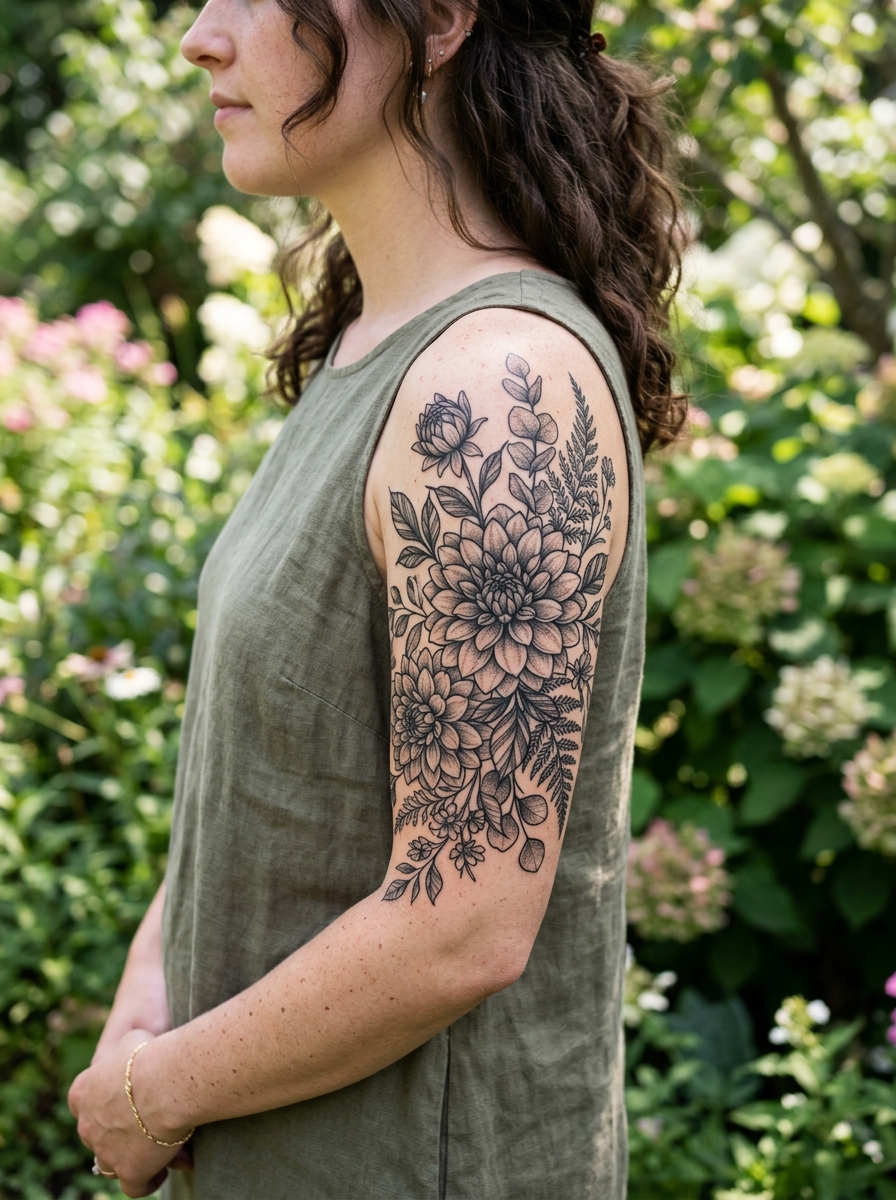
A dahlia is the one garden flower that can carry a tattoo entirely on structure, with no symbolism required. The bloom is built from dozens — sometimes hundreds — of petals arranged in mathematically tidy rows, and that geometry is what makes it tattoo well.
I have watched artists light up when a dahlia reference lands in their inbox, and groan five minutes later when they realise how much petal mapping is involved. Both reactions are correct.
It is a harder flower than a rose and a very different job from a peony, which forgives a loose petal edge because the bloom is meant to look blowsy. A dahlia does not forgive that. Every petal is a defined shape.
These 19 ideas cover the flower across realism, fine line, gothic black and grey, Mexican folk styling and full sleeve work — grouped by the decision you actually have to make, which is which dahlia you are getting.
Which Dahlia Form Is Right for You?
Dahlias are classified by flower form, and the form you pick changes the size, the cost and the way the piece ages more than the style does.
| Dahlia form | What it looks like | Smallest size that works | Best suited to |
|---|---|---|---|
| Dinner plate (decorative) | Huge, flat, many overlapping petal rows | Roughly palm-sized and up | Colour realism, upper arm, thigh, back |
| Ball | Perfect sphere of tubed petals | Medium — around 8 cm | Botanical illustration, black and grey |
| Pompon | Smaller, tighter version of the ball | Small — 5 cm is workable | Ornamental, geometric, clustered designs |
| Cactus / semi-cactus | Pointed, rolled, spiky petals | Small to medium | Fine line, dynamic compositions |
| Anemone | Open cushioned centre, flat outer petals | Small to medium | Illustrative styles, forearm placement |
| Single / collarette | One or two petal rows, open centre | Very small — under 5 cm | Minimal fine line, wrist, ankle |
If you want to see how wide the range actually runs, the American Dahlia Society organises garden dahlias into formal classes by exactly these flower forms, and the RHS dahlia hub is a decent visual reference for named varieties.
Why Petal Count Decides Everything About a Dahlia Tattoo
Most flower tattoos fail slowly. A dahlia can fail fast, and the reason is almost always that it was made too small for its petal count.
A decorative dahlia can carry well over a hundred petals. Each one needs its own outline and its own shadow, or the bloom collapses into a grey disc from two metres away.
Tattoo ink spreads slightly under the skin over the years. That spread is usually harmless on a bold design and merciless on a design whose whole readability depends on thin gaps between petal rows.
This is the same problem chrysanthemum tattoos run into, and artists solve it the same way: they reduce the petal count on purpose. A tattooed dahlia with forty well-drawn petals reads more like a dahlia than one with a hundred crowded ones.
In my experience the single best question to ask a consult is not “can you do this?” but “how many petals will you actually draw at this size?” A good artist will answer immediately.
19 Dahlia Tattoo Ideas, Grouped by What You Actually Want
I have sorted these by design problem rather than by style label, because the form of the bloom constrains the style far more than the other way round.
1–3. Botanically Accurate Blooms: Ball, Cactus and Anemone
These three are the ideas for anyone who wants the tattoo to be identifiable as a specific kind of dahlia, not just “a flower”.
The ball dahlia is the most satisfying of the three to tattoo. Every petal rolls into a tube, the tubes spiral around a sphere, and the shading job is basically drawing a ball out of small curved shapes.
The cactus dahlia gives you pointed, quilled petals that fan outward. It is the most dynamic form and the one that survives shrinking best, because the petal tips are spiky enough to stay distinct.
The anemone dahlia is the quiet favourite among artists I have asked — an open cushion centre ringed by flat guard petals, which gives you a focal point instead of a uniform mass.
4–6. Fine Line, Pompon and Small-Scale Dahlias
Small dahlias are possible. They just require dropping the petal count honestly instead of pretending you can miniaturise a dinner plate.
Fine line botanical treatment outlines the petal structure with no fill at all. It is elegant, and it is also the version most likely to soften over a decade — worth reading up on how fine line tattoos generally age before committing.
A pompon dahlia works small for a structural reason: its petals are short, uniform and arranged in tidy rows, so a 5 cm version still looks like the real flower.
A small watercolour dahlia takes the opposite approach — abandon structure, keep the colour. Watercolour work usually needs a line or shadow underneath it if you want it to still read in fifteen years, and most artists will tell you that unprompted.
7–9. Dark, Gothic and Near-Black Dahlias
Dahlias bloom in genuinely near-black burgundies. That is a real horticultural fact, and it means you can get a gothic dahlia in full colour.
The burgundy dahlia uses those deep varieties directly. It reads darker than black and grey while still being a colour piece, which is a rare combination.
A black and grey gothic dahlia goes further — high contrast, deep blacks, the bloom lit as if by candlelight. This is where the flower’s natural drama pays off.
The dahlia with a skull is the third, and it is not a generic memento mori. The dahlia is the national flower of Mexico, so this pairing sits inside a specific tradition; the flower and skull combination carries different weight here than it does with a rose.
And yes, the name “black dahlia” also carries a 1947 true-crime association in the United States. Worth knowing before you use the phrase as your caption, not a reason to avoid the flower.
10–12. Bold Colour: Neo-Traditional, Mexican Folk and Geometric
If you want a dahlia that reads from across a room, these are the three routes.
Neo-traditional stylisation is the most reliable long-term choice in the whole list. Bold outlines, simplified petal shapes, dimensional colour — it ages the way traditional work ages, which is to say well.
The Mexican folk art dahlia leans into the flower’s origin with vivid colour and decorative patterning, often alongside Day of the Dead imagery. If you have no connection to that tradition, talk to your artist about it honestly rather than treating it as a style filter.
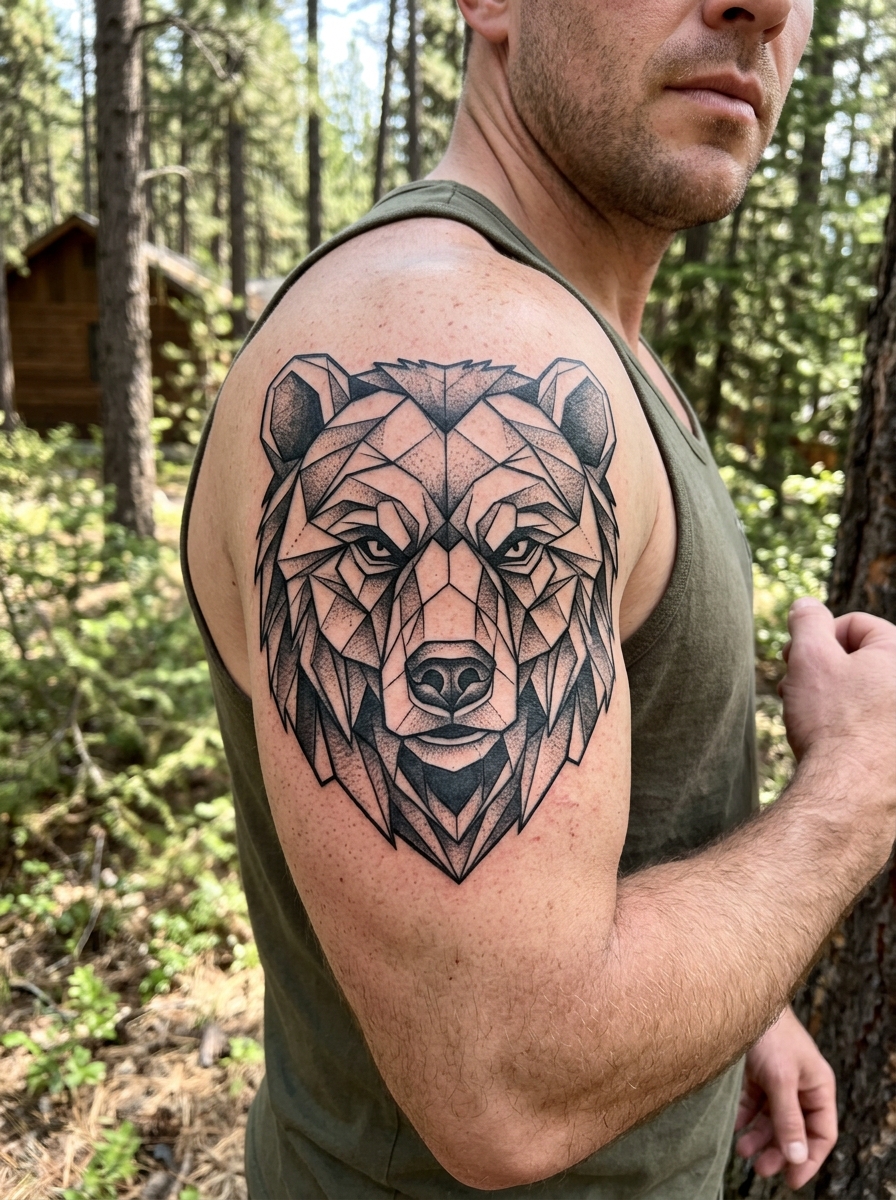
Geometric dahlias translate the bloom’s radial symmetry into angular facets. It suits the flower better than it suits most flowers, precisely because the underlying arrangement really is geometric.
13–15. Dahlias Paired with a Second Element
A dahlia is a strong enough shape to dominate a composition, so anything you add to it needs a job.
A butterfly gives the eye somewhere to go after the bloom and introduces movement into what is otherwise a static, symmetrical shape.
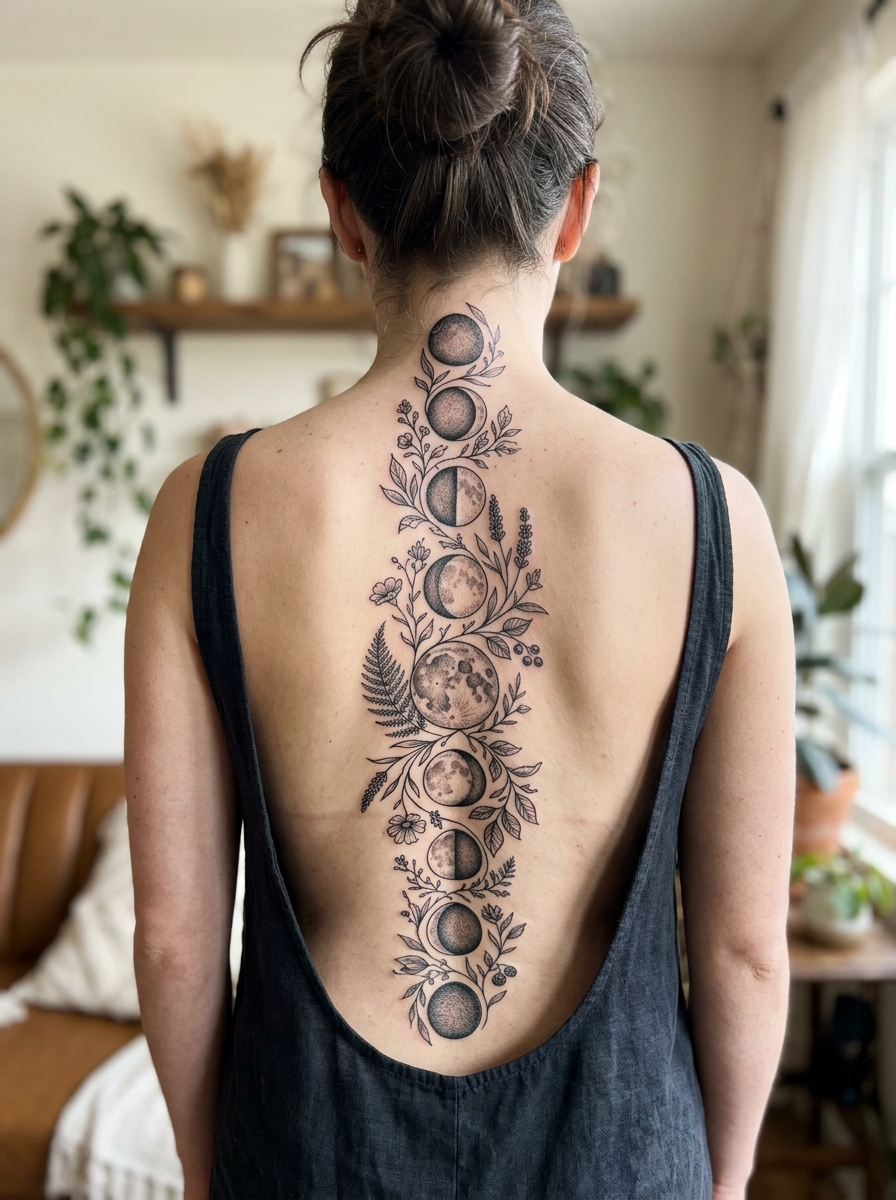
A crescent moon puts the flower in a night context — and since dahlias flower through autumn until the first frost, there is a real seasonal logic to it. Moon phase designs pair with botanical work particularly cleanly.
A dahlia bouquet is the third option: multiple blooms of different forms in one loose arrangement. This is the design that most often grows into a bigger piece later, so plan the edges.
16–17. Large-Scale Work: Sleeves and Single-Stem Forearms
Dahlias are unusually good sleeve flowers because each bloom is big enough to carry a whole section on its own. A floral half sleeve built on dahlias needs far less filler than one built on smaller flowers.
The single stem forearm dahlia is the opposite idea and, honestly, the one I recommend most often. One stem, a few leaves, one open bloom, running wrist to elbow.
It works because dahlia stems are genuinely substantial — thick and slightly woody — so the stem carries visual weight instead of looking like a thin line holding up a heavy flower.
18–19. Dinner Plate Realism and the Surrealist Dahlia Portrait
The dinner plate dahlia in colour realism is the flagship version. Some named cultivars produce blooms around 25 to 30 cm across, and a realism piece has to earn that scale on the body too.
Budget for multiple sessions. Every artist I have asked about large colour realism florals describes the same thing: the outline session is quick and the petal rendering is what takes the hours.
The surrealist dahlia portrait is the outlier — a face with dahlia blooms integrated into or replacing the hair. It needs an artist who does both portraiture and botanical work well, which is a smaller list than you would hope.
Variations Worth Considering Before You Book
A few adjustments come up in almost every dahlia consult I have sat in on.
Swap the Form, Keep the Style
If you love a realism reference but the placement is small, changing from a decorative dahlia to a pompon or cactus form usually solves it without changing the style at all.
Go Black and Grey Instead of Colour
Colour realism on a dahlia is expensive because of the petal count. The same design in black and grey is typically faster and holds its structure longer.
Add a Second Bloom Rather Than Enlarging One
Two medium dahlias often fill an awkward space better than one oversized bloom, and they give the artist somewhere to hide the composition’s edges.
Pick a Named Cultivar
Bringing in a specific variety — a particular ball or cactus type you actually like — gives the artist a real colour reference instead of a generic pink flower.
Practical Tips for Getting a Dahlia Tattooed
Placement matters more than usual here because the design needs a flat, wide area. Upper arm, outer thigh, back and forearm all work; ribs and feet fight you on both healing and readability, and they sit high on most painful tattoo spots lists.
Bring three to five reference photos of the same dahlia form rather than ten photos of ten different flowers. Artists consistently tell me the second approach produces a worse drawing.
Expect a large colour realism dahlia to run across two or more sessions, and ask for that timeline up front rather than discovering it at hour four.
For healing, follow the aftercare your artist gives you rather than anything you read online, including this. If you see spreading redness, increasing pain after the first few days, swelling, discharge or a fever, that is a doctor’s call, not a forum’s — infections and ink allergies are both real, and both are treatable when they are caught early.
Common Mistakes — and What to Do If You Are Still Not Sure
The mistake I see most often is picking a reference photo of a real dahlia and asking for it at half the size the petal structure needs.
The second is treating “dahlia” as one flower. It is a genus with a few dozen wild species and thousands of named garden cultivars, and the forms look nothing alike.
The third is defaulting to colour without pricing the alternative. If you have not compared, look at what black and grey floral work can do with the same design first.
And if the dahlia itself is the uncertain part rather than the execution, it is worth browsing birth flower tattoo ideas to see whether a different bloom carries the meaning you actually want.
Frequently Asked Questions
What does a dahlia tattoo mean?
There is no single fixed meaning, and anyone who tells you otherwise is selling something. The dahlia is most strongly associated with Mexico, where it is the national flower and was cultivated long before European gardeners got hold of it. In general floral language it tends to be read as dignity, commitment and standing out — but the flower’s cultural association with Mexico is the meaning with actual historical grounding. Most people I have spoken to choose it for how it looks first and find the meaning afterwards.
How small can a dahlia tattoo be?
It depends entirely on which dahlia form you choose. A single or collarette dahlia with one or two petal rows works under 5 cm without trouble, and a pompon form is usually fine around 5 cm. A decorative or dinner plate dahlia realistically needs to be palm-sized or larger, because its identity comes from having many visible petal rows. Shrinking a dinner plate dahlia is the most common way these tattoos go wrong.
Do dahlia tattoos age well?
Usually yes, provided the petal count was reduced for the size. Bold styles like neo-traditional age best, black and grey holds structure well, and very fine line or watercolour versions tend to soften the most over ten to fifteen years. The failure mode is specific: as ink spreads slightly, the thin gaps between petal rows close up and the bloom flattens. An artist who deliberately leaves wider negative space between rows is protecting against exactly that.
Is a dahlia harder to tattoo than a rose?
Generally yes, in the sense that it is less forgiving. A rose is built from a few large, curved petal masses that an artist can improvise within, while a dahlia is built from many small repeated shapes that all have to sit in the right place. That makes it more drawing work at the design stage and more sitting time in the chair. It is not a difficult flower for a competent botanical artist, but it is a bad choice for someone learning on you.
What colours work best for a dahlia tattoo?
Dahlias come in nearly every colour except true blue, so you have unusual freedom here. Deep burgundy and near-black varieties are popular because they give gothic weight in colour, and coral, peach and dusty pink hold up well in realism. Yellows and very pale pastels are the ones to think twice about, since light pigments generally fade faster and can look washed out sooner. Ask your artist which pigments they have seen last on your skin tone specifically.
Quick Summary
- Pick the dahlia form before the style — ball, pompon, cactus, anemone, decorative or single. It decides your minimum size.
- Dinner plate and decorative dahlias need palm-sized space or bigger; pompon, cactus and single forms work small.
- Ask your artist how many petals they will actually draw at your chosen size. Fewer, cleaner petals read better than many crowded ones.
- Neo-traditional and black and grey age the most reliably; fine line and watercolour soften fastest.
- Near-black burgundy varieties give you a gothic dahlia without leaving colour.
- The dahlia is Mexico’s national flower, so folk-art and Day of the Dead treatments sit in a real cultural tradition — approach them accordingly.
- Upper arm, outer thigh, back and forearm are the placements that suit the shape best.
- Follow your artist’s aftercare, and see a doctor for spreading redness, worsening pain, discharge or fever rather than asking the internet.