Most floral tattoos borrow their meaning from the person wearing them. Hawaiian flowers do not work that way. A hibiscus, a plumeria or an ohia lehua arrives on your skin with a history already attached, and the best Hawaiian flower tattoos are the ones that respect what the plant already means.
I have spent a lot of time looking at tropical botanical work, and the split is obvious within about three seconds. Some pieces are a generic pink flower with a beach behind it. Others are recognisably a specific plant, drawn by someone who knew which plant it was.
This guide covers the flowers themselves, the styles that suit each one, and the placements that hold up over ten or twenty years. If you are leaning toward the bold black patterning route rather than colour realism, the Polynesian tattoo ideas guide is worth reading alongside this one.
Eighteen ideas below, grouped so you can find your flower first and your style second.
Which Hawaiian Flower Is Right for You?
The flower you choose sets the ceiling on what the tattoo can do. Some of these read beautifully at two inches; others need an arm.
| Flower | What it carries | Best style | Works smallest at |
|---|---|---|---|
| Hibiscus | Hawaii’s state flower; the islands in shorthand | Colour realism or bold traditional | About 2 in / 5 cm |
| Plumeria | Lei, welcome, the spirit of aloha | Fine line or soft colour | About 1 in / 2.5 cm |
| Ohia lehua | Pele, the volcano, a well-known love legend | Colour realism, red on dark leaves | About 3 in / 7.5 cm |
| Bird of paradise | Tropical drama, architectural form | Full colour, larger scale | About 4 in / 10 cm |
| Anthurium | Gloss, heart shape, modern tropical | Colour realism with strong highlights | About 3 in / 7.5 cm |
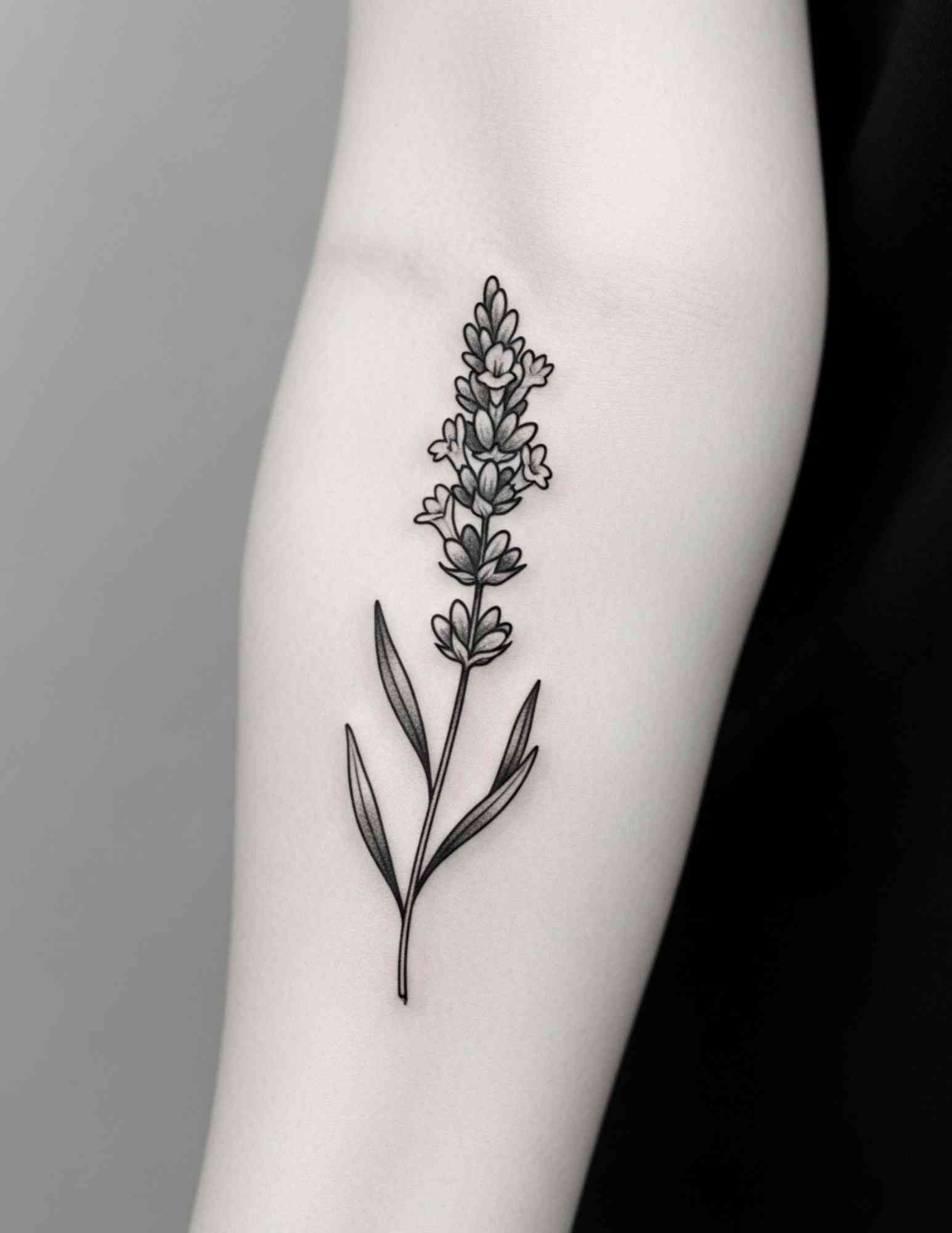
| White ginger | Fragrance, restraint, a less obvious pick | Fine line botanical | About 2 in / 5 cm |
Those minimum sizes are what I have seen hold up rather than hard rules. Any artist who tattoos botanical work regularly will give you their own numbers, and you should take theirs over mine for your specific skin and placement.
Why Hawaiian Flowers Carry More Weight Than Other Botanicals
A rose is a rose almost anywhere. Hawaiian flowers are tied to a living culture, and several of them sit inside stories that people in Hawaii still tell.
The ohia lehua is the clearest example. The legend connects the tree and its blossom to the goddess Pele and to two lovers, and picking a lehua blossom is widely said to bring rain. That is not decoration; it is the point of the flower.
The plumeria carries a different weight. It is the lei flower, and a lei is given as welcome, farewell, congratulation and grief. Wearing one permanently is closer to wearing a gesture than wearing a plant.
There is also an ecological layer worth knowing. Native ohia forests have been hit hard by a fungal disease the University of Hawaii tracks as Rapid Ohia Death, and several Hawaiian plants are managed against invasive pressure by the Hawaii Invasive Species Council. Knowing that changes how a lot of people feel about the tattoo.
None of this means a non-Hawaiian person cannot wear these flowers. It means doing five minutes of reading before you commit, which is what separates a tribute from a souvenir.
The Core Hawaiian Flowers Worth Tattooing
These six are the botanical backbone. Get the flower right and the style almost picks itself.
1. Hibiscus (Pua Aloalo)
The yellow hibiscus, Hibiscus brackenridgei, is Hawaii’s state flower, and it is the shape most people picture when they hear “Hawaiian flower tattoo”.
Five broad petals, a long protruding stamen, and a colour gradient that runs pale yellow at the petal edge into orange at the throat. That gradient is the whole tattoo.
In my experience, hibiscus pieces fail when the artist flattens the petals into a single yellow. The flower has ruffled, almost crepe-paper edges, and an artist who builds those folds gives you something that still looks like a flower from across a room.
Red and pink cultivars tattoo just as well and hold their saturation slightly better than pale yellow, which is worth weighing if you have a lot of sun exposure.
2. Plumeria, or Frangipani
The plumeria is the lei flower: five overlapping petals in a pinwheel, white or pink, with a yellow throat.
It is also the most forgiving Hawaiian flower to tattoo. The shape is simple enough to survive at an inch across, which is why you see it on wrists, behind ears and along collarbones so often.
Every artist I have asked about small floral work names plumeria as the one they would put on a first-timer. Clean outline, one soft colour pass, done in under an hour for a small single bloom.
3. Bird of Paradise
Orange sepals and a blue tongue emerging from a green spathe, angled like a bird’s head. There is nothing else shaped like it.
This one is an architecture problem, not a petal problem. The strength of the design comes from the sharp diagonal of the spathe, so it wants a placement with length: outer thigh, ribs, upper arm.
When I have seen it done small, it stops reading as a bird of paradise and starts reading as an orange smudge. Give it four inches or give it to a different flower.
4. Ohia Lehua
The lehua blossom is not a petal flower at all. It is a radial burst of red stamens on a woody native tree, and it looks closer to a firework than a bloom.
That texture is what makes it a good tattoo and a hard one. The stamens need individual needle work with gaps of open skin between them, and the moment they merge you have a red ball.
It also carries the most cultural weight of anything in this list, which is worth raising with your artist directly rather than treating as a design note.
5. Anthurium
The anthurium’s heart-shaped red spathe has a lacquered, almost plastic surface, with a pale spadix standing straight out of it.
Gloss in tattooing is faked with highlights, so this design lives or dies on where the artist leaves skin unpigmented. Ask to see healed examples, not fresh ones, because those highlights are exactly what softens over the first year.
On the forearm it reads cleanly at about three inches, and the heart shape gives it an easy double meaning if you want one.
6. Heliconia
Stacked red and yellow bracts in the shape that earns it the lobster claw nickname. It is the most graphic of the tropical flowers.
Because the bracts alternate down a stem, heliconia naturally fills a long narrow space, which makes it one of the few tropical flowers that suits a forearm strip or a calf.
I like it as a supporting element too. A single heliconia stem behind a hibiscus gives a composition depth without adding another focal point.
7. White Ginger (Awapuhi Keokeo)
White ginger is the one nobody expects. Star-shaped white blooms, famous in Hawaii for scent rather than colour.
Since the flower is white, colour realism has almost nothing to work with. Fine line botanical illustration is the honest answer here, and it is beautiful in that register.
This is my usual suggestion for someone who wants a Hawaiian flower without the tourist association. Most people will not recognise it, and the ones who do will say something.
Style and Composition Variations
Same flowers, different treatment. This is where most of the personality lives.
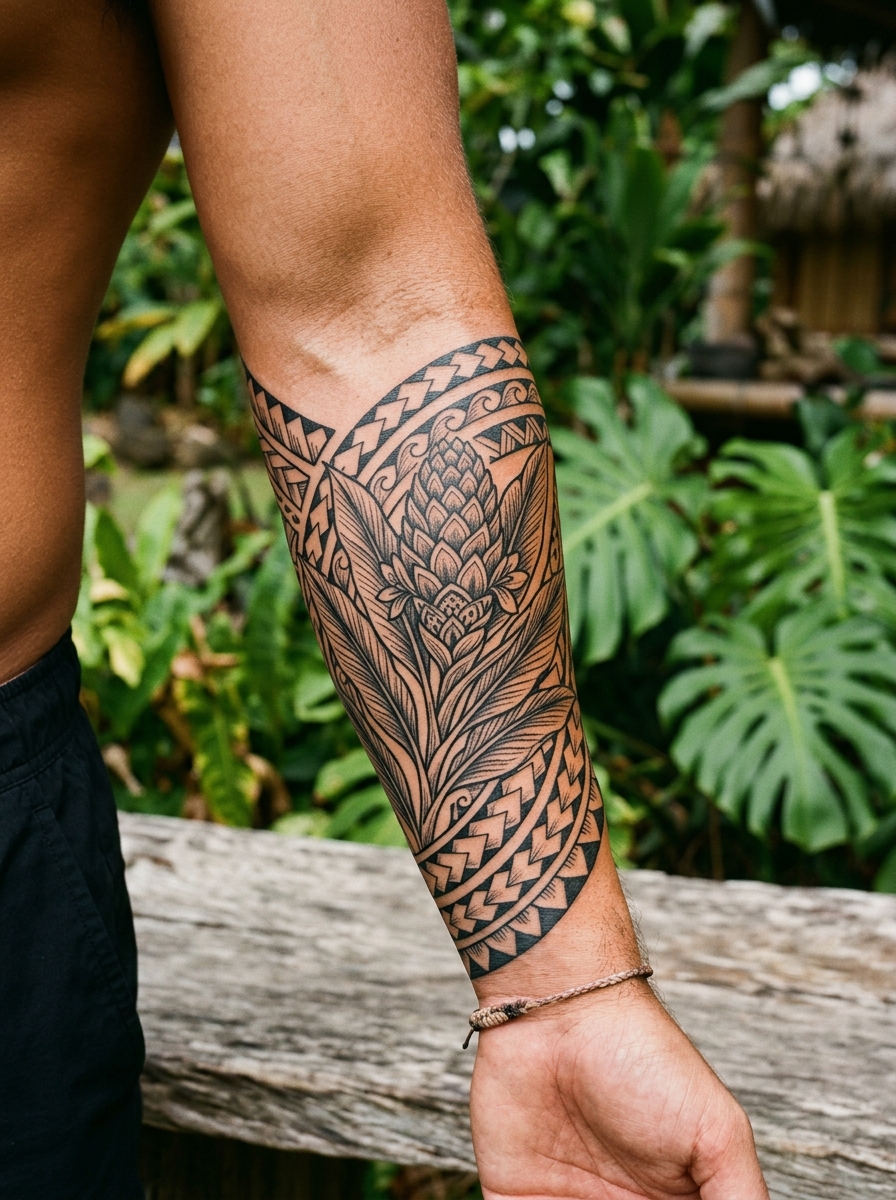
8. Tribal Hibiscus in Polynesian Patterning
The hibiscus outline filled and surrounded with solid black Polynesian patterning. No colour, no shading, just weight and negative space.
It ages better than almost anything else in this article. Solid black with clear gaps holds its shape for decades where soft colour gradients do not.
Worth saying plainly: authentic Polynesian motifs carry family and genealogical meaning, so look at the traditional tribal conventions first and talk to an artist trained in them.
9. Plumeria Behind the Ear
The placement references the real custom of tucking a flower behind the ear, and the side is traditionally said to signal whether the wearer is taken or available.
Small, quick, and painful in a sharp bony way for about fifteen minutes. Most people I have talked to rate it worse than the forearm and better than the ribs.
Keep it simple. Fine detail behind the ear blurs faster than almost anywhere else because the skin is thin and moves constantly.
10. The Full Tropical Sleeve
Hibiscus, plumeria, bird of paradise and broad foliage running wrist to shoulder, usually in saturated colour.
This is a multi-session project, typically several full days spread over months. Plan the whole sleeve on paper before the first needle touches you, because a sleeve built one flower at a time almost always ends up crowded.
If you want the look without the commitment, the floral half sleeve approach gives you the same density in half the canvas.
11. Lotus with Hawaiian Blooms
A lotus placed among hibiscus or plumeria. Botanically it is a mismatch, since the lotus is not a Hawaiian native, and symbolically that is the whole intention.
People choose it when the tattoo is about growth or transformation and the tropical flowers are the setting rather than the subject.
The lotus flower tattoo designs worth copying keep one flower clearly dominant so the eye has somewhere to land.
12. Flower Ankle Bracelet
Small blossoms linked by a thin stem, circling the ankle like jewellery. A wearable lei.
Ankles are bony and the line has to stay even as it curves around, which is harder than it looks. Ask for a stencil you can walk around in before committing.
More variations in the flower ankle tattoo collection, including single-flower placements if a full band feels like too much.
13. The Lei Design
A full garland of alternating flowers wrapping the forearm, upper arm or collarbone.
The lei is the single most loaded object in Hawaiian flower culture, given for arrival, departure, graduation and mourning alike.
Technically it is a wrap problem: the artist has to design it so the flowers still make sense from the angle you actually see your own arm.
14. Flowers with a Honu
Hawaiian blooms arranged around a green sea turtle. The honu is a navigator and a good luck figure in Hawaiian tradition.
Composition-wise it works because the shell gives you a patterned anchor and the flowers soften its hard edge, which is exactly what a geometric shape needs.
If the turtle is the real reason for the tattoo, read the sea turtle tattoo meaning before finalising the design.
15. Plumeria and Waves
Flowers set against breaking water, putting the island plant back into its geography.
The contrast does the work here: soft organic petals against the hard repeating curve of a wave. Black-and-grey water under colour flowers is the combination I have seen heal best.
More water-side compositions in the ocean tattoo ideas guide.
16. Watercolour Treatment
Loose washes of tropical colour bleeding past the flower outline, imitating paint on wet paper.
It photographs beautifully and it is the least durable option in this article. Without a line structure underneath, the washes spread and fade noticeably faster.
If you want it anyway, and plenty of people reasonably do, read the trade-offs in the watercolour tattoo guide first and ask your artist to keep a light line skeleton under the colour.
17. Black and Grey Hawaiian Flowers
The same blooms with all the colour removed, carried entirely by shading and petal structure.
This is the version I would pick for longevity. No pigment to shift, no yellow to go muddy, and it suits skin tones where bright tropical colour can sit oddly.
It also forces good drawing. A black-and-grey hibiscus has nowhere to hide if the petal folds are wrong.
18. Single Small Blossom
One plumeria on the wrist, inner arm or shoulder blade. No composition, no scene.
Roughly half the people I have seen get large tropical work started with one of these years earlier. It is the cheapest way to find out whether you actually like having a flower on you.
Keeping Tropical Colour Alive
Saturated tropical colour is the most sun-sensitive thing you can put in skin, and Hawaiian flower tattoos tend to land on arms, ankles and shoulders that see a lot of daylight.
Follow whatever aftercare instructions your artist gives you, since they know their ink and their technique. The general shape is: keep it clean, keep it lightly moisturised, and do not pick at it while it flakes.
Once it is fully healed, high-SPF sunscreen on the tattoo every time it is exposed is the single biggest factor in how the colour looks at year ten. Yellows and pale pinks go first, and they go faster than anyone expects.
If a healing tattoo becomes hot, swollen, increasingly painful after the first few days, weeps pus, or you develop a rash or fever, that is a doctor’s call rather than a forum’s. Reactions to red and yellow pigments in particular can show up weeks or even months later, so get anything persistent looked at by a medical professional rather than waiting it out.
Common Mistakes, and What to Do If You Are Still Not Sure
The mistake I see most often is choosing the flower from a Pinterest board rather than from a photograph of the actual plant. Reference a real bloom and the tattoo gains ten years of credibility.
The second is scale. A bird of paradise, a heliconia or a lehua cluster crammed into a two-inch space loses the exact feature that identifies it.
The third is treating Polynesian patterning as decoration. If you want the black-work language, go to someone who works within it properly rather than someone who will trace it off an image.
Still undecided? Look at the wider beach tattoo ideas if you want the setting rather than the plant, or the fine line tattoo ideas if what you actually want is something small and quiet that happens to be tropical.
For plant identification before you sit down, the National Park Service Hawaii Volcanoes plant pages are a solid free reference for what these species actually look like in the wild.
Frequently Asked Questions
What is the most popular Hawaiian flower tattoo?
The hibiscus is the most requested by a clear margin, followed by the plumeria. The hibiscus wins on recognition, since it is Hawaii’s state flower and the shape most people associate with the islands. The plumeria wins on versatility, because it works at sizes the hibiscus cannot. If you want something less common, white ginger and heliconia are both beautiful and rarely chosen.
Is it disrespectful to get a Hawaiian flower tattoo if I am not Hawaiian?
Flowers themselves are generally not restricted, and plenty of people with a real connection to the islands wear them without issue. The sensitivity lies more in Polynesian tribal patterning, which can carry family and genealogical meaning, and in sacred motifs used casually. In my experience the respectful path is simple: learn what the flower means, choose an artist who knows the tradition, and do not treat the imagery as a holiday souvenir. If you are unsure, ask a Hawaiian artist directly.
How much does a Hawaiian flower tattoo cost?
Prices vary widely by artist, city and size, so any single figure would be misleading. What I can tell you is the shape of it: a small single plumeria is typically a shop-minimum job, a detailed colour hibiscus on the forearm is usually a half-day session, and a full tropical sleeve is a multi-session project priced by the day. Ask for a quote on the specific design rather than the flower type. Colour work generally costs more than black and grey because it takes longer.
Do Hawaiian flower tattoos fade quickly?
Colour tropical work fades faster than black and grey, and the pale yellows and soft pinks common in these flowers are the most vulnerable. Sun exposure is the main driver, and these tattoos often sit on arms and ankles that get plenty of it. Daily sunscreen on a healed tattoo makes a large difference, and most colour pieces benefit from a touch-up at some point. Black-and-grey versions of the same flowers hold up considerably longer.
Which placement works best for a Hawaiian flower tattoo?
It depends on the flower more than on your preference. Long architectural flowers like bird of paradise and heliconia need a long placement such as the outer thigh, ribs or calf. Round flowers like hibiscus and anthurium sit well on the forearm, shoulder or upper back. Small plumeria works almost anywhere, including behind the ear and around the ankle. Bring your artist a photo of the flower and let them tell you where the shape will read best.
Quick Summary
- Pick the flower first. Hibiscus for recognition, plumeria for small work, ohia lehua for cultural depth, white ginger for something unexpected.
- Match scale to shape. Bird of paradise, heliconia and lehua need four inches or more; plumeria holds at one.
- Reference a real photograph of the plant, not another tattoo.
- Black and grey outlasts colour, and solid Polynesian black-work outlasts everything.
- Treat tribal patterning as a tradition with rules, and go to an artist trained in it.
- Plan a full sleeve as one composition before the first session, not flower by flower.
- Sunscreen on the healed tattoo is the main thing standing between your colour and a faded version of it.
- Anything hot, swollen, weeping or worsening after the first few days is a doctor’s question, not a forum’s.