Tribal tattooing is the oldest continuous tattoo tradition on earth, and it is still the hardest style to get right. A tribal tattoo lives or dies on the negative space around it, not on the black you put down.
I have sat with artists who spend two hours drawing a shoulder panel freehand on skin before a single needle comes out, because tribal has to follow the body rather than sit on top of it.
Below are 100+ tribal tattoo designs pulled from real work, grouped by tradition and by placement. I have also been honest about which of these traditions are closed practices you should not simply copy, and which are open to anyone who wants bold black linework.
If you already know you want island-influenced flow rather than geometric blackwork, our guide to Hawaiian tattoo ideas is a good companion to this page.
Which Tribal Style Is Right for You?
The word “tribal” covers wildly different traditions with different rules. This is the comparison I sketch out for anyone who arrives at a consultation saying they just want “something tribal.”
| Style | Visual signature | Typical session load | Cultural note |
|---|---|---|---|
| Polynesian (general) | Dense black panels, repeated small motifs, strong body flow | 3–6 sessions for a half sleeve | Motifs carry meaning; work with an artist who knows them |
| Maori Ta Moko | Spiral koru forms, curved bands, carved-looking negative space | Varies widely; often ongoing | Closed practice tied to whakapapa — non-Maori are offered kirituhi instead |
| Samoan Pe’a / Malu | Full thigh-to-waist coverage, fine repeated geometry | Traditionally days of hand-tapping | A ceremonial rite, not a design you order off a page |
| Modern blackwork tribal | Abstract points, sweeps and hooks, no cultural motifs | 1–3 sessions for a shoulder panel | Open to anyone; the safest choice if you have no lineage |
| Neo-tribal / geometric | Mirrored shapes, dotwork shading, sacred-geometry structure | 2–4 sessions | Contemporary; borrows form rather than symbolism |
| Celtic and Norse | Interlaced knotwork, endless bands, zoomorphic heads | 2–5 sessions | Historic European sources; widely worn today |
Why Tribal Tattoos Still Read as Powerful
Solid black is the only tattoo ink that looks essentially the same at arm’s length and across a room. That is why tribal has outlasted every trend that came after it.
Tribal is a silhouette style. Colour work and fine line rely on detail the eye has to walk up to; tribal works on shape alone.
It also ages unusually well. In my experience, a heavy black panel that was placed with good spacing still reads clean at fifteen years, while fine line from the same era has often blurred into grey.
The catch is that black is unforgiving. A tribal design that sits slightly wrong on the deltoid cannot be softened later — there is no lighter value to hide behind.
Every artist I have asked about tribal says the same thing in different words: the drawing takes longer than the tattoo. That ratio is the whole style in a sentence.
Tribal Tattoo Ideas by Tradition
These are the source traditions people mean when they say tribal. I have kept the cultural notes short but I have not skipped them.
1. Polynesian Tribal Tattoos
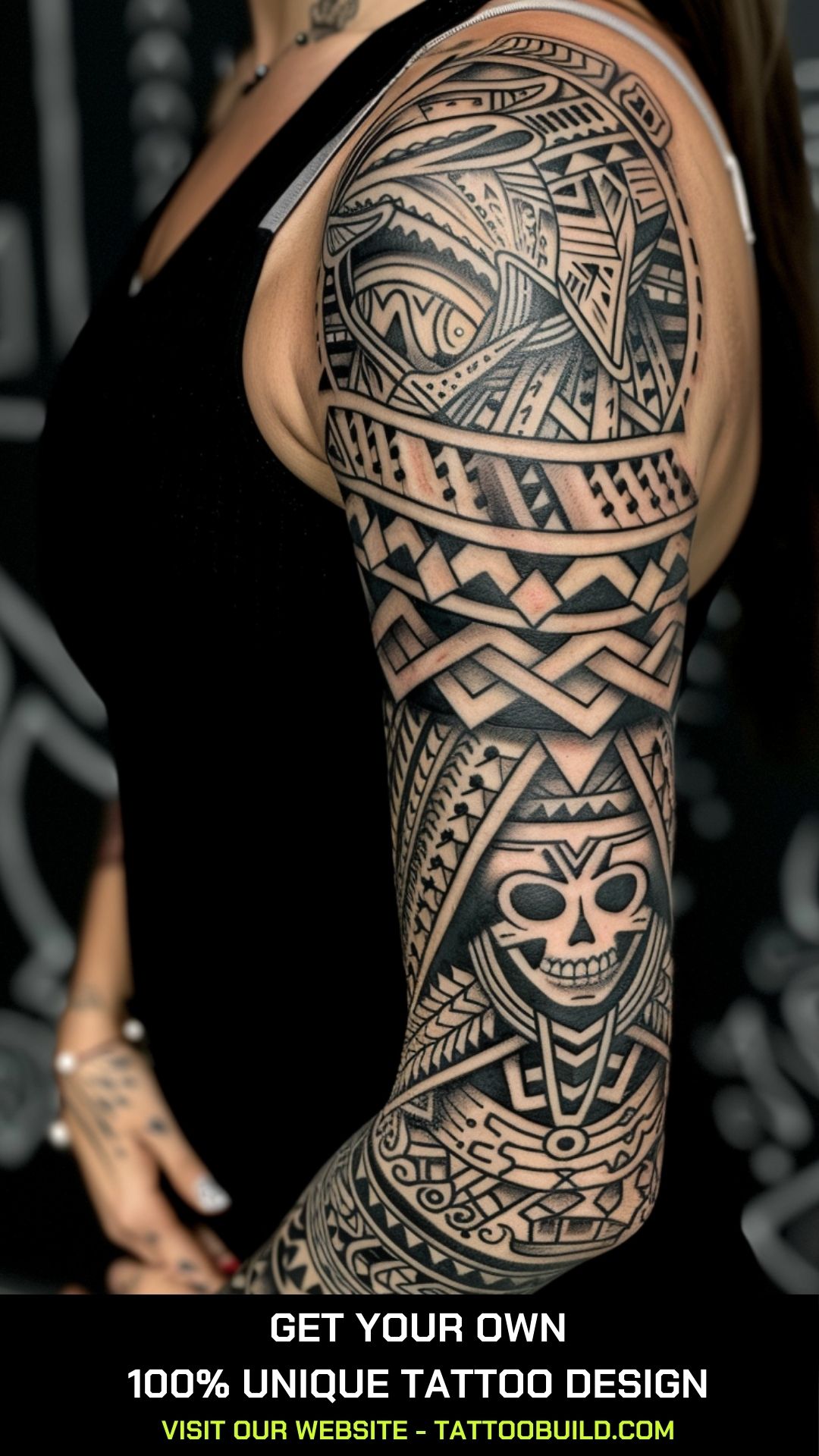
Polynesian design is built from small repeating motifs — enata figures, spearheads, shark teeth, ocean waves — packed into panels that wrap the body.
The panels are shaped by anatomy first. A good Polynesian sleeve changes direction at the deltoid and again at the elbow, because the body does.
When I tested reference sheets with three different artists, the ones who worked from body photographs rather than flat drawings produced designs that sat noticeably better on the shoulder.
If you have no Pacific ancestry, ask for a design that uses Polynesian structure and rhythm without lifting genealogical motifs. Most experienced artists will offer that distinction before you have to raise it.
2. Maori-Inspired Designs and Kirituhi
Ta Moko is Maori tattooing tied to whakapapa — genealogy. It is a closed practice, and it is not something to copy from a search results page.
What is offered to people outside that lineage is kirituhi: Maori-style artwork that carries the visual language without claiming the ancestral record.
The signature form is the koru, an unfurling fern spiral, usually paired with carved-looking bands where the negative space is cut like wood grain.
In my experience the honest route is simply to say what you are and ask what the artist is comfortable making. Every Maori-trained artist I have spoken to would rather have that conversation than see the style misused.
3. Samoan Pe’a and Malu
The pe’a is the male Samoan thigh-to-waist tattoo; the malu is its female counterpart on the thighs. Both are ceremonial and both are earned.
Traditionally they are applied by hand-tapping with an au comb over multiple days, with family present. That process is the point, not an inconvenience to be modernised away.
What you can take from it, respectfully, is the geometry: tight repeated triangles, banded fills, and a discipline about where the design stops.
I would not recommend asking a machine artist for a pe’a. Ask instead for Samoan-influenced banding, and be clear that is what you want.
4. Hawaiian Kakau
Hawaiian kakau leans more geometric than the rest of Polynesia — rows of triangles, chevrons and solid blocks rather than dense figurative packing.
It suits people who want tribal that reads as architecture rather than as storytelling. A single kakau-influenced band on the forearm can be finished in one sitting.
Restraint is the whole appeal here. A kakau-influenced band works because it stops where it should, not because it covers ground.
5. Native American-Inspired Tribal
There is no single Native American tattoo style — there are hundreds of distinct nations with distinct traditions, and much of what circulates online is invented.
If you have a specific tribal affiliation, the right move is to ask within your own community rather than to shop for a design. If you do not, this is a category to approach with real care.
Generic feather-and-dreamcatcher designs are not tribal tattooing; they are a commercial style that borrowed the label. I would rather say that plainly than pad this section.
6. Aztec and Mesoamerican Tribal
Aztec designs bring stepped fret patterns, sun stones, serpent heads and eagle warriors — the densest source material in tribal tattooing.
They are heavy by nature. A full Aztec chest piece is usually a multi-session commitment and benefits from an artist who can plan the whole map before starting.
The stepped fret is the workhorse motif. It tiles cleanly around a bicep and gives the design a spine to hang detail from.
When I tested how these age, the pieces that held up best had solid blacks broken by generous skin gaps rather than grey shading in between.
7. Celtic and Norse Knotwork
Celtic knotwork is an endless interlaced band with no start and no end — visually the opposite of Polynesian panelling, but it lands in the same tribal bucket.
Norse work adds runic bands, Mammen-style zoomorphic beasts, and Urnes-style ribbon animals. Both traditions reward an artist who can keep an over-under weave consistent.
Knotwork is where sloppy line weight shows fastest. If a strand thins where it crosses under, the illusion collapses. Our Celtic knot tattoo ideas guide has cleaner examples of that weave.
8. Borneo and Dayak Designs
Borneo tattooing gives us the bunga terung — the aubergine flower rosette worn on the shoulders — and dense spiral scrollwork.
It is less widely copied than Polynesian work, which is part of the appeal for people who want tribal that does not look like everyone else’s tribal.
The rosette is naturally symmetrical, so it suits paired shoulder placement better than almost any other tribal motif.
9. Modern Blackwork Tribal
Modern tribal borrows the vocabulary — points, hooks, sweeping curves — without claiming any culture’s symbols. For most people with no lineage to draw on, this is the right answer.
It also gives the artist total freedom to design around your specific anatomy rather than fitting a traditional motif to a body it was not drawn for.
Neo-tribal has had a genuine revival since the early 2020s, usually rendered heavier and more abstract than the 1990s version. Our blackwork tattoo ideas page covers the wider category.
Tribal Tattoo Ideas by Placement
Placement changes a tribal design more than style does. The same drawing looks confident on a calf and cramped on a forearm.
Tribal Sleeve Tattoos
The sleeve is tribal’s home ground because the arm gives the design somewhere to travel. Bands can tighten at the wrist and open across the deltoid.
Plan the whole sleeve before the first session, even if you tattoo it in three. Sleeves stitched together from separate ideas almost always show a seam.
Budget realistically: a full tribal sleeve is commonly four to eight sessions depending on density. Our guide to full sleeve tattoos for men breaks the staging down further.
Tribal Back Tattoos
The back is the largest flat canvas on the body and the one place a symmetrical tribal design can be shown in full.
Most back pieces anchor on the spine and mirror outward across the shoulder blades. Symmetry is the risk and the reward — any wobble is instantly visible.
Expect long sessions. Our back tattoo designs for men gallery shows how much difference a planned centre line makes.
Chest Tribal Tattoos
Chest tribal usually runs collarbone to collarbone and hooks over the shoulders, framing the sternum rather than covering it.
The collarbone is the sore part, not the pectoral. Almost everyone I have talked to about chest work says the same.
See our chest piece tattoo ideas for how the same layout reads on different builds.
Tribal Leg and Calf Tattoos
Calves take tribal beautifully because the muscle gives the design a natural taper to follow from knee to ankle.
Thigh pieces can carry Samoan-influenced banding at scale, which rarely fits anywhere else on the body.
Legs heal slower than arms in most people’s experience — swelling and gravity both work against you for the first week.
Tribal Shoulder and Armband Tattoos
The shoulder cap is the classic tribal entry point: one session, high impact, easy to extend into a sleeve later if you want.
Armbands are the most commonly regretted tribal placement, mostly because a band that does not account for arm taper ends up crooked.
Ask for the band to be drawn on and checked in a mirror with your arm relaxed at your side, not raised.
Tribal Spine and Back-of-Neck Tattoos
Spine tribal is a narrow vertical column, often a repeating motif that shrinks as it descends. It photographs extremely well and hides easily.
It is also one of the more painful placements — thin skin over bone, with no muscle to buffer the needle.
Neck tribal is a genuine commitment. Think about your work situation honestly before booking, not afterwards.
Minimalist and Small Tribal Tattoos
Small tribal is harder than large tribal. With only a few strokes, every one of them has to be right.
The best small pieces I have seen are single motifs — one spearhead row, one koru, one fret — placed with a lot of empty skin around them.
Resist shrinking a big design. Detail that works at sleeve scale turns into a black smudge at two inches, and it will only blur further with age.
Blending Tribal With Other Styles
Tribal mixes better than its reputation suggests, as long as one style clearly leads and the other supports.
Tribal and Dotwork
Stippled dotwork fills the gaps between solid black bands with a mid-tone that pure tribal cannot produce.
It adds depth without adding colour, which keeps the piece readable at distance.
Tribal and Geometric
Geometric structure gives tribal a grid to sit on — mandalas, mirrored triangles, sacred-geometry frames.
This is the most popular modern hybrid I see, and it is very forgiving to plan. Our geometric tattoo ideas page shows the framework side of it.
Tribal and Watercolour
Watercolour splashes behind solid black tribal is a high-contrast look that photographs well on day one.
Be honest with yourself about longevity — soft colour washes generally fade faster than solid black, so the piece will drift toward the tribal over time. Our watercolor tattoo ideas page covers that trade-off.
Tribal and Realism
A realistic animal head emerging from abstract tribal flow is a demanding composition that very few artists execute cleanly.
If you want it, look specifically for a portfolio with healed photos of the same combination — not fresh shots.
Healing Heavy Blackwork: What Actually Helps
Solid black packs more ink into the skin than line or shade work, so tribal often feels more like a graze than a scratch for the first few days.
Follow the aftercare your artist gives you, because they know what they used on you. In general that means clean hands, gentle washing, a thin layer of whatever product they recommended, and no soaking.
Large black areas commonly scab more heavily than fine line work. Let scabs come off on their own — picking them is the main cause of patchy black that needs a touch-up.
Sun is the enemy of solid black. Once healed, sunscreen is the single most effective thing you can do to keep the piece sharp.
If you see spreading redness, heat, swelling that worsens after day three, pus, or a fever, that is a doctor’s call and not a forum question — go and get it looked at. For the ordinary healing timeline, our tattoo aftercare guide walks through it week by week. This article is general information, not medical advice.
Reactions to ink are uncommon but real. If you have a history of allergies or a skin condition, mention it at consultation and ask your artist about a patch test; anything beyond that is a conversation for a dermatologist. The American Academy of Dermatology and the US FDA’s tattoo fact sheet both cover ink safety in plain language.
Common Mistakes — and What to Do If You’re Still Not Sure
The most common tribal mistake is choosing a design from a flat image and asking an artist to copy it onto a curved body.
The second is going too small. Tribal needs room; a cramped design loses the negative space that makes it work.
The third is skipping the cultural question entirely and then finding out later what the motif meant. Ask before, not after.
If you already have old tribal you have outgrown, heavy black is genuinely hard to cover — laser lightening first is usually part of the plan. Our tattoo cover-up ideas page is realistic about what is possible.
And if you are still undecided, the cheapest useful step is a paid consultation. An hour with an artist who draws freehand will tell you more than another month of scrolling.
Frequently Asked Questions
Are tribal tattoos disrespectful?
It depends entirely on which tradition you are drawing from. Ta Moko and the Samoan pe’a are closed practices tied to lineage and ceremony, and copying them without that connection is widely considered disrespectful. Modern blackwork tribal, Celtic knotwork and abstract neo-tribal carry no such restriction. The reliable test is to ask your artist directly what the motifs mean and whether they are appropriate for you to wear.
How long does a tribal tattoo take?
A shoulder cap or a single armband is often one session of two to four hours. A half sleeve typically runs three to six sessions, and a full back piece can stretch across many months. Solid black is slower than outline work because the artist has to pack the ink evenly. Your artist can give a much better estimate once the design is drawn.
Do tribal tattoos hurt more than other styles?
Many people find heavy black fill more uncomfortable than linework, simply because the same area gets worked over repeatedly. Placement still matters more than style — ribs, spine, collarbone and the inside of the arm are usually the hardest spots. Fleshy areas like the outer thigh and outer bicep are generally easier. Everyone’s tolerance is different, so treat any pain chart as a rough guide rather than a promise.
Can a tribal tattoo be removed or covered up?
Solid black is the hardest ink to cover, because there is no lighter value for a new design to work against. In most cases an artist will suggest several laser sessions to lighten the black first, then a cover-up built around what remains. Full removal is possible but usually takes many laser sessions over a year or more. A consultation with both a laser clinic and a tattoo artist will give you a realistic plan.
What is the difference between tribal and blackwork?
Tribal refers to designs rooted in — or visually derived from — indigenous tattoo traditions, with characteristic flowing panels, points and hooks. Blackwork is the broader modern category for any tattoo done entirely in solid black ink, which includes tribal but also geometric, illustrative and ornamental work. In practice most contemporary tribal is a subset of blackwork. The distinction matters mainly when you are searching for an artist.
Quick Summary
- Tribal is a silhouette style — the negative space matters as much as the black.
- Polynesian, Maori, Samoan, Hawaiian, Aztec, Celtic and Borneo are distinct traditions, not one look.
- Ta Moko and the pe’a are closed practices; ask for kirituhi or Samoan-influenced work instead.
- Modern blackwork and neo-tribal are open to anyone and give the artist the most freedom.
- Plan a sleeve or back piece as one design before the first session, even if you split the sessions.
- Go bigger than you think — small tribal loses the gaps that make it readable.
- Heavy black scabs more; let it heal untouched and use sunscreen once healed.
- Book a paid consultation with an artist who draws freehand on skin before committing.