Blackwork is the least forgiving style in tattooing, and that is exactly why it looks so good decades later. There is no colour to carry a weak design and no grey wash to soften a shaky line. It is solid black against bare skin, and every decision shows.
I have sat for two large blackwork pieces and watched a lot more get made, and the pattern is consistent: the artists who specialise in it think about the design very differently from everyone else. They plan the empty skin first and the black second.
That mindset is what separates blackwork from the heavy linework styles it gets confused with. Blackwork is about mass and silhouette, not just outline.
Below are 20 directions worth considering, each one shown in real work rather than a flash sheet, plus what I have learned about how these pieces sit, heal and age on men’s bodies.
Which Blackwork Direction Is Right for You?
Blackwork is not one look. These are the four broad approaches you will actually be choosing between when you talk to an artist.
| Approach | Looks Like | Best Placement | Sitting Time | Watch Out For |
|---|---|---|---|---|
| Heavy / solid fill | Large unbroken black areas, silhouette-driven | Outer arm, back, calf | Longest — fills are slow and repetitive | Patchy healing if packed too aggressively in one pass |
| Geometric / ornamental | Repeating shapes, symmetry, negative-space channels | Sleeve, chest, thigh | Moderate, but stencil work is lengthy | Alignment errors that become obvious across a joint |
| Tribal-derived | Flowing bold bands that follow muscle | Upper arm, shoulder, pectoral | Moderate | Borrowing closed cultural motifs without understanding them |
| Illustrative blackwork | Animals, masks, figures built from black mass | Forearm, chest, back | Shortest of the four for a single piece | Detail packed too tightly, which blurs with age |
Why Blackwork Ages the Way It Does
Solid black is the most stable thing you can put in skin. It is dense, it sits in one tonal register, and it has nowhere to fade to except a softer version of itself.
Colour shifts. Fine grey wash thins out. A tattoo built from black mass simply spreads a little at the edges over the years, which is why the strongest blackwork designs leave breathing room between elements from day one.
That spread is also why dotwork transitions are handled so carefully by good artists — stippling that is too fine will eventually read as a smudge rather than a gradient.
The trade-off is honesty about correction. A large solid fill is very hard to cover or rework later, and laser removal of dense black usually takes multiple sessions with a specialist. In most cases you should treat a big blackwork commitment as permanent in a way a small line tattoo is not.
Choose the design assuming you will still have it at 60, because with blackwork you probably will.
20 Blackwork Tattoo Ideas for Men
1. Full Sleeve of Geometric Patterns
A complete sleeve built from repeating triangles, hexagons, diamonds and interlocking bands. There is no shading anywhere in it — the geometry carries all the visual complexity by itself.
What makes this work is the wrapping. A good artist maps the pattern to the actual muscle so the shapes stay square when your arm turns, which is far harder than it looks on a flat drawing.
Expect a long project. Every sleeve like this I have seen took multiple full-day sessions, mostly because the stencil work between passes is slow and exacting. If you like this direction, the broader geometric sleeve approaches are worth reading through before you book.
2. Blackwork Skull
A skull in solid black with heavy outlines and filled shadow, with the orbital bones and cheekbones cut out as negative space rather than drawn in.
The skull is the most tested subject in tattooing, which is exactly why blackwork suits it. Stripping out tone forces the artist to get the underlying anatomy right, and a badly proportioned skull has nowhere to hide.
In my experience this reads best at medium scale on the forearm or outer bicep, roughly palm-sized or larger. Smaller than that and the negative-space gaps start closing up as the ink settles.
3. Tribal Upper Arm Band
A bold band encircling the upper arm in flowing solid black. This is the oldest form of blackwork there is.
Traditional tattooing from Polynesia, Borneo and the Philippines uses solid black in exactly this way — to mark status, lineage and passage rather than decoration. If you are drawn to that visual language, read up on genuine Polynesian tattoo traditions first.
Every artist I have asked about this is clear on the same point: some motifs are specific to families or communities and are not open for general use. Ask your artist to design something in the style rather than copying a piece you found online.
4. Mandala Chest Piece
A large circular mandala centred on the chest, with solid black fills and fine linework inside the black to create texture without introducing tone.
Chest placement gives the symmetry something to sit on, and the sternum makes a natural centre point. Getting the circle to actually read as a circle across a curved chest is the technical challenge here.
This one hurts. The sternum and the skin over the ribs are among the sharper places to get tattooed, and mandalas involve a lot of repetitive packing. If the scale appeals but the placement does not, mandala sleeve designs are the usual alternative.
5. Black Panther
A panther mid-stride, rendered almost entirely in solid black with the musculature suggested by the gaps left in it.
An all-black animal in an all-black style sounds like it should collapse into a blob, and in weaker hands it does. The whole piece lives or dies on where the artist decides not to put ink.
When I tested this idea with an artist, they sketched the negative space first and the outline second — a good sign you are talking to someone who actually works in the style.
6. Blackwork Raven
A raven with heavy black feathering and a hard silhouette. The bird is already black, so the style is not fighting the subject.
Ravens carry a lot of meaning depending on where you look — memory and thought in Norse mythology, omens in European folklore, a trickster and creator figure in several Pacific Northwest Indigenous traditions.
Practically, the strength here is the outline. A raven in profile with clean wing shapes stays legible at a distance, which is more than most detailed bird tattoos manage after ten years.
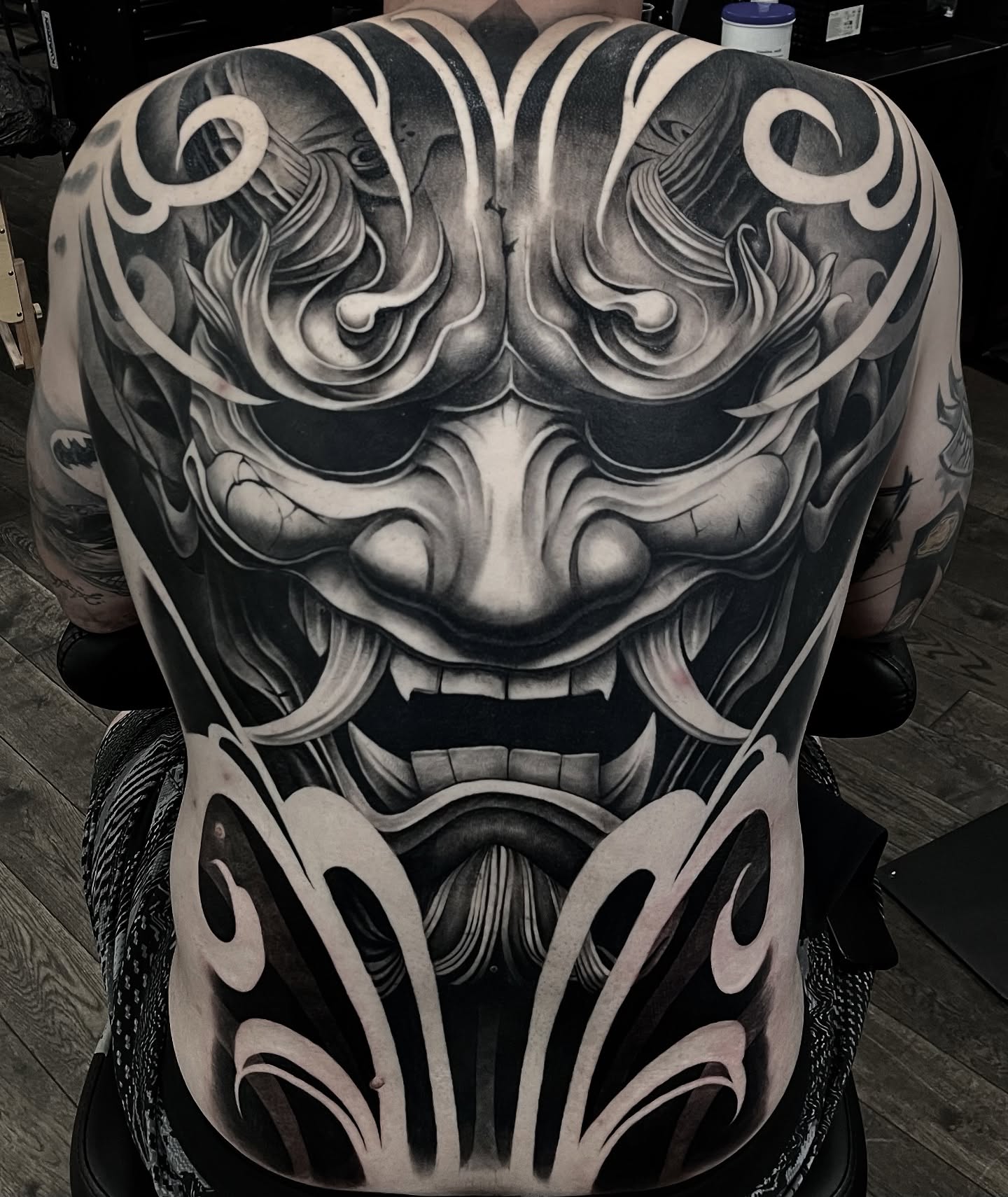
7. Samurai Mask (Hannya)
A hannya mask in solid black with the horns, teeth and glare cut out as negative space.
In Japanese Noh theatre the hannya represents a woman consumed by jealousy and grief — it is a face of suffering, not simply a demon. Worth knowing before you wear one permanently.
The blackwork treatment strips out the traditional colour and leaves pure expression. I find these read strongest on the outer forearm or shoulder, where the mask can sit upright rather than tilting with the limb.
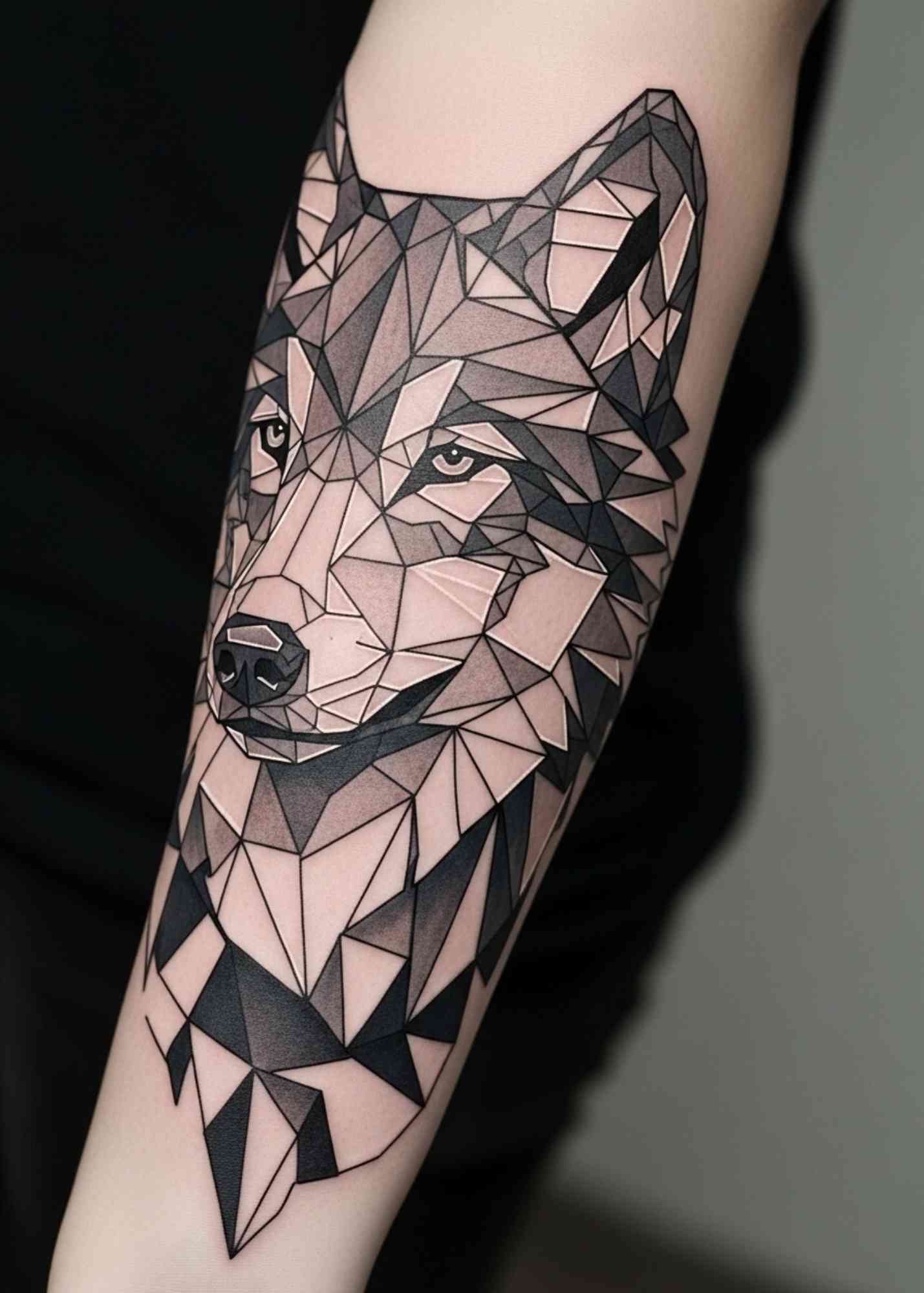
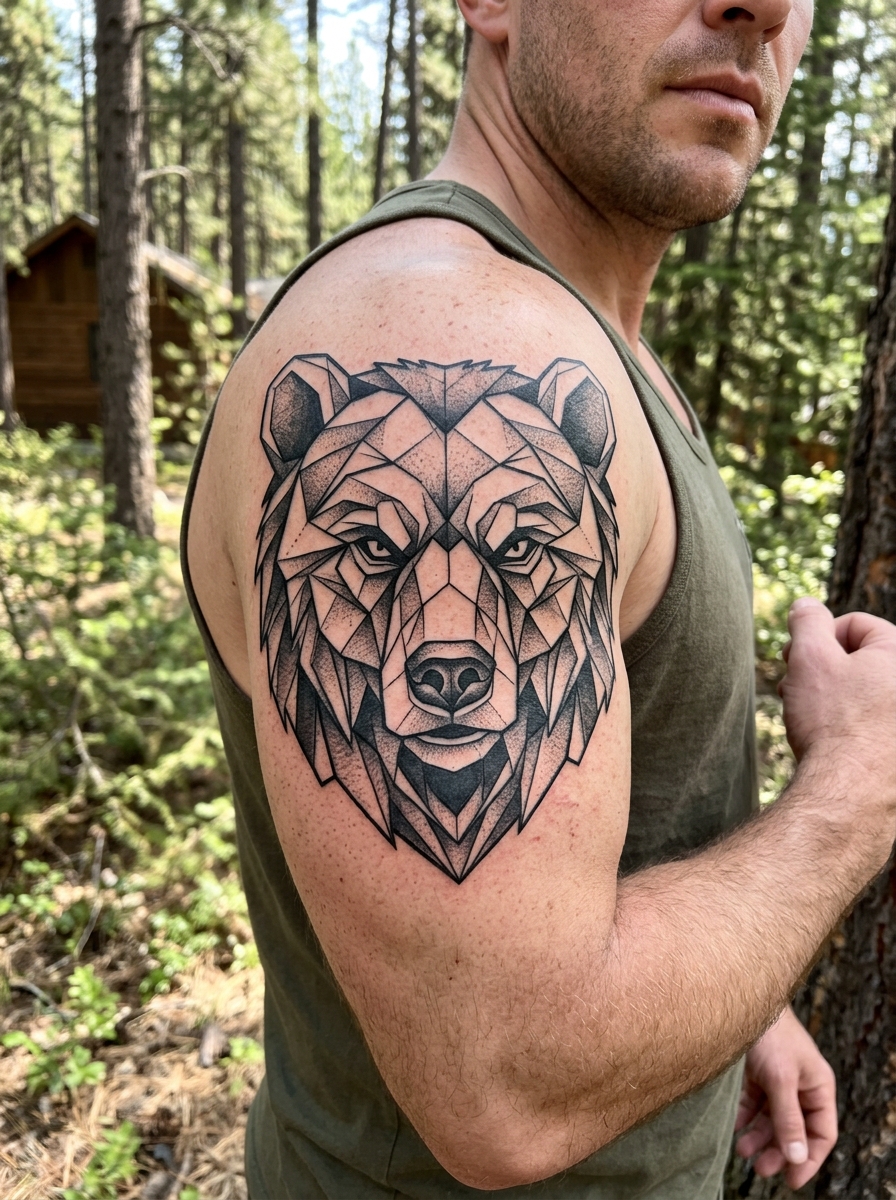
8. Geometric Bear
A bear head broken into angular facets, with alternating solid planes and bare skin building the shape.
Faceting an animal is a way of getting weight and presence without any shading at all. The trick is keeping the facets large enough that they still read as separate shapes years from now.
This approach works for almost any strong-featured animal. If you like the geometry more than the bear specifically, the same logic is applied to other geometric bear designs and to wolves, stags and rams.
9. Blackwork Dragon
A dragon running the length of the arm, with heavy black scales and negative space marking the claws, spine ridge and eyes.
Dragons suit blackwork because the body is one long flowing shape — the design naturally follows the limb instead of being pasted onto it.
The scale work is the slow part. Every artist I have asked says the same thing: keep the individual scales bigger than feels right on paper, because they will soften as the tattoo settles and merge into a single dark mass if they were tight to begin with.
10. Abstract Blackwork Patches
Loose solid-black shapes placed across the arm with deliberate gaps between them, referencing nothing in particular.
This is one of the more contemporary directions and it divides people sharply. There is no subject to explain and no meaning to defend, which is either the appeal or the problem depending on your temperament.
It is also unusually flexible. Because the shapes are abstract, they can be added to over years, and they cover previous work more sympathetically than a figurative design would.
11. Maze or Labyrinth Pattern
Interlocking black paths with bare skin running between them, so the eye follows the channels rather than the ink.
Mazes are a rare case where the negative space is genuinely the subject. The black is just the wall.
Keep the channels wide. In my experience this is the design type most often ruined by ambition — paths drawn thin enough to look impressive on the stencil close up within a few years and the whole pattern turns into a dark block.
12. Blackwork Wolf with Forest Background
A wolf head set against a dense black treeline, where the background does as much work as the animal.
Using a solid black field behind the subject is a classic blackwork move. It makes the wolf pop without any shading and gives the piece a defined edge instead of fading out into skin.
It is also a lot of packing. Expect a longer session than the drawing suggests. Related takes on the same animal appear in most geometric wolf designs, which handle the head very differently.
13. Bold Koi Fish
A koi with heavy black scales and negative space carrying the water movement around it.
Traditional Japanese koi rely on colour and grey wash for their sense of motion. Doing one in blackwork means rebuilding that movement out of shape alone.
The result is graphically stronger and less literal. It sits well on the forearm or the outside of the calf, where the fish can curve with the limb.
14. Blackwork Eye
A single eye with a heavy black iris, surrounded by ornamental linework that frames rather than decorates it.
Eyes are a small commitment with a lot of presence, which makes them a reasonable entry point into the style if you are not ready for a sleeve.
Placement matters more than usual. An eye that sits crooked on the inner forearm is noticeable in a way a crooked abstract shape never would be, so take the stencil placement seriously and check it in a mirror before anyone starts.
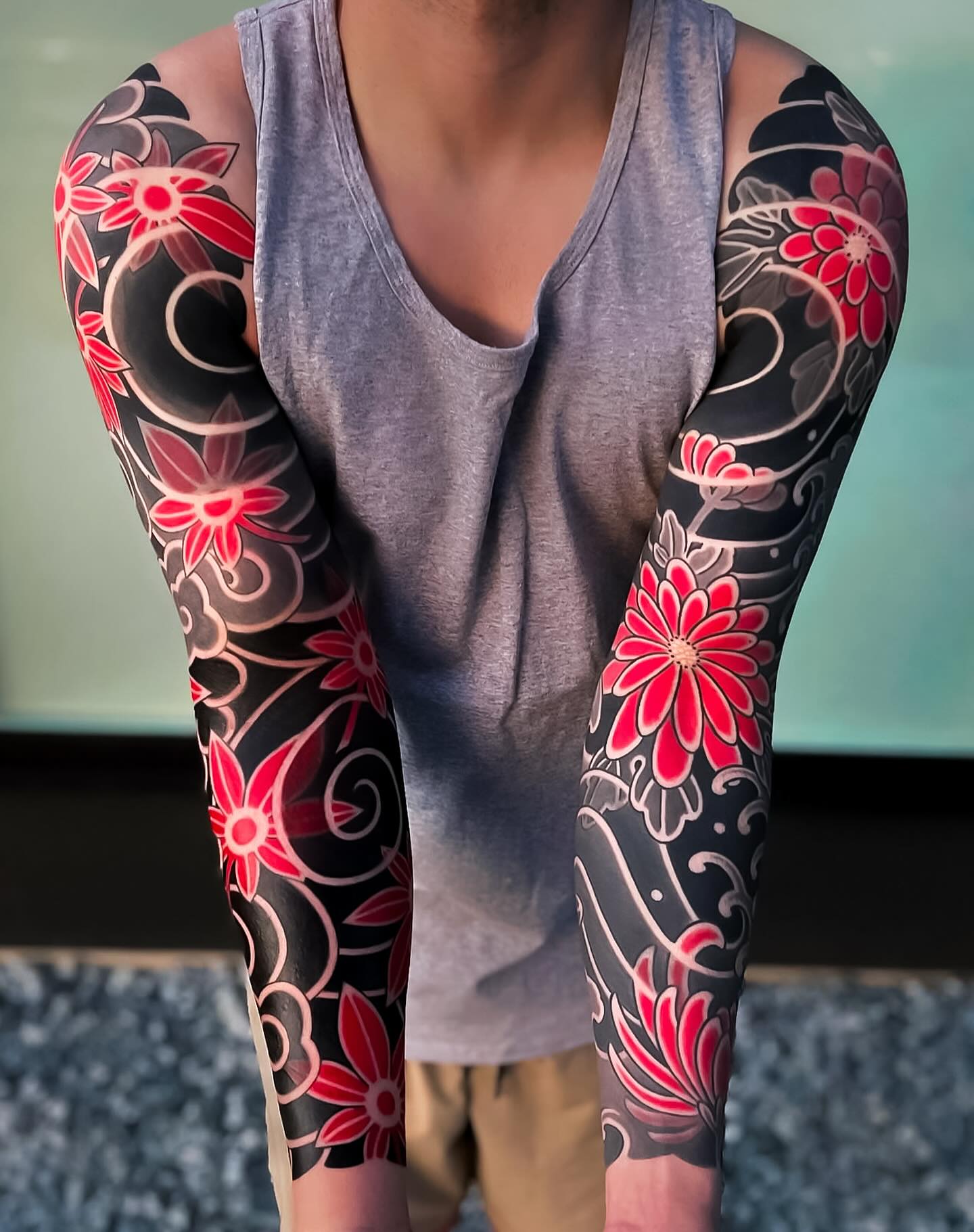
15. Geometric Sleeve with Tribal Influence
A hybrid: the flowing band structure of tribal work carrying a geometric pattern inside it.
This is where a lot of modern blackwork sleeves actually land. It gives you the wrap and movement of traditional banding with contemporary shapes that are not borrowed from a specific culture.
It is also easier to build in stages than a single unified pattern, which matters if you are paying for the sleeve over a year rather than in one block.
16. Full Back Blackwork
A back piece running from shoulders to lower spine in ornamental solid black.
The back is the largest uninterrupted canvas on the body and the only place a symmetrical design can be fully realised without a joint breaking it up.
Be realistic about the commitment. A full back in blackwork is typically many long sessions spread over months, and the healing between them affects your sleep and your gym routine more than most people expect.
17. Blackwork Phoenix
A phoenix with flames cut through the solid black wings as negative space.
There is a nice tension in a bird of fire and light rendered entirely in darkness, and the flame shapes give the artist somewhere to be intricate without adding tone.
The negative-space flames are the part to scrutinise in an artist’s portfolio. Compare a few phoenix tattoo designs side by side and you will quickly see whose flames still read as flames after healing.
18. Japanese-Influenced Blackwork
Waves, koi, dragons and oni rendered in solid black instead of the traditional colour palette.
Irezumi has centuries of established structure behind it, and translating that into blackwork is a real reinterpretation rather than a shortcut. Some traditional artists have strong feelings about it.
Done well, the familiar imagery in unfamiliar monochrome feels fresh rather than derivative. Done carelessly, it just looks like an unfinished colour piece — the difference is whether the design was built for black from the start.
19. Blackwork Compass with Geometric Fill
A compass rose with each directional segment alternating between solid fill and bare skin.
The symmetry of a compass gives blackwork something rigid to work against, and the alternating fills create movement without any shading.
It is a good medium-scale option — big enough to be a real piece at around the size of your palm, small enough to be finished in one sitting.
20. Dotwork-to-Blackwork Gradient
A design that transitions from dense stippling into solid fill, using the dots as the bridge between bare skin and black.
This is the most technically demanding option on the list. The gradient has to be built so that it still reads as a gradient after the dots soften.
In practice that means larger dots and a shorter transition zone than the artist’s flash drawing usually shows. Ask to see healed photos of this specific technique, not fresh ones — fresh dotwork always looks better than it will in five years.
Variations Worth Considering Instead
If full blackwork feels like too much, these adjacent approaches give you most of the graphic weight with less commitment.
Blackwork Outlines Only
Heavy black outlines with no fill at all. You keep the boldness and the ageing advantage, but the piece stays open and the sessions are much shorter.
Blast-Over Work
Solid black elements placed straight over existing faded tattoos. It is a legitimate way to reclaim old work without a cover-up, though it only succeeds when the new design is genuinely bolder than what is underneath.
Ornamental Blackwork
Jewellery-like patterns that follow the body rather than depicting anything. Softer than heavy fills and far easier to extend later. Most ornamental tattoo designs sit in this space.
Negative-Space-Led Designs
Flip the ratio: mostly black with a small subject cut out of it. It is a striking effect, but it means committing to a large fill for a small image, so be sure of the shape before you start.
Aftercare and Healing for Large Black Areas
Solid fills heal differently from linework. The skin is worked harder over a wider area, so expect more swelling, more weeping in the first couple of days, and heavier scabbing than you would get from an outline piece.
Follow the aftercare instructions your artist gives you rather than anything you read online, including this. They know what they put in your skin and how they worked it.
Beyond the initial heal, the two things that actually matter long term are sun protection and moisturising. The American Academy of Dermatology recommends broad-spectrum SPF 30 or higher on tattooed skin and a water-based moisturiser when the area feels dry.
Patchy healing in a large fill is common and usually fixable. Most artists build a touch-up into the price of heavy blackwork precisely because fills often need a second pass. Ask about that before you book, not after.
If you see spreading redness, heat, pus or a fever, that is not normal healing — see a doctor rather than waiting it out. The FDA notes that infections and allergic reactions can occur even with proper hygiene, and that reactions to ink can be hard to treat because the pigment is difficult to remove.
Still Not Sure? The Mistakes I See Most
Booking a generalist. Blackwork looks simple in a portfolio photo, which is exactly why artists who do not specialise in it accept the work. Look for someone whose entire portfolio is black.
Judging fresh photos. Fresh blackwork is uniformly dark and always looks perfect. Ask specifically for healed photos at six months or more — that is where patchy packing shows up.
Going too detailed. Almost every regret I have heard about blackwork comes down to detail packed too tightly for the scale, not to the subject choice.
Starting too big. If this is your first heavy piece, a forearm or a chest piece tells you a lot about how your skin takes solid fill before you commit to a back.
Frequently Asked Questions
Does blackwork hurt more than other tattoo styles?
Generally yes, though it is the duration rather than the intensity that people struggle with. Packing solid black means going over the same area repeatedly, so the skin gets more irritated than it would from a single line pass. Bony and thin-skinned areas like the sternum, ribs and inner arm are the hardest. Most artists will break a large fill across multiple sessions for exactly this reason.
Can a blackwork tattoo be covered up or removed later?
Covering solid black is very difficult — there is essentially nothing darker to work with, so most cover-ups end up being blast-overs or larger black designs rather than a new image. Laser removal of dense black does work, and black actually responds better to laser than many colours do, but it typically takes multiple sessions over months. Treat any large fill as a permanent decision. If removal is something you are considering, see a dermatologist rather than a DIY kit.
How long does a blackwork sleeve take?
In my experience a full geometric or ornamental sleeve is usually several full-day sessions spread over months, not a single weekend. The drawing and stencil work between sessions adds significant time that people forget to account for. Ask your artist for a realistic session count at the consultation and treat any answer that sounds fast as a warning sign.
Does blackwork fade badly on darker skin tones?
Solid black is generally the most reliable choice on deeper skin tones, because the contrast comes from density rather than hue. The design does need to be planned for it, though — negative space reads differently against darker skin, so gaps often need to be more generous. Look specifically for an artist with healed photos on skin tones similar to yours.
Is tribal blackwork appropriative?
It depends entirely on what you take. Designing something in a bold banded style is different from copying a specific Polynesian or Bornean motif that carries family or community meaning. Every artist I have asked who works in these traditions says the same thing: ask, learn what the elements mean, and commission an original design rather than lifting one from a photo.
Quick Summary
- Blackwork is solid black only — no colour, no grey wash — so the design has to work on shape alone.
- It ages better than almost any other style, but it is also the hardest to cover or remove.
- The four main directions are heavy fill, geometric or ornamental, tribal-derived and illustrative.
- Negative space is the real subject in most strong blackwork; the black is just the surrounding mass.
- Keep detail larger than feels right — tight detail merges into a dark block as the tattoo settles.
- Book a specialist, and judge them on healed photos at six months, never fresh ones.
- Large fills swell and scab more than linework, and often need a touch-up pass — ask if it is included.
- Signs of infection mean a doctor, not a wait-and-see; follow your artist’s aftercare over anything online.