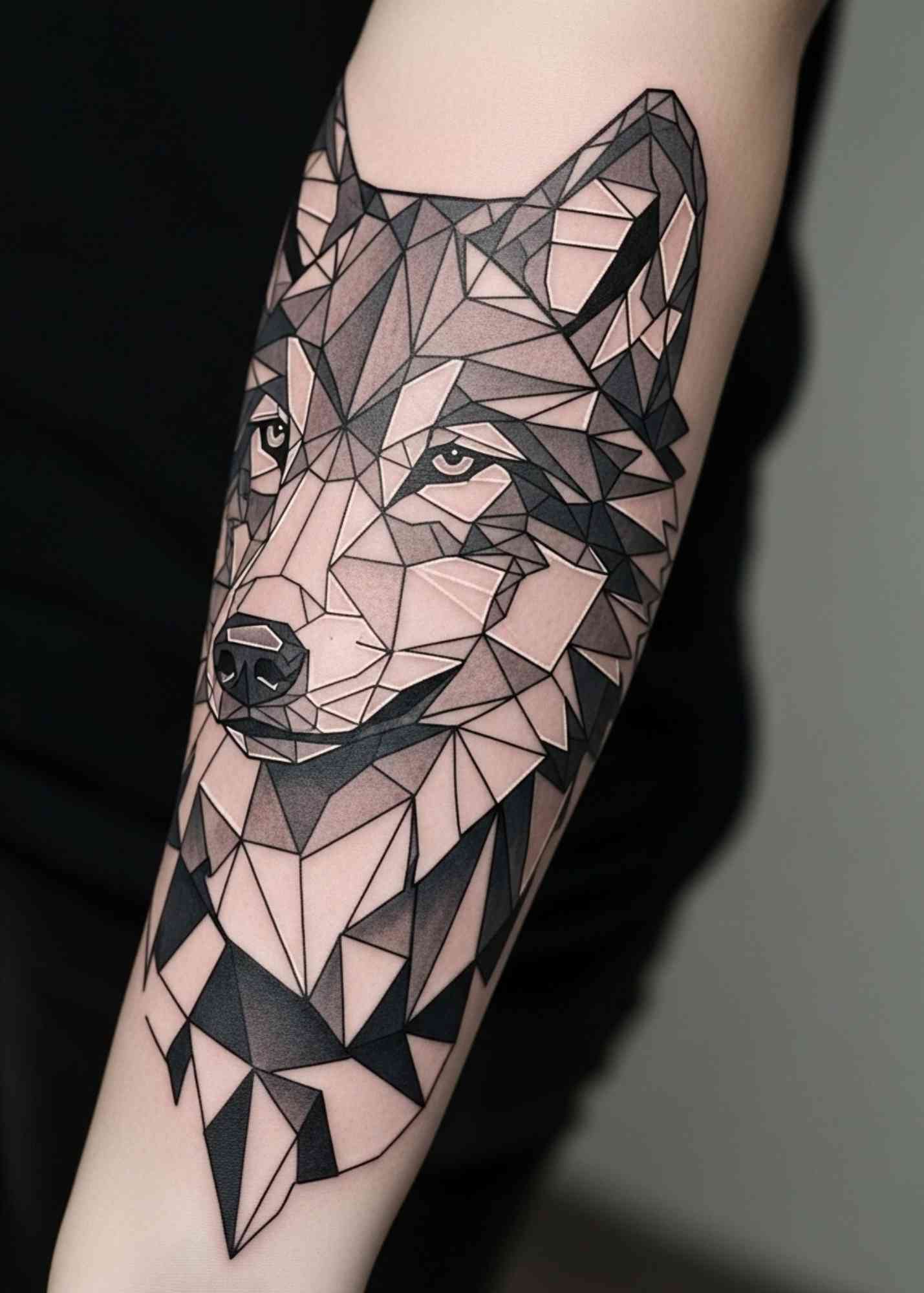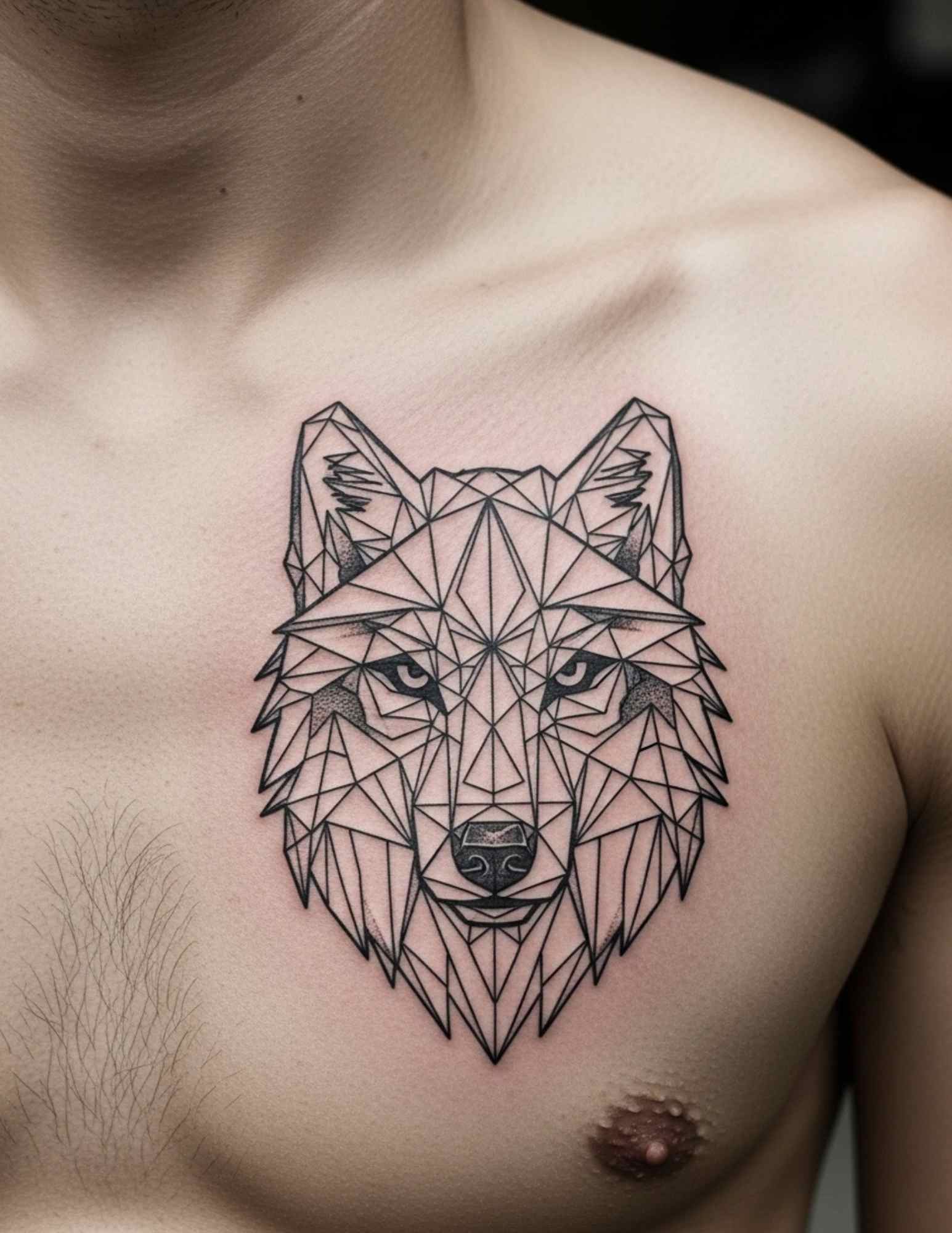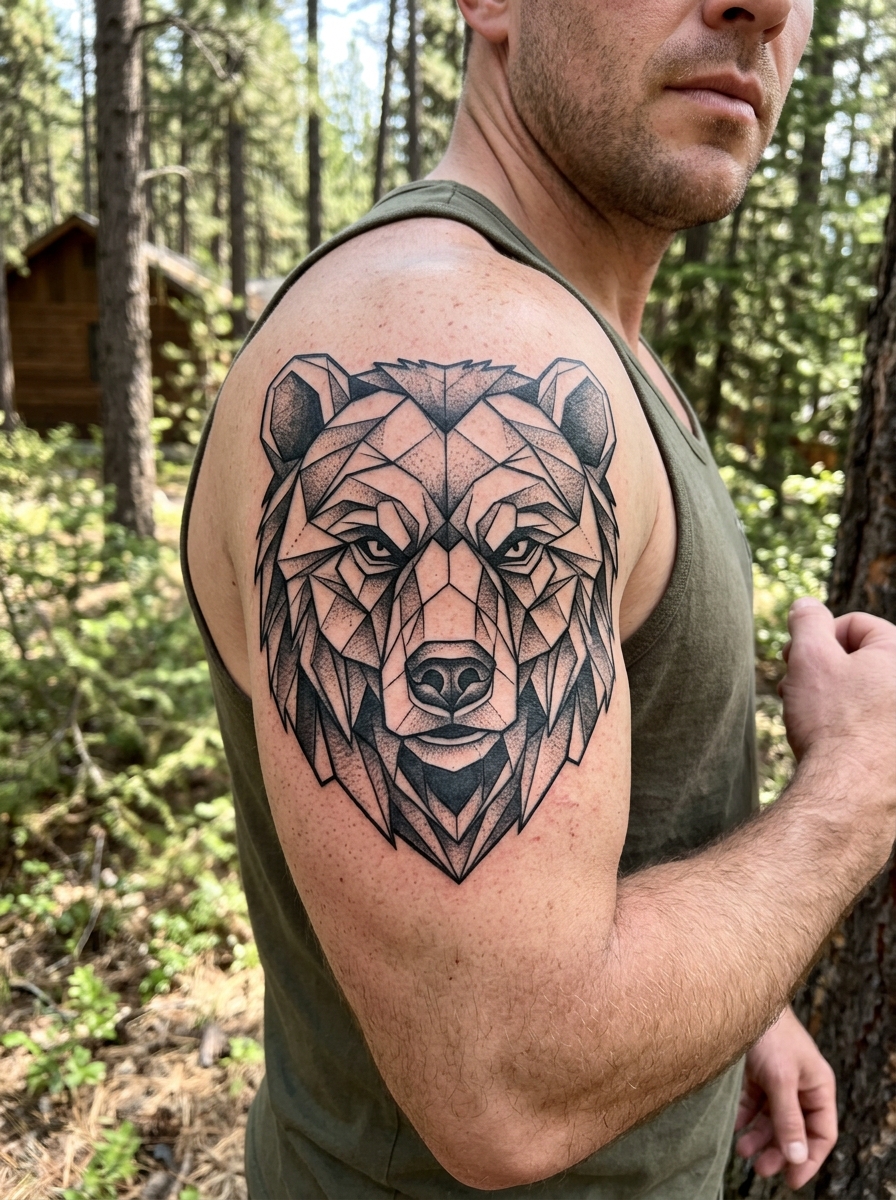
I have lost count of how many bear designs I have sketched out for people who wanted something strong without it looking aggressive. A geometric bear tattoo works because the triangles and lines do the shading for you, so the piece stays readable for decades instead of blurring into a grey smudge.
That is the practical argument. The emotional one is simpler: a bear reads as protection, stubbornness and quiet strength, and geometry gives that a modern frame rather than a woodland-cabin one.
When I tested a few of these layouts as stencils on my own forearm before committing, the difference between a design that works and one that does not came down to how large the smallest shape was. Anything under about three millimetres closed up within a couple of years.
Below are sixteen directions I keep coming back to, with the honest trade-offs of each. If you want the wider category first, my guide to geometric tattoo designs covers the underlying style before you narrow it to an animal.
Which Geometric Bear Style Is Right for You?
These five approaches cover most of what artists actually offer. I have sat for three of them and watched friends heal the other two.
| Style | Best Size | Typical Sitting | Ages Well? | Suits You If |
|---|---|---|---|---|
| Low poly | 5 in and up | 3–5 hours | Very well – flat shapes, no gradients | You want a bold, modern, sculptural look |
| Sacred geometry | 4–7 in | 3–6 hours | Well if the grid lines stay spaced | You want symbolism layered behind the animal |
| Dotwork geometric | 4 in and up | 4–8 hours | Softens noticeably – plan for that | You prefer texture over hard black fill |
| Silhouette fill | 3 in and up | 2–4 hours | Best of the five | You want something legible from a distance |
| Mandala bear | 6 in and up | 5–8 hours | Depends heavily on line spacing | You want an ornamental, symmetrical piece |
Why Geometric Bears Hold Up Better Than Most Animal Tattoos
Skin moves and ink spreads. That is not a flaw in anyone’s work, it is just what tattooed skin does over ten or twenty years.
Realistic animal portraits depend on soft gradients, and gradients are exactly what blur first. Geometry depends on edges and spacing, which hold their shape far longer.
The single biggest predictor of how a geometric bear will look in 2040 is the gap between lines, not the skill of the shading. Every artist I have asked has said some version of the same thing.
There is also the symbolism, which is older than the style. Bears carry meanings of protection, solitude and maternal ferocity across a lot of cultures, and the traditional bear tattoo meaning goes into that history in more depth than I will here.
Geometry adds a second layer on top: order imposed on something wild. That contrast is most of the appeal, and it is why these pieces rarely look dated the way tribal work from twenty years ago can.
16 Geometric Bear Tattoo Ideas Worth Considering
Each of these has been drawn a thousand times, so the differences that matter are structural rather than decorative. I have flagged the ones I would hesitate to put on a first-timer.
1. Faceted Grizzly Portrait
The faceted grizzly is the default geometric bear for good reason. The head is broken into flat planes that follow the real muscle structure, so it still reads as a grizzly rather than an abstract shape.
The face is where this design lives or dies. If the artist flattens the brow ridge and the muzzle into the same plane, the animal stops looking like a bear and starts looking like a rock.
I would give this at least five inches on the forearm. Smaller than that and the facets around the eyes start merging into each other within a few years.
Real grizzlies have a distinct shoulder hump and a dished face, and Britannica’s entry on the grizzly covers that anatomy if you want the reference right. Bring a photo to your consultation rather than relying on the artist to know it.
2. Low Poly Bear Head
Low poly borrows directly from 3D modelling, where a surface is approximated with a small number of flat triangles. Applied to a bear head it produces something that looks carved rather than drawn.
The trick is varying triangle size. Large planes across the forehead and cheek, smaller ones around the nose and eyes, and the whole thing suddenly has depth.
In my experience this is the most forgiving geometric style for people with skin that scars easily, because there is no fine detail to lose.
It also scales up beautifully. A low poly bear across a shoulder blade at ten inches looks deliberate in a way a scaled-up portrait rarely does.
3. Bear Silhouette with Geometric Fill
Here the outer edge is a clean, recognisable bear shape and everything inside is pattern. It is the most legible design on this list.
Because the silhouette carries the recognition, the internal geometry can be as busy as you like without confusing the eye.
I have seen these done as small as three inches on an inner wrist and they still read correctly, which is unusual for a detailed piece.
Ask for the internal lines to stop just short of the outline. Lines that touch the border tend to bleed into it and muddy the silhouette over time.
4. Bear with Dotwork Shading
Dotwork replaces solid black with stippled density, which gives fur a texture that flat geometry cannot. The result feels softer and more organic.
It is slower to tattoo and it fades differently. Dots spread, so a dotwork bear at fifteen years looks smokier than the day it was done.
That is not necessarily bad. Some of the best-looking old dotwork I have seen has aged into something closer to an etching.
If you like this density of black, the blackwork tattoo designs guide is worth a look for how the same principles apply to larger pieces.
5. Bear with Sacred Geometry
Placing a bear head over a Flower of Life or Metatron’s Cube pattern is one of the most requested variations, and one of the easiest to get wrong.
The problem is competition. Two detailed elements fighting for attention produces visual noise rather than meaning.
The fix is hierarchy: the bear solid and dark, the geometry fine and light behind it. When I tested layered stencils, anything closer than about a 3:1 weight ratio looked muddy.
The symbolism is personal rather than historical here. These patterns have decorative traditions behind them, but the specific bear-plus-grid combination is a modern invention, and I would not pretend otherwise.
6. Geometric Bear and Forest
A triangle or hexagon frame containing a bear, pine trees and a mountain ridge is practically its own genre now.
It works because the frame gives the scene a horizon line, and the horizon gives the bear a sense of scale.
Keep the tree line simple. Every one of these I have seen fail has failed because the artist packed in twenty trees where six would have read better.
This suits the outer forearm and the calf particularly well, where the natural taper of the limb matches the frame.
7. Mandala Bear
A mandala bear puts the animal head at the centre of a radiating symmetrical pattern. It is ornamental in a way the other designs are not.
Symmetry is the whole point, which means placement matters more than usual. Off the centreline of a limb, the pattern reads as lopsided even when it is technically perfect.
These take the longest of anything on this list. Five to eight hours is normal for a full upper arm piece, often across two sessions.
If the ornamental side appeals more than the animal, this collection of mandala tattoo ideas has a wider range of layouts to borrow from.
8. Polar Bear in Geometric Style
A polar bear in geometric style is largely an exercise in negative space, because the animal is white and your skin is the lightest value available.
That makes it a genuinely difficult piece. The bear is defined by what is not tattooed, so every line has to be placed correctly the first time.
This is not a design for a first tattoo. I would want to see healed examples of an artist’s negative space work before booking it.
On darker skin tones the effect changes significantly and usually needs rethinking rather than adapting. An honest artist will tell you that upfront.
9. Black Bear Low Poly
Where the grizzly version uses outlines, the black bear version leans on solid fill. Whole facets are blacked out rather than merely outlined.
The contrast between filled and empty planes is what creates the form, so the artist is essentially working in two values.
It heals fast for something so dark, in my experience, because there is no layered shading to irritate.
Expect a touch-up. Large solid black areas commonly need one pass of correction a couple of months after healing, and most artists include it.
10. Bear Paw in Geometric Pattern
The paw is the smallest geometric bear design that still reads instantly. Four toes, a pad, and claws are enough information.
I have seen these work at two inches on an ankle, which no full bear design manages.
Because it is small, spacing discipline matters most. Ask for fewer internal lines than you think you want.
It also works as a companion piece. A paw on one wrist and a full bear elsewhere is a common pairing.
11. Geometric Bear Skull
The skull version trades warmth for severity. Faceting a skull emphasises the structure that is already there, so the geometry feels earned rather than imposed.
Cheekbones and the eye sockets are the hard parts. Get those planes wrong and it reads as a generic animal skull rather than a bear.
This is the best test of an artist’s line control on this list. Ask to see a healed skull piece specifically.
On the meaning side, the bear skull tattoo meaning guide covers the mortality and ancestry associations if that is part of why you want it.
12. Watercolour and Geometric Bear
Loose colour washes behind hard black geometry is a striking combination and the most divisive entry here.
The honest caveat: watercolour elements generally fade faster than black linework, especially the lighter washes and especially with sun exposure.
Build the piece so the black structure still works alone. If the colour drops out over fifteen years, you want a design, not a ghost.
I usually point people toward watercolour tattoo ideas before they commit, so they can see how these age in practice.
13. Bear Head in Circle
A bold circle around a faceted bear head is the calmest layout on this list. The frame contains the angles and stops them sprawling.
Circles are harder to tattoo than they look. On a curved limb a true circle appears as an ellipse, so the artist has to compensate deliberately.
It suits the outer forearm, the shoulder cap and the back of the calf, where there is a flat enough plane to hold the shape.
Keep the frame line noticeably heavier than the internal linework. That weight difference is what makes it look intentional.
14. Half Bear, Half Geometric
One half of the face rendered realistically, the other dissolving into triangles. Conceptually strong, technically the most demanding design here.
The transition zone is everything. A hard vertical split looks cheap; a gradual dissolve where facets grow out of the fur looks extraordinary.
Budget for a large piece. Under about seven inches there is not enough room for the transition to breathe, and it just looks like a mistake.
Only a subset of artists can do both halves well. Look for a portfolio with genuine realism in it, not just geometry.
15. Geometric Bear with Constellation
Mapping the Ursa Major stars across a geometric bear ties the design to the night sky, which is where the bear association comes from in the first place.
Ursa Major is Latin for “great bear”, and the seven bright stars most people know as the Plough or Big Dipper sit inside that larger constellation. Britannica’s Ursa Major entry sets out which stars belong to which.
Get the star positions right. Anyone who knows the sky will notice if they are decorative rather than accurate, and accuracy costs nothing.
For layout options beyond the bear, this set of constellation tattoo ideas has a range of star-map arrangements.
16. Geometric Mother Bear and Cub
Two bears in matching facet language is the most common family piece I get asked about, usually for a parent and child.
What makes it work is consistency. The cub should use the same triangle angles and the same line weight, just fewer of them.
Scale the cub to roughly half the mother’s height rather than shrinking the whole design proportionally. A miniature adult bear reads wrong.
It is also the easiest design here to extend later. A second cub added years afterwards fits naturally if the facet grammar was consistent to begin with.
Placement and Size Variations
The same design behaves very differently depending on where it goes. These are the four placements I get asked about most.
Outer Forearm
The flattest, most visible surface most people have, and the easiest to design symmetrically for.
Pain is moderate over the muscle and sharper near the wrist. It is a reasonable first-tattoo location, and a tattoo pain chart gives a realistic picture of what to expect elsewhere on the body.
Upper Arm and Shoulder Cap
The most forgiving placement for large pieces, and the one where mandala and forest scenes look best.
The curve does distort straight lines, so the stencil has to be applied with your arm in a natural resting position rather than stretched out.
Calf and Shin
The calf takes big geometric work well and heals reliably. The shin is considerably more painful and I would not start there.
Leg pieces also stay covered most of the year, which matters if your workplace has a policy about visible ink.
Chest and Sternum
Symmetrical designs like a circle-framed bear head sit naturally on the sternum, but it is one of the more painful areas.
Skin here moves a lot with breathing and posture, so expect the artist to spend longer than usual on stencil placement.
Getting the Best Result From Your Artist
Book a consultation before you book the session. Every good geometric artist I have worked with wanted to talk through line spacing before drawing anything.
Bring reference for the bear, not just for the style. Artists who do beautiful geometry do not necessarily know bear anatomy, and the animal is the part people will recognise.
Ask specifically to see healed photographs, ideally three or more years old. Fresh geometric work looks perfect on everybody; healed work separates the specialists from the rest.
On aftercare, follow whatever your artist tells you over anything you read online, including this. General guidance from the American Academy of Dermatology covers the basics, and our tattoo aftercare guide goes through the full routine day by day.
If anything looks infected during healing — spreading redness, heat, pus, or a fever — see a doctor rather than asking a tattoo forum. That is a medical question, not an artistic one.
Still Not Sure? Avoid These Five Mistakes
Going too small. This is by far the most common regret I hear. Geometric detail needs room, and a design that is cramped on day one is illegible in a decade. A proper tattoo size guide is worth reading before you settle on dimensions.
Choosing an artist by their Instagram feed alone. Fresh-ink photos are shot in ideal light minutes after the needle comes out. Healed work tells you far more.
Packing in too many elements. Bear, forest, mountains, constellation and mandala in one piece is four ideas too many. Pick one supporting element.
Ignoring how the limb curves. A design drawn flat on paper will distort on a bicep. A good artist adjusts for this; ask whether they have.
Rushing the stencil stage. Twenty extra minutes getting placement right is the cheapest insurance available on a piece you will have permanently.
Frequently Asked Questions
How much does a geometric bear tattoo cost?
Cost depends on size, placement, your artist’s hourly rate and your city, so any figure I gave you would be misleading. What I can say is that most of the designs here are three to eight hour pieces, so the rate matters more than the design. Ask for a quote on the specific size you want rather than on the style. Many artists charge a flat rate for pieces under a few hours and hourly above that.
Do geometric tattoos age well?
Generally yes, better than most detailed styles, because flat shapes and clean edges hold their form as ink spreads. The limiting factor is line spacing: lines placed too close together will eventually merge into a solid block. Dotwork softens more noticeably than solid linework, and fine grid patterns are the most vulnerable element. Ask your artist to space things more generously than looks necessary on paper.
Is a geometric bear a good first tattoo?
Some versions are. A silhouette fill or a bear paw is straightforward, moderate in pain and heals predictably. The polar bear negative space piece and the half-realism half-geometric design are both technically demanding and I would not recommend either as a starting point. If it is your first, a forearm or upper arm placement at a moderate size is the sensible entry.
What does a geometric bear tattoo mean?
There is no single fixed meaning, and I would be suspicious of anyone who tells you otherwise. Bears broadly carry associations with protection, strength, solitude and maternal fierceness across a number of cultures. The geometry itself is a modern stylistic layer rather than a symbolic tradition, though many people read it as order imposed on something wild. Your own reason is the one that matters.
How long does a geometric bear tattoo take to heal?
Surface healing usually takes around two to three weeks, with the deeper layers settling over roughly two to three months. Heavy blackwork sections often feel tender for longer than fine linework. Keep it out of direct sun and avoid soaking it during that first fortnight. If you notice spreading redness, swelling, discharge or fever at any point, contact a doctor rather than waiting it out.
Quick Summary
- Geometric bears age better than realistic animal portraits because flat shapes and edges hold up as ink spreads.
- Line spacing predicts long-term legibility more than any other factor — err on the generous side.
- Low poly and silhouette fill are the most forgiving styles; polar bear negative space and half-realism pieces are the hardest.
- Give a full bear design at least five inches; a bear paw works down to about two.
- Keep supporting elements to one — forest, mandala, constellation or sacred geometry, not all four.
- Ask every artist for healed photographs at least three years old before booking.
- Watercolour elements fade faster than black linework, so the black structure should work on its own.
- For anything that looks like infection or an allergic reaction during healing, see a doctor rather than a forum.