Geometric tattoo designs live or die on line quality, not on how clever the concept is. I have looked at hundreds of them, and the pieces that still look sharp years later almost always came from an artist who could pull a clean straight line freehand.
That is the part most guides skip. The shapes are easy to admire on a screen; holding them steady on curved, moving skin is the actual skill.
In this guide I have pulled together the geometric styles I keep seeing hold up well — lotus mandalas, faceted animals, minimal linework, ornamental bands — plus the honest trade-offs of each. If you want the symbolic side specifically, my guide to sacred geometry tattoo ideas goes deeper on meaning.
Every photo below is a real tattoo, not a rendering. Use them as conversation starters with your artist rather than as things to copy line for line.
Which Geometric Style Is Right for You?
This is the comparison I wish someone had handed me before my first geometric piece. Sitting times assume a competent artist working at a normal pace.
| Style | Typical Sitting | Best Placement | Ages Well? | Good For |
|---|---|---|---|---|
| Minimalist geometric | 30–90 minutes | Wrist, ankle, inner arm | Very well if lines are not hair-thin | First tattoos, low commitment |
| Fine line geometric | 1–3 hours | Inner forearm, sternum, spine | The weakest of the group — expect softening | Delicate, jewellery-like pieces |
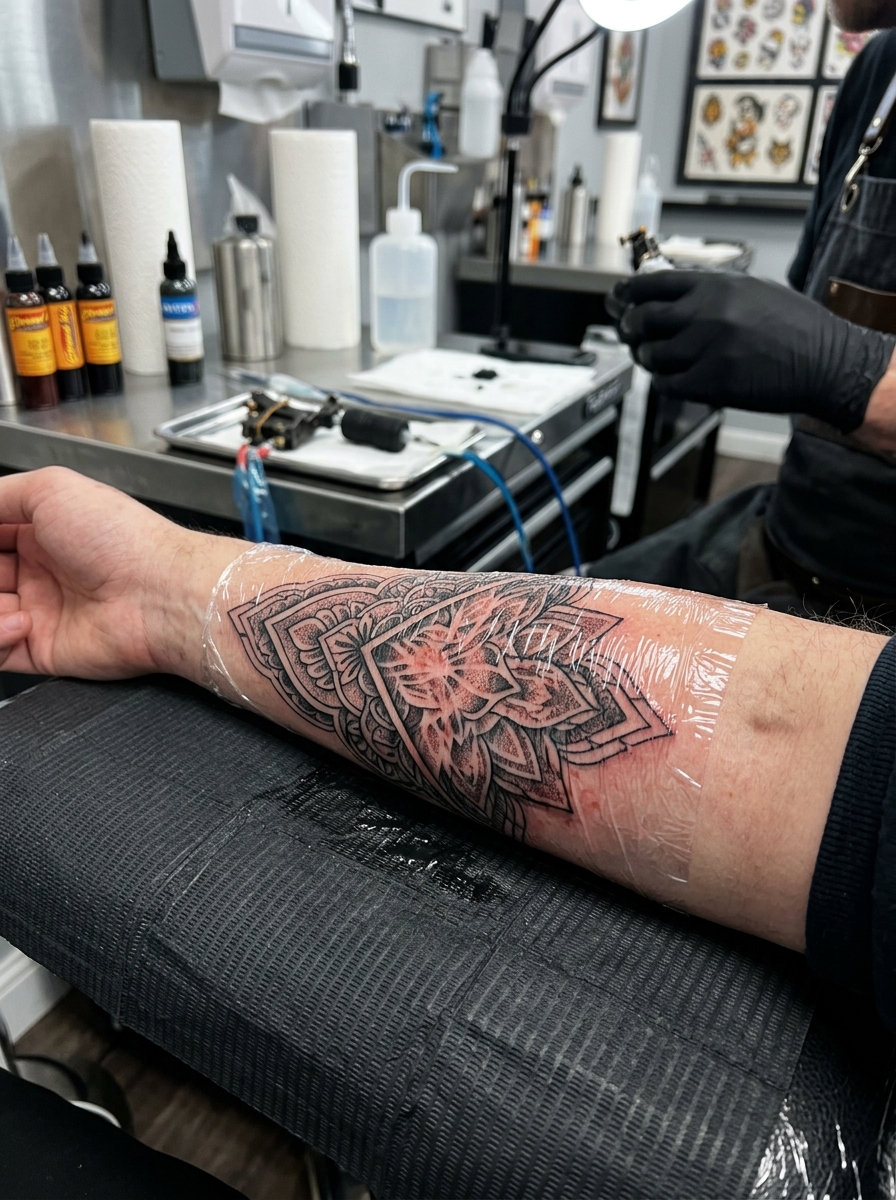
| Dotwork / mandala geometric | 3–8 hours, often split | Shoulder, thigh, chest | Well, if dots are packed properly | Large symmetrical statement pieces |
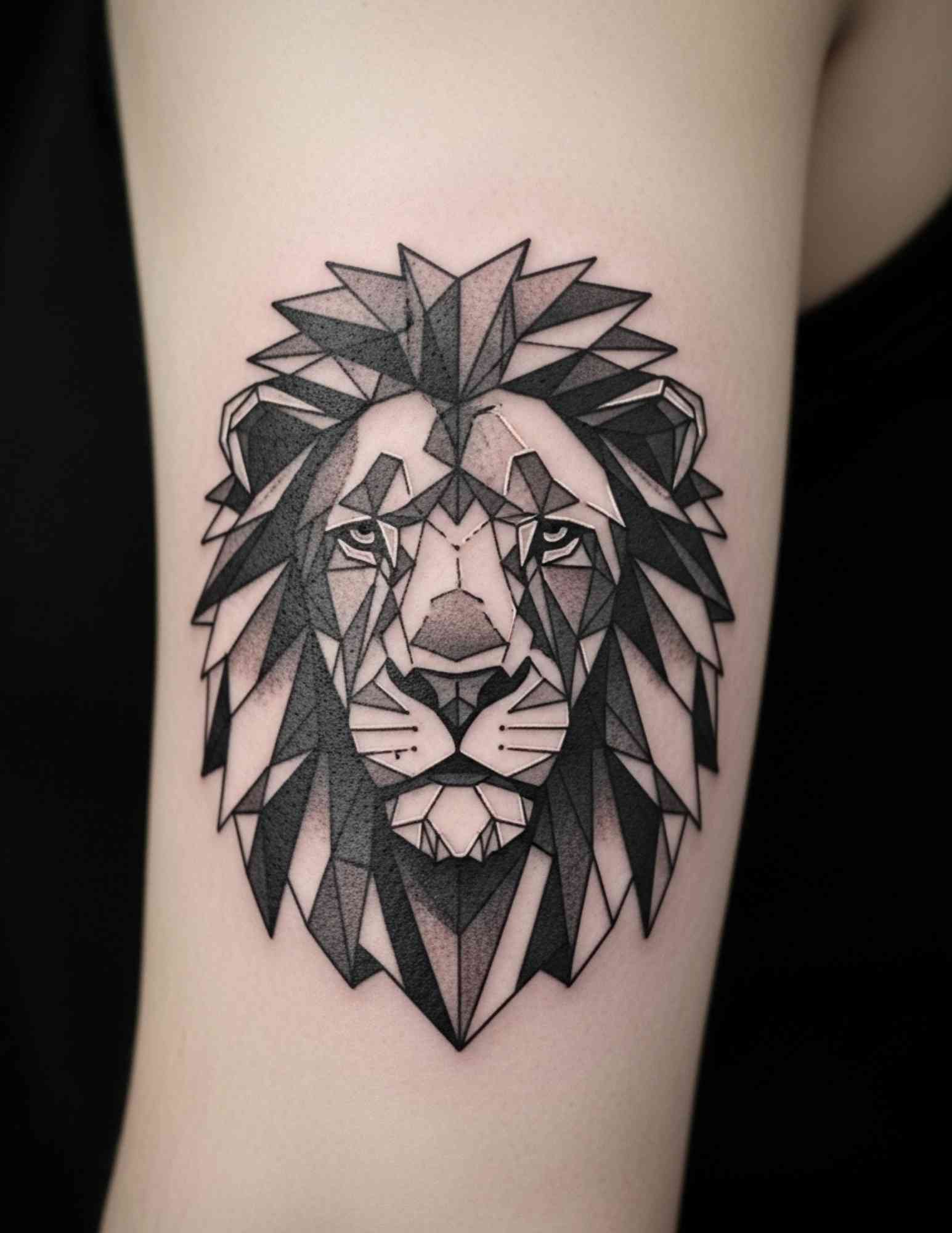
| Faceted animals (wolf, deer, skull) | 3–6 hours | Outer arm, calf, back | Very well — bold shapes hold | Bold, readable mid-size work |
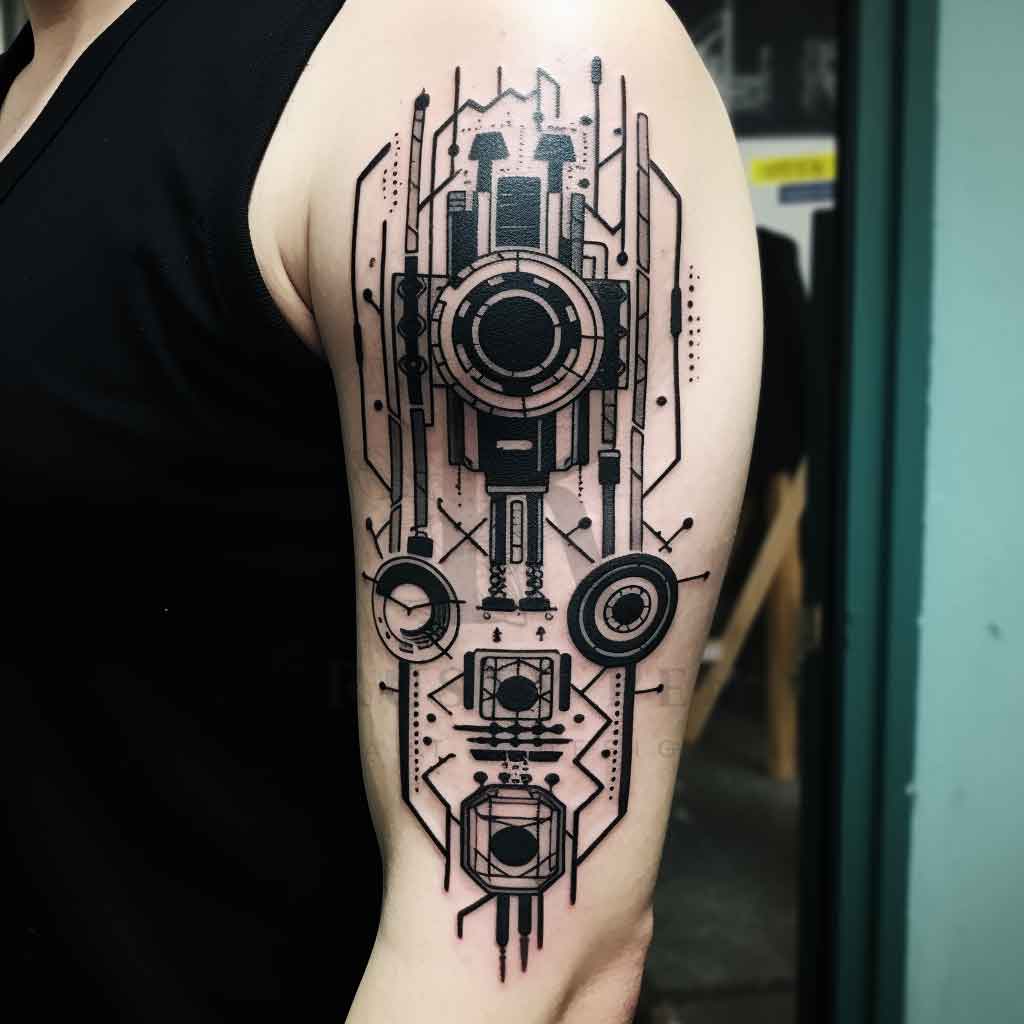
| Blackwork / ornamental bands | 2–5 hours per band | Upper arm, wrist, thigh | Best of the group | High-contrast, long-term pieces |
| Sacred geometry composites | 6–15 hours across sessions | Chest, full back, sleeve | Well, but crowding is the risk | Long-term projects with meaning |
What Actually Makes a Geometric Tattoo Age Well
Skin is not paper. It stretches, it moves, and ink spreads a little in every direction over the years — that spread is what softens a design.
Geometry punishes that spread more than almost any other style, because your eye is very good at spotting a line that has gone slightly crooked or a circle that has gone slightly oval.
In practice, three things decide the outcome: line weight, spacing between elements, and placement. Lines thinner than roughly a single-needle stroke and gaps smaller than a couple of millimetres are the two most common regrets I hear about.
Placement matters more than people expect. A ribcage or an inner bicep moves and folds constantly; a forearm, outer calf or shoulder blade is a far more stable canvas for anything symmetrical.
None of this means fine work is a mistake — it just means going in knowing that a delicate piece will likely need a touch-up sooner than a bold one. Most artists price a first touch-up cheaply or free within the first year, so it is worth asking before you book.
Geometric Tattoo Ideas Worth Stealing
These are the eight directions I see requested most often, with what each one actually asks of you.
1. Abstract Geometric Art
Pure abstraction — interlocking shapes with no representational subject at all. This is the most flexible option because the design can be shaped to fit the body part rather than the other way round.
It is also the easiest to get wrong. Without a recognisable subject, the composition has to carry everything, so I would only take this route with an artist whose portfolio already shows abstract work. If that direction appeals, abstract tattoo ideas covers the non-geometric side of it too.
Ask your artist to draw it on you, not on paper. Abstract compositions read completely differently once they wrap a limb.
2. Geometric Lotus
The lotus is the most common geometric request I come across, and there is a practical reason: it is naturally symmetrical, so it suits geometry without any forcing.
Most versions layer petals outward from a centre point, often inside a circle or triangle. Adding dotwork shading between petals gives depth without needing colour.
Expect two to four hours for a palm-sized piece. Sternum and spine placements photograph beautifully but are among the more painful spots, and the sternum in particular moves with every breath.
If you like the density but not the flower, mandala tattoo ideas scratch a very similar itch.
3. Minimalist Geometric
A few lines, maybe a circle, and a lot of empty skin. In my experience this is the single best first tattoo in the geometric family.
It is quick, it is cheap, and it heals fast. The catch is that minimal designs have nowhere to hide — one wobbly line is the whole tattoo.
Do not let anyone talk you into going smaller than about two inches. Shrinking a geometric design closes the gaps between lines, and closed gaps are what turn into a grey smudge a decade later.
More in this direction: minimalist tattoo ideas.
4. Geometric Tree of Life
Roots and branches mirrored around a centre, usually closed inside a circle. The symmetry is the point — it is a tree redrawn as a diagram.
The design carries a lot of meaning for people without being obvious about it, which is part of why it keeps coming back. It also scales well: it works at two inches on a forearm and at twelve on a back.
The main pitfall is branch density. Too many thin branches inside a small circle and the whole thing fills in over time. Ask for fewer, thicker branches than the reference you bring. Tree of life tattoos covers the non-geometric versions.
5. Geometric Skull
Skulls take to faceting better than almost any subject, because a skull already reads as a set of hard planes.
The strongest versions I have seen use solid black fill on some facets and leave others empty, so the contrast does the shading rather than grey wash. That approach also ages considerably better.
Budget three to six hours. This is a mid-size piece by nature — a geometric skull under about three inches loses the facet detail that makes it work.
6. Geometric Globe
A wireframe sphere with latitude lines, sometimes with continents picked out in dots. Popular with people who travel, and it stays subtle in a way most travel tattoos do not.
The difficulty here is curvature. Drawing a convincing sphere on a curved arm means the artist has to distort the grid deliberately, and not every artist will do that. Look for a portfolio with existing spheres or planets in it.
The outer forearm and the shoulder are the friendliest placements — both give you a fairly flat, stable surface.
7. Geometric Nature and Mountains
Pine trees, peaks and a sun, contained inside a triangle, circle or hexagon. This is probably the most-tattooed geometric idea of the last decade, which cuts both ways.
It is well-trodden, so almost any artist can execute it competently. It is also common enough that you will see it on other people, and some readers care about that.
If you want to keep the feel but avoid the cliché, ask for an unusual frame shape or a landscape you have actually stood in rather than a generic range.
8. Geometric Deer and Antlers
Deer sit in a nice middle ground: soft enough to feel gentle, angular enough that faceting suits them. Antlers give the design a natural frame.
Deer skull versions read much harder and pair well with ornamental geometry around the edges. Both work well on the outer arm or the calf.
One honest note — the antler tips are usually the first detail to soften, because they tend to be the thinnest lines in the piece. Ask for them slightly heavier than looks right on paper.
More Geometric Variations to Consider
If none of the eight above fits, these four are the directions I would look at next.
Fine Line Geometric
Hairline strokes, single-needle work, lots of negative space. The most delicate and the most fashionable of the geometric family.
I will be straight about this one: fine line work generally needs touch-ups sooner than anything else here, and some of it softens noticeably within a few years. If that trade is worth it to you, it is a lovely style — just size it generously.
Geometric Armbands and Bracelets
A repeating pattern banded around the wrist, bicep or thigh. Structurally the safest geometric tattoo you can get, because the bold shapes hold their edges.
The one thing that ruins an armband is a bad join. Where the pattern meets itself on the inner arm, the repeat has to line up — ask to see the stencil wrapped fully before the needle goes anywhere.
Heavier versions cross into blackwork territory, where the pattern is carried by solid fill rather than outline.
Geometric Wolf
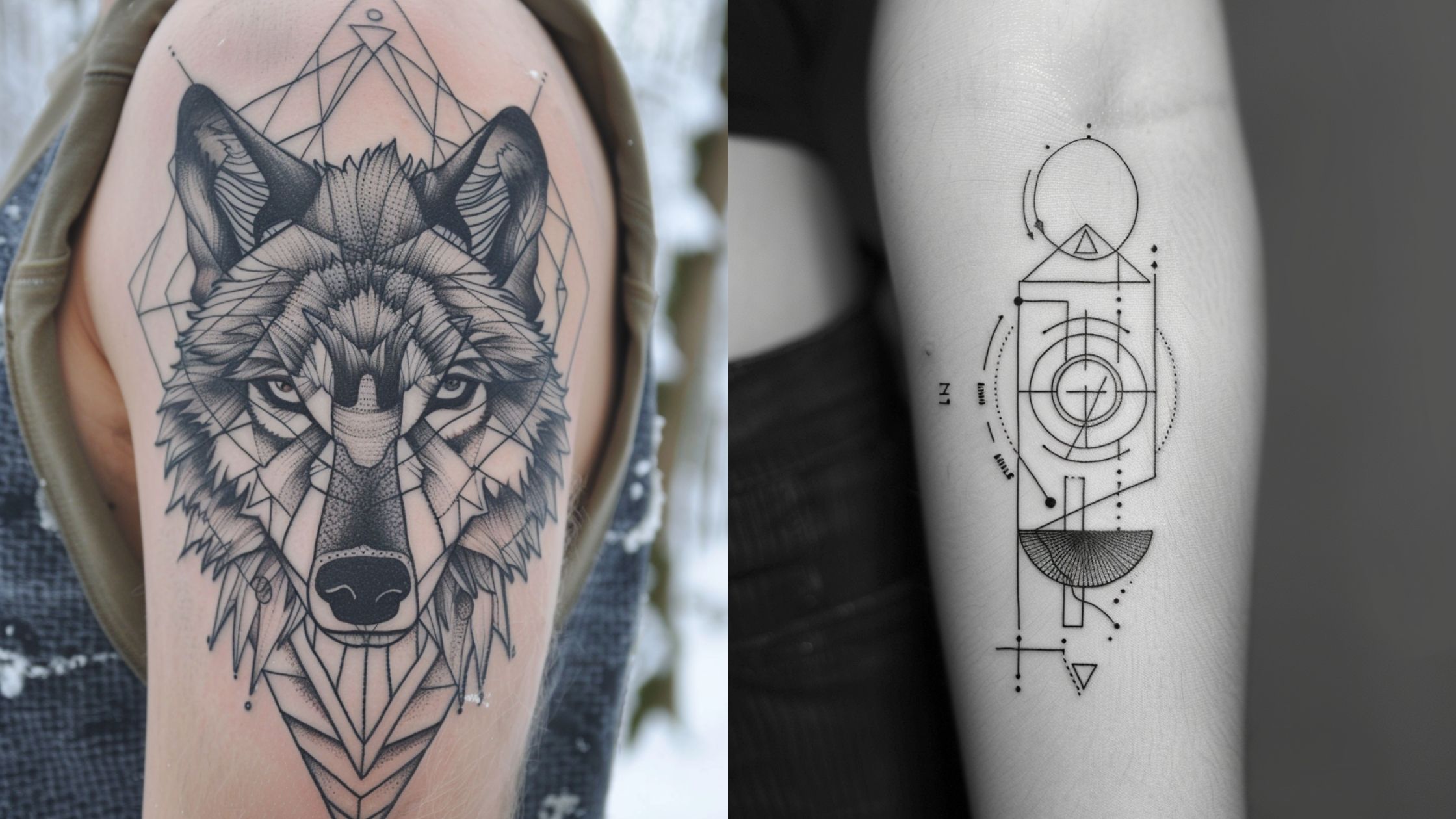
The wolf is the faceted-animal design people ask for most. Built from triangular planes, it reads clearly from a distance, which is more than most detailed tattoos manage.
Half-realistic, half-geometric splits are a common variation and look striking when the transition is deliberate rather than a fade. More options in wolf tattoo ideas.
Ornamental and Sacred Geometry Hybrids
Repeating patterns, mandala detail and sacred geometry motifs layered together, usually with no single subject at all.
These are long projects — often six to fifteen hours across multiple sittings — and they are worth planning as a whole rather than adding to piecemeal. Geometric tattoo ideas for men has more large-scale examples.
Getting a Geometric Tattoo That Stays Sharp
Vet the artist on straight lines, not on Instagram polish. Scroll their feed for long single lines and perfect circles — those are far harder to fake than shading.
Ask to see healed photos, not fresh ones. Fresh geometry always looks crisp; a healed photo at six months tells you whether their line work holds. In my experience artists who specialise in this style are happy to show them, and the ones who dodge the question are telling you something. If you are still narrowing down placement, forearm tattoo ideas is a good place to compare.
For healing, follow whatever aftercare your artist gives you over anything you read online, including this. The general consensus from dermatologists — the American Academy of Dermatology among them — is to keep a new tattoo clean, moisturised and out of direct sun, and to keep it out of pools and open water until it has fully healed.
Sun is the long game. UV exposure fades black ink and blurs edges over years, so sunscreen on a healed geometric piece is genuinely the cheapest touch-up prevention there is. And if something looks wrong while healing — spreading redness, swelling that increases after a few days, fever, or a rash — see a doctor rather than waiting it out. The US Food and Drug Administration notes that infections and allergic reactions to tattoo inks do happen, and they are treatable when caught early.
Common Mistakes — and What to Do If You Are Still Not Sure
Going too small is the mistake I see most. Geometric designs need breathing room between elements; shrink the design and you close those gaps.
The second is picking an artist by price rather than by portfolio. A crooked line cannot be fixed cheaply, and cover-ups on geometric work are genuinely difficult because the eye already knows what the shape was supposed to be.
The third is over-designing. Stacking a mandala, a landscape, an animal and a sacred geometry frame into one piece rarely reads well at arm’s length.
A useful test: view the design at the size it will be tattooed, from about two metres away. If it turns into a grey blob, simplify it.
Still deciding? Compare the delicate end of the spectrum at fine line tattoo ideas against the bold end at blackwork tattoo ideas, then pick the weight you want before you pick the subject.
Frequently Asked Questions
Do geometric tattoos age well?
Bold geometric work ages very well — often better than portraits or watercolour, because solid shapes tolerate a little ink spread. Fine line and dotwork geometry is more fragile and usually softens sooner, particularly at small sizes. The two biggest factors are line weight and the gap between elements. In my experience, anything with at least a couple of millimetres of clear skin between lines still looks like itself a decade on.
How much does a geometric tattoo cost?
Pricing depends far more on your city and the artist’s rate than on the style itself, so any single figure would be misleading. Most artists quote either an hourly rate or a flat price for the piece, and geometric work often takes longer than it looks because the stencil placement has to be exact. A small minimalist piece is typically a single short session; a full sacred geometry back piece is a multi-session project. Ask for a written quote and a session plan before you book.
Are geometric tattoos more painful than other styles?
The style itself is not more painful, but two things about it can make the session feel longer. Long straight lines mean sustained passes rather than short bursts, and heavy black fill or dense dotwork means going over the same skin repeatedly. Placement still matters more than style — ribs, sternum and inner arm are sore spots regardless of what is being tattooed. Tell your artist if you need breaks; nobody sits better by trying to tough it out.
Can a geometric tattoo be covered up or removed later?
Cover-ups on geometric work are harder than average because the original shapes are recognisable, so the new design usually has to be bigger and darker. Laser removal is possible but takes multiple sessions spread over months and is not guaranteed to clear the ink completely, especially with heavy black. If you are unsure about a design, that is a good reason to start smaller. Any removal should be discussed with a qualified practitioner or dermatologist rather than attempted at home.
What should I bring to my consultation?
Bring three or four reference images, a clear idea of placement, and an honest sense of your budget and how many sessions you can commit to. Photos of the actual body part help the artist plan around curvature. It also helps to say what you do not want — no colour, no realism, no script — since that narrows the design faster than listing what you like. Expect a good artist to change your idea somewhat; that is usually the design getting better.
Quick Summary
- Geometric tattoos succeed or fail on line quality — vet the artist on straight lines and circles, not on shading.
- Ask to see healed photos at six months or more, not fresh work.
- Do not go too small. Closed gaps between lines are what blur into grey over time.
- Bold styles — faceted animals, ornamental bands, blackwork — age best; fine line ages softest.
- Stable placements (forearm, outer calf, shoulder blade) suit symmetrical designs better than ribs or inner bicep.
- Sunscreen on healed work is the cheapest way to delay a touch-up.
- Follow your artist’s aftercare, and see a doctor for spreading redness, worsening swelling, fever or a rash.
- Plan large sacred geometry pieces as a whole rather than adding to them piecemeal.