Sacred geometry is the idea that a handful of mathematical patterns sit underneath everything — the packing of seeds in a sunflower head, the faces of a quartz crystal, the floor plan of a cathedral. A sacred geometry tattoo is not a picture of something; it is a diagram of a relationship, and that is exactly why it either lands perfectly or falls apart.
I have watched a lot of these heal over the years, and the pattern is consistent. The ones that still look extraordinary at year five were drawn by someone who treats a compass and a straightedge as real tools rather than a stylistic reference.
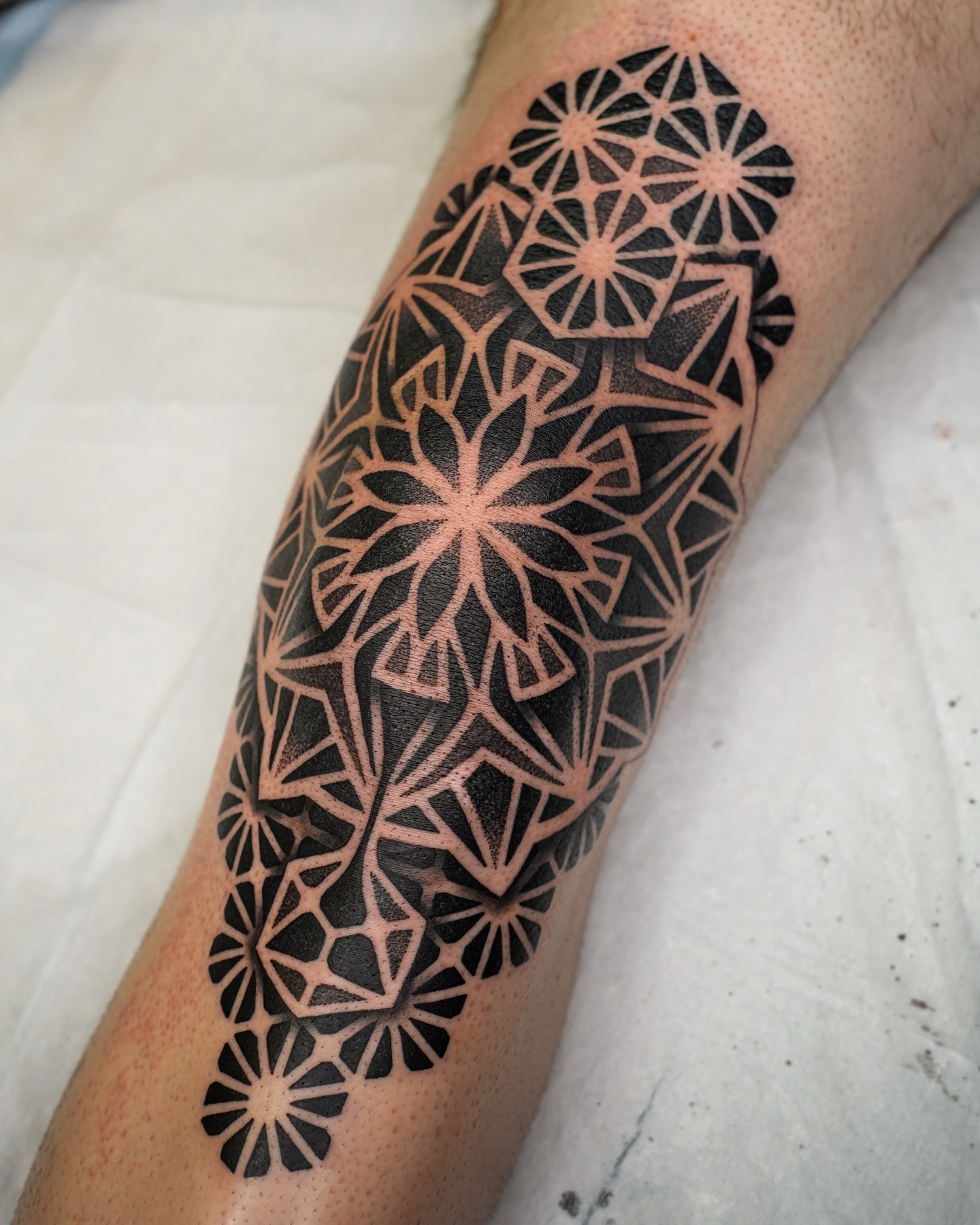
That is also why so much of this work overlaps with dotwork technique — stippled shading lets an artist build depth inside a geometric field without thickening the lines that define it.
Below are 20 ideas covering the core symbols, a few less familiar forms, and what I would actually ask an artist before booking any of them.
Which Sacred Geometry Symbol Is Right for You?
The symbols are not interchangeable. They come from different traditions, they demand different amounts of skin, and they age differently.
| Symbol | Tradition | Minimum size that works | Best for |
|---|---|---|---|
| Flower of Life | Found at Abydos, Egypt; later in European and Islamic ornament | Palm-sized and up | Forearm, shoulder blade, centre chest |
| Metatron’s Cube | Medieval Jewish mystical texts | Hand-span and up | Chest, upper back, outer thigh |
| Sri Yantra | Hindu tantric practice | Hand-span and up | Sternum, upper back, inner forearm |
| Merkaba | Jewish mysticism, adopted by modern esotericism | Small to medium | Forearm, calf, back of neck |
| Fibonacci spiral | Mathematics; named for Leonardo of Pisa | Small upward | Inner forearm, ribs, ankle |
| Platonic solids | Classical Greek geometry | Medium; five forms need room | Full forearm, spine, sleeve panel |
| Tree of Life (Kabbalah) | Jewish mystical tradition | Medium to large | Spine, back, upper arm |
Why Precision Matters More Here Than in Almost Any Other Style
With a rose, a wobbly line reads as character. With a hexagonal grid, a wobbly line reads as a mistake, because the eye is comparing every cell to every other cell in the same instant.
Geometry is self-checking — the design contains its own reference, so any deviation announces itself. That is the single biggest reason I tell people not to bargain-hunt on this style.
Skin also moves. A circle drawn on a relaxed inner bicep can distort when the arm is flexed, so a good artist will stencil, have you move, and re-stencil before a needle touches you.
Ink spread is the other long-game factor. Fine lines placed too close together will, over years, blur toward each other — which is why experienced geometric artists leave more negative space than a fresh photo suggests they should.
In my experience the artists who do this well are unusually happy to talk about the boring parts: stencil software, line weight in millimetres, how they handle a curve that crosses a joint. Enthusiasm about process is a good sign.
20 Sacred Geometry Tattoo Ideas
1. Flower of Life
Nineteen overlapping circles in a hexagonal arrangement, enclosed by a larger circle. It is the parent pattern — the Seed of Life, the Fruit of Life and Metatron’s Cube can all be traced out of it.
A version of it is carved into a wall at the Temple of Osiris at Abydos in Egypt, and related circle-grid ornament shows up across medieval Islamic and European decoration. Whatever you make of the metaphysics, the drafting problem is real: every circle has to be the same size and every intersection has to land.
When I have asked artists which sacred geometry piece they find hardest, this one comes up most often. Ask to see a healed photo, not a fresh one.
2. Metatron’s Cube
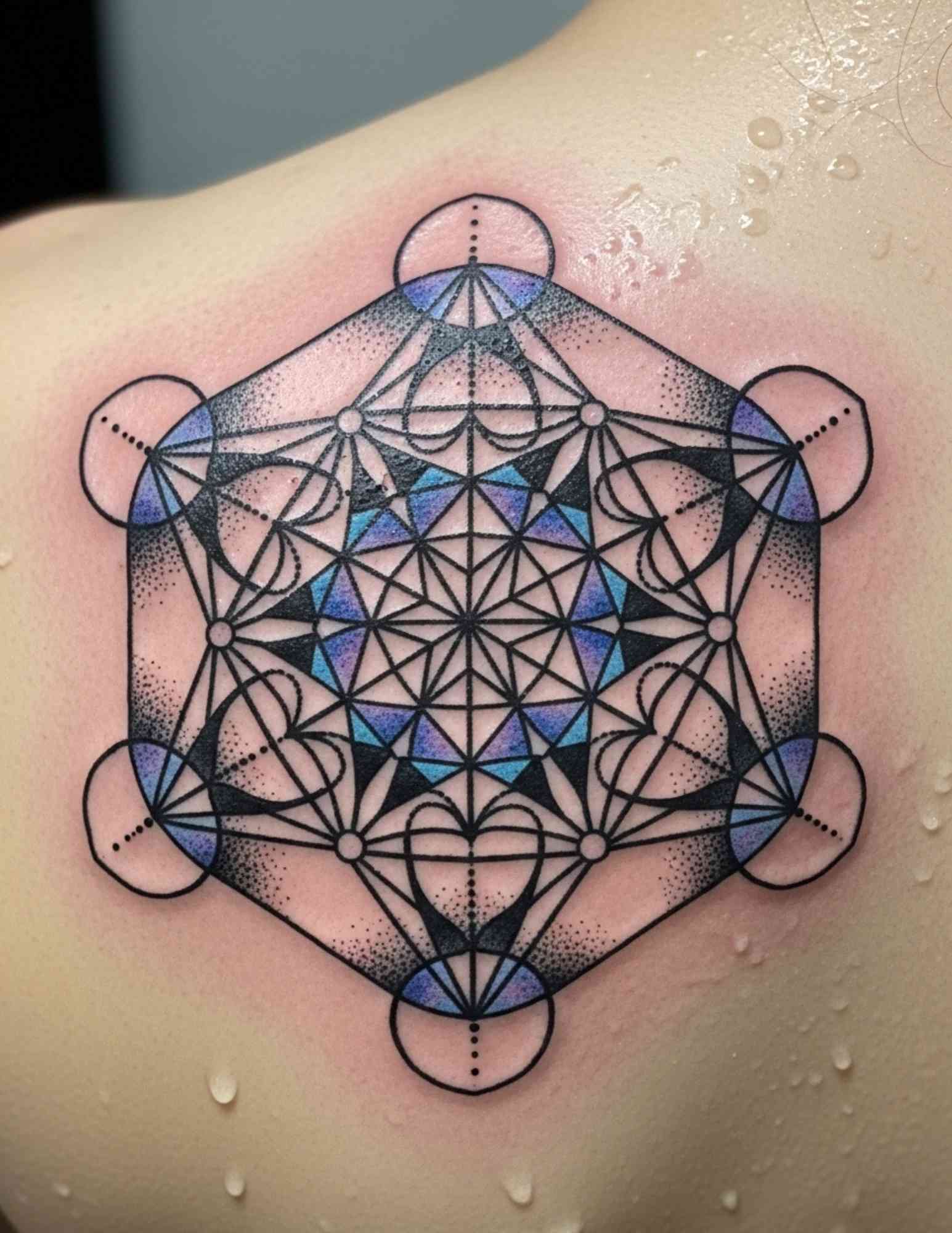
Built by connecting the centres of the thirteen circles of the Fruit of Life. All five Platonic solids can be found inside the resulting line figure, which is why it rewards staring at.
It needs scale. Compressed onto a small forearm patch, the interior lines crowd and eventually merge. As a chest piece or between the shoulder blades it stays readable for decades.
3. Sri Yantra
Nine interlocking triangles radiating from a central point, the bindu, ringed by lotus petals and a square border. It is a living object of devotion in Hindu tantric practice, not a decorative motif.
If the tradition matters to you, say so at the consultation — artists will often adjust placement advice accordingly. If it does not, be honest with yourself about wearing it anyway.
Technically it is brutal: the four upward and five downward triangles have to intersect at exact points, and a millimetre of drift is visible. Related devotional geometry appears in lotus mandala designs too.
4. Vesica Piscis
Two circles of equal radius, each passing through the other’s centre. The almond-shaped overlap is the vesica — the simplest sacred geometry form and the seed of most of the others.
This is the one I recommend most often to people getting their first geometric piece. It is small, it is cheap, and it tells you honestly whether your artist can draw a true circle.
Credit: @ndigaink
5. Merkaba
Two interlocking tetrahedra forming a three-dimensional star. In modern esoteric usage it is described as a light-body vehicle; historically the word traces back to the chariot imagery of Jewish mystical literature.
Rendered flat it is a clean geometric star. Rendered with shading on each face it reads as a solid object floating on the skin, which is the version most people are picturing.
6. Fibonacci Spiral
Quarter-circle arcs drawn through a run of squares whose sides follow the Fibonacci sequence — 1, 1, 2, 3, 5, 8, 13. The ratio between consecutive terms creeps toward the golden ratio, roughly 1.618.
A note on honesty: the claim that this spiral is everywhere in nature is overstated. It genuinely governs some phyllotaxis and shell growth; it does not govern faces, galaxies or the Parthenon, whatever the poster said.
It suits the inner forearm and the ribs, where a long curve has room to open.
Credit: @alices_tattoo
7. Platonic Solids
Tetrahedron, cube, octahedron, dodecahedron, icosahedron — the five convex solids whose faces are all identical regular polygons. Plato mapped them onto fire, earth, air, aether and water.
As a set they make a natural vertical column: five forms, evenly spaced, running the length of a forearm or either side of the spine. Individually, the dodecahedron and icosahedron carry the most visual weight.
Credit: @1mm.tattoo
8. Torus
A donut form generated by revolving a circle around an axis outside itself. It comes up constantly in energy-field diagrams, and it is one of the few sacred geometry motifs that needs real shading to read at all.
Drawn as concentric lines flowing over and through the ring, it produces a genuine sense of movement — closer to ornamental linework than to hard-edged geometry.
Credit: @justinryanxom
9. Seed of Life
Seven circles — one central, six around it — the first stage in constructing the Flower of Life. Traditionally read as the seven days of creation.
It is the practical choice when you want the Flower of Life’s language at a fraction of the size. Behind the ear, on the sternum, on the inner wrist, it stays crisp because there is far less line to blur.
Credit: @s.q.u.i.d.vicious
10. Golden Ratio Rectangle
The rectangle whose sides stand in the golden ratio, subdivided repeatedly into a square and a smaller golden rectangle. Strip out the spiral and you are left with the nested frame itself.
It is the most restrained option here — clean straight lines, no mysticism required — and it works well on the ribs or along the outside of a calf.
Credit: @kitsunebi_tattoo
11. Tree of Life (Kabbalah)
Ten sephirot connected by twenty-two paths, arranged in three columns. This is a specific diagram from Jewish mystical tradition, and it is worth knowing that before wearing it — it is not the generic branching tree it is often confused with.
The straight-line version reads as pure geometry. Hybrid designs that grow the diagram into an actual tree are common; if that appeals, our tree of life tattoo guide covers the softer variants.
Credit: @madonnastattoos
12. Icosahedron
Twenty equilateral triangular faces, the most complex of the Platonic solids and the one Plato assigned to water. Alone, at scale, it is a striking object.
Wireframe versions — every edge drawn, including the hidden ones — give you a dense field of triangles that reads beautifully in blackwork against solid fill.
13. Yantra
Beyond the Sri Yantra there is a whole family of yantras, each associated with a particular deity or intention, and each following its own strict construction rules with a square bhupura border and four gates.
If you want one of these, find an artist who knows the specific construction rather than one who will approximate it from a reference photo. The rules are the point.
Credit: @astratattooz
14. Enneagram
A nine-pointed figure inside a circle, formed from a triangle and an irregular hexagonal path. It reached the West through G. I. Gurdjieff’s teaching in the early twentieth century and later became the frame for the personality typology of the same name.
Small, clean and unusual — most people will not recognise it, which is either the appeal or the problem depending on your temperament.
15. Hexagonal Grid
The tessellation nature keeps returning to — honeycomb, basalt columns, the cell structure of a dragonfly’s wing. It is the most efficient way to tile a plane with equal shapes.
As a tattoo it works best when it fades: dense at the centre, dissolving into scattered cells at the edges. A solid slab of hexagons is a lot of black and, in my experience, harder to live with than people expect.
Credit: @weschetattoo
16. Star Tetrahedron
The Merkaba drawn flat — two overlapping triangles producing a six-pointed star, with the interior lines left in. Simpler to execute and simpler to read.
Good on the back of the neck, the sternum, or the outside of the ankle, where a compact symmetrical form has somewhere to sit.
17. Labyrinth
Not a maze — a labyrinth has one path with no choices, winding to the centre and back out. The classical seven-circuit form appears on Cretan coins; the eleven-circuit version is set into the floor of Chartres Cathedral.
It is one of the few sacred geometry forms that is genuinely about walking rather than seeing, which gives it a different weight as a tattoo.
18. Metatron’s Cube in Colour
Blackwork geometry over a wash of watercolour or a soft colour field behind the lines. The structure stays black; the colour never crosses it.
Be realistic about longevity. Soft colour washes fade faster than solid black, especially on skin that sees sun, so plan for the piece to look more like line work as the years pass.
19. Sacred Geometry Sleeve
A full arm built from connected forms — Platonic solids at the elbow, a Flower of Life field at the shoulder, spirals filling the gaps. Designed as one composition rather than assembled piece by piece.
This is multi-session work and it needs an artist who plans the whole arm on paper first. Our geometric sleeve ideas and mandala sleeve designs show how the wrap-around problem gets solved.
20. A Form Personal to You
Most people who spend time in this material end up attached to one or two forms specifically — something they keep drawing, or keep noticing.
That is a better basis for a tattoo than picking whichever symbol is most saved on Pinterest this year.
Variations Worth Considering
Negative-space geometry
Instead of drawing the lines, black out the surrounding field and let untouched skin form the symbol. It ages well because there are no fine lines to blur — but it is close to irreversible, so be certain.
Geometry framing something else
A Flower of Life field behind a portrait, or a Metatron’s Cube framing a botanical piece. The geometry does the structural work and the subject does the emotional work.
Split and mirrored placements
Half a symmetrical form on each forearm, or a mirrored pair either side of the spine. It only works if your artist stencils both sides in one sitting.
Single-needle micro geometry
Very small, very fine versions on the wrist, finger or behind the ear. Honest caveat: at that scale these need touching up sooner than most other work, and some artists will not take the booking for that reason.
Placement, Healing and Aftercare
Pick flat, stable skin where you can. Geometry sits best on the outer forearm, upper back, chest, outer thigh and calf — anywhere the surface does not fold sharply when you move.
Sessions on this style tend to run long, because stencilling and re-stencilling eats real time before the needle starts. If sitting is the part you are worried about, our tattoo pain management tips are worth reading first.
Follow the aftercare your artist gives you rather than a routine from the internet, keep the area clean, and stay out of the sun while it heals. Sun is the main long-term enemy of fine geometric line work — sunscreen on a healed piece is not fussiness, it is maintenance.
If you see spreading redness, swelling that worsens after the first few days, pus, or a fever, contact a doctor rather than waiting it out. The FDA’s guidance on tattoos and permanent makeup covers infection and allergic reaction risk; nothing in this article is medical advice, and an artist or physician who can look at your skin beats any guide.
Common Mistakes — and What to Do If You’re Still Not Sure
The most common mistake is going too small. Interior detail that looks fine in a stencil closes up as ink settles, and there is no fixing it later without a cover-up.
The second is hiring on price. This is the wrong style to save money on — a general artist can produce a beautiful rose and still not have the hand for a true circle.
The third is wearing a devotional diagram with no idea what it is. You do not need to belong to a tradition to appreciate its geometry, but you should at least be able to say what you are wearing.
Still undecided? If it is the meaning drawing you rather than the maths, browse spiritual tattoo ideas. If it is the pattern-making, the geometric cyberpunk direction scratches a similar itch with none of the theology.
Frequently Asked Questions
Do sacred geometry tattoos age well?
They can age very well, but they are less forgiving than most styles. Solid, well-spaced lines hold their shape for many years, while dense fine linework packed tightly together tends to soften and merge as ink spreads under the skin. The main variables are line weight, spacing and sun exposure. In my experience the pieces that still look sharp after a decade were drawn slightly bolder and slightly more open than the owner originally wanted.
How much do sacred geometry tattoos cost?
Prices vary far too much by city, artist and size for any figure here to be useful. What is consistent is that this style takes longer than it looks — stencilling, checking alignment and re-stencilling can consume a large share of the session before any ink goes in. Expect to be quoted for that drafting time as well as the tattooing. Ask for a session estimate rather than a per-hour number.
Is it disrespectful to get a Sri Yantra or a Kabbalistic Tree of Life?
Opinions differ, including within the traditions themselves, so there is no single answer. Both are functional religious diagrams rather than decorative motifs, and some practitioners have views about where on the body they should sit. The reasonable middle ground is to learn what the symbol actually is, decide honestly whether that meaning is yours to wear, and raise it with your artist. Plenty of artists have thought about this more than you would expect.
What should I ask an artist before booking?
Ask to see healed photographs of geometric work, not just fresh ones, and ask for close-ups rather than gallery shots. Ask how they draw circles and how they handle a design crossing a joint. Ask what line weight they are planning and why. An artist who is comfortable with those questions is usually the one you want.
Can a sacred geometry tattoo be covered up or removed later?
Cover-ups are difficult because geometric lines are regular, so the eye finds them under new work unless the cover is quite dark and dense. Laser removal is possible but it is a course of treatments over months, and results depend on ink, depth, colour and your skin. Both routes are jobs for professionals — a licensed removal clinic or an experienced cover-up artist — and neither should ever be attempted at home.
Quick Summary
- Sacred geometry tattoos are diagrams, so precision matters more than in almost any other style.
- Start with the Vesica Piscis or the Seed of Life if this is your first geometric piece.
- Metatron’s Cube, the Sri Yantra and the Tree of Life all need real scale to stay readable.
- Go slightly bolder and more open than the reference photo suggests — ink spreads over the years.
- Flat, stable skin ages best: outer forearm, upper back, chest, outer thigh, calf.
- Learn what a devotional symbol means before wearing it, and say so at the consultation.
- Ask for healed close-ups of geometric work before you book anyone.
- Sunscreen on healed line work is maintenance, not vanity.