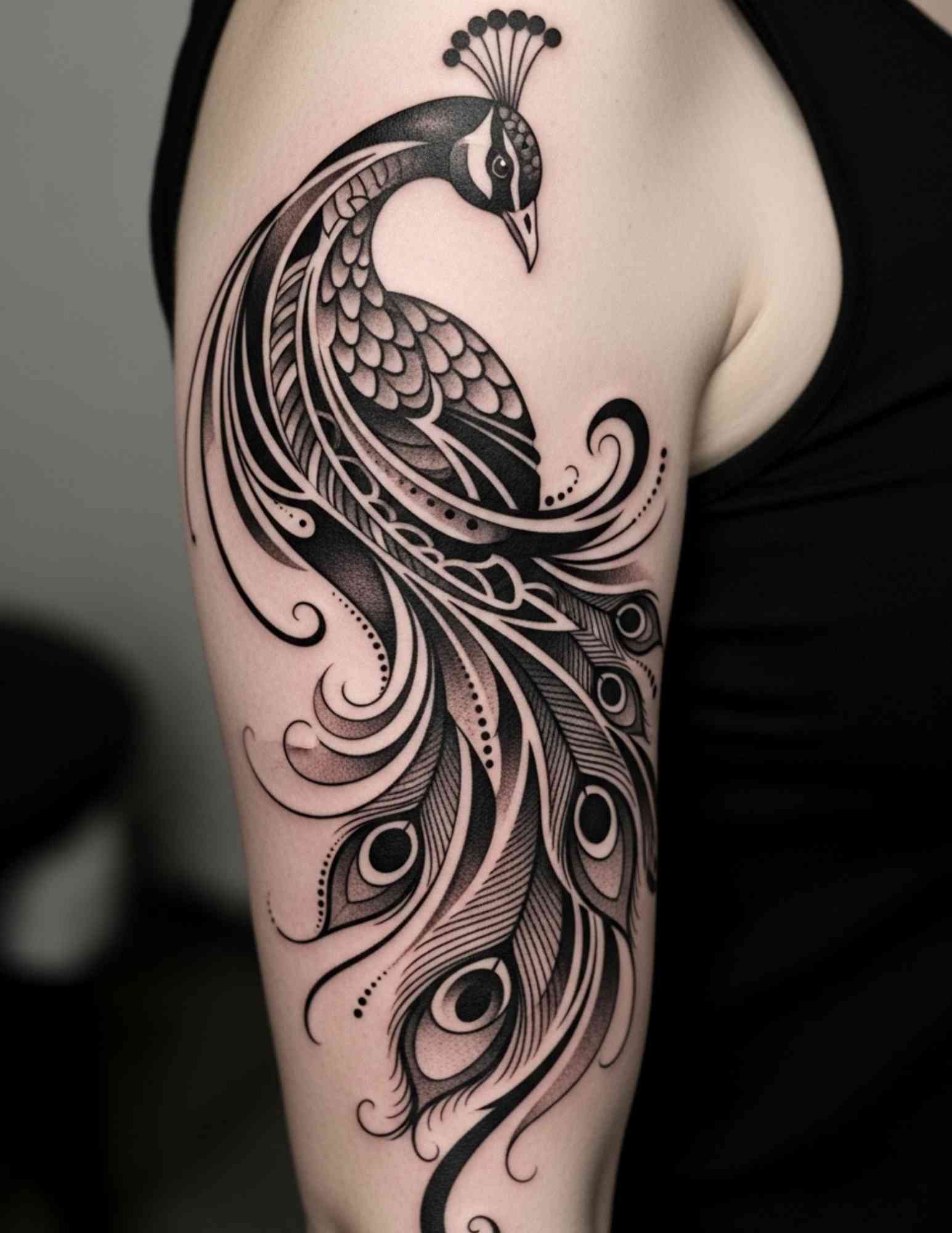
Peacocks are the one animal where the tattoo can genuinely be as loud as the bird, and that is exactly where most designs go wrong. A peacock tattoo lives or dies on how much space you give the tail, not on how many colours you cram into it.
I have watched a lot of people walk into consultations with a reference photo of a full open fan and a spot on their forearm in mind, and the honest answer is usually that one of those two things has to change. The bird is built around a display that is wider than it is tall, and skin does not always cooperate.
What follows is a working guide rather than a gallery caption reel — which styles hold up, which placements actually fit the shape, and what to expect from the colour over time. If you are still deciding between animals entirely, the meanings behind different bird tattoos are worth reading first.
Every design below is a real approach I have seen executed well, with the trade-offs named rather than glossed over.
Which Peacock Tattoo Style Is Right for You?
Style choice matters more than subject choice here. The same peacock rendered two ways will age completely differently.
| Style | What It Looks Like | Best Placement | How It Tends to Age |
|---|---|---|---|
| Full-colour realism | Photographic bird, packed teal and gold, subtle gradients | Back, thigh, full sleeve | Softens noticeably; needs the most touch-up attention |
| Neo-traditional | Bold outlines containing saturated jewel tones | Shoulder, outer arm, thigh | Very well — the linework holds the shape as colour fades |
| Japanese-influenced | Stylised bird with background elements and heavy structure | Back, full sleeve, ribs to hip | Excellent, provided the black is committed to |
| Blackwork | Solid black shapes, no colour at all | Almost anywhere | The most predictable option on this list |
| Dotwork | Feathers built from stippled dots and open space | Spine, forearm, calf | Well, though dots can merge slightly over many years |
| Watercolour | Loose splashes and bleeds, often with no outline | Shoulder blade, upper arm | The least predictable; anchor it with linework |
| Fine line | Thin single-weight linework, minimal or no fill | Forearm, ankle, ribs | Lines thicken and soften; keep detail spaced out |
If none of those terms are familiar, our breakdown of tattoo styles explained covers what separates them in practice.
Why Peacock Tattoos Are Harder Than They Look
The peacock is one of the few subjects where the reference photo actively works against you. Photographs capture iridescence, and iridescence is a structural effect — the feather barbs scatter light rather than holding pigment.
Tattoo ink cannot do that. It can only imitate the result with careful colour placement, which means a good peacock tattoo is really an exercise in controlled colour transitions rather than accurate colour matching.
In my experience, the artists who handle this well are the ones who reduce the palette rather than expand it. Three or four well-separated hues with clean value shifts read as iridescent from two metres away. Nine hues read as mud.
The second problem is shape. A displaying peacock is a wide arc, and very few areas of the body are wide arcs. Backs are, upper chests roughly are, and thighs can be persuaded to be. Forearms are not.
The third is time. A colour-packed back piece is multi-session work, and colour packing is genuinely uncomfortable because the same skin gets worked repeatedly. That is worth planning for rather than discovering.
It is also worth reading the FDA’s fact sheet on tattoo inks if you have reacted to pigments before — red and some coloured inks are the ones most often associated with delayed reactions.
19 Peacock Tattoo Ideas Worth Considering
These are grouped by approach rather than numbered arbitrarily, because the approach is the decision you actually have to make with your artist.
1. Full-Fan Back Pieces
This is the design the bird was made for. The open tail fills the shoulder blades and upper back, and the body sits low and central.
The reason it works is proportion. A back gives you roughly the same aspect ratio as the display itself, so nothing has to be compressed or cropped to fit.
Expect this to be a multi-session commitment. The outline and body might come first, with the feather eyes and colour built up over subsequent sittings, and it is normal for a piece like this to run across several months.
In my experience the pieces that hold up best keep some breathing room between feathers rather than filling every gap. If you are weighing up the placement generally, our guide to back piece tattoo ideas covers how the area handles large work.
2. Feather Sleeves and Long Vertical Pieces
If the full fan will not fit, a single tail feather often will. Feathers are naturally long and narrow, which is the exact shape a forearm, calf or spine offers.
The eye of the feather becomes the focal point, usually placed where it will be seen most — near the wrist on a forearm, or between the shoulder blades on a spine piece.
A single feather is not a compromise design. Done at a decent size, with real attention to the barbs, it often reads better than a cramped full bird.
One practical note: barbs need space. When they are drawn too close together they merge as the tattoo settles, and the feather turns into a solid shape.
3. Single Feather and Small-Scale Designs
Smaller feather designs on ribs, ankles and inner forearms are the most common peacock request I come across, and the most commonly over-detailed.
At small scale, detail is the enemy. Every artist I have asked about small feather work says the same thing — simplify the barb pattern, keep the eye clean, and let the negative space do the work.
Muted colour tends to suit small pieces better than full saturation. A soft teal and a warm gold, without the full spectrum, keeps the design from looking busy.
For related fine-scale ideas, our collection of feather tattoo ideas shows how different feather types behave at small sizes.
4. Japanese-Influenced and Neo-Traditional Peacocks
Both of these styles solve the peacock’s ageing problem the same way — by putting a strong black structure underneath the colour.
Japanese-influenced work tends to stylise the bird rather than reproduce it, often placing it among wind bars, waves or florals so the composition flows with the body.
Neo-traditional keeps the bold outline but pushes the palette into jewel tones, which happens to suit a peacock unusually well.
If you want a piece that will still read clearly in twenty years, this is the direction I would point you in first.
5. Blackwork and Dotwork Peacocks
Removing the colour entirely sounds like it defeats the point. In practice it often produces the most striking version of the design.
Blackwork relies on shape and contrast, so the silhouette of the fan does the work that colour would otherwise do. Dotwork softens the same idea, building feather texture from stippling.
Dotwork is slow. A feather that looks light and airy can take considerably longer than a solid-shaded equivalent, because every dot is placed individually.
Black and grey is the most reliable long-term choice for a peacock, and it is worth at least considering before committing to full colour.
6. Watercolour and Abstract Interpretations
Watercolour peacocks lean into the splash and bleed of loose colour, usually behind or around a lightly lined bird.
The honest caveat: watercolour without any linework underneath is the least predictable style on this page. Colour that has nothing containing it tends to soften and spread as it settles.
When I have seen watercolour peacocks age well, there was almost always a fine black or dark line structure holding the bird together, with the splashes acting as background rather than as the subject.
Abstract versions go further and suggest the bird with shapes and colour blocks alone. If bright work appeals to you generally, our colourful tattoo ideas gallery is a useful reference point.
7. Geometric and Mandala Peacocks
The peacock’s tail eye is close to a natural mandala, which is why the two combine so easily.
Geometric treatments frame the bird inside triangles, circles or line grids, or replace the feather barbs with repeated geometric marks.
These pieces depend entirely on precision. A slightly wobbly mandala is far more visible than a slightly wobbly feather, so it is worth seeking out an artist who specialises in it rather than one who occasionally does it.
The same principles apply at larger scale — our mandala sleeve ideas show how the geometry carries across a full limb.
8. Peacocks Paired with Other Symbols
Lotus flowers, snakes, roses and moons all appear alongside peacocks regularly, and each changes the reading of the piece.
The practical rule is one focal point. The peacock is already visually dominant, so a second element should support the composition rather than compete with it.
Florals work particularly well for this because they fill negative space at the edges of the tail without demanding attention themselves.
In my experience, pairings go wrong when both elements are rendered at the same level of detail. Let one recede.
Variations Worth Considering Before You Book
Whole Bird or Just the Feather?
This is the single biggest decision, and it is mostly a question of available space. Under roughly a hand’s width, the feather almost always wins.
A feather also carries most of the same symbolism — the eye, the association with watchfulness and renewal — without needing the body of the bird to sell it.
Colour or Black and Grey?
Colour is the obvious choice and the higher-maintenance one. Black and grey is the quieter choice and the one that asks less of you over the following decade.
A middle path exists: black and grey bird with colour restricted to the feather eyes only. It reads as a colour piece from a distance and ages closer to a black and grey one.
Where Does It Actually Fit?
Back, outer thigh and full sleeve handle a whole bird. Forearm, calf, spine and ribs handle a feather.
Chest and shoulder sit in between — a bird in profile with a partially furled tail often works there where a full display would not.
Placement also affects how much the session hurts, which our tattoo pain management guide goes into properly.
Getting a Peacock Tattoo That Lasts
Colour-packed work asks more of the healing process than line work does, mostly because more of the skin has been worked over.
Follow the aftercare your artist gives you rather than anything you read online, including this page — they know what they put in your skin and how heavily they worked it. The American Academy of Dermatology’s guidance on caring for tattooed skin is a reasonable general baseline.
Sun exposure is the main long-term threat to colour. Once the tattoo is fully healed, sunscreen over it is the cheapest thing you can do to slow fading, and it matters more for teal and gold than it does for black.
Expect to need a touch-up. Large colour pieces frequently need one after healing, and reputable studios often build that into the price. Ask about it up front rather than assuming.
If anything about the healing looks wrong to you — spreading redness, increasing pain after the first few days, discharge, or a rash that appears weeks or months later — contact your artist and see a doctor rather than waiting it out. Delayed reactions to coloured pigments are uncommon but real, and they are a medical question rather than a tattooing one.
Common Mistakes and How to Avoid Them
The most frequent one is scale. People choose a placement first and a design second, then ask the artist to make the design fit. It rarely survives the compression.
The second is bringing a photograph as the design brief. A photo is a reference for colour and mood; it is not a tattoo, and a good artist will redraw it rather than trace it.
The third is picking an artist by price rather than by portfolio. Colour realism and dotwork are genuinely different skill sets, and very few artists are excellent at both.
Still weighing it up? It may help to look at how other large colour subjects are handled — the phoenix tattoo ideas collection covers a bird with similar composition problems and different solutions.
Frequently Asked Questions
How much does a peacock tattoo cost?
There is no honest flat answer, because it depends on size, colour, your artist’s rate and your region. A small single feather is typically a single short session, while a full-colour back piece is multi-session work and priced accordingly. The useful move is to get a quote from two or three artists whose portfolios you actually like, rather than shopping on price. Ask whether a touch-up is included, because on large colour work that answer varies a lot between studios.
Do peacock tattoos hurt more than other tattoos?
The subject does not change the pain, but the approach does. Colour packing means the same area of skin gets worked repeatedly in one sitting, which most people find more wearing than outline work. Placement matters far more than design — ribs, spine and inner arm are widely reported as tougher than outer thigh or outer arm. Breaking a large piece into shorter sessions is a reasonable request and most artists will accommodate it.
Will the colours fade?
All tattoo ink changes over time, and bright colours generally show that change more visibly than black does. Teal, gold and other bright hues will soften, particularly with sun exposure. Sunscreen on healed work and an occasional touch-up will keep a colour peacock looking sharp for far longer than doing nothing. If low maintenance matters to you, black and grey or neo-traditional with strong outlines is the safer bet.
What does a peacock tattoo mean?
Meanings vary a lot by culture, so it is worth choosing the one that matters to you rather than accepting a generic list. Broadly, peacocks are associated with renewal and rebirth because they moult and regrow their train each year, and the feather eyes have long been linked with watchfulness. In Hindu tradition the peacock carries specific religious associations, and it is the national bird of India. If a design draws on a particular tradition, it is worth understanding that context before committing to it.
Can a peacock tattoo cover a scar or an old tattoo?
Often yes, because the spread tail gives an artist a lot of shape and texture to work with, which is exactly what cover-ups need. Whether it will work for your specific case is a question only an artist can answer in person, after seeing the existing tattoo or scar. Cover-ups usually require darker and more saturated ink than a fresh piece, which can limit how light and airy the design can be. For scar tissue in particular, make sure the scar is fully mature and get your artist’s read on whether it will hold ink evenly.
Quick Summary
- The tail is the design — pick a placement wide enough to hold it, or switch to a single feather instead.
- Backs, outer thighs and full sleeves suit the whole bird; forearms, calves, spines and ribs suit feathers.
- Fewer, well-separated colours read as iridescent. A crowded palette reads as mud.
- Neo-traditional and Japanese-influenced styles age best because black linework holds the shape.
- Blackwork and dotwork are the most predictable long-term options if low maintenance matters.
- Watercolour needs some line structure underneath it, or the colour has nothing containing it.
- Budget for multiple sessions and a likely touch-up on any large colour piece, and ask what is included.
- Follow your artist’s aftercare, keep healed work out of direct sun, and see a doctor if healing looks wrong.