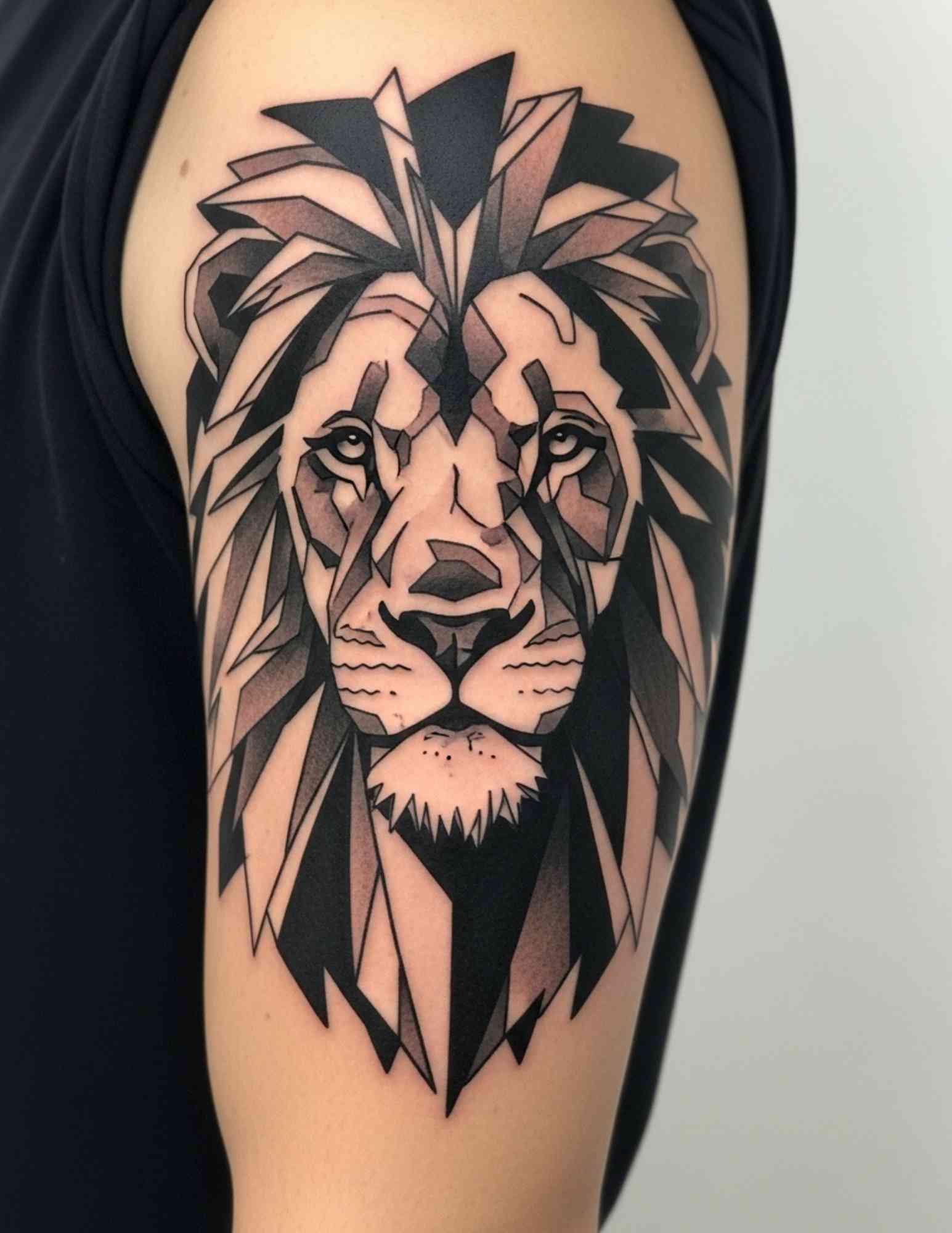
A geometric lion tattoo is the only version of this subject where the artist’s precision is as visible as the animal’s power. Strip a lion down to planes and angles and there is nowhere left to hide a wobbly line.
I have spent a lot of time looking at lion tattoos, and the geometric ones divide sharply into two piles: the ones that were designed, and the ones that were decorated.
The difference is almost always structural. In my experience the successful pieces start from the underlying skull and mane shape and then break that form into facets, rather than drawing a lion first and scattering triangles over the top afterwards.
What follows is the range of what this style can actually do, from a wrist-sized minimal head to a full chest piece. If you are still deciding on the animal itself, it is worth browsing broader lion tattoo ideas before committing to a geometric treatment.
Which Geometric Lion Approach Is Right for You?
Four broad approaches cover most of what artists are producing in this style. They differ in how much skin they need, how much they cost, and how well they hold up over decades.
| Approach | Smallest size that works | Typical sitting | How it ages |
|---|---|---|---|
| Minimal line facets | Around 5–7 cm | 1–2 hours | Very well if the lines are not hairline thin |
| Low-poly faceted head | Around 10–12 cm | 3–5 hours | Well, though fine internal facets soften first |
| Dotwork-shaded geometric | Around 12–15 cm | 5–8 hours, often split | Lightest stipple can fade; mid-tones hold |
| Solid blackwork geometric | Around 10 cm | 4–7 hours | Best of the four, but hardest to cover later |
Sizes here are rough guidance from designs I have watched artists lay out, not fixed rules. Your artist’s line weight changes all of these numbers.
Why the Geometric Treatment Suits the Lion
The lion is already a symbol about order rather than chaos. Heraldry put lions on shields precisely because the animal stood for sovereign authority, not wildness.
Faceting the animal amplifies that reading. A geometric lion looks carved rather than caught, and carving implies a decision was made about every edge.
There is a practical reason too. Realistic lion fur is one of the harder things to tattoo convincingly, and it is one of the first things to blur as a tattoo settles over ten or fifteen years.
Flat planes and clean edges do not have that problem in the same way. Every artist I have asked about long-term legibility says the same thing: structure survives, texture does not.
The trade-off is that geometry is unforgiving. The eye detects an angle that should have matched its neighbour and did not, even when the viewer cannot say what is wrong. If you want the wider context on how the style behaves across subjects, the general geometric tattoo designs guide covers the mechanics.
The Geometric Lion Designs Worth Considering
Sacred Geometry and Mandala Framing
The most common composition places the lion’s head at the centre of a circular framework: concentric rings, a Flower of Life lattice, or a full radial mandala where the petals double as the mane.
It works because the mane is already radial. You are not imposing a shape on the animal; you are formalising one it already has.
When I have seen this go wrong, it is almost always because the mandala was drawn at the same visual weight as the face. The face then stops reading as a face at arm’s length and the whole piece flattens into pattern.
Ask for the face to sit at least one line-weight heavier than the surrounding geometry. That single adjustment is usually the difference between a design that reads from across a room and one that only works in a photograph. The same weight hierarchy is what makes lotus mandala tattoo compositions hold together.
The Split: Half Realistic, Half Geometric
One side of the face is rendered in black and grey realism; the other dissolves into flat planes, usually with a diagonal or vertical seam down the muzzle.
It is the most conceptually loaded option on this list, and also the most expensive, because you are paying for two different skill sets in one sitting.
The thing worth knowing before you book it: the two halves age at different rates. Soft realistic shading loses contrast faster than hard geometric edges, so a split piece that is perfectly balanced on day one will usually favour the geometric half after a decade.
That is not a reason to avoid it. It is a reason to ask your artist to push the realistic side slightly darker than looks right in the stencil.
Dotwork Fill Inside the Planes
Instead of solid fill or smooth grey wash, each facet is shaded with stippling of varying density.
Up close you see the construction. From two metres away it reads as tone. That double reading is the whole appeal of dotwork on a geometric subject.
It is slow work. When I have watched dotwork artists fill a lion mane, the session runs considerably longer than a whip-shaded equivalent of the same size, and it is worth budgeting for that rather than being surprised at the end.
Be honest with your artist about how thin you want the lightest passages. Very sparse stipple on high-friction skin does not always hold, and a good dotwork tattoo specialist will tell you where they would rather not go too light.
Blackwork at Full Contrast
No grey at all. The darkest planes go solid black, the lightest are left as bare skin, and everything reads as pure shape.
This is the version that holds up best over twenty or thirty years, for the simple reason that solid black has the most pigment in it and the least to lose.
The catch is permanence in a less welcome sense. Large solid black areas are the hardest thing to cover up or lighten later, so this is not the approach for someone who is only fairly sure about the design.
If you know you want it, it is the strongest choice here. The broader blackwork tattoo designs guide is worth a look for how solid fills behave on different body parts.
Geometric lion designs and the prompts behind them
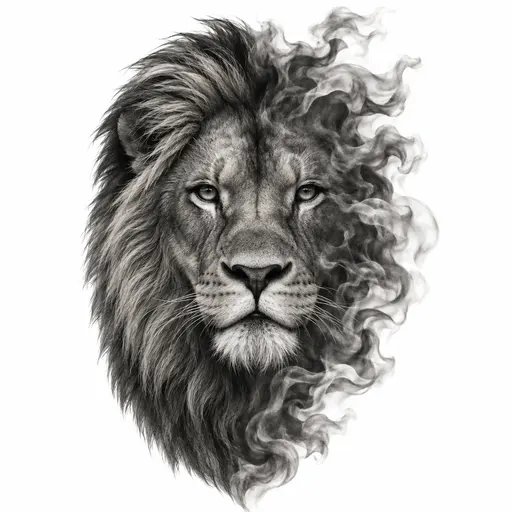
A lion's face in soft morning light, half of its mane dissolving into smoke
Use this idea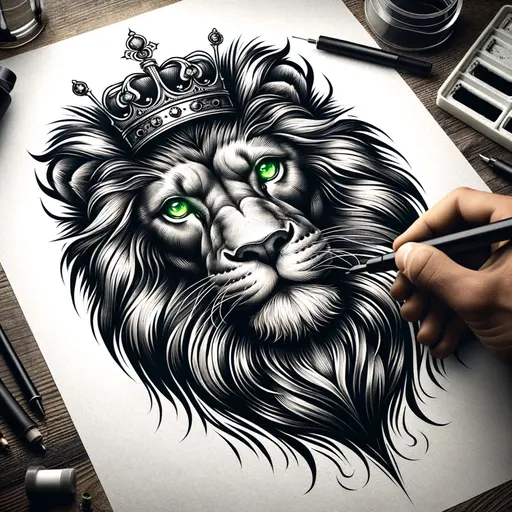
Lion with crown and green eyes
Use this idea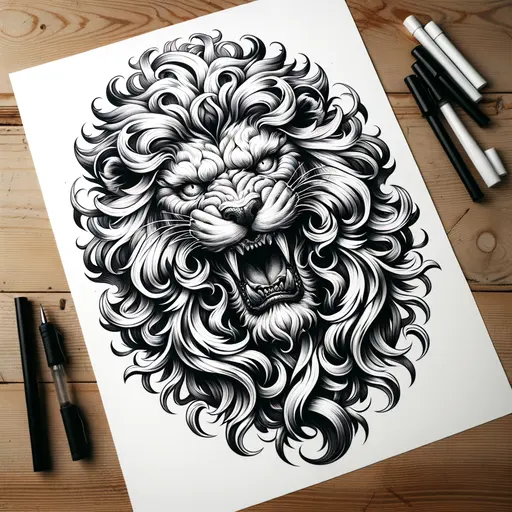
a lion tattoo design on a white paper background
Use this idea
The Geometric Lioness
Remove the mane and the facial planes have to carry the entire design. The cheekbones, brow ridge and muzzle become the structure.
It is harder to draw well and considerably less common, which is part of the appeal if you do not want the piece everyone recognises.
The lioness also sits better in narrow placements. A maned lion needs roughly a square area to work; a lioness head is closer to an oval and fits a forearm or calf without being squeezed.
Ask to see a lioness specifically in an artist’s portfolio rather than assuming a strong maned lion means they can do both. They are different drawing problems.
Chest Pieces and Sleeve Anchors
At chest scale the lion’s frontal symmetry lines up with the body’s own symmetry, which is why so many of these pieces are centred on the sternum with the mane spreading toward the shoulders.
It is a demanding placement. The sternum is one of the more uncomfortable areas for most people, and the design usually needs two or three sessions.
On an arm the job is different. The lion becomes the anchor and abstract geometry flows out of it to fill the rest of the sleeve, so the head has to be placed where it will still be seen when your arm is down.
In my experience outer upper arm or outer forearm are the safest bets for that. If a full arm is the plan, the geometric sleeve tattoo ideas collection shows how the surrounding pattern is usually structured.
Crowned and Heraldic Lions
The crowned lion is the oldest version of this symbol and the most direct. It says one thing and it says it without hedging.
Geometry helps here, because a faceted crown reads as an object rather than a decoration. Drawn realistically on top of a stylised head it tends to look stuck on.
Keep the crown small relative to the head. The most common error I see is a crown scaled so large that it becomes the subject and the lion becomes its hat.
If the crown is really the part you care about, a standalone minimal crown tattoo may serve you better than folding it into a lion piece.
Three-Quarter Angle Portraits
Almost every geometric lion is drawn face-on. Turning the head to three-quarters is the simplest way to make yours look less like everyone else’s.
The angle exposes more of the mane on one side and creates asymmetry, which gives the composition movement that a frontal view never has.
It is harder to draw. Faceting a form in perspective means the planes have to foreshorten consistently, and that is genuinely difficult without a solid grasp of the underlying anatomy.
This is the design I would be most careful about who I let near. A frontal geometric lion can survive a mediocre artist; a three-quarter one cannot.
Variations Worth Considering
Pairing the Lion With a Second Symbol
A compass rose behind the head turns raw power into directed purpose. Faceted mountains beneath it place the animal in a landscape drawn in the same visual language.
Both work because the second element is geometric too. Adding a realistic rose or a script banner to a faceted lion almost never sits right.
If the second symbol is doing the heavy meaning, read up on what it already carries first — the compass tattoo meaning guide is a useful starting point.
Scaling Down: Micro Lions and Single Eyes
Geometric styling miniaturises better than realism, because flat planes stay readable at sizes where fur turns to mush.
A wrist-sized faceted head is achievable. Just accept that it will be simplified — six or eight planes, not sixty.
The other route down in scale is to tattoo only the eye. It keeps the intensity and drops the recognisability, which some people prefer.
Colour, and More Than One Lion
Selective colour suits this style better than most, because the facets give the artist natural boundaries to fill. Gold and amber in a few planes, the rest left black or bare.
Multiple lion faces at different scales — a pride — is the usual way people represent family in this style. Vary the level of detail so the smaller faces read as further away rather than just smaller.
Practical Advice Before and After the Appointment
Ask to see healed photographs, not fresh ones. Fresh geometric work looks immaculate on everybody; healed work at six months is where you find out whether the artist’s lines hold their weight.
Look specifically at long straight lines and repeated angles in healed shots. Wobble and blowout show up there first, and a portfolio full of only fresh photos is a reasonable thing to ask about.
Stencil placement matters more here than in most styles. Because the design is symmetrical, a stencil applied slightly off-axis will look crooked forever. Stand up, sit down, and check it in a mirror before anyone starts.
For healing, follow the aftercare your artist gives you rather than anything you read online, including this. General medical guidance on tattoo risks and infection signs is available from the Mayo Clinic, and the US Food and Drug Administration publishes consumer information on tattoo inks and reactions.
If you develop spreading redness, increasing pain after the first few days, discharge, or a fever, contact a doctor rather than waiting it out. Nothing in this article is medical advice, and an allergic or infectious reaction is not something to manage at home.
Still Not Sure? Common Mistakes to Avoid
The first mistake is treating geometry as a filter rather than a structure. Triangles laid over a finished lion drawing do not make a geometric lion; they make a lion with triangles on it.
The second is going too fine, too small. Hairline facets at wrist scale tend to close up as the tattoo settles, and what was a crisp lattice becomes a grey patch.
The third is picking an artist who does geometric work occasionally rather than constantly. This is the one that actually matters. Look at how a dedicated specialist handles clean structure in linework tattoo pieces before you judge a portfolio.
And if you are drawn to the geometric style more than to lions specifically, it is worth seeing the same treatment on other animals — geometric wolf tattoo ideas cover the most common alternative subject in the same style.
Frequently Asked Questions
How long does a geometric lion tattoo take?
A small minimal head can be finished in one or two hours. A detailed faceted forearm piece usually runs three to five hours, and a chest piece or sleeve anchor commonly needs multiple sessions. Dotwork-shaded versions take noticeably longer than the same design in whip shading, because stippling is slow by nature. Your artist should give you a session estimate once the design is drawn, not before.
Do geometric tattoos age worse than other styles?
Not inherently, but they show their age differently. Solid black and confident mid-weight lines hold up very well over decades. What suffers is very fine internal detail and the lightest stipple, which can soften or close together as skin changes. In most cases a geometric piece drawn with appropriate line weight for its size will still read clearly long after a heavily textured realistic piece has gone soft.
What is the best placement for a geometric lion?
Outer forearm, outer upper arm, chest and upper back are the most common, mainly because they offer flat, low-distortion skin that suits symmetrical designs. Areas that flex and stretch heavily, like the inner elbow or the ribs near the waist, can distort straight lines over time. A maned lion needs roughly square space; a lioness or a single eye fits narrower areas more comfortably.
Can a geometric lion tattoo be done in colour?
Yes, and the style takes selective colour unusually well because the facets provide clean boundaries to fill. Golds, ambers and deep blues are the most common choices. Full-colour treatments are less usual, since saturating every plane tends to flatten the contrast that made the geometry legible. Most artists I have spoken to prefer to colour a minority of planes and leave the rest black or bare.
How do I know if an artist is good enough for geometric work?
Ask for healed photographs of geometric pieces, ideally six months or older. Check whether long straight lines stayed straight and whether repeated angles match each other. A portfolio with a lot of geometric work is a better sign than one strong geometric piece among many other styles. If an artist is reluctant to show healed results, that is worth paying attention to.
Quick Summary
- Geometric styling suits the lion because the animal already symbolises order and authority, not wildness.
- The strongest designs build from the underlying skull and mane structure rather than laying triangles over a finished drawing.
- Solid blackwork ages best of the four main approaches, but is also the hardest to cover or lighten later.
- Dotwork fill gives the best close-up detail and takes the longest to sit for.
- The lioness and the three-quarter portrait are the two least common variations and the two hardest to draw well.
- Keep paired symbols — compass, mountains, crown — in the same geometric language as the lion.
- Ask for healed portfolio photographs, and check straight lines and repeated angles in them.
- Follow your artist’s aftercare, and see a doctor for spreading redness, discharge or fever rather than self-treating.