Geometric tattoos reward stillness. You stop, you look, and the longer you look the more the design gives back — lines that seemed decorative resolve into structure.
I have spent a lot of hours in shops watching geometric work go on, and the thing that surprises people every time is how slow it is. A palm-sized mandala can eat four hours because there is nowhere for a wobble to hide.
That precision is the whole appeal. A rose can be a little loose and still read as a rose; a hexagon that is two degrees off reads as a mistake forever. Geometric work is the style where the artist’s hand matters most, which is why I always tell people to shortlist by portfolio before they shortlist by price.
Below are 21 directions I keep coming back to, from single-session forearm pieces to full back builds. If the spiritual side is what pulls you, the deeper sacred geometry tattoo ideas guide covers that thread on its own.
Photo: @noemie.rosa
Which Geometric Style Is Right for You?
Geometric is a family, not a single look. These are the four sub-styles I see most, and how they actually behave over time.
| Style | How It Reads | Best Placement | Ageing & Upkeep |
|---|---|---|---|
| Fine-line geometric | Delicate, technical, almost drafted | Inner forearm, calf, upper arm | Softens fastest; expect a touch-up eventually |
| Dotwork geometric | Textured, shaded, meditative | Shoulder, chest, outer thigh | Ages well if the dots are spaced, muddies if crowded |
| Blackwork geometric | Bold, graphic, high contrast | Sleeve, back, thigh | Holds up best long term; longest sessions |
| Sacred geometry | Symmetrical, symbolic, layered | Chest, centre back, sternum | Symmetry makes any drift visible — artist choice is critical |
What Actually Makes a Geometric Tattoo Work
Three things, and none of them is complexity.
The first is line weight discipline. A good geometric piece uses two or three deliberate line weights — heavy for the outer frame, medium for structure, hair-thin for interior detail. When everything is drawn at the same weight, the design flattens into noise.
The second is negative space. The bare skin between the shapes is part of the composition, not leftover. Artists who work in linework tattoo styles tend to be strongest here because they are used to letting a design breathe.
The third is body mapping. A perfect square drawn on a flat page wraps around a forearm and stops being square. Every artist I have asked about this says the same thing: the stencil has to be drawn on the body, not printed and slapped on.
Ask to see the stencil placed and then walk to a mirror before the first line goes down. A good artist expects that. Two minutes there saves a lifetime of a mandala that sits slightly off-centre.
21 Geometric Tattoo Ideas for Men
1. Sacred Geometry Chest Piece
The Flower of Life or Metatron’s Cube opened out across the upper chest — the piece shown at the top of this guide is a good example of the format.
Sacred geometry has genuine philosophical roots, and a chest placement puts it at the physical centre of the body, which most people find suits the symbolism. Practically, the chest is a wide flat canvas that lets a symmetrical design stay symmetrical.
Budget two or three sessions for a full pec-to-pec build. The one warning I would give: this is the least forgiving placement in tattooing, because both sides are visible at once and the eye catches any imbalance instantly.
2. Geometric Wolf Head
Photo: @kamayatattoostudio
A wolf’s face rebuilt entirely from triangles and hard-edged planes — no curves, no softness. The angularity makes the animal read as almost architectural, and it is one of the few motifs where the geometric treatment adds meaning rather than just style.
It works small on a forearm and it works large across a shoulder blade. If this is the direction you are leaning, the dedicated geometric wolf tattoo ideas roundup has far more variations than I can fit here.
Ask your artist to keep the eyes slightly softer than the rest — fully faceted eyes tend to look blank.
3. Platonic Solids Arrangement
The five Platonic solids — tetrahedron, cube, octahedron, dodecahedron, icosahedron — arranged as a vertical column down the forearm or spine. It is a quietly nerdy tattoo in the best way: anyone who recognises them will say something, and anyone who does not still sees five clean shapes.
The vertical stack suits long narrow placements better than anything else on this list. Keep them in ascending face-count order if you want it to feel deliberate rather than decorative.
4. Mandala Shoulder Piece
Photo: @alexsteiger
A mandala sitting on the shoulder cap, radiating outward so the pattern follows the round of the deltoid. This is the placement mandalas were made for — the natural curve does half the composition work for you.
Dotwork shading suits it better than solid black because it keeps the piece from going heavy on a joint that moves constantly. In my experience these are among the most comfortable large geometric pieces to sit for, since the outer shoulder is well padded.
Expect four to six hours for a shoulder cap done properly.
5. Geometric Lion Face
Photo: @vishalkushwaha.vrk
A lion built from angular facets, with the mane converted into repeating structural shapes rather than drawn hair. The trick that makes these work is contrast: sharp faceting through the mane, slightly softer geometry in the face itself, so the animal still reads as alive.
There are a lot of mediocre versions of this tattoo out there, mostly because the artist faceted everything uniformly. Look through the geometric lion tattoo ideas collection and you will see the good ones all vary their shape density.
Chest, outer arm and thigh all carry it well.
6. Dot Work Diamond
A diamond or gemstone rendered entirely in stippled dots, with the facets suggested by dot density rather than line. Done well it has a soft, almost printed quality that no other technique gives you.
Done badly it turns into a grey smudge within five years. The difference is spacing — dots that are placed with breathing room stay readable as the ink spreads slightly with age.
If the texture appeals to you generally, the broader dotwork tattoo ideas guide covers what the technique can and cannot do.
7. Tesseract (4D Cube)
Photo: @vdvtattoos
A cube nested inside a cube with the vertices connected — the standard two-dimensional shadow of a four-dimensional hypercube. It is a genuinely clever tattoo because the shape is impossible to resolve visually, so your eye keeps trying.
Fine line is the right call here; heavy outlines close the interior spaces and kill the illusion. It sits well on the inner forearm, where people will actually see it, and it stays legible down to about three inches.
8. Geometric Mountain Range
A mountain range abstracted into overlapping triangles, often with a horizontal band or circle framing the scene. This is the most accessible piece on the list — it is the geometric tattoo that people who do not think of themselves as geometric tattoo people end up getting.
It suits a first tattoo well: small, single session, and the shapes are simple enough that a competent artist will not struggle. Adding a thin sun disc or a dotwork sky lifts it above the generic version you have seen a hundred times.
9. Fibonacci Spiral
Photo: @isismuniztattoo
The Fibonacci sequence drawn as a spiral over the grid of squares that generates it. Leaving the construction squares visible is what makes it a good tattoo rather than just a nice curve — you can see the logic working.
It flows beautifully along a forearm or up a calf because the natural taper of the limb matches the taper of the spiral. Keep the outer square light and the spiral itself heavier, or the grid competes with the curve.
10. Linework Skull with Geometric Fill
A skull drawn in clean outline, with the cranium filled by a geometric or sacred-geometry pattern instead of shading. The contrast between the organic silhouette and the rigid interior is the entire point.
I like this one because it sidesteps the two problems most skull tattoos have: it is not gory, and it does not need heavy black to read. Sternum, outer forearm and the back of the upper arm are all strong placements.
Give the pattern room — a cramped fill just looks busy.
11. Hexagonal Honeycomb Sleeve Element
Photo: @bluebelltattoo
Hexagons tiling across the arm, usually fading out at the edges so the pattern dissolves rather than stops. On its own it is a bit plain; as connective tissue between larger pieces in a sleeve it is one of the most useful patterns there is.
The hexagon also happens to be the most efficient tiling shape in nature, which gives it a bit of meaning if you want that. Have the fade planned before the first hexagon goes down, because retrofitting an edge to a finished grid is difficult.
12. Geometric Eagle
Photo: @ravenhearttattoo
An eagle with the wing feathers stylised into repeating angular shapes, wings usually spread across the chest or upper back. The repetition in the feathers is what carries this design — it gives the artist a natural rhythm to work with, and rhythm is what most geometric animal pieces lack.
Chest placement lets the wingspan follow the collarbones, which is the version I would pick. It needs scale, though; below about six inches the feather detail closes up.
13. Icosahedron Forearm Piece
Photo: @dark_gustavo_tattoo
A twenty-sided solid rendered in clean fine line, sitting on the inner forearm. Of all the single-object geometric tattoos, this is the one I would recommend to someone testing the water.
It is one session, usually two to three hours, it is small enough not to commit your whole arm, and the complexity of the form means it does not look like a starter tattoo. Have the artist vary the internal line weight so the near edges read closer than the far ones — otherwise the solid flattens out.
14. Geometric Sun
A sun with the rays drawn as precise triangles or graduated lines radiating from a patterned centre disc. Sun symbolism is about as universal as it gets, and the geometric treatment keeps it from looking like a holiday souvenir.
It suits round placements — shoulder cap, back of the calf, centre chest — because the radial symmetry needs a surface that does not distort it. Pair it with a matching moon on the opposite side if you want a two-piece set that still works separately.
15. Blackwork Geometric Sleeve
Photo: @manuel.rogaschewski.tattooer
Heavy solid black panels arranged against deliberately bare skin, wrapping the arm as a single composition. This is the most committed option here and the most striking in person, because the untattooed skin becomes an active part of the design.
It is also the most demanding: multiple long sessions, significant cost, and packing large areas of solid black is genuinely uncomfortable. It ages better than any other style on this list.
The blackwork tattoo ideas for men guide goes deeper on what you are signing up for.
16. Geometric Bear with Dotwork
Photo: @davila_tattoos
A bear split between faceted planes and soft dotwork shading, usually with the geometry concentrated in the head and the dotwork carrying the body. Mixing the two techniques in one animal is harder than it looks — the transition has to be gradual or the piece reads as two tattoos stitched together.
When it lands, though, it has more depth than a purely faceted animal. Shoulder and outer thigh both give it enough room.
17. Compass Rose with Sacred Geometry
A compass rose with sacred geometry patterns worked into the dial and the surrounding ring. The compass carries obvious meaning around direction and finding your way, and the geometric layer keeps it from being the same nautical compass everyone got in 2016.
It is naturally radial, so it wants a placement with a flat circular field — upper back, chest, outer shoulder. Adding faint coordinate numerals is a nice touch if the numbers actually mean something to you.
18. Geometric Koi Fish
Photo: @graham.s.white
A koi rebuilt from angular scales and hard-edged fins, with the body still holding its swimming curve. The tension between the rigid geometry and the fluid movement is what makes this one interesting.
It is also a useful bridge piece if you like Japanese motifs but not Japanese colour work. Forearm and outer thigh suit the elongated shape best.
Keep the scale pattern smaller near the head and larger toward the tail to preserve the sense of motion.
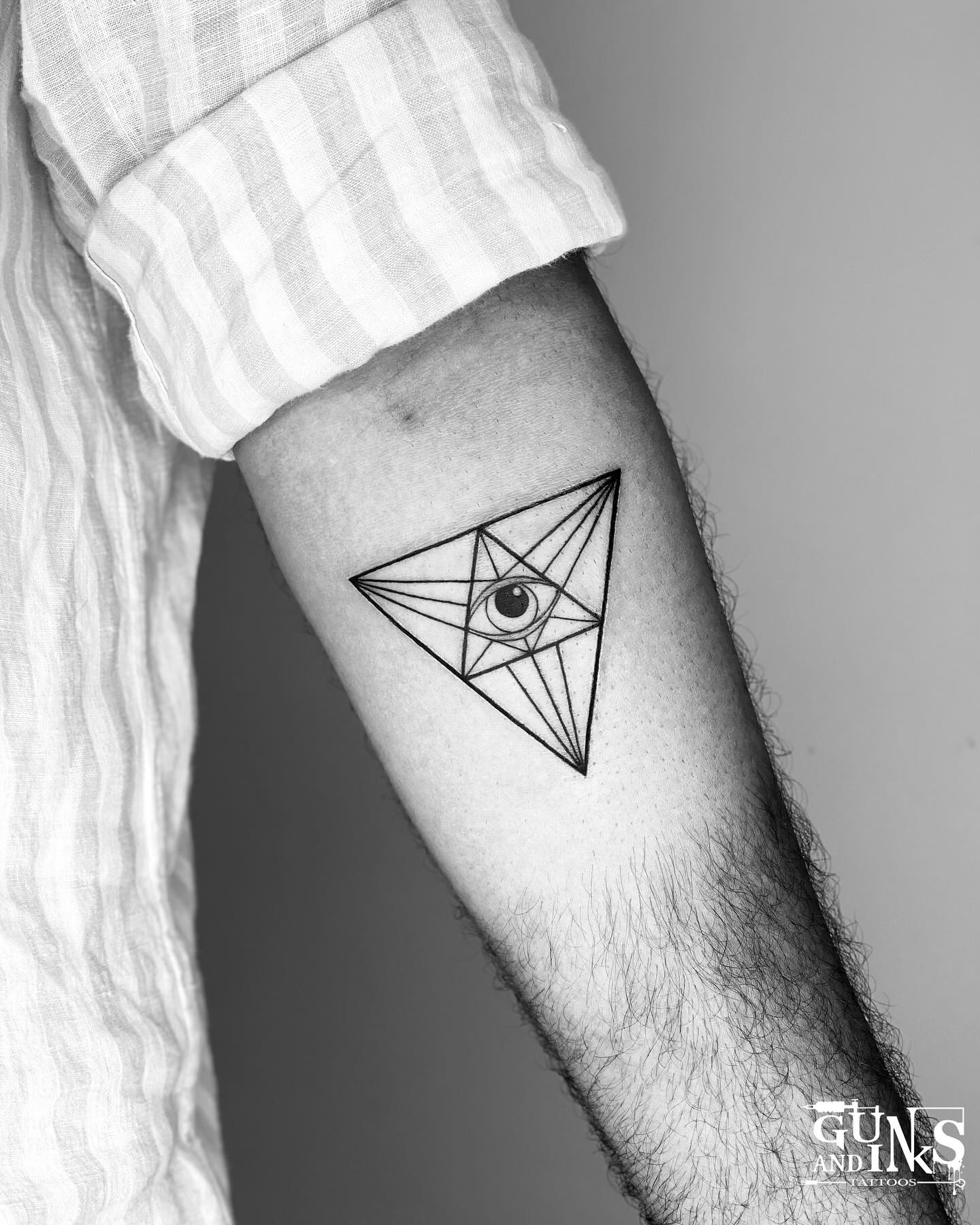
19. Triangle Eye (All-Seeing Eye)
Photo: @gunsandinkstattoos
An eye set inside a triangle, usually with radiating lines or a dotwork halo behind it. It is the most requested geometric motif I have seen and, honestly, the most overdone — which is not a reason to avoid it, just a reason to make yours specific.
Ask the artist to build the eye from your own reference rather than the stock version. Sternum and inner forearm are the placements that suit the vertical triangle shape.
20. Geometric Phoenix
Photo: @zen_x_tattoo_chengalpattu
A phoenix with angular wing structure rising over a sacred geometry backdrop. The rebirth symbolism is well worn but the geometric treatment gives it a cleaner, less theatrical feel than the usual flames-and-feathers version.
It needs vertical room, so back, ribs and outer thigh are the realistic options. Have the backdrop drawn at a lighter weight than the bird — if they compete, the whole thing turns into pattern.
21. Full Back Geodesic Structure
A geodesic dome or lattice structure covering the full back, with the triangular framework following the shoulder blades and spine. This is a project rather than a tattoo — realistically many sessions across a year or more, and a serious financial commitment.
It is also the single most impressive geometric application I have seen in person, because the structure can be mapped to the actual anatomy underneath. Only worth attempting with an artist who has finished large-scale geometric work before, and who will draw the whole thing on your back freehand.
Geometric Hybrids Worth Considering
Pure geometric is not the only route. These crossovers keep the precision but soften the coldness some people find in the style.
Geometric and Botanical
Line-drawn plants growing through or around a geometric frame. The organic shapes stop the piece from feeling clinical, and the frame stops the plants from feeling generic.
Geometric and Realism
Half a realistic portrait or animal, half the same subject faceted into planes, with a clean split down the middle. Technically demanding — you need an artist strong in both, which is a smaller pool than you would think.
Geometric and Ornamental
Geometric structure with ornamental filigree and jewellery-style detail layered on top. This is where geometric sleeve concepts tend to go once they grow past a single panel.
Geometric and Script
A short line of text integrated into the structure — running along an edge, or replacing one segment of a pattern. Keep it short. Long passages fight the geometry rather than joining it.
Getting a Geometric Tattoo Right
Pick the artist before you pick the design. In geometric work the execution is the design, and there is no style where the gap between a specialist and a generalist shows up more plainly.
When you look at a portfolio, look at healed photographs rather than fresh ones. Fresh line work always looks crisp. Healed work at a year old tells you whether the artist’s lines hold their weight.
On pain: geometric sessions run long because there is no rushing a straight line, and long is what actually hurts. Ribs, sternum, inner arm and the back of the knee are the placements people struggle with most — there are practical ways to make a long sitting easier in our tattoo pain management tips.
On healing and safety: follow the aftercare your artist gives you, keep the piece out of direct sun while it settles, and take any spreading redness, heat or discharge to a doctor rather than to a forum. The FDA tattoo and permanent makeup fact sheet sets out the real risks — infection, allergic reaction, granulomas — plainly. This article is not medical advice, and anything that worries you belongs in front of a professional.
Mistakes I See Most Often — and What to Do Instead
Going too small. Geometric designs rely on interior detail, and interior detail closes up as ink spreads over the years. If your artist says a design needs another inch, believe them.
Choosing a design from a flat image without body mapping. A pattern that looks perfect on a screen can distort badly across a bicep.
Uniform line weight throughout. It is the fastest way to turn an interesting design into visual static.
Crowding the negative space. The urge to fill every gap is strong and it is almost always wrong.
Still Not Sure Which Direction to Take?
If you want something bold that will hold up for decades, start with blackwork. If you want something quieter and technical, start with fine linework.
If the chest is where you are headed, our chest piece tattoo ideas for men guide covers how to plan a design around that particular canvas before you commit to a pattern.
And if none of the 21 above has grabbed you outright, that is useful information. A geometric tattoo you are lukewarm about will not improve on your skin.
Frequently Asked Questions
Do geometric tattoos age well?
Blackwork and well-spaced dotwork geometric tattoos generally age very well, because bold shapes stay readable even as ink softens. Fine-line geometric work is the most vulnerable, since thin lines thicken slightly over the years and tightly packed detail can close up. The main variable is how much breathing room the design has. In most cases a fine-line geometric piece will benefit from a touch-up at some point, which is normal rather than a sign anything went wrong.
How long does a geometric tattoo take?
A small single-object piece like an icosahedron or a geometric mountain usually runs two to four hours. A shoulder mandala is more commonly four to six. Full sleeves and back pieces are multi-session projects measured in months. Geometric work is slower than most styles at the same size because straight lines and symmetry cannot be rushed, so build extra time into your expectations rather than your artist’s.
Are geometric tattoos more painful than other styles?
Not inherently — the needle does not know what shape it is drawing. What makes them feel harder is duration and repetition, since long unbroken passes over the same area accumulate. Placement matters far more than style: ribs, sternum, inner arm and the back of the knee are uncomfortable in any style. Eating properly beforehand and scheduling breaks makes a bigger difference than most people expect.
Can a geometric tattoo be added to later?
Often yes, and patterns like honeycomb or lattice are specifically useful for expansion. The catch is that it has to be planned. A standalone piece placed without thought for what might come next can box in a future sleeve. If you think you may expand, say so at the first consultation so the artist can leave the composition open.
What should I look for in a geometric tattoo artist?
Healed photographs, first and last. Look for lines that are still even at a year old, symmetry that holds up when you compare the left and right halves, and negative space that has been used deliberately. Ask whether they draw the stencil on the body rather than printing a flat transfer, because body mapping is what separates good geometric work from good geometric drawing. Any artist worth booking will be happy to answer that.
Quick Summary
- Geometric tattooing splits into four working styles: fine line, dotwork, blackwork and sacred geometry — each ages differently.
- Line weight variation, negative space and body mapping are what separate a strong geometric piece from a flat one.
- Start small and technical (icosahedron, tesseract, geometric mountains) if you are testing the style.
- Go blackwork if longevity matters most; it holds up better than any other option here.
- Faceted animals — wolf, lion, bear, eagle, koi — work best when the faceting varies rather than covering everything uniformly.
- Symmetrical placements like chest, sternum and centre back are the least forgiving, so choose a specialist for them.
- Judge artists on healed photographs and on whether they draw the stencil directly on the body.
- Follow your artist’s aftercare, and take any sign of infection or allergic reaction to a doctor rather than treating it yourself.