The first owl tattoo I ever watched being stencilled took the artist forty minutes just to place. She kept shifting it a centimetre at a time across the client’s sternum, because an owl’s face is almost perfectly symmetrical, and the human body is not — get the axis wrong by a few millimetres and the whole bird looks like it is squinting.
That is the thing nobody warns you about with owls. They look like an easy subject and they are one of the least forgiving animals in tattooing.
Owls also carry more contradictory symbolism than almost any other bird tattoo subject. Wisdom in Greece, death in medieval Europe, good fortune in Japan, a messenger between worlds in several Indigenous traditions. You are rarely picking just one meaning.
Below are twenty directions worth considering, drawn from designs I have seen healed rather than only fresh, plus what I have learned about placement, style choice and the parts that go wrong.
Photo: @jakebray15
Which Owl Tattoo Style Is Right for You?
Style choice drives cost, session length and how the piece looks in a decade far more than size does. This is the shorthand I use when someone is stuck between directions.
| Style | Best For | Smallest Size That Works | How It Tends to Age |
|---|---|---|---|
| Traditional American | A bold, readable owl you never have to explain | Around palm-sized | Excellent — heavy outlines hold their shape longest |
| Black and grey realism | Species-accurate portraits, feather detail | Forearm-length or larger | Good with strong contrast; soft grey wash can flatten |
| Neo-traditional | Colour, florals, decorative framing | Around palm-sized | Strong — outlines plus saturated colour hold well |
| Geometric / blackwork | Graphic impact, symmetry, chest and back | Palm-sized upward | Very good, though large solid black may need a touch-up |
| Watercolour | Soft, painterly, less literal designs | Forearm-length | The least predictable — ask to see healed work first |
| Fine line / minimalist | Discreet placements, first tattoos | Two to three inches | Softens over time; expect some line spread |
None of these are rules. They are the trade-offs I would want explained to me before I sat down.
Why Owls Are Harder to Tattoo Than They Look
An owl’s face is a facial disc — a shallow dish of stiff feathers that funnels sound toward the ears. Rendered badly, it turns into a flat plate.
The second difficulty is the feather transition. Owls have soft, fringed flight feathers that break up air turbulence, which is why they fly almost silently, and that softness is genuinely difficult to draw. The boundary between the primaries and the secondaries is where I see most owl tattoos fall apart.
Third is the eye. According to the Cornell Lab of Ornithology, an owl’s eyes are fixed in their sockets, which is precisely why the bird swivels its head so far instead of moving them. That fixed, forward stare is the whole emotional weight of the design.
And then symmetry. Owl faces are frontal and mirrored, so any drift in placement reads instantly as a mistake, even to people who cannot say what is wrong.
None of this makes an owl a bad choice — it makes artist selection the single most important decision you will make.
Classic Owl Tattoo Styles
1. Traditional American Owl
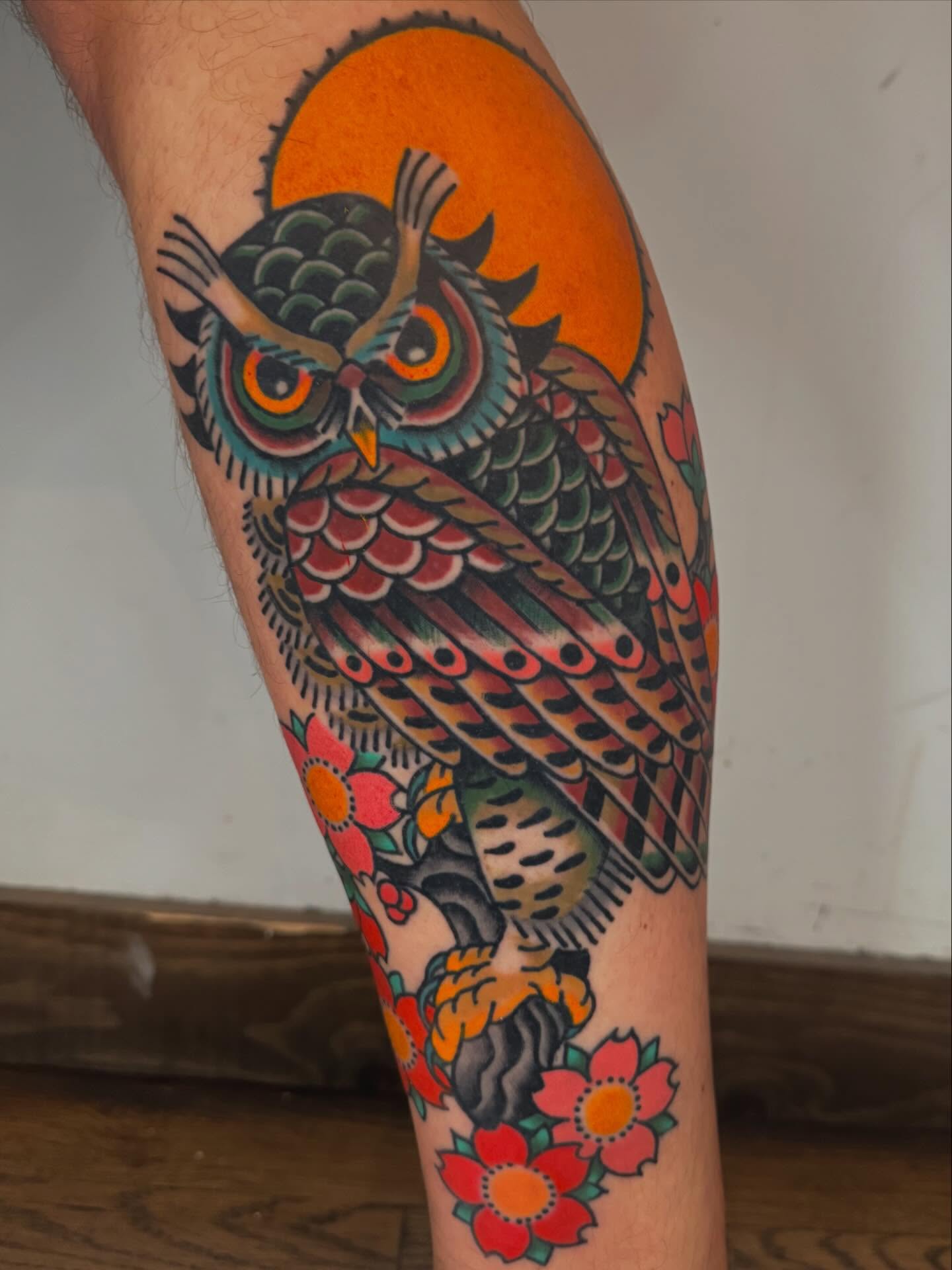
Bold outlines, flat colour fills, feathers reduced to shapes rather than copied from a photo — the design pictured at the top of this guide is a clean example.
Traditional owls survive better than almost anything else in the medium because everything about them is built for legibility at a distance. The red, yellow and green palette is not nostalgia; those pigments were chosen decades ago partly because they held up.
In my experience this is also the safest first owl. There is very little that a competent traditional artist can get wrong here, and the style is forgiving on arms, calves and the outer thigh where skin moves.
2. Realistic Barn Owl Portrait
The barn owl is the one I would pick for realism, because the heart-shaped facial disc gives the artist a strong graphic shape to anchor to.
Rendered in grey wash, with the fine barbules of each feather picked out, a barn owl has a genuinely ghostly quality. It is the species most associated with the pale shape crossing a field at dusk.
Ask for strong contrast rather than an all-mid-grey portrait. Realism that relies entirely on soft tone tends to lose definition after a decade, and on an owl that means the face collapses first.
Photo: @countyourblessings.tattoo
3. Geometric Owl
An owl’s face rebuilt from triangles and flat planes, with the organic curves removed entirely.
The geometric treatment strips out the warmth of the animal and leaves something colder and more architectural, which suits people who want the symbolism without the sentimentality. It also plays well with the symmetry that owls hand you for free.
If you like this direction, it is worth browsing broader geometric tattoo designs first, because the linework conventions carry across subjects and you will spot a good geometric artist quickly.
Photo: @thecoppercointattoo
4. Neo-Traditional Owl with Florals
A stylised owl perched among roses or peonies, proportions pushed slightly, colour saturated into jewel tones.
Neo-traditional keeps the bold outline of traditional work but allows a far more illustrative approach to shading and ornament. For owls specifically, that means you can keep readable feather shapes while still getting depth in the plumage.
This is the style I recommend most often to people who want colour but are nervous about how colour ages. The outline underneath does the structural work, so even if the fill softens, the bird stays a bird.
Photo: @worldofneotrad
5. Watercolour Owl
Loose washes of purple, blue and burnt orange bleeding deliberately past the owl’s edges.
The effect is ethereal and slightly melancholy, as though the bird is dissolving into the night around it. Done well it is beautiful and unlike anything else on the arm.
Be honest with yourself about this one. Watercolour without any underlying line structure is the least predictable style over time, and every artist I have asked about it says the same thing: ask to see photographs of their watercolour work healed at three years or more, not fresh.
Photo: @ogiegabutentattoo
Symbolic and Esoteric Owl Designs
6. Owl with a Third Eye
An owl’s face with a stylised eye at the forehead, borrowed from esoteric traditions of inner sight.
It deepens the wisdom reading considerably — you are no longer just saying the bird sees in the dark, you are saying it sees through things. The motif sits most comfortably in blackwork or geometric styles, where a third eye reads as a design element rather than an anatomical error.
One practical note from watching these get drawn: the third eye needs to be smaller than the natural eyes, or the face stops looking like an owl.
7. Minimalist Single-Line Owl
One continuous line describing the whole silhouette. No fill, no shading, nothing to hide behind.
Single-line work is a real test of draughtsmanship and the good examples are startling in how little they need. It is also the most discreet owl on this list, which matters if your workplace is conservative.
Expect some softening. Fine lines spread slightly as skin ages, so a design that relies on 2mm gaps between lines will eventually close them. Ask the artist to build in more space than looks necessary.
Photo: @rickymartineztattoos
8. Great Horned Owl in Flight
Wings spread, talons forward, caught in the hunting posture rather than perched.
A flying owl captures the animal’s power in a way a portrait cannot, and it gives you a design that reads as motion. The great horned owl is the right species for it — heavy-bodied, ear tufts, unmistakable in silhouette.
This one needs room. Compressed into a small space, a flying owl loses everything that makes it work, so plan on the upper back, the chest, or a full outer thigh.
Photo: @artworkbyg
9. Snowy Owl Portrait
White plumage and yellow eyes, usually handled in black and grey with negative space doing most of the work.
Snowy owls carry a different set of associations from the rest of the family: the Arctic, isolation, and the composure of a predator that has no need for camouflage.
A word of caution on white ink highlights. They can look spectacular fresh and they very often fade to near-invisible within a couple of years, especially on skin that sees sun. In most cases I would let untouched skin be the white instead.
10. Owl Perched on a Skull
One of the oldest pairings in tattoo iconography, and it still works.
Wisdom seated above mortality — or, read the other way, death presided over by knowledge. The tension between the two symbols produces something more interesting than either on its own, which is exactly why traditional artists have been drawing it for a century.
Composition matters here more than detail. The skull should sit low and heavy, the owl slightly forward, or the design reads as two separate tattoos that happen to be touching.
Photo: @yesitattoos
Cultural and Graphic Owl Tattoo Approaches
11. Japanese-Influenced Owl (Fukurō)
In Japan the owl carries a much warmer reputation than it does in Western folklore, associated with protection and good fortune.
Rendered in Japanese style, the owl comes with the full grammar of the tradition: bold linework, simplified natural forms, and a structured background of clouds, wind bars or waves that ties the piece into the body.
If you are drawn to this, read up on Japanese tattoo designs before the consultation. The background is not decoration in this style — it is what makes the composition work, and it is the part clients most often try to cut for budget reasons.
Photo: @mrnikita666
12. Blackwork Owl Chest Piece
A large, symmetrical owl face in solid black, centred on the sternum.
The chest gives you a natural axis, and an owl’s frontal symmetry uses it better than almost any other subject. Done properly it is genuinely imposing. Done slightly off-centre it is unfixable, which is why the stencil stage takes so long.
Solid black over the sternum is also one of the more uncomfortable places to sit, and large black fills sometimes need a second pass once healed. Plan for it rather than being surprised. There is more on placement in our guide to chest piece tattoos, and on the style itself in blackwork tattoo ideas.
Photo: @inko_melbourne
13. Owl Inside a Crescent Moon
The owl perched within the curve of a crescent, stars scattered around it.
This composition links the bird’s nocturnal life to the moon’s symbolism of cycles and change, and the enclosing crescent gives the design a frame — which is what lets it stay readable at small sizes when most owl designs cannot.
It is the idea on this list I would recommend for a first tattoo. Compact, balanced, and it sits well on a forearm, a shoulder blade or a calf. Pairs naturally with moon phase tattoo designs if you want to extend it later.
Photo: @beltanebeetattoo
14. Dotwork Owl
The whole bird built from stippled dots, form emerging from density rather than line.
Up close it reads as pointillism. From across a room it resolves into a soft, slightly textured portrait, and the texture happens to suit plumage better than almost any other technique.
Dotwork is slow. A full dotwork owl can take several sessions where a lined version would take one, and the cost reflects that. If the texture appeals, dotwork tattoo ideas across other subjects will tell you quickly whether you like the finish.
15. Owl Eye Close-Up
Not the whole bird. One eye, at scale, in as much detail as the skin will hold.
Owl irises are structurally beautiful — concentric rings of amber and gold, with a pupil that changes size dramatically. Isolating one is intimate and a little unsettling, in the best way.
Because there is nowhere to hide, this design lives entirely on the artist’s control of gradient. I would only take it to someone whose healed realism I had seen in person.
Photo: @tattoosbyrios
Bold and Modern Owl Tattoo Ideas
16. Tribal Owl Silhouette
The owl’s shape filled with bold pattern work rather than shading.
The treatment is unapologetically graphic and produces a design with more visual weight per square inch than anything else here. It also ages extremely well, because there is no fine detail to lose.
Worth saying plainly: many tribal patterns belong to specific cultures with their own protocols around who may wear them. If you are drawn to a particular tradition, ask an artist from that tradition rather than borrowing the look wholesale. A general tribal tattoo approach avoids that problem.
Photo: @daddy_om_tattoos
17. Vintage Scientific Illustration Style
The owl as it would appear on a Victorian natural history plate: precise anatomy, formal posture, a small line of ground beneath the feet.
This style carries a learned, documentary quality that suits the owl’s intellectual reputation better than almost any other approach. It sits somewhere between realism and linework, which also makes it more durable than pure realism.
Bring an actual plate as reference. Artists work much better from a specific historical example than from a description of the genre.
18. Owl with an Hourglass
An owl standing beside or above an hourglass, sand mid-fall.
Time, wisdom and mortality in one composition. The symbolism is not subtle, but it is genuinely layered, and it suits people who want their tattoo to carry a specific philosophical argument rather than a mood.
The hourglass gives the design a strong vertical, which makes it a natural fit for the forearm, the outer calf or the ribs.
19. Coloured Tawny Owl
The warm rufous browns and buff tones of a tawny owl, handled in colour realism.
Tawny owls are the classic night bird of British woodland and the source of the archetypal hoot — which is actually a duet, the female’s sharp call answered by the male’s hoot. Rendered in warm earth tones, they feel more atmospheric than dramatic.
Earth-tone colour realism is one of the better-ageing colour approaches, because it does not depend on bright pigments staying bright. In most cases the browns simply deepen.
Photo: @kaileewinterburn
20. Geometric Owl with Mandala Wings
The body handled geometrically, the wings opening out into elaborate mandala patterning.
It is an odd combination on paper and it works surprisingly often, because the predator’s form and the meditative circular geometry pull against each other in a way that holds attention.
Symmetry is the whole game here. Mandala work exposes any drift immediately, so this is a design that needs an artist who is comfortable drawing on the body freehand rather than relying on a printed stencil.
Owl Pairings and Variations Worth Considering
If none of the twenty is quite right, the usual fix is not a different bird — it is a different companion element.
Owl and Key
A key held in the talons or hanging beneath the perch. Reads as knowledge that unlocks something, and it gives a vertical portrait a useful bottom weight.
Owl and Book or Candle
The scholarly reading, taken literally. It suits the vintage illustration style particularly well and is a common choice for people marking a degree, a career, or a teacher.
Owl and Compass
Guidance plus night vision. The compass rose also solves a composition problem, because it gives the artist a circular frame behind a frontal owl face.
Owl Feather Alone
A single owl feather instead of the bird. Far more discreet, far cheaper, and it keeps the association without committing your whole forearm to a portrait.
Owl Skull
The skull of the owl rather than the living bird. Uncommon, quietly unnerving, and it sidesteps the symmetry problems that make the face so demanding.
Getting an Owl Tattoo That Still Looks Good in Ten Years
Judge an artist by their healed work, not their fresh work. Every portfolio looks good the day the tattoo is finished; ask specifically for photographs taken a year or more later, and be a little wary of anyone who cannot produce any.
Look for confident feather rendering in particular. The transition between primary and secondary feathers is where owl tattoos most often fall apart, and you can see whether an artist has solved it in about five seconds of scrolling.
Give the design phase real time. Book a consultation, bring several references rather than one, and be specific about which part of each reference you actually want — the eyes from one, the posture from another. Artists work much faster from that than from a mood board.
On healing: follow the aftercare your artist gives you, keep the piece out of direct sun once healed, and use sunscreen on it afterwards. The American Academy of Dermatology has straightforward guidance on caring for tattooed skin. If you see spreading redness, swelling, pus or a fever, that is a matter for a doctor, not a forum thread — and nothing in this article is medical advice.
Still Not Sure? Common Owl Tattoo Mistakes
Going too small is the most frequent one. An owl portrait under about three inches usually loses the facial disc, and once that goes the bird becomes a generic bird.
Choosing the species after the style is the second. Barn, snowy, great horned and tawny owls look genuinely different and carry different associations, so decide which bird you want before you decide how it will be drawn.
Ignoring the placement’s movement is the third. Owls sit best on flat, stable areas — chest, upper back, outer thigh, forearm — and distort on the inner bicep or over a joint.
And if the owl itself is the sticking point rather than the execution, the neighbouring subjects are worth a look. Raven tattoo ideas cover much of the same mythological ground with a very different silhouette, and crow tattoo designs tend to work better at small sizes than owls do.
Frequently Asked Questions
What does an owl tattoo actually symbolise?
It depends entirely on which tradition you are drawing from, which is part of the appeal. In Greek myth the owl accompanies Athena and stands for reason and strategy; in medieval Western European folklore it was read as an omen of death; in Japan the fukurō is associated with protection and good luck; and in several Indigenous traditions it is a messenger between the living and the dead. Most people who get one are choosing wisdom, night, or the space between those two ideas. You do not have to pick a single meaning, and in my experience most wearers do not.
How much does an owl tattoo cost?
There is no honest flat answer, because pricing varies enormously by country, city and artist reputation. What I can tell you is what drives the number: style, size and session count. A palm-sized traditional owl is usually one sitting; a realistic chest or back piece is normally several, and the total scales with hours rather than square inches. Ask for an hourly rate and an estimated number of sessions at the consultation, and treat a quote that seems dramatically below local norms as a reason to look harder at the portfolio.
Where is the best placement for an owl tattoo?
Flat, stable areas suit owls best because the face is symmetrical and distortion shows immediately. The chest, the upper back between the shoulder blades, and the outer thigh are the strongest choices for a frontal portrait. Owls in flight need width, so the upper back and chest work better than a limb. Smaller compositions like an owl inside a crescent moon sit comfortably on a forearm, a calf, or a shoulder blade.
How long does an owl tattoo take to finish?
A small, simple owl is usually a single session of a few hours. A detailed realistic portrait or a full blackwork chest piece is commonly spread over multiple sessions, often with several weeks between them to allow healing. Rushing that gap is a bad idea. Ask your artist for their expected session plan up front, because it also tells you a lot about how carefully they have thought about the design.
Do owl tattoos age well?
Some styles do noticeably better than others. Traditional, neo-traditional and blackwork owls hold their shape longest because a strong outline keeps the design readable even as the fill softens. Realism and watercolour depend far more on the individual artist and on how much sun the area gets. Whatever the style, sun protection is the single biggest thing within your control once the piece has healed.
Quick Summary
- Owls carry contradictory symbolism across cultures — wisdom, death, protection, and passage between worlds — and you are not obliged to choose one.
- The facial disc, the feather transitions and the fixed forward stare are what make owls technically demanding, so artist selection matters more than style.
- Traditional, neo-traditional and blackwork owls hold up best over decades because a strong outline carries the design.
- Realism suits the barn owl and the great horned owl; ask for real contrast rather than an all-mid-grey portrait.
- Watercolour and fine line are the least predictable long term — ask to see healed work at three years or more.
- Flat, stable placements suit owls: chest, upper back, outer thigh, forearm. Avoid joints and the inner bicep.
- Going too small is the most common mistake; under roughly three inches, the facial disc disappears.
- Once healed, sun protection is the single biggest factor you control in how the tattoo ages.