The tattoo is finished, the artist wraps it, and you walk out feeling like the hard part is over. It is not. Most tattoos look healed in two to three weeks but are not actually healed for three to six months, and that gap is where almost every avoidable problem happens.
I have sat through this timeline more times than I can count, on placements ranging from an inner forearm to a full rib panel, and the pattern is remarkably consistent once you know what to watch for.
What follows is an honest, stage-by-stage account of how long a tattoo takes to heal — surface healing, deep healing, and the awkward middle where it looks done and definitely is not. If you want the compressed version, the tattoo healing stages guide covers the same ground in less detail.
Timeframes here are typical ranges, not guarantees. Skin varies, and your artist knows your specific piece better than any article does.
How Long Does a Tattoo Take to Heal by Placement?
Placement is the single biggest variable in how long your tattoo takes to heal. The table below reflects the ranges I have consistently seen and heard from artists, not laboratory figures.
| Placement | Surface Healing | Full Dermal Healing | What Slows It Down |
|---|---|---|---|
| Outer/upper arm | 2 weeks | 2-3 months | Very little; the easiest placement to heal |
| Calf and thigh | 2-3 weeks | 3-4 months | Tight trousers, gym friction, swelling if you stand all day |
| Forearm and inner bicep | 2-3 weeks | 2-4 months | Sleeve rub; inner bicep skin is thin and stays tender longer |
| Ribs, sternum, spine | 3 weeks | 4-6 months | Constant movement from breathing, bra straps, sleeping position |
| Hands, fingers, feet | 2-3 weeks | 6 months+, often needs a touch-up | Fast skin turnover, washing, shoes, constant use |
| Elbows and knees | 3-4 weeks | 4-6 months | Skin folds and stretches with every movement; heavy flaking |
| Neck and behind the ear | 2 weeks | 2-3 months | Good blood supply helps, but collars and hair products irritate |
| Large colour-packed pieces | 3-4 weeks | 6-12 months | Density of ink; more trauma means a longer inflammatory phase |
If you are still choosing a spot, it is worth reading about the most painful tattoo spots alongside this table — the areas that hurt most and the areas that heal slowest overlap more often than not.
What Is Actually Happening Under Your Skin
A tattoo machine drives pigment through the epidermis and deposits it in the dermis, the layer underneath. That is a few thousand tiny puncture wounds per square inch.
Your body responds the way it responds to any wound: inflammation first, then new tissue, then remodelling. The visible healing you can see is only the epidermis; the part that actually determines how your tattoo looks in five years happens in the dermis, out of sight.
Immune cells called macrophages surround the ink particles. Some pigment is carried away, and some stays locked in place — which is why a tattoo is permanent but also why it softens slightly over the first year.
This is also why the timeline splits in two. Surface healing is finished when the skin has closed and stopped flaking. Dermal healing is finished when the collagen around the pigment has fully reorganised, and that takes months.
Understanding the split saves people a lot of panic. Nothing has gone wrong when a three-week-old tattoo still looks slightly off — it is simply not finished yet.
The Tattoo Healing Timeline, Stage by Stage
Every tattoo I have healed has moved through these six phases in roughly the same order. The durations shift; the sequence does not.
Days 1 to 3: The Open Wound Phase
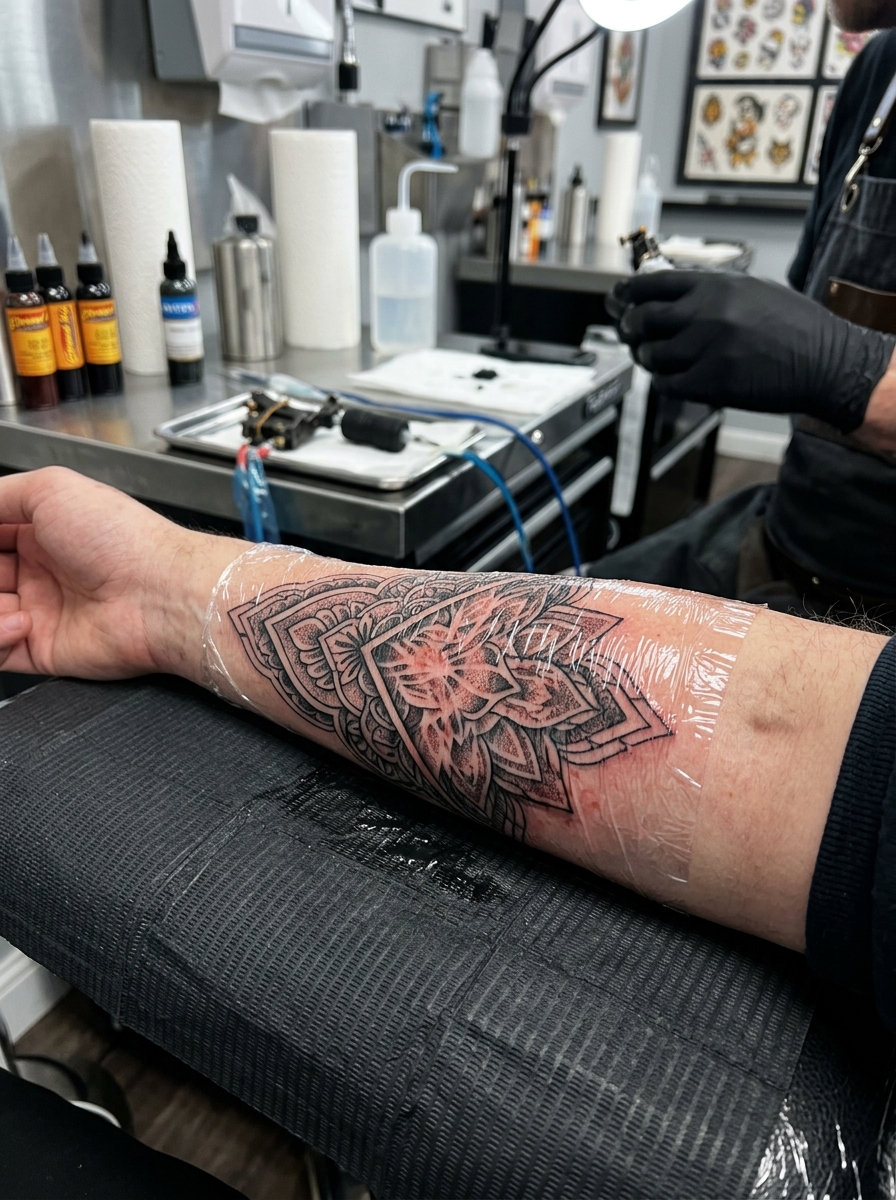
Your tattoo is red, warm, and puffy, and it will feel like a bad sunburn. That is the inflammatory response doing its job.
Clear or faintly blood-tinged fluid — plasma — weeps from the surface for the first day or two. Blot it with clean paper towel rather than rubbing, and it settles on its own.
The first wrap comes off on your artist’s schedule, not the internet’s. A basic cling film wrap usually comes off within a few hours, while an adhesive film can stay on for days. Our guide on how long to keep a tattoo wrapped covers the difference properly, and the Saniderm tattoo healing article explains what to expect if your artist used that.
In my experience this is the phase people underestimate physically. If the piece was large, expect to feel genuinely tired for a day — your body is running a repair job.
Days 4 to 7: Tightness and the First Itch
The weeping stops and the surface tightens into a dry, slightly leathery feel. Movement over the area can pull uncomfortably.
A thin, dull film forms across the design. Colours look flat and lines look thicker than you remember — this is normal and temporary.
The itching starts here for most people. Every artist I have asked says the same thing: a light tap or a thin layer of unscented lotion, never a scratch.
Light, dry scabbing is acceptable. Thick, raised, dark scabs usually mean the tattoo was worked heavily or is being kept too dry, and they are worth mentioning to your artist.
Week 2: The Peeling Stage
This is the phase that alarms first-timers. The skin flakes off in sheets and the flakes are visibly coloured.
That is surface pigment coming away with dead epidermis, not your tattoo falling out. The ink that matters is sitting deeper, untouched.
When I got my first heavily shaded piece I was convinced I had ruined it in week two. It looked completely normal by week four.
Let the flakes fall on their own. Pulling a piece of half-attached skin can lift pigment out of the dermis with it and leave a light patch that needs a touch-up later.
Weeks 3 to 4: The Milky Phase
Peeling has finished and a thin layer of brand-new skin now covers the design. Under some lighting it looks cloudy, matte, or slightly grey.
This is the single most misread stage of tattoo healing. People assume the tattoo has faded permanently when they are simply looking at it through immature skin.
That new skin is thin and offers almost no UV protection. Direct sun here does real, permanent damage to the pigment beneath, so cover it or use a high-factor sunscreen once the surface has fully closed.
The tattoo will look progressively clearer over these two weeks as the cells mature and become more transparent.
Months 2 to 3: Settling and Sharpening
By now the tattoo looks finished to anyone else. The true colour depth and line contrast come forward during this window.
Lines often read slightly softer than they did on day one. That is not a blowout or a mistake — it is ink settling into its permanent position.
Small raised ridges along heavily worked lines are common and usually flatten out over several weeks. If a raised area stays itchy or bumpy well past this point, have your artist or a dermatologist look at it.
This is also when most artists are happy to book a touch-up. Going earlier means assessing skin that has not finished changing.
Months 4 to 6: Full Dermal Healing
The deeper repair finishes here for most standard pieces. Collagen has reorganised around the pigment and the skin’s texture matches the area around it.
Large colour-packed work, blackout sections, and anything on hands, feet, elbows, or knees can run past six months, and up to a year is not unusual.
Once you are here, the tattoo is as permanent as it will get. From this point maintenance is one thing only: sunscreen, consistently, for the rest of its life.
The tattoo aftercare advice from the American Academy of Dermatology is a good, conservative baseline if you want a medical source rather than studio folklore.
What Changes Your Healing Timeline
Two people can get the same design on the same day and heal weeks apart. These are the variables that actually move the needle.
Size and Ink Density
A fine-line wrist piece and a saturated black-and-grey half sleeve are not the same wound. More passes and more packed colour mean more trauma and a longer inflammatory phase.
Solid black fill and heavy colour packing are the slowest of all, which is why blackout work is often quoted at six months or more.
Blood Supply and Movement
Areas with good circulation and little friction — upper arm, calf, outer thigh — heal fastest. Joints and extremities heal slowest because the skin never stops moving or renewing.
Hands and feet are the outlier case. The epidermis there turns over quickly and the tattoo sits under constant use, so patchy healing and a scheduled touch-up are normal rather than a failure.
Your Aftercare Method
Dry-healing, lotion-healing and adhesive-film healing all work, and artists disagree strongly about which is best.
What matters more than the method is consistency. In my experience the people who heal badly are almost always the ones who did three different things in three weeks.
If you are choosing a product, the Aquaphor for tattoo healing comparison and the adhesive film breakdown cover the two most common routes.
General Health and Habits
Sleep, hydration and reasonable nutrition genuinely speed up wound healing. Smoking genuinely slows it down.
Some conditions and medications — diabetes, autoimmune conditions, immunosuppressants, certain acne treatments — meaningfully affect skin repair. Talk to your doctor before booking rather than after, and tell your artist so they can plan the session.
Alcohol in the first day or two thins the blood and increases weeping. It is not dangerous, but it makes the first phase messier than it needs to be.
The Artist’s Hand
Needle depth and how hard the skin is worked change healing more than most clients realise. An over-worked tattoo scabs heavily and heals slowly.
This is the strongest argument for choosing an experienced artist in a licensed studio. The consumer guidance from the FDA is a reasonable primer on why studio standards matter.
How to Support Healing Day by Day
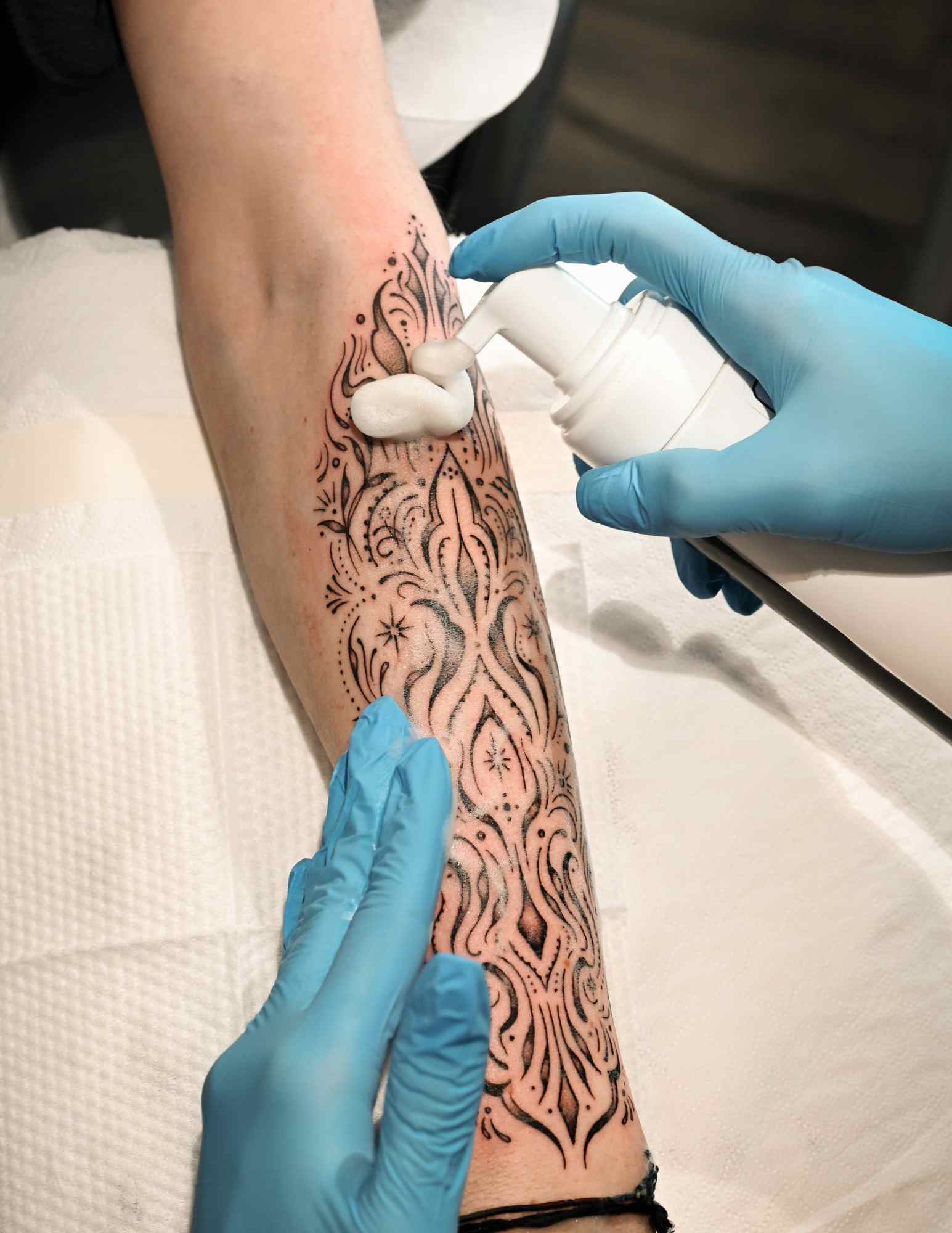
Wash gently twice a day with clean hands, unscented soap and lukewarm water for the first two weeks, then pat dry with paper towel rather than a shared bath towel.
Moisturise thinly, not thickly. A light layer of unscented lotion two to three times a day is enough; smothering the tattoo traps moisture and bacteria and can pull scabs loose.
Keep it out of standing water. Showers are fine from day one, but baths, pools, hot tubs and the sea should wait — our guide on how long after a tattoo you can swim explains the timeline and the reasoning.
Wear loose clothing over the area, sleep on clean sheets, and skip the gym for the first few days if the placement will rub or sweat heavily. Full step-by-step routines are in the tattoo aftercare guide.
Common Healing Mistakes and When to Worry
The mistakes I see most often are picking flakes, over-moisturising, early sun exposure, and swimming too soon. All four are avoidable and all four show up in the healed result.
A fifth one is switching products mid-heal because a stranger online said something different. Pick one sensible routine and stay with it.
Normal healing looks like redness, mild swelling, tenderness, flaking and itching, all improving day by day.
Get medical advice if you see redness spreading outward after the first 48 hours, yellow or green discharge, raised hives or bumps appearing after day three, a fever, or an area that feels hot well into the second week. Those can indicate infection or an ink reaction, and they need a GP or dermatologist rather than an aftercare tweak.
This article is not medical advice. A properly applied tattoo in a licensed studio carries a low infection risk, but not a zero one — the Mayo Clinic overview on tattoo risks is worth reading before you book.
If your concern is pain rather than healing, the tattoo pain management guide is a better starting point than sitting with it.
Frequently Asked Questions
How long does a tattoo take to heal completely?
Surface healing takes about two to three weeks for most tattoos, and full dermal healing takes three to six months. Large colour-packed pieces, blackout work and tattoos on hands, feet, elbows or knees can take up to a year. The tattoo will look finished long before it actually is. If anything is still painful or raised past a couple of months, ask your artist to look at it.
Is it normal for my tattoo to look faded while healing?
Yes, and it happens twice. During week two the peeling layer makes colours look dull, and during weeks three and four a thin cloudy layer of new skin mutes the design further. Both resolve on their own as the skin matures. If the tattoo still looks patchy after three months, that is a touch-up conversation, not a healing one.
Can I speed up tattoo healing?
You cannot make skin regenerate faster than it does, but you can avoid slowing it down. Consistent gentle washing, light unscented moisturiser, no picking, no soaking and no sun cover almost all of it. Sleep, hydration and not smoking help genuinely. Anything promising dramatically faster healing is overselling.
How long before I can go in the sun or swim?
Keep a new tattoo out of pools, baths, hot tubs and the sea until the surface has fully closed and stopped flaking, which is usually three to four weeks. Direct sun should wait until the milky phase has passed, and after that high-factor sunscreen is the single best thing you can do for long-term vibrancy. When in doubt, wait the extra week.
When should I book a touch-up?
Most artists prefer to wait until the tattoo has fully settled, generally somewhere between two and three months. Judging a tattoo before then means judging skin that is still changing. Hands, feet and fingers are the common exception, where a touch-up is often expected from the start. Many studios include one free touch-up, so ask at the time of booking.
Quick Summary
- Surface healing: two to three weeks for most tattoos, three to four for large or joint placements.
- Full dermal healing: three to six months, and up to a year for heavy colour or blackout work.
- Days 1-3: redness, swelling and clear plasma are normal; follow your artist’s wrap instructions.
- Week 2: peeling with coloured flakes is surface ink shedding, not your tattoo coming out.
- Weeks 3-4: the milky phase makes the design look dull; it clears on its own.
- Placement rules the timeline: upper arms and calves are fastest, hands, feet and joints slowest.
- Never pick, never soak, never sunbathe a healing tattoo — those four habits cause most patchy results.
- See a doctor for spreading redness, coloured discharge, fever or late-appearing bumps.