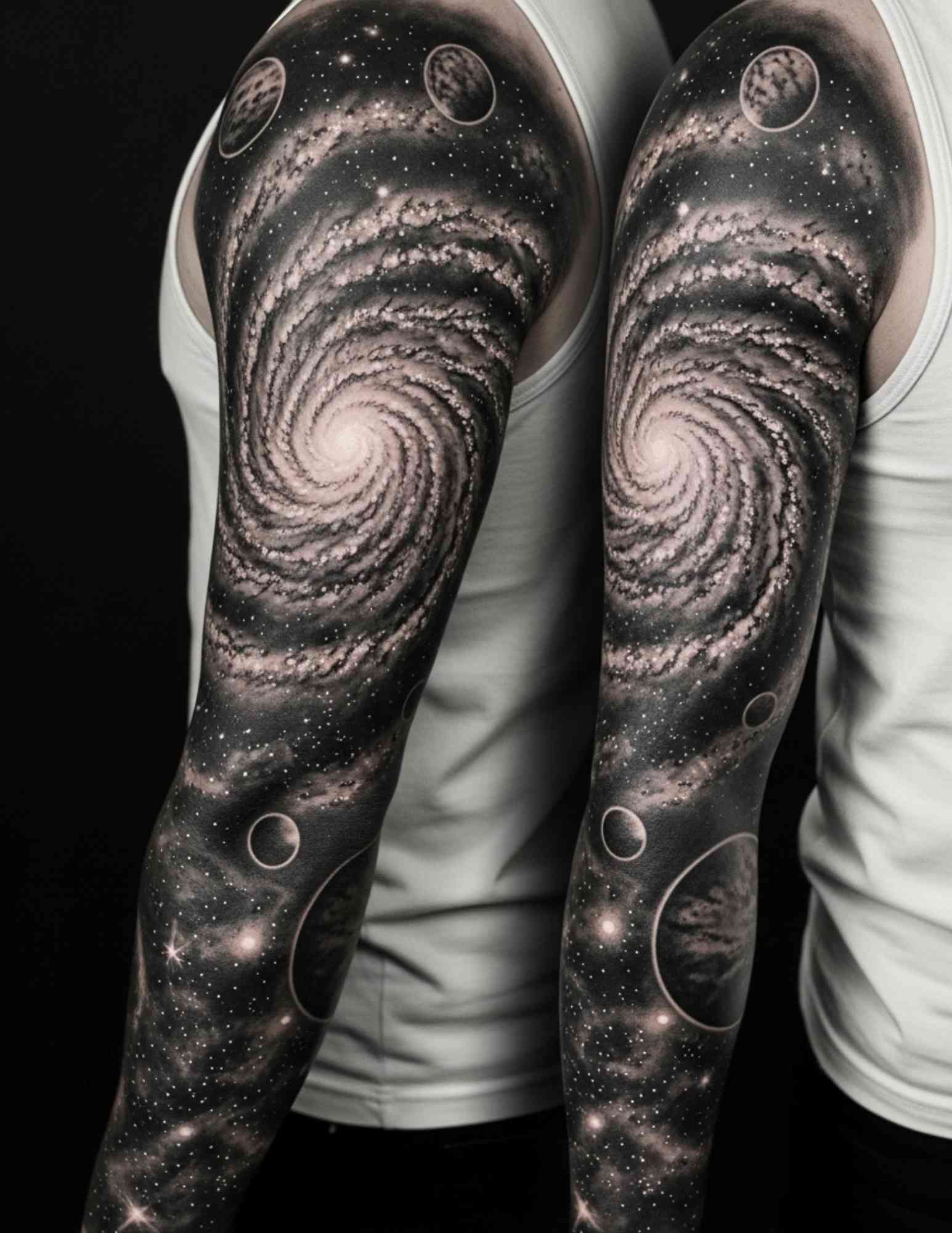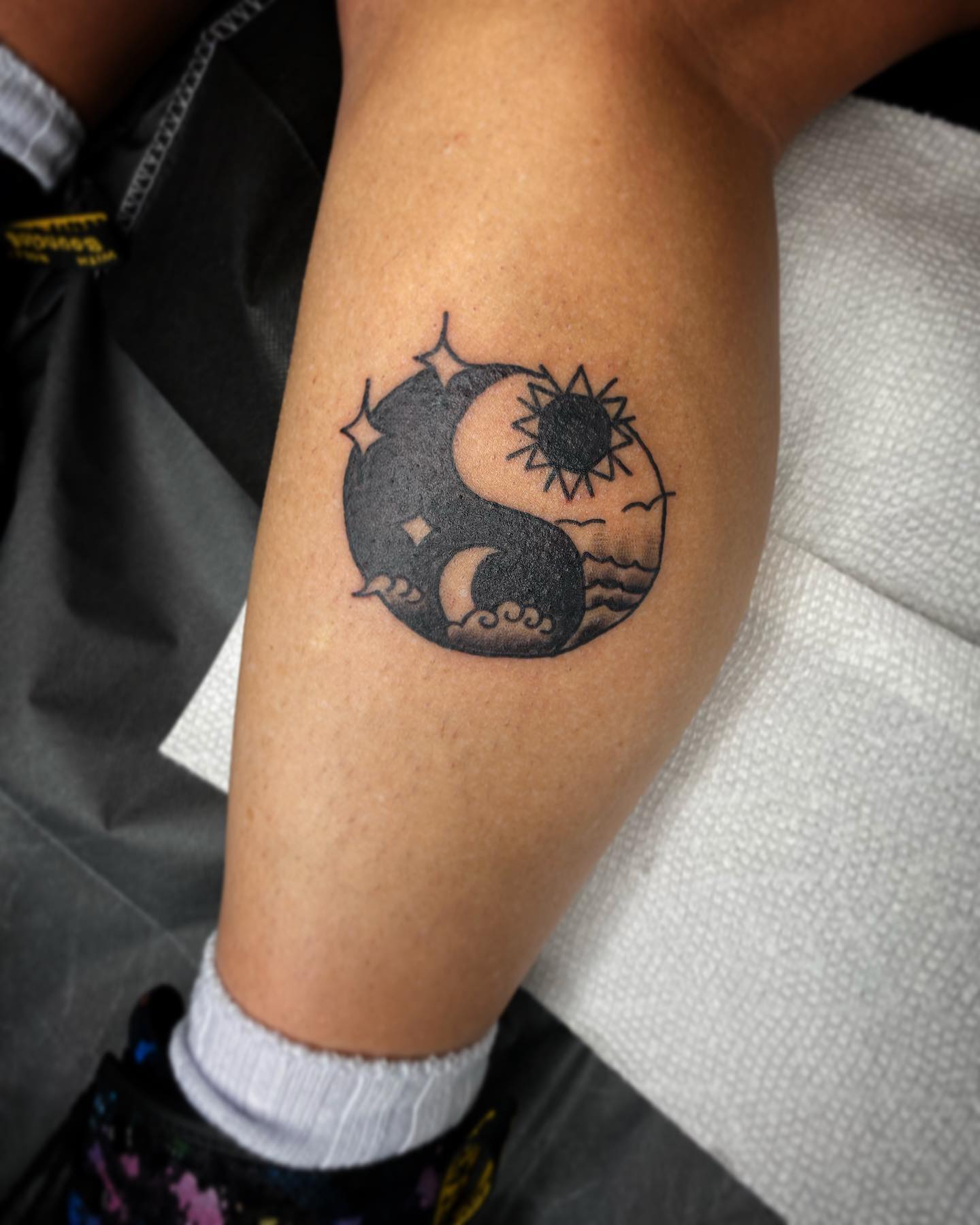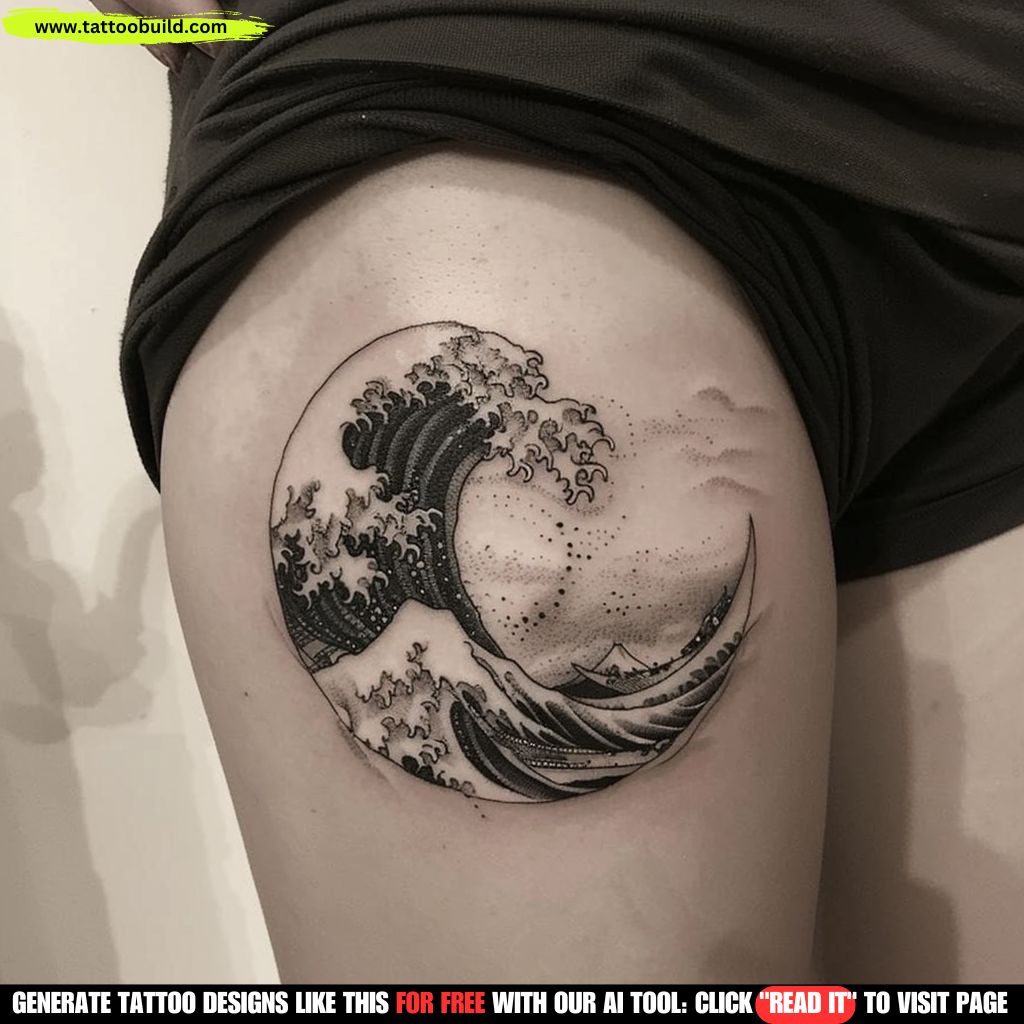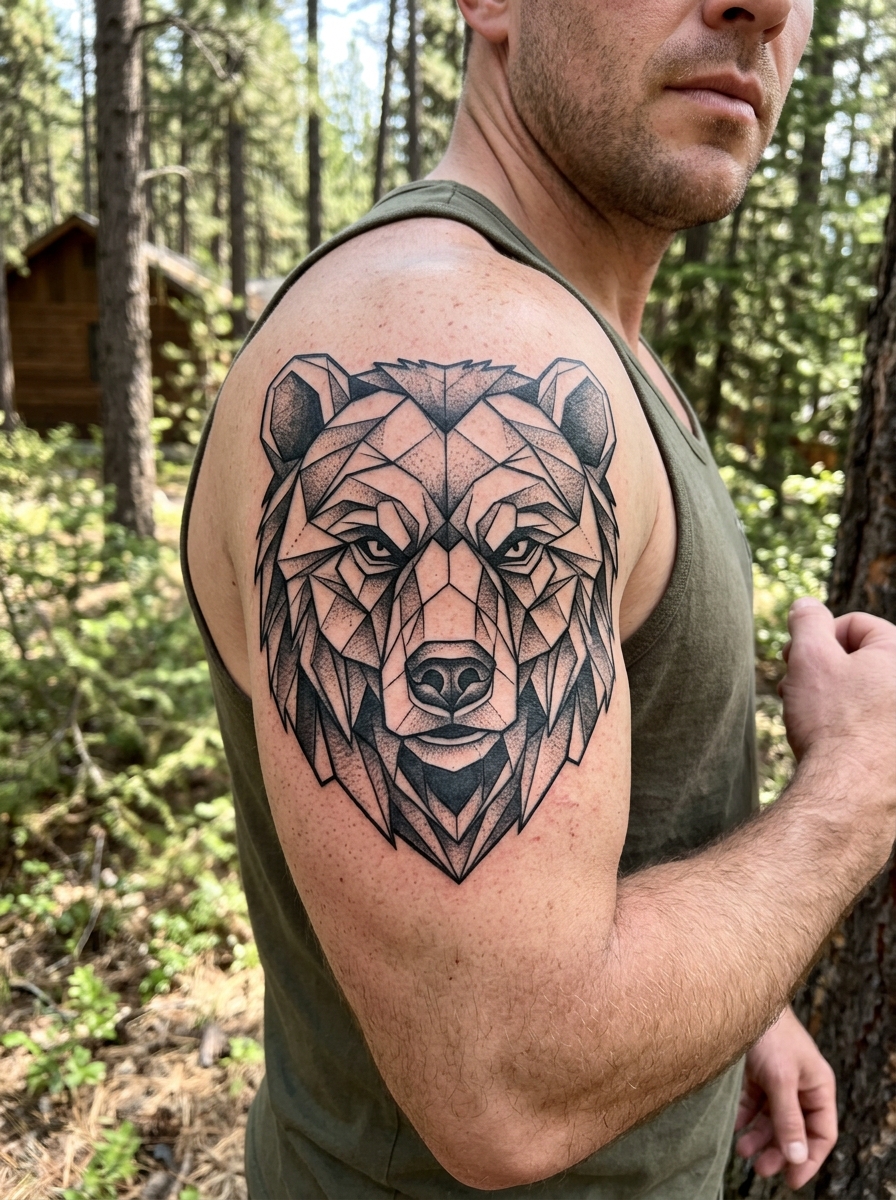
A moon phase tattoo is one of the few designs that reads as both deeply personal and completely legible to a stranger. Everyone knows what the shapes mean. Not everyone knows why you chose them.
I have been writing about celestial tattoo designs for years, and the moon phase arc is the request I see more than any other. It has stayed popular through a decade of trend churn, which tells you something.
Part of that is practical. A row of circles in varying states of fill is one of the most forgiving shapes you can put on skin — it scales, it ages, and it fits almost anywhere.
What follows is the version of this guide I wish I had been handed the first time I sat down with an artist to talk about lunar work: the styles that hold up, the placements that behave, and the mistakes I keep watching people make.
Which Moon Phase Tattoo Style Is Right for You?
Before the ideas, a quick orientation. The style you pick affects healing, cost, and how the piece looks in fifteen years far more than the subject does.
| Style | Best For | Typical Size | How It Ages |
|---|---|---|---|
| Fine line | Delicate arcs, bracelets, first tattoos | 2–6 inches | Softens noticeably; often needs a touch-up within 5–10 years |
| Blackwork | Bold statements, larger placements | 4–12 inches | Holds its shape longest of any style here |
| Black and grey shading | Realistic lunar surfaces, single full moons | 3–8 inches | Mid-tones lift gradually; contrast flattens over time |
| Watercolour | Dreamy, painterly moon phases | 4–10 inches | Fades fastest; needs sun protection and touch-ups |
| Geometric / dotwork | Sacred geometry, mandala hybrids | 4–10 inches | Dense dotwork can blur; wider spacing survives better |
If you want one honest recommendation from that table: in my experience, people who choose blackwork or simple bold linework are the ones who still like their moon tattoo a decade later.
What Each Moon Phase Actually Means
The Moon takes roughly 29.5 days to complete one cycle of phases, a span NASA calls the lunar month. That number matters more than it sounds like it should.
It means the full sequence is a closed loop, not a line. Whatever the design says about your life, it says it as a cycle that returns.
The individual phases carry their own associations, most of them drawn from folk tradition rather than anything scientific. The new moon reads as beginnings, the waxing crescent as intention, the full moon as clarity and peak energy, the waning gibbous as gratitude, and the dark moon as release.
I say “reads as” deliberately. These meanings are cultural, not fixed, and different traditions assign them differently — which is precisely why nobody can tell you your tattoo means the wrong thing.
If you are still deciding between a full arc and a single phase, browsing broader moon tattoo ideas first usually clarifies things faster than staring at phase charts.
Moon Phase Tattoo Ideas That Work on Skin
These are the concepts I see executed well most consistently. Every one of them has been done badly too, so I have noted what separates the two.
1. The Classic Seven-Phase Arc
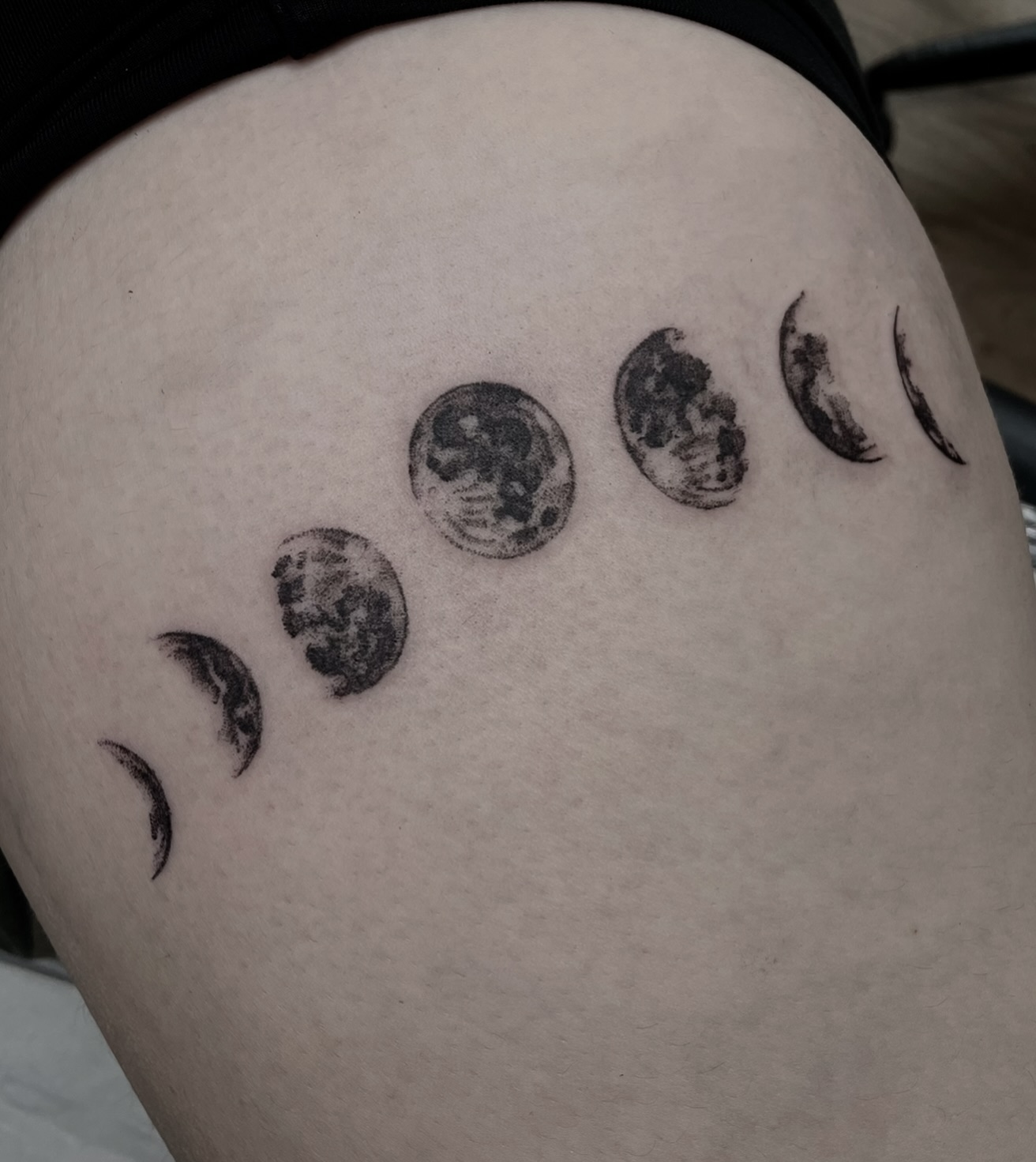
Seven circles moving from new moon through full and back to dark, arranged in a gentle curve. This is the format most people picture when they say “moon phase tattoo”.
It works because it is readable at any scale and it follows the natural curve of the collarbone, forearm, and ribcage without fighting the body.
The thing that ruins it is uneven spacing. When the gaps between circles drift by even a millimetre or two, the eye catches it immediately, and no amount of pretty shading rescues the piece.
Ask to see the stencil on your skin, standing up, in a mirror, before the needle touches you. Every artist I have asked considers this a completely normal request.
2. Crescent Moon With a Face
A profile face resting inside the curve of a crescent, borrowed from alchemical woodcuts and older tarot illustration.
It is one of the oldest moon motifs in Western imagery, and it gives the design something most phase arcs lack — a character rather than a symbol.
Faces are unforgiving at small sizes. A profile that reads beautifully at four inches turns into a smudge at one and a half, because the features rely on tiny relationships between line weights.
When I have seen this done well, it has almost always been at least three inches tall, on a flat area like the outer forearm or shoulder blade.
3. Moon Phases Down the Spine
The same sequence, rotated ninety degrees and stacked vertically along the vertebrae. The symmetry of the placement makes the whole thing feel ceremonial.
It also elongates the torso visually, and because there are no fine internal details, it tends to age better than most spine work.
Be honest with yourself about the pain. The spine sits directly over bone with very little padding, and most people I have spoken to rate it among the more difficult placements they have sat through.
Booking it as two shorter sessions rather than one long one is a reasonable ask. If you are weighing the placement generally, our guide to spine tattoo ideas covers the practical side in more depth.
4. New Moon Surrounded by Stars
A solid dark circle with stars scattered around it at varying sizes. It reverses the usual arrangement, where the moon is the bright thing.
The negative space is doing most of the work here, which is exactly why it stays legible as it ages — there is nothing delicate to lose.
Vary the star sizes deliberately. Stars drawn at identical scale look like a pattern; stars drawn at three or four different sizes look like a sky.
If the star element is what draws you, a mapped constellation tattoo paired with a single phase is a natural extension of the same idea.
5. The Moon Phase Bracelet
A continuous band of phases wrapping the wrist like jewellery. Delicate, intricate, and one of the most requested versions of this design.
It is also the version I would think hardest about. Wrap-around wrist bands sit in one of the highest-friction areas on the body, and fine line work there commonly needs a touch-up sooner than the same design on an upper arm.
That is not a reason to avoid it — plenty of people happily book a refresh every few years. It is a reason to budget for one.
Ask your artist to run the join at the inner wrist rather than the outer edge, where it is least likely to be scuffed. More options in our roundup of wrist tattoo ideas.
6. Sun and Moon Pairings
A stylised sun at one end, a full moon at the other, phases trailing between them. Day and night, waking and dreaming, the two halves of anything.
It is a common concept, and commonness is not a flaw — it is usually a sign the design solves a problem well.
The failure mode is a sun that overpowers the moon. Rays add visual weight fast, and an unbalanced pair reads as a sun tattoo with some circles attached.
When I have seen this land, the sun was kept smaller than instinct suggests, or drawn in outline while the moon carried the solid fill. We have a full gallery of sun and moon tattoo ideas if this is the direction pulling at you.
7. Moon Phases Across the Collarbone
Phases spread across the upper chest, with the full moon centred at the sternum and the crescents tapering toward each shoulder.
This is a commitment. It transforms the whole chest area rather than decorating a corner of it, and it is visible in most necklines.
The collarbone is bone with almost nothing over it, so expect a sharper sensation than a forearm session and plan for a longer sit than the size suggests.
Symmetry is the whole game here. Have the stencil checked with your shoulders relaxed and your arms down, because the chest shifts noticeably between postures.
8. Bold Blackwork Phases
Heavy, solid circles in flat black. No gradients, no shading, no texture. Just clean shapes in varying states of fill.
If longevity is your priority, this is the version I would point you toward first. Solid black packed well by a competent artist holds its edges longer than any other approach on this page.
Large areas of solid black also take longer to heal than linework and can feel tender for several extra days. That is normal; anything that gets hotter, more swollen, or more painful after the first few days is not, and warrants a call to your artist or a doctor.
See more of the approach in our blackwork tattoo designs collection.
Variations Worth Considering
If the standard arc feels too familiar, these are the directions I have seen produce the most distinctive results.
Hand and Finger Phases
A small crescent on the back of the hand, or a short phase arc running along the fingers. Bold, visible, and not a decision to make quickly.
Hands are the hardest placement on the body to keep looking sharp. Constant washing, sun exposure, and thin skin mean fading and patchy healing are common, and many artists decline hand work on a first-time client for exactly that reason.
Moon Phase Mandalas
A central full moon opened out into a circular mandala, with crescents radiating like petals. Intricate and genuinely striking when the geometry is clean.
This one lives or dies on the artist. Look specifically for a portfolio of healed mandala work, not fresh photos — dense dotwork can close up over time. Our mandala tattoo ideas gallery is a useful reference to bring to a consultation.
Botanical Frames
A single filled moon wrapped in trailing wildflowers, ferns, or lavender. The tension between the perfect circle and the loose organic growth is the entire appeal.
It also solves a real problem — botanicals let an artist soften the edges of a design so it sits on a curved limb without looking pasted on.
Sacred Geometry and Landscapes
Phases layered with triangles and hexagons, or a rising full moon set above a dark mountain range. Both anchor the cosmic imagery in something structured.
The landscape version is the more forgiving of the two, because heavy black peaks give the piece contrast that survives fading.
Personalised Phases
Rather than the generic seven, some people tattoo the exact phase the moon was in on a date that matters — a birth, a move, a beginning.
This is the version I recommend most often. It looks identical to a stranger and means something specific to you, which is close to the ideal balance for a visible tattoo.
Other common additions: a sun-sign or moon-sign glyph placed at the full moon position, seasonal motifs behind each phase, or the whole sequence contained inside a long rectangular border like a strip of film.
Healing and Aftercare for Moon Phase Work
Moon phase tattoos are usually small to medium and mostly linework, which makes them straightforward to heal. The general rule still applies: follow your artist’s instructions over anything you read online, including this.
The American Academy of Dermatology’s guidance on caring for tattooed skin is the clearest general-purpose source I have found — keep it clean, keep it moisturised, and keep it out of the sun.
Sun exposure is the single biggest factor in how a moon phase tattoo ages, and it matters most for fine line and watercolour work. Once fully healed, daily sunscreen on the area is genuinely the highest-value habit you can build.
Skin can also react to tattoo ink in ways that have nothing to do with hygiene — bumps, persistent itching, or raised patches, sometimes appearing months later. The AAD documents several of these tattoo skin reactions. If something looks wrong, see a doctor rather than waiting it out, and never attempt to treat or remove a tattoo yourself.
Still Not Sure? Common Mistakes to Avoid
Going too small is the mistake I see most. A seven-phase arc squeezed into two inches gives each moon barely a quarter-inch of space, and the crescents blur into dots within a few years.
Second: choosing an artist by style rather than by portfolio. Crisp circles are much harder to draw freehand than they look, and not every excellent artist is a geometry specialist.
Third: over-specifying. Bring references, then leave room for your artist’s read on how the design should sit on your particular body. A rigid brief usually produces a rigid result.
If you are still weighing the aesthetic rather than the design, our fine line tattoo ideas collection is the best place to work out whether that delicacy is what you actually want.
Frequently Asked Questions
How small can a moon phase tattoo be?
For a full seven-phase arc, most artists I have spoken to want at least three to four inches of length so each circle has room to read. Below that, the crescents start losing their shape as the ink settles. A single crescent or full moon can go much smaller — an inch is usually workable. If you want something tiny, choose one phase rather than compressing the whole sequence.
Do moon phase tattoos hurt?
The design itself is not especially painful, but the popular placements are. Spine, collarbone, ribs, and hands all sit over bone with little padding and are widely rated among the more uncomfortable spots. Outer forearm, outer thigh, and shoulder are considerably gentler. Pain is also highly individual, so treat any ranking as a rough guide rather than a promise.
How many phases should I include?
Seven and eight are the most common, because both give a clean symmetrical sequence with the full moon at or near the centre. Five works well in tight spaces. Some people use only three — new, full, and dark — which reads more like a statement than a diagram. There is no correct number; let the space you have and the meaning you want decide it.
Will a fine line moon phase tattoo fade?
All tattoos soften with time, and fine line work shows it soonest because the lines have less ink to lose. Expect some blurring over the years, faster in high-friction and sun-exposed areas like wrists, hands, and feet. Many people schedule a touch-up every several years and are perfectly happy with that arrangement. If you would rather never think about it again, bolder linework or blackwork is the better bet.
Can I add colour to a moon phase tattoo?
Yes, and watercolour washes of blue, purple, and silver are a popular route. Be aware that colour generally fades faster than black, and light pastel tones fade fastest of all. Colour also sits differently on different skin tones, so ask your artist to show healed examples on skin similar to yours before committing. A good compromise is a black structure with colour used as an accent rather than the whole design.
Quick Summary
- The seven-phase arc is the most versatile format and suits the collarbone, spine, forearm, and ribcage.
- Blackwork and bold linework age best; fine line and watercolour will need touch-ups sooner.
- Give a full arc at least three to four inches so each phase keeps its shape.
- Spine, collarbone, and hands are the most striking placements and also the most demanding ones.
- Tattooing the exact phase from a date that matters to you is the easiest way to personalise the design.
- Check the stencil in a mirror, standing, before any needle touches skin — spacing errors are the usual failure.
- Sun protection after healing does more for longevity than any other single habit.
- Any reaction that worsens after the first few days is a reason to contact your artist or a doctor.