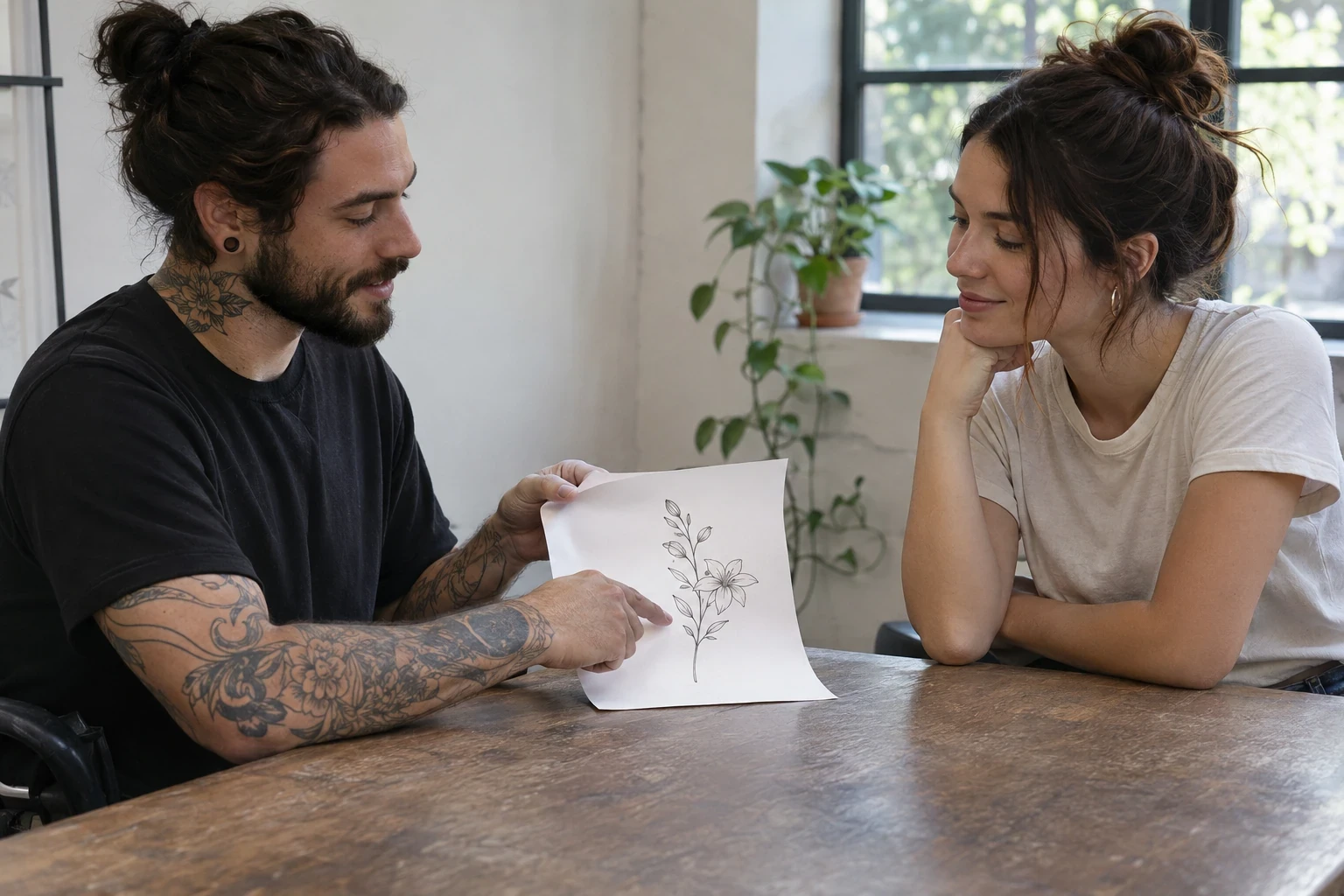
For a useful tattoo consultation, bring a clear idea, a small set of references, your preferred placement and approximate size, plus a budget range and written questions. Use the meeting to agree what the artist will design, how changes work, what the booking terms mean and what happens next. You do not need a finished drawing before asking for help.
A consultation is a planning conversation. It may happen in person, by video or through the studio's inquiry form. It does not automatically include tattooing, a finished custom design or a confirmed appointment. Ask the studio what its consultation includes before you attend.
The images here are AI-generated educational concepts featuring fictional adults. The wearable designs are AI-generated tattoo mockups, not real client work or healed results.
Start with a brief the artist can use
Write a few sentences describing the subject, the feeling you want and the elements that matter most. Separate the essentials from the details you are happy to change. A brief such as “a black botanical tattoo for my inner forearm, with a fern as the main subject and plenty of open skin” gives the artist more useful direction than a folder of unrelated pictures.
Include your approximate size in a measurement the studio uses, not only “small” or “medium.” Mention whether you want color or black and gray and whether the tattoo needs to fit around existing work. If you are still weighing styles, our minimalist tattoo ideas can help you identify which line weight and level of detail you prefer.
As one studio example, Pioneer Tattoo Company's FAQ asks consultation clients to bring reference photos and discuss style and color preferences. It describes sizing, placement and pricing as part of its consultation. Its procedures are an example, not a rule for every studio. Source checked 22 November 2026.
Bring a few references with a purpose
Choose a small set that shows different useful features: subject, line weight, color or spacing. Explain what each image contributes instead of asking the artist to combine every detail. A plant photograph can be source material while a tattoo image demonstrates a style; neither needs to become a direct copy.
Discuss placement on the body
This fern mockup shows why a placement conversation should go beyond naming a body part. The direction of the stem and the space around the leaves affect how it sits along the forearm. Ask the artist to explain orientation and viewing angles using a sketch or placement demonstration.
Ask what detail needs room
This rose example leaves space between the petals and the surrounding skin. Use an on-skin example to discuss proportions rather than treating a screen image as an exact sizing template. Ask which details the artist would simplify if you wanted a smaller version.
Make room for questions and feedback
A consultation should leave you able to explain the plan in your own words. If a term or design suggestion is unclear, ask the artist to show you what they mean. You can be open to their recommendations while keeping a clear boundary around the elements you do not want.
Record decisions before you leave
A simple notebook can hold the agreed direction and the questions still open. Confirm the next action, the expected communication channel and whether an appointment is actually reserved. Keep the studio's written terms alongside your notes so you do not rely on remembering a conversation.
Questions to ask before paying a deposit
Use these questions as a conversation checklist. You do not need to interrogate the artist; you need enough information to decide whether the proposed work and process suit you.
- Design: Which parts of my idea work well together, and which would you simplify or change?
- Portfolio: Can you show examples of similar work, including healed pieces where available?
- Size: What size would you recommend for this amount of detail, and why?
- Placement: How will the drawing sit when I stand, bend or turn the limb?
- Review: When will I see the custom drawing, and how do I request changes?
- Scope: What would count as a small revision, and what would require a new design or quote?
- Price: Is the quote fixed, hourly or an estimate, and what is included?
- Sessions: Is this planned as one appointment or several, and when will that be confirmed?
- Deposit: Is it credited toward the tattoo, and what are the cancellation, rescheduling and refund terms?
- Next step: What do you need from me, and when should I expect a reply or appointment confirmation?
Discuss money without guessing the final price
Give the artist a realistic spending range before the design becomes too elaborate. Ask what can be achieved within it and which changes would affect the quote. You may decide to simplify the idea, choose a different size or plan stages. Do not assume splitting a project into sessions makes its total cost lower.
Get the studio's own written terms rather than applying another artist's policy. Confirm whether consultation or drawing fees exist, whether the deposit is separate from those fees, how it is applied and what happens if you change the design. Prices and policies vary by artist and location; this guide does not suggest a universal fee.
Ask which payment methods are accepted and whether the final balance or appointment length can change. If something is described as an estimate, find out what could move the price outside that estimate and how the artist will discuss it with you.
Know what a consultation can leave undecided
You may leave with a direction rather than a finished drawing. Ask when the artist normally prepares custom work and when you can review it. Do not assume the drawing will be sent before the appointment, and do not assume a consultation obliges you to book.
A design can also need further assessment in person, particularly when it must fit around existing tattoos or use an unusual placement. Send clear photographs through the studio's requested channel and explain what the images show. You can ask for privacy arrangements or an alternative way to discuss a placement without sending an intimate photograph.
If a concern involves your health or medication, ask a qualified clinician or pharmacist for advice and tell the studio about relevant restrictions. A consultation with an artist does not replace medical guidance, and you should not change prescribed medication to fit a booking.
A short example of a useful inquiry
Hi, I would like to discuss a black and gray botanical tattoo for my inner forearm. I am thinking of a fern with an open, light composition, approximately the length shown in the attached placement photo. The references show the line weight and spacing I like; I am looking for an original drawing rather than a copy. My budget range is [your range]. Could you let me know whether this suits your work, how you arrange consultations and when designs are reviewed?
Replace the brackets with your own information and use the studio's preferred booking channel. If the form asks for specific measurements or photographs, follow those instructions. Keep personal background as brief as you are comfortable with; explain a memory when it helps the design, without feeling obliged to share private details.
Leave with a written next step
Before the conversation ends, repeat back the plan: subject, style, approximate size, placement, artist, review process and booking status. Ask for the quote or estimate and deposit terms in the studio's normal written format. Check whether your appointment is confirmed or still waiting for a payment, form or artist response.
Save your own notes and send any missing references through the agreed channel. Once you have booked the tattooing session, use our tattoo appointment preparation guide for that separate stage. For a broader overview of the first appointment, see getting a tattoo for the first time.
Tattoo consultation FAQ
Do I need to know exactly what I want?
No, but arrive with a direction the artist can respond to. A subject, a placement, a rough size and a few examples of styles you like are a practical starting point. Ask whether the artist offers idea-development consultations if your concept is still broad.
What should I wear?
Choose clothing that makes it easy to discuss the intended placement while keeping you comfortable. Ask about privacy, changing space and any studio requirements beforehand. You do not need to undress at a table to have a useful design conversation.
Can I bring pictures of another person's tattoo?
You can use them to explain a style or compositional feature. Say what you like about each image and ask for an original interpretation. For a personal subject such as a pet or a meaningful object, bring your own clear source photographs as well.
Is a consultation free?
Ask the studio before booking. Some charge for consultation or design time and others have a different process. Confirm the specific service and terms instead of assuming that a deposit, consultation fee and drawing fee mean the same thing.
Will I get tattooed at the consultation?
Only if the studio explicitly books it that way. Confirm whether you are attending a planning meeting or a tattoo appointment and whether a same-day session is an option. Do not organize your day around an assumed procedure.
What if I decide not to go ahead?
Tell the studio clearly and promptly. Check the terms you were given for any fee or deposit already paid. You can decide a design or process is not right for you before committing to the tattoo itself.