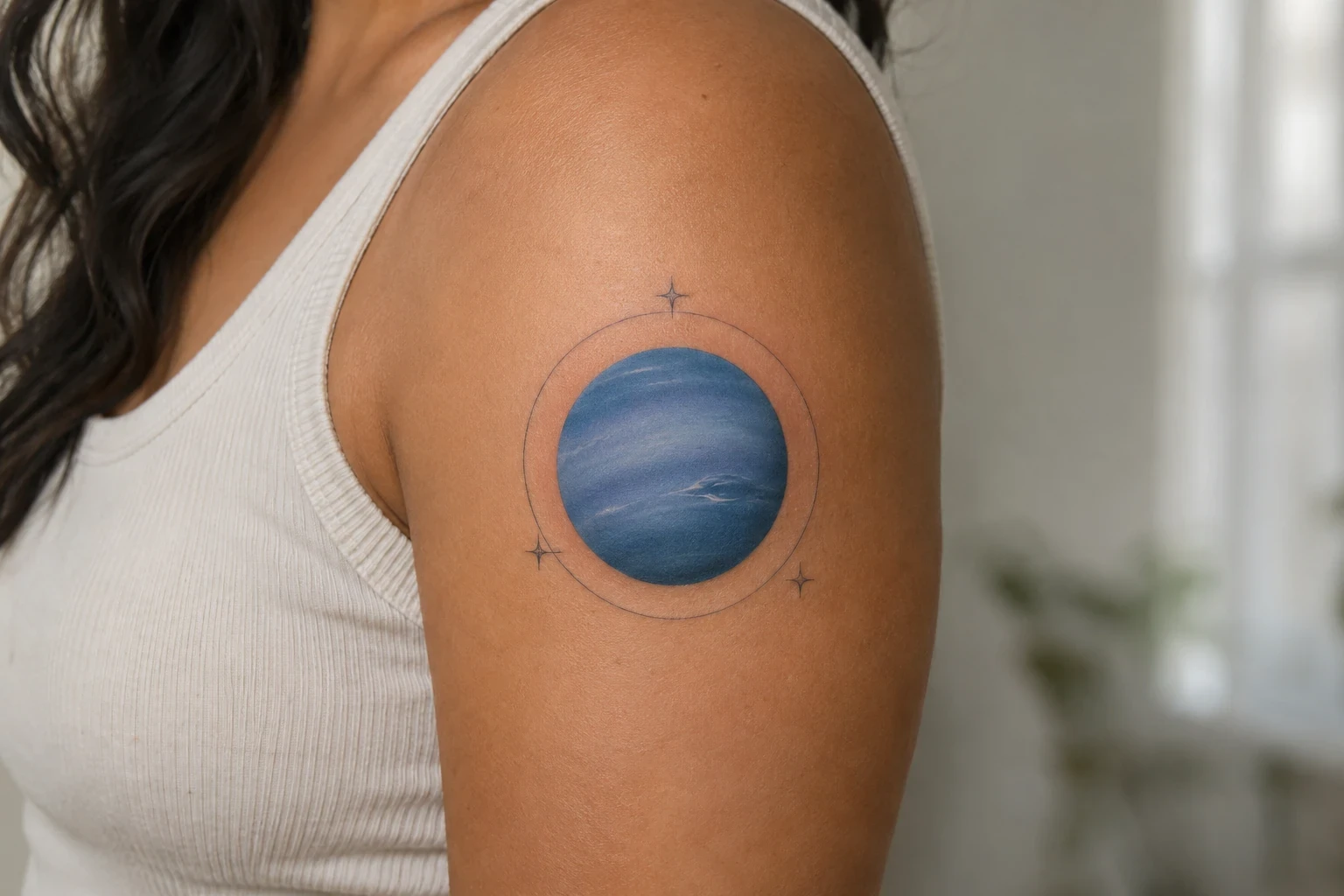
A Neptune tattoo can use a simple blue planet disk or build a larger composition around stars, waves and geometric frames. These 22 Neptune tattoo ideas focus on the planet, with different line weights, palettes and placements to discuss with your artist.
All images are AI-generated tattoo mockups on fictional adults. They show design possibilities, not real client tattoos or healed results. The colors, companion objects and apparent distances are artistic choices, not calibrated astronomical diagrams.
Choose the planet version of Neptune
NASA describes Neptune as an ice giant. It also has rings, shown clearly in Webb's near-infrared observations. A tattoo can draw on those features without copying the appearance or color treatment of a particular space image. Sources checked 23 November 2026.
For this gallery, the central motif is a planet with a smooth atmospheric appearance. A blue disk alone is a stylized symbol; adding tiny details does not make it an exact scientific rendering. If that accuracy matters to you, bring a clearly identified astronomical reference and explain which features you want preserved.
If you meant the sea-god interpretation instead, our Poseidon tattoo ideas explore that separate visual direction. Here, waves and compass motifs are optional companions to the planet, rather than a portrait of a deity.
1. Simple blue Neptune
A small blue disk keeps the idea direct. The inner forearm offers an easy viewing area, while a few pale atmospheric marks add interest without turning the piece into a busy scene. Ask the artist which details will remain readable at the size you want, and choose the blue from their own work.
2. Dotwork planet
This monochrome approach uses stippling and curved marks to suggest the planet's atmosphere. The calf offers enough space to see the texture. It is a useful option if you prefer black and gray; the meaning comes from your chosen subject and context rather than a particular ink color.
3. Watercolor Neptune
Blue and teal washes give the planet a painterly setting. The upper-arm example keeps a recognizable disk within the looser color. Discuss how soft you want the edges to feel and ask to see the artist's healed color work rather than using a generated mockup to predict the result.
4. Neptune in an orbit frame
A separate elliptical frame adds motion around the planet. On the forearm, the outline extends beyond the blue disk to keep the surrounding shape readable. This is a decorative orbit-like line, not a scale model or a claim about the path of a specific moon.
5. Planet with a star cluster
A loose cluster of stars creates a light celestial composition above the planet. The upper arm gives the marks room to spread without crowding the disk. Treat their arrangement as a pattern you can personalize; it is not a labeled or verified constellation map.
6. Neptune above ocean waves
Ocean waves below the planet connect the blue palette with a second flowing shape. The calf example stacks the motifs vertically so neither has to overlap the other. Decide whether you want the waves to remain a small accent or lead a broader ocean-and-space composition.
7. Planet above a mountain ridge
A mountain ridge provides a grounded shape beneath the planet. The forearm offers room for the gap between the two subjects, which helps them read separately. Use a meaningful landscape reference if you have one, while keeping its details simpler than the main planet motif.
8. Neptune and leafy sprigs
Leafy branches give the circular planet a softer frame. On the upper arm, they can follow the lower curve without hiding the blue disk. This combination can connect an interest in space with a love of plants, but it does not carry one fixed symbolic meaning.
9. Diamond-framed Neptune
A diamond makes the planet part of a more geometric design. The forearm arrangement leaves skin between the circle and the border. Have the artist check the line weight of the frame alongside the shading so one element does not overpower the other.
10. Neptune in an arch
An arch turns the planet into a small framed view. The calf suits the tall outline, with open space above and below the disk. You can keep it as a simple portal-like shape or discuss a larger architectural composition, but extra detail will change the space it needs.
11. Light-and-shadow Neptune
Shading part of the sphere creates a light-and-shadow study. The upper-arm example uses the full circular form, with blue remaining visible in the lit area. The lighting is an artistic treatment; ask the artist to plan a clear contrast rather than treating it as an astronomical phase chart.
12. Neptune in a night-sky panel
A dark rectangular panel gives the blue planet a night-sky setting. The calf offers a clear vertical area for the solid shape. Discuss the panel's footprint and the small light gaps with the artist, since the result has much more visual weight than an isolated disk.
13. Planet and compass star
A compass-style star below the planet adds a directional motif without lettering. The forearm example gives each symbol its own space. It might connect to a personal journey or decision, but the meaning is yours; the star is not a navigation instruction or a map of Neptune's position.
14. Neptune and a tiny rocket
A tiny rocket adds a playful exploration theme. The upper arm gives the diagonal shape room beside the planet, keeping the composition from becoming a single crowded circle. The spacecraft is an imagined design rather than a depiction of a named mission.
15. Neptune above an open book
An open book beneath the planet can connect the tattoo to learning, reading or a field of study. The calf lets the subjects stack neatly. Keep the pages simple, and plan any lettering separately if you want a personal date or short phrase added later.
16. Fine rings around Neptune
Thin ring lines add another feature associated with Neptune. The forearm example treats them as a restrained graphic accent. Their visibility, angle and thickness are stylized; show the artist a reliable reference if you want a more astronomy-focused interpretation rather than a decorative ringed-planet emblem.
17. Planet with a companion moon
A smaller companion disk adds a second scale to the composition. On the upper arm, the open space around both circles helps them remain separate. This is a decorative planet-and-moon arrangement, not a portrait of a particular moon or an accurate distance comparison.
18. Neptune and a telescope
A telescope below the planet makes the stargazing connection explicit. The calf offers room for the tripod without pushing its lines into the disk. Ask the artist to simplify the instrument's outline and check that the legs stay distinct when the drawing is reduced to the intended size.
19. Heart-framed planet
A heart outline changes the planet from a standalone emblem to a more personal keepsake. The upper-arm example leaves the disk as the central focus. The frame might mark a shared interest or an affectionate association with space, without needing a universal meaning.
20. Neptune beneath a bright star
One larger star gives the composition a clear vertical direction. The forearm leaves space between the star's points and the planet. Although the motif resembles a navigational star, the design is decorative; use a different arrangement if you want to refer to an identified star or sky position.
21. Planet in a black circle
A black circular backdrop gives the lighter planet a strong border. The upper arm provides room for the contrast and the narrow separating halo. Discuss how large the dark area should be before committing, because a solid backdrop changes the balance of the entire tattoo.
22. Half color and half linework
A half-color, half-linework planet makes two treatments part of one circular design. The calf gives the boundary a long clear view. Keep the outer contour continuous so the halves read as one subject, and decide with the artist how much atmospheric detail each side needs.
Turn a planet idea into an artist brief
Start with the planet, the approximate size and the body area. Then choose one supporting idea: a frame, a landscape, a plant or a star pattern. Explain what you like about the reference rather than asking an artist to copy the mockup. A useful brief might be “a muted blue Neptune disk with subtle bands, no broad ring system, and a small mountain outline below it.”
Choose between an isolated disk and a larger scene early. A small planet can leave plenty of surrounding skin visible, while a dark panel, detailed telescope or botanical frame changes the footprint. Our minimalist tattoo ideas offer more examples of compositions that let a simple shape do most of the work.
Ask to see the drawing at its intended size and on a placement stencil. Check the circular silhouette, the contrast of the planet against your skin and the space between nearby lines. Use the artist's portfolio, including healed work where available, to discuss the likely visual approach. These mockups cannot establish how a particular color or fine detail will look after healing.
For help preparing that conversation, use our tattoo consultation checklist. Bring the references that matter and identify any scientific feature, exact text or personal detail that needs a separate accuracy check.
Neptune tattoo questions
What does a Neptune planet tattoo mean?
It may reflect an interest in astronomy, exploration, study or a personal association with the planet. Waves and other companions can add your own context. There is no universal meaning, and a planet design does not have to make an astrological statement.
Should Neptune be shown with rings?
Neptune has rings, but you can choose whether to include them in a decorative tattoo. If you do, explain whether you want a subtle feature based on a reference or a more graphic interpretation. Avoid assuming every familiar ringed-planet drawing depicts Neptune accurately.
Can the tattoo be black and gray?
Yes. Shading, stippling and a clear circular outline can establish the visual direction without blue ink. Tell the artist how important the specific planetary identity is to you, because a simplified monochrome sphere may also read as a more general space motif.
Which placements work for a small planet design?
The forearm, upper arm and calf are options to discuss. The planet's size and any companion motif matter more than copying one placement from a photo. Have the artist show how the design sits when the limb is relaxed and viewed from different angles.
Are these real or scientifically exact tattoos?
No. These are AI-generated tattoo mockups on fictional adults, intended to explore design choices. Their colors, scales, stars, rings and lighting can be stylized. For a scientifically precise design, work from an identified reference and review the artist's final drawing before tattooing.