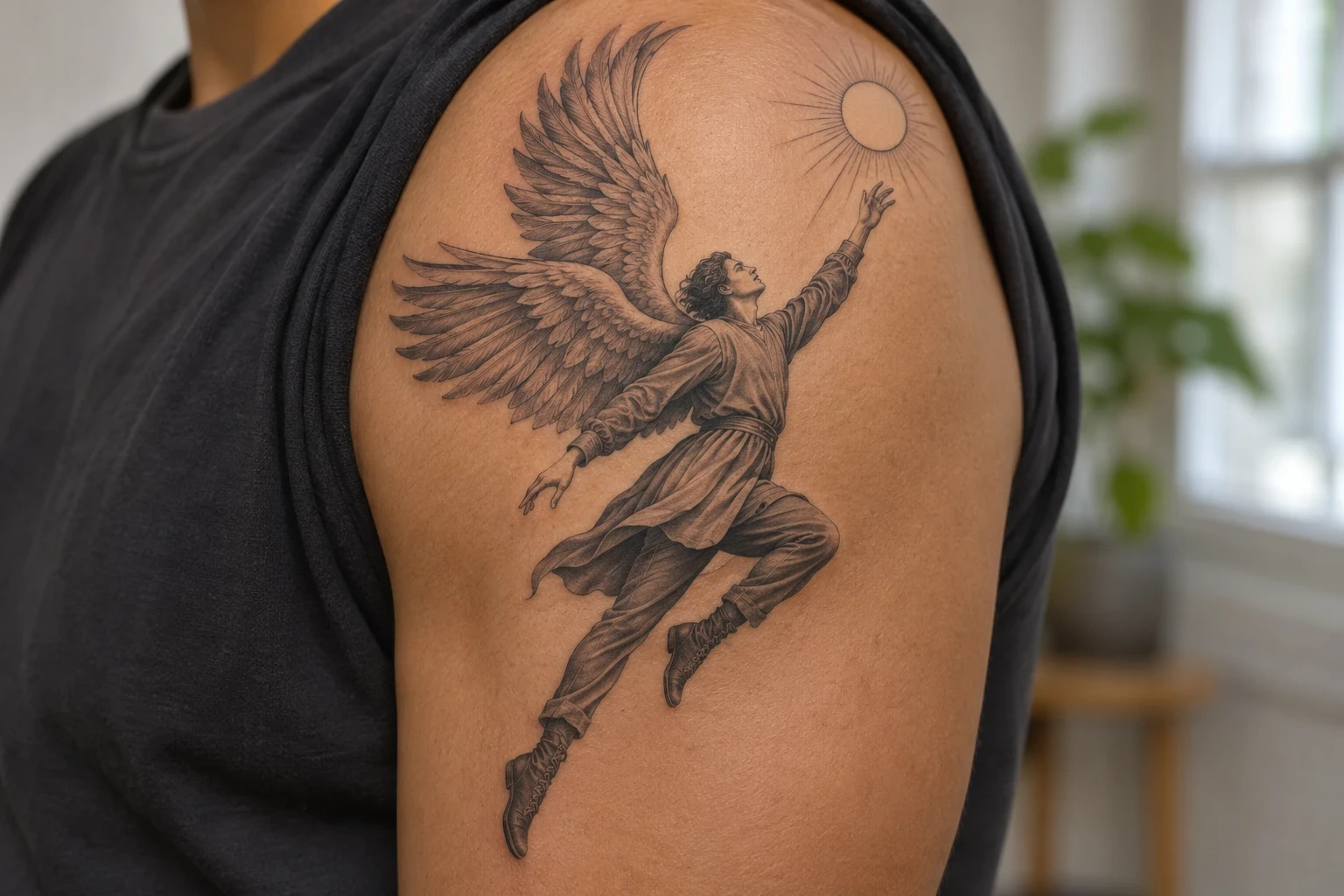
An Icarus tattoo can show a whole winged figure or reduce the story to a feather, a sun and a line of sea. The strongest starting point is the moment you want to emphasize: reaching upward, floating through open space, or a feather separating from a wing.
In the myth, Daedalus makes the wings that let Icarus fly; the sun’s heat melts their wax. The National Gallery of Art’s discussion of Chagall’s Orphée describes that story and the tension between flight and its consequences. These designs offer different visual references to it, rather than treating every winged person as an angel.
All 20 designs are AI-generated tattoo mockups on fictional adults, plus a separate hero. The figures are modern, clothed interpretations, not copies of a particular ancient image or real client tattoos. Use them to discuss size and placement with your artist, and ask to see healed work in the style you like.
1. Dark winged silhouette
The dark body and feathered wings make this silhouette readable without a detailed face. Keep the lowered arms and crossed legs separate from the wing edges.
2. Feather wing and wax drop
A single wing and wax drop make a compact reference to the story. Give the drop a clean outline and leave a gap between the lower feathers.
3. Wing beneath a sun disk
A sun above a wing makes the relationship between the two shapes the focus. Try different distances between them before deciding on the size of either element.
4. Ascending woodcut Icarus
A back view lets the wings share the composition evenly. The figure’s arms should remain distinct from the feather edges, especially at the shoulders.
5. Wing above the waves
Two wave lines can suggest the sea without turning a small piece into a full scene. Keep a clear gap between the wing tip and the water so both shapes remain visible.
6. Icarus in an oval frame
A thin oval gives the floating figure a quiet boundary. If a wingtip approaches the border, increase the space rather than pressing the feather details into it.
7. Three falling feathers
Three separate feathers can carry the sense of movement without a body. Vary their angles and leave enough open skin that they look like individual shapes.
8. Fine-line winged traveler
A standing figure is a calmer alternative to flight. The folded wings should remain recognizable from the side, even if the face stays very simple.
9. Blackwork wings and sun
Dark wings work as a graphic emblem. Keep the central gap open so the two wings do not become one solid shape beneath the sun.
10. Icarus in an open diamond
A diamond adds a modern frame. Let it sit outside the figure’s important outlines instead of cutting through hands, feet or wing tips.
11. Separated wing and feather
A separated feather can suggest the story without showing a figure in distress. Keep the wing complete and make the small detached shape intentional.
12. Sunset wing emblem
A horizon gives the wing a level base. The half sun and the lower edge of the wing need separate outlines so they do not become a single dark band.
13. Winged figure medallion
A pale figure against a dark field emphasizes silhouette. Compare the design from a few steps back to see whether both wings and the pose are still clear.
14. Traveler beside a cliff
A figure beside a landscape can show the pause before a journey. Keep the traveler and the edge as separate forms, with open space around the small silhouette.
15. Blue accent beneath a wing
The blue curve gives the wing and small seated figure a shared base. Keep the accent secondary so the feather structure and the little figure remain distinct.
16. Paired wings with wax drops
A paired-wing emblem puts the wax detail on both sides. Simple rounded drops are easier to read than many small trailing marks.
17. Wing and three tiny stars
Stars make this a more open-ended flight image. They are decorative additions here, rather than a claim that this exact arrangement belongs to the ancient story.
18. Winged figure like an engraving
An engraved frame gives the figure the feel of a small illustration. Keep the border light enough that the upright pose remains the subject.
19. Feather beneath a sun arc
A feather under an arc is a quiet, compact design. Decide whether the arc should read as a sun or simply as a frame before choosing the shading.
20. Two wings framing open sky
Two wings can frame bare skin as part of the design. Preserve the empty center and the space above the horizon so the piece does not need another object to feel finished.
Choose the pose before the feather detail
A small figure needs a clear pose first. Look for a readable gap between the arms, wings and legs, then decide how much feather detail the design can carry. If those outlines merge in a small stencil, try a larger size or a simpler wing shape before adding shading.
For a symbolic design, decide which elements must be present for you: a sun, a wax drop, a feather or the sea. One or two can be enough. A wing by itself leaves the reference open; a sun and wax detail make the Icarus story more explicit.
For other mythological subjects, browse our Greek mythology tattoo ideas. For a different relationship with the sea, see Poseidon tattoo ideas. If you prefer a small emblem, compare the open spacing in our minimalist tattoo ideas.
Common questions
What can an Icarus tattoo mean?
It might connect with ambition, curiosity, freedom, limits or the consequences of a choice. A wearer can value several parts of the story at once, or simply enjoy the image. The design does not tell a stranger which interpretation is theirs.
Is a falling winged figure always Icarus?
No. Winged figures appear in many stories and artistic traditions. A sun, feather-and-wax reference or a specific artwork can help identify Icarus, but the pose alone does not establish the subject.
Do I have to show the fall?
No. Wings being made, a figure preparing to fly, an upward pose or a simple feather can all refer to the story. The Met’s Daedalus Forming the Wings of Icarus out of Wax is an example of an artwork focused on preparation rather than the fall.
Where does a detailed Icarus tattoo fit?
Start by comparing the pose at two sizes on a broad placement such as an upper arm, thigh or calf. A winged figure is often wider than it first appears in a drawing. Your artist can help keep the entire silhouette readable as the placement curves.