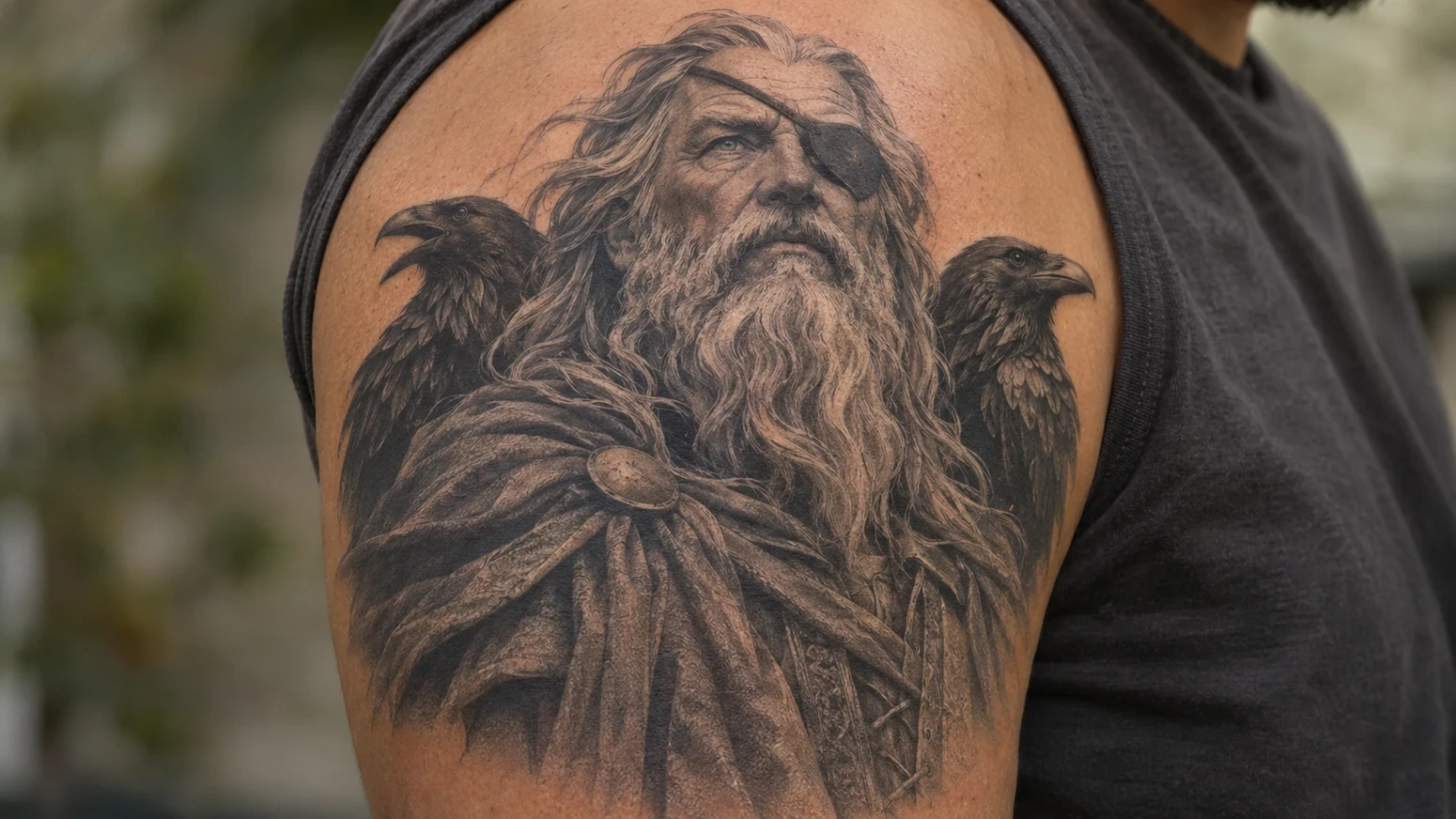
An Odin tattoo is easier to read when you choose one main reference: the one-eyed face, the two ravens, or the traveler with a staff. Trying to fit every part of his story into a small portrait can hide the very detail that identifies him.
The National Museum of Denmark’s account of the Viking gods describes Odin giving up an eye for access to Mímir’s well of wisdom. The Swedish History Museum describes his ravens Huginn and Muninn, associated with thought and memory. Those references give you several starting points without needing lettering.
These 23 ideas are AI-generated tattoo mockups on fictional adults. They are contemporary design concepts, not reconstructions of Viking-age tattoos or real client work. Compare the shapes and placements, then ask your artist how they would adapt a design and show you healed work in the same style.
1. Wanderer beneath a broad hat
A broad hat gives this portrait a clear top edge. Keep one side of the brim light enough that it doesn’t merge with the eye and hair; the staff can remain a simple line beside the face.
2. One-eyed Odin profile
A profile puts the nose, cheek and beard into one long silhouette. Try the stencil with your leg relaxed and viewed from the side, rather than judging it only from above.
3. Two ravens on a spear
Two perched ravens make a quieter composition than two birds in flight. Leave a visible gap between their heads and the spear point so each part reads at a glance.
4. Odin in an open knot frame
The loose frame gives the face a boundary without covering the forehead. This is a decorative contemporary knot treatment; simplify the crossings if they compete with the portrait.
5. Half portrait and one raven
A split portrait is deliberately stylized. The join should look intentional, with the raven’s beak and Odin’s nose each retaining a distinct outline instead of becoming an accidental hybrid face.
6. Minimal spear and two feathers
A spear and two feathers offer a small alternative to a portrait. Keep the feather shafts apart and allow the spear point enough open skin that its shape stays clear.
7. Woodcut Odin bust
Parallel marks can suggest carved or printed texture without using a smooth gray gradient. Ask the artist where they would keep white space around the eye patch, cheek and beard.
8. Round Odin medallion
A circular field makes the hat and beard feel like a compact emblem. The edge of the circle should still be readable when the arm turns; avoid squeezing the brim right against it.
9. Odin amid mist
Mist softens the lower edge of a portrait. Keep it below the main facial features so the face remains the subject rather than disappearing into an all-over gray area.
10. Blue-gray Odin portrait
Muted blue adds another tone without introducing a second subject. Decide whether the blue should frame the hair or blend into the cloak, and keep the strongest contrast around the face.
11. Raven in flight above a staff
A bird in flight takes up more width than a perched bird. Give the wings space on either side and use the plain staff as a vertical anchor beneath them.
12. Cloaked wanderer silhouette
A small traveler silhouette works best with a readable gap between the staff and body. Let the cloak carry the shape instead of trying to fit detailed facial features under a tiny hat.
13. Odin’s eye and feather
An eye-and-feather emblem leaves the Odin reference open to interpretation. Choose it if that ambiguity suits you, or add a more explicit reference if you want the subject recognized immediately.
14. Two ravens on a bare branch
A branch gives the bird pair a shared base. Keep its smaller twigs away from the beaks and feet so the birds remain the darkest and most recognizable shapes.
15. Wolf beside Odin
A wolf can balance the portrait with a second profile. These two faces need room to stay separate; use a larger stencil if the muzzle or beard becomes crowded.
16. Odin inside a diamond
A thin diamond creates a geometric contrast with flowing hair. This is a modern frame rather than a claim about an ancient Odin symbol, so let it serve the composition.
17. Crossed raven feathers and spear
Two crossed feathers can give a short spear a wider base. Keep the crossing low enough that it doesn’t hide the spearhead, and use fewer feather marks at smaller sizes.
18. Wanderer at the forest edge
A few trees establish a setting without turning the tattoo into a full landscape. The traveler should remain visible as a complete figure, with a gap around the hat and staff.
19. Traditional Odin and raven
A limited palette and heavy outline give this portrait a flash-inspired look. The raven below the face works as a dark base; leave some space between its beak and the beard.
20. Spear with a plain sun disk
A plain disk can give the spear a focal point. Here it is a contemporary color accent, not an assertion that this exact combination is an ancient Odin emblem.
21. Brushwork Odin profile
Brush edges give the hair movement. Keep those edges inside a deliberate silhouette so the portrait doesn’t look like scattered marks when viewed from farther away.
22. Two raven heads in an oval
Facing the two heads outward creates a balanced badge. Make the beaks long enough to read as ravens and leave a gap between each beak and the oval border.
23. Traveler hat and staff emblem
A hat, staff and feather can suggest a traveler without showing a face. Give the hat brim its own outline and let the long staff set the direction of the piece on the arm.
Make the reference clear at your chosen size
A portrait needs enough space for the eye area to stay separate from the hair and brow. An eye patch is a modern visual shortcut in these mockups; the mythological reference is the loss of one eye. You can discuss a closed eye or a shadowed side of the face with your artist if you prefer a subtler treatment.
For a raven design, look first at the silhouette. Two birds should have two readable heads, beaks and bodies before you add individual feathers. For a spear, leave a clear path from the point to the shaft. If the outline gets lost in a beard or wing, remove a detail before making the whole tattoo darker.
For a broader selection, see our Norse mythology tattoo ideas. Compare the birds in our raven tattoo ideas and the decorative treatments in our Viking tattoo ideas.
Common questions
What can an Odin tattoo mean?
A wearer might connect it with the search for knowledge, a story they value, or a personal interest in Norse mythology. For some people the subject also has religious significance. None of those meanings is automatic, and the artwork alone doesn’t tell you what its wearer believes.
Do two ravens refer to Odin?
They can. Huginn and Muninn are a recognizable reference in Odin’s stories, but two birds can also be chosen for other reasons. If you want the Odin connection to be explicit, combine the pair with a portrait or another reference you have researched.
What is Odin’s spear called?
The Swedish History Museum’s Aesir display names the spear Gungnir. A plain spear tattoo can allude to it, but a modern artist’s spear drawing is not an authenticated historical depiction.
Do I need runes in an Odin design?
No. A portrait, bird pair or spear can provide the reference without text. If you want a particular word, find a reliable language specialist before committing it to skin rather than treating decorative rune strings as translations.