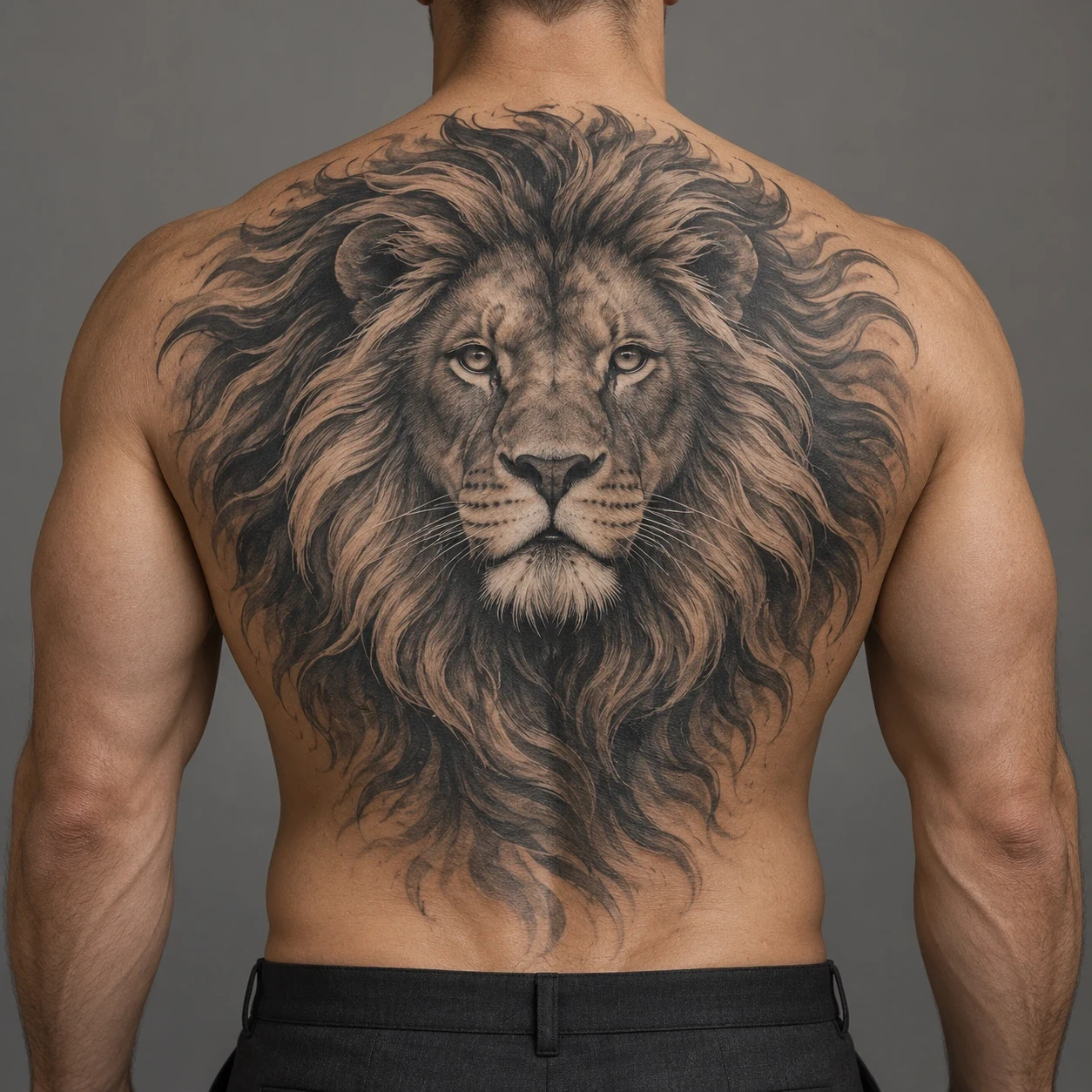
Viking tattoo ideas work best when the symbol you choose actually means something to you, not just because it looked fierce on a Pinterest board.
I have spent a lot of time looking at Norse-inspired work, both in studios and in the healed photos artists post months later.
The pattern is consistent. The pieces that still look sharp after two or three years are the simple, confident ones: heavy black line, clear negative space, no crowding.
This guide walks through the symbols that come up most often, what each one genuinely traces back to, and how they behave as tattoos. If you want a broader angle on the theme, our roundup of warrior tattoo ideas covers ground beyond Scandinavia.
Which Viking Symbol Is Right for You?
Most people arrive with a feeling rather than a symbol. This table maps the common motivations onto the designs that carry them.
| Symbol | Usually Chosen For | Works Best At | Ages Well? |
|---|---|---|---|
| Valknut | Courage, facing mortality | Forearm, shoulder, calf | Very well — geometric and open |
| Vegvisir | Direction, finding your way | Forearm, upper back, chest | Well if kept 4 inches or larger |
| Yggdrasil | Family, roots, connection | Back, thigh, full forearm | Depends on line weight |
| Mjolnir | Protection, strength | Forearm, sternum, calf | Excellent — solid shapes |
| Odin portrait | Wisdom, sacrifice | Upper arm, back, thigh | Needs a skilled realism artist |
| Longship | Journeys, ancestry | Forearm, ribs, half sleeve | Good with strong silhouette |
| Runes | A word, name or vow | Forearm band, spine, ribs | Good if letters stay spaced |
| Fenrir | Untamed nature, defiance | Upper arm, calf, chest | Good in bold blackwork |
| Valkyrie | Honour, remembrance | Back, thigh, upper arm | Needs size to hold detail |
| Helm of Awe | Protection, resolve | Chest, back of hand, shoulder | Very well — radial and bold |
What Viking Tattoos Actually Mean — and What They Do Not
Here is the part most guides skip. Not every symbol sold as “Viking” is actually from the Viking Age.
The Valknut is genuinely old. It appears on Gotland picture stones such as the Stora Hammars stones and on wood from the Oseberg ship burial, and it is repeatedly found alongside imagery connected to Odin.
The Vegvisir and the Helm of Awe are different. Both are documented in Icelandic grimoires written centuries after the Viking Age — the Huld Manuscript of 1860 for the Vegvisir, and the seventeenth-century Galdrabók for Ægishjálmur.
That does not make them bad tattoos. It just means the honest description is “Icelandic magical stave”, not “authentic Viking symbol”, and I would rather you knew that before it is permanent.
One more thing worth saying plainly: a handful of Norse symbols, particularly certain runes, have been appropriated by extremist groups. Every artist I have asked about this recommends discussing context and placement before committing, and choosing a composition that reads clearly as mythology rather than as an isolated emblem. The documented history of these symbols is worth twenty minutes of your time.
Norse Symbol Tattoos: Staves, Trees and Runes
These are the geometric, graphic designs. They rely on line quality rather than shading, which makes them forgiving over time but unforgiving in the chair — a wobbly line has nowhere to hide.
1. Valknut
Three interlocking triangles, sometimes drawn unicursal (one continuous path) and sometimes as three separate shapes threaded together.
Its exact meaning is not recorded anywhere — no surviving text explains it. Scholars connect it to Odin and to the passage between life and death, largely because of where it appears: burial contexts and stones showing sacrifice.
As a tattoo it is close to ideal. The open interior means it stays legible even at three inches, and the straight lines heal predictably.
When I have seen it go wrong, it is almost always because the artist tried to fill the negative space with texture. Leave it empty. The shape is the design.
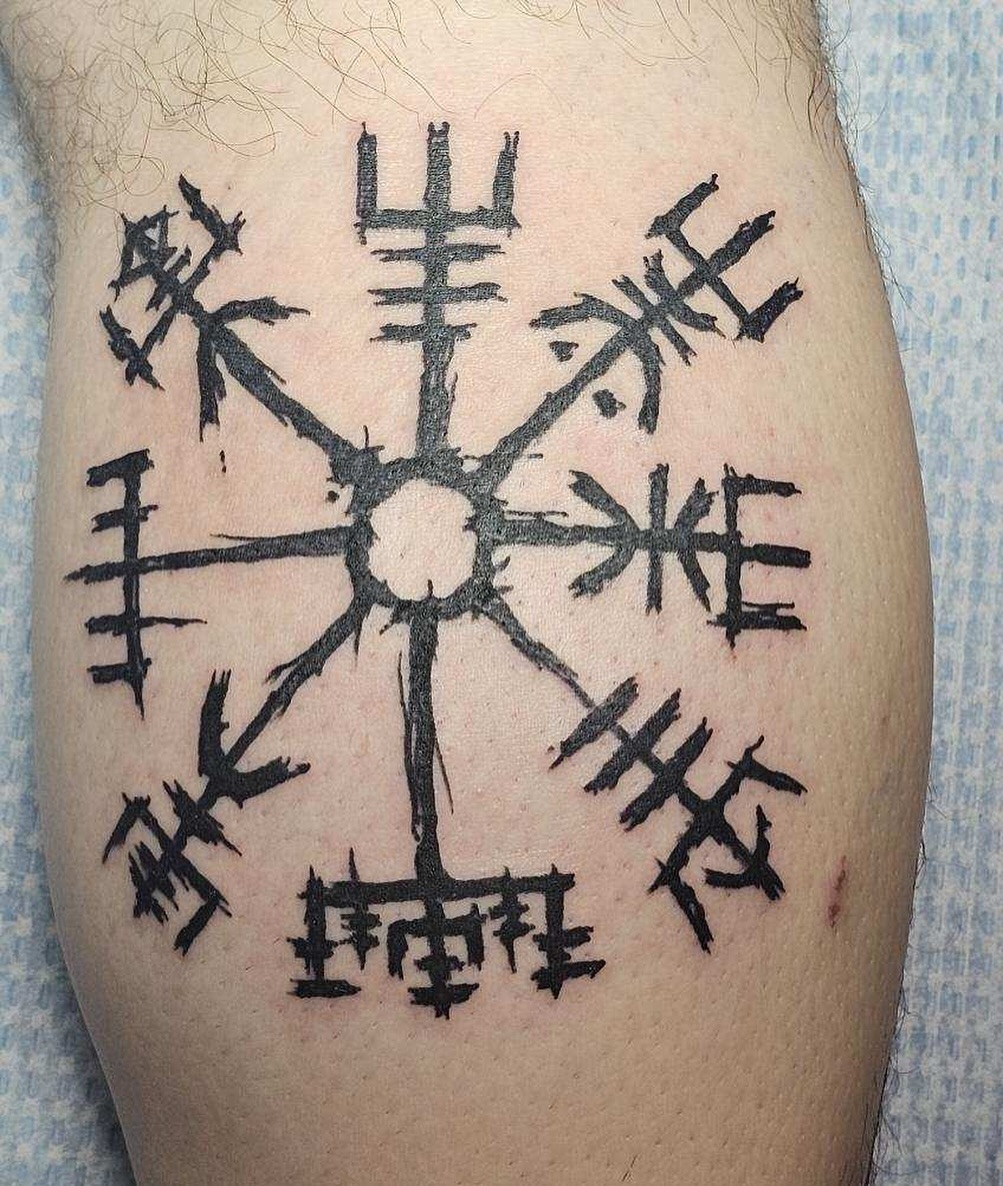
2. Vegvísir (The Icelandic Compass)
Eight staves radiating from a centre point, each one topped with a different terminal.
The Huld Manuscript describes it as a charm so that its bearer will not lose their way in storms or bad weather, even when the way is unknown. That line is the reason it has become the go-to tattoo for people navigating a hard chapter.
Size is the whole game with this one. Below about four inches the eight arms start to merge as the ink settles, and in my experience the small ones look noticeably muddier at the two-year mark than the larger ones do.
Common variations include setting it inside a runic ring, or replacing one arm with a compass needle. Both work, as long as the eightfold symmetry stays readable.
3. Yggdrasil (The World Tree)
The immense ash tree of the Poetic Edda and Prose Edda, holding the nine worlds in its branches and roots.
People pick it for family, for roots, for the idea that everything connects. It is easily the most requested Norse design among the people I have talked to who are getting their first large piece.
The design decision that matters is branch density. A tree with fifty fine branches will read as a grey smudge within a few years; a tree with twelve confident ones will still look like a tree at twenty.
Circular framing is the standard composition — roots and canopy mirrored inside a ring. It sits naturally on the shoulder blade, the outer forearm, or the thigh. Our wider gallery of tree of life tattoo designs shows how differently the same idea can be handled.
4. Runes and Runic Bands
Two alphabets get used. The Elder Futhark has 24 characters and predates the Viking Age; the Younger Futhark has 16 and is the script actually in use across Scandinavia between roughly 800 and 1100.
If historical accuracy matters to you, Younger Futhark is the Viking one. Most tattoo flash uses Elder Futhark because it has more characters and looks more elaborate.
Get any runic text checked by someone who reads it before you sit down. Runes are not a one-to-one cipher for English letters, and transliterating a name letter by letter often produces something that means nothing at all.
As a design, a runic band around the forearm or a vertical line down the spine is one of the cleanest Norse options there is. Keep the characters spaced — ink spreads slightly with age, and tight runes are the first thing to blur.
5. Helm of Awe (Ægishjálmur)
Eight tridents radiating from a centre, more aggressive and denser than the Vegvísir.
It appears in the Galdrabók, a seventeenth-century Icelandic book of spells, described as a charm of protection and of striking fear into an opponent. The name itself shows up much earlier, in the Poetic Edda, though not as a drawn symbol.
Of all the Norse staves, this is the one that ages best. The radial symmetry and heavy strokes mean small amounts of blur do not change how it reads.
It sits well centred on the chest, on the shoulder cap, or on the back of the hand where the symmetry follows the shape of the hand. This is one of the few designs I would say genuinely improves with a bolder line weight. If you like that graphic approach, the wider blackwork tattoo style is worth exploring.
Gods, Beasts and Ships: The Narrative Designs
These are the pictorial pieces. They need more room, more time in the chair, and an artist whose portfolio actually shows this kind of work healed — not just fresh.
6. Odin
Usually rendered as a one-eyed bearded figure, often with the ravens Huginn and Muninn on his shoulders, sometimes with the wolves Geri and Freki at his feet.
The story people are usually reaching for is the sacrifice: Odin giving up an eye at Mimir’s well for wisdom, and hanging nine nights on Yggdrasil to gain the runes.
This is the design that most often disappoints, and it is nearly always a size problem. A detailed face crammed into a four-inch space loses the features first — the eye, then the beard separation, then the whole thing goes flat.
Give it the upper arm, the back, or the thigh, and budget for several sessions. If you want the symbolism without the portrait, the ravens alone carry it well — see our raven tattoo ideas for that route.
7. Mjölnir (Thor’s Hammer)
The short-handled hammer of the thunder god, and the one Norse symbol with unambiguous archaeological backing — hammer amulets have been recovered from Viking Age graves across Scandinavia and beyond.
It is a protection symbol. It was worn as a pendant, and it appears in the sagas at weddings and blessings, not only in battle.
As a tattoo it is close to bulletproof. The silhouette is simple and heavy, so it reads at almost any size and survives blur better than nearly anything else here.
The interesting choices are in the surface: knotwork filling the head, runic inscription along the handle, or completely plain. In my experience the plain ones look the most confident five years on.
8. The Viking Longship
A shallow-draught vessel with a square sail, overlapping clinker-built planks, and often a carved animal head at the prow.
It is the most literal of the Norse designs. It means voyage, and people choose it for a move, a migration, a career change, or ancestry they are reconnecting with.
The silhouette does the work here. If the shape of the hull and sail is not instantly recognisable from six feet away, no amount of internal detail will save it.
It suits the forearm and the ribs particularly well because the horizontal shape follows the limb. Rough water below the hull adds movement without adding clutter. For non-Norse takes on the same theme, our ship tattoo ideas gallery is a useful comparison.
9. Fenrir
The great wolf bound by the gods with the ribbon Gleipnir, fated to break free at Ragnarök. The god Týr loses his hand in the binding.
It is chosen for defiance, for something in you that refuses to be contained, and sometimes for the Týr angle — sacrifice made knowingly.
Bold blackwork suits this better than realism. A stylised, heavy-lined wolf holds its menace as it ages; a photorealistic one tends to soften into something friendlier than intended.
The upper arm, calf and chest all give it the room it needs. Wolves also pair naturally with other Norse elements — see how they work alongside directional symbols in our wolf compass tattoo designs.
10. Valkyrie
The choosers of the slain, who decide who falls in battle and carry the chosen to Valhalla.
Small silver and bronze valkyrie figurines have been found in Scandinavia, so there is real archaeological grounding here — though the winged helmet you see in most tattoo flash is a nineteenth-century opera invention, not a Viking one.
It is the most common Norse choice among women I have spoken to, usually framed around honour, remembrance, or someone lost.
Because it is a figure with drapery, wings and armour, it needs real estate: back, thigh, or a full upper arm. Squeezed smaller, the wings become the first casualty.
Variations Worth Considering
If none of the ten above quite fits, these are the directions I most often see people take instead.
Norse Knotwork Instead of a Single Symbol
Urnes and Borre style interlace — the ribbon-like animal ornament found on Viking Age carvings and metalwork — makes an excellent band or filler.
It carries the aesthetic without committing you to a specific god or stave, which is useful if the symbolism is the part you are unsure about.
Huginn and Muninn on Their Own
Thought and Memory, the two ravens who fly the world and report back to Odin.
A pair of ravens works beautifully as two small matched pieces — one on each collarbone, or facing each other across the chest. It is far more forgiving than a full portrait.
Shields, Axes and Bearded Warriors
The object-based route: a round shield, a bearded axe, a drinking horn. Straightforward, masculine, and easy to place.
These read as Viking without needing anyone to know their mythology, which some people prefer.
Jörmungandr, the World Serpent
The serpent that encircles the world, biting its own tail — a Norse ouroboros, and Thor’s opposite at Ragnarök.
The circular composition wraps a bicep, a knee or a shoulder cap naturally, and the repeating scale texture is genuinely satisfying to look at.
Practical Advice Before You Book
Look at healed photos, not fresh ones. Every tattoo looks good on day one. Ask any artist you are considering for pictures of blackwork they did two or more years ago — a good one will have them ready.
Go larger than feels necessary. The single most common regret I hear about Norse designs is size, not subject. A Vegvísir at six inches will still be a Vegvísir in fifteen years; the same design at two and a half inches probably will not be.
Think about placement in terms of how the skin moves and how much sun it takes. Inner arm and back hold ink better than hands and feet, which see more friction and more UV. Our tattoo pain chart is worth a look if you are weighing ribs against forearm.
Healing is where the design is won or lost. Follow whatever aftercare your artist gives you rather than advice from the internet, keep it clean and out of the sun, and do not pick at it — our tattoo aftercare guide covers the routine in detail. If you notice spreading redness, heat, swelling that worsens after the first few days, pus, or a fever, contact a doctor rather than waiting it out. The American Academy of Dermatology’s tattoo safety guidance is a sound reference, and nothing in this article is medical advice.
Common Mistakes — and What to Do If You Are Still Not Sure
Copying a design straight from a search result. Artists will usually adapt it rather than trace it, and the version drawn for your specific limb will always sit better.
Taking a rune’s meaning from a single website. Interpretations vary widely and a lot of what circulates online is modern invention presented as ancient fact. The National Museum of Denmark’s Viking Age resources are a better starting point than most.
Stacking four symbols into one piece because you cannot decide. Pick one and give it room. You can always add later; you cannot easily take away.
Still undecided? Start with a smaller symbol on the forearm and live with it for a year before committing to a larger composition. If you already know you want scale, our guide to half sleeve tattoo ideas shows how Norse elements build into a full arm.
Frequently Asked Questions
Did Vikings actually have tattoos?
Probably, but the evidence is thin. The most cited source is the tenth-century Arab traveller Ahmad ibn Fadlan, who described Rus traders he met on the Volga as marked from fingernails to neck with dark green figures. Skin does not survive in Scandinavian burial conditions, so there is no direct archaeological proof. The honest answer is that it is likely but unconfirmed.
Is the Vegvísir a real Viking symbol?
Not in the Viking Age sense. Its earliest known appearance is the Huld Manuscript, compiled in Iceland in 1860 — roughly eight centuries after the Viking Age ended. It is a genuine piece of Icelandic magical tradition, just a much later one than most tattoo descriptions suggest. Plenty of people get it anyway, and knowing the real history does not diminish the meaning they attach to it.
Where do Viking tattoos hurt the least?
Generally the outer forearm, outer upper arm, outer thigh and calf, where there is more muscle and fat between the needle and bone. Ribs, sternum, spine, inner arm and the tops of the feet are usually reported as considerably more painful. Pain tolerance varies a lot between individuals, so treat any chart as a rough guide rather than a promise. Sitting well fed and well slept makes a bigger difference than most people expect.
How much does a Viking tattoo cost?
It depends almost entirely on size, detail and your artist’s rate, which varies enormously by city and reputation. A small stave is often a shop-minimum piece; a detailed Odin portrait or a full Yggdrasil back piece runs into multiple sessions. Ask for a consultation and a written estimate before booking. Choosing an artist on price alone is the most expensive mistake available, because corrective work costs more than the original.
Do I need Scandinavian ancestry to get a Viking tattoo?
No. Norse mythology is broadly treated as shared cultural heritage rather than a closed practice, and no serious objection exists to people outside Scandinavia wearing it. What does matter is understanding what you are wearing, since a small number of these symbols have been co-opted by extremist groups. Learn the history, choose a composition that reads clearly as mythology, and talk it through with your artist.
Quick Summary
- Pick the symbol for its meaning to you, not for how aggressive it looks.
- The Valknut, Mjölnir and Helm of Awe are the most forgiving designs over decades.
- The Vegvísir and Helm of Awe are Icelandic magical staves from later centuries, not Viking Age symbols.
- Odin portraits, valkyries and full Yggdrasil trees need scale and a specialist artist.
- Younger Futhark is the Viking-era runic alphabet; get any runic text checked before it is inked.
- Go larger than feels necessary — size regret is far more common than subject regret.
- Check healed portfolio photos, not fresh ones, before you book.
- Follow your artist’s aftercare, and see a doctor for any sign of infection.